D-Day, Normandy, 6 June 1944

A convoy of Landing Craft Infantry (Large) sails across the English Channel toward the Normandy Invasion beaches on D-Day, 6 June 1944. Each of these landing craft is towing a barrage balloon for protection against low-flying German aircraft. Among the LCI(L)s present are: LCI(L)-56, at far left; LCI(L)-325; and LCI(L)-4. Photograph from the U.S. Coast Guard Collection in the U.S. National Archives.

Allied troops storm Utah Beach under heavy German artillery and machine gun fire in Normandy, France, June 6, 1944. More than 23,000 men of the U.S. 4th Infantry Division landed on Utah Beach, the westernmost of the assault beaches. (U.S. Coast Guard photo)

The Normandy invasion maked an important day in the history of the World, but also in the history of the Coast Guard. If you would like to look back on this event, here are some Coast Guard stories pulled from my Heritage Page.

D-Day, 6 June 1944

U.S. Coast Guard Rescue Flotilla One at Normandy

D-Day, Normandy Remembered

The Long Blue line: “Lucky Ox”—surviving the killing fields of D-Day

LCI(L) 85: The Four- Leaf Clover

“Coast Guard veteran turns 100, reflects on ‘scary days’ and ‘unbelievable sights’ of D-Day invasion” –D8 Press Release

The Long Blue Line: Seaman First Class Fletch Burton—he went in harm’s way so others might live free

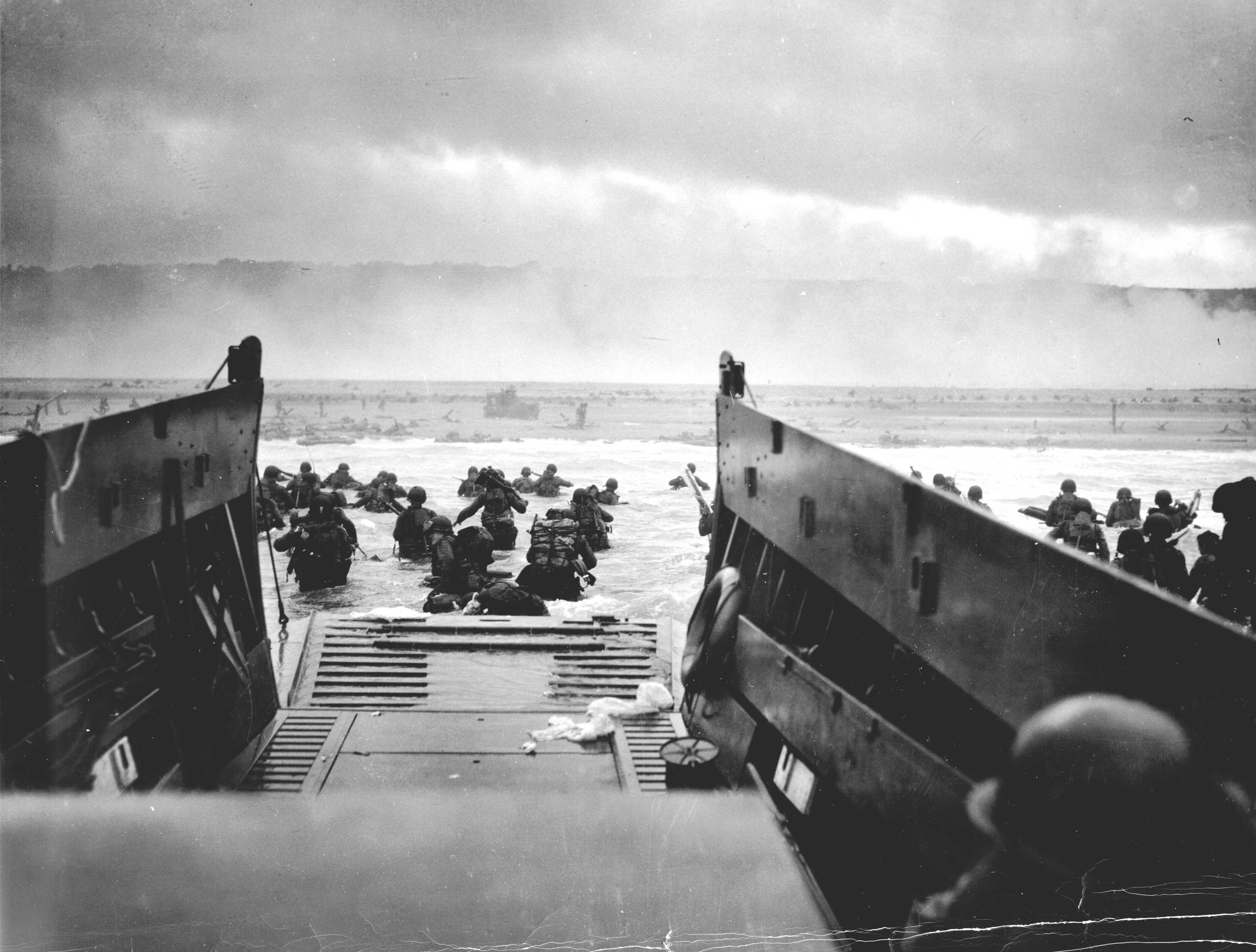
A LCVP (Landing Craft, Vehicle, Personnel) from the U.S. Coast Guard-manned USS Samuel Chase disembarks troops of Company E, 16th Infantry, 1st Infantry Division (the Big Red One) wading onto the Fox Green section of Omaha Beach (Calvados, Basse-Normandie, France) on the morning of June 6, 1944. American soldiers encountered the newly formed German 352nd Division when landing. During the initial landing two-thirds of Company E became casualties.

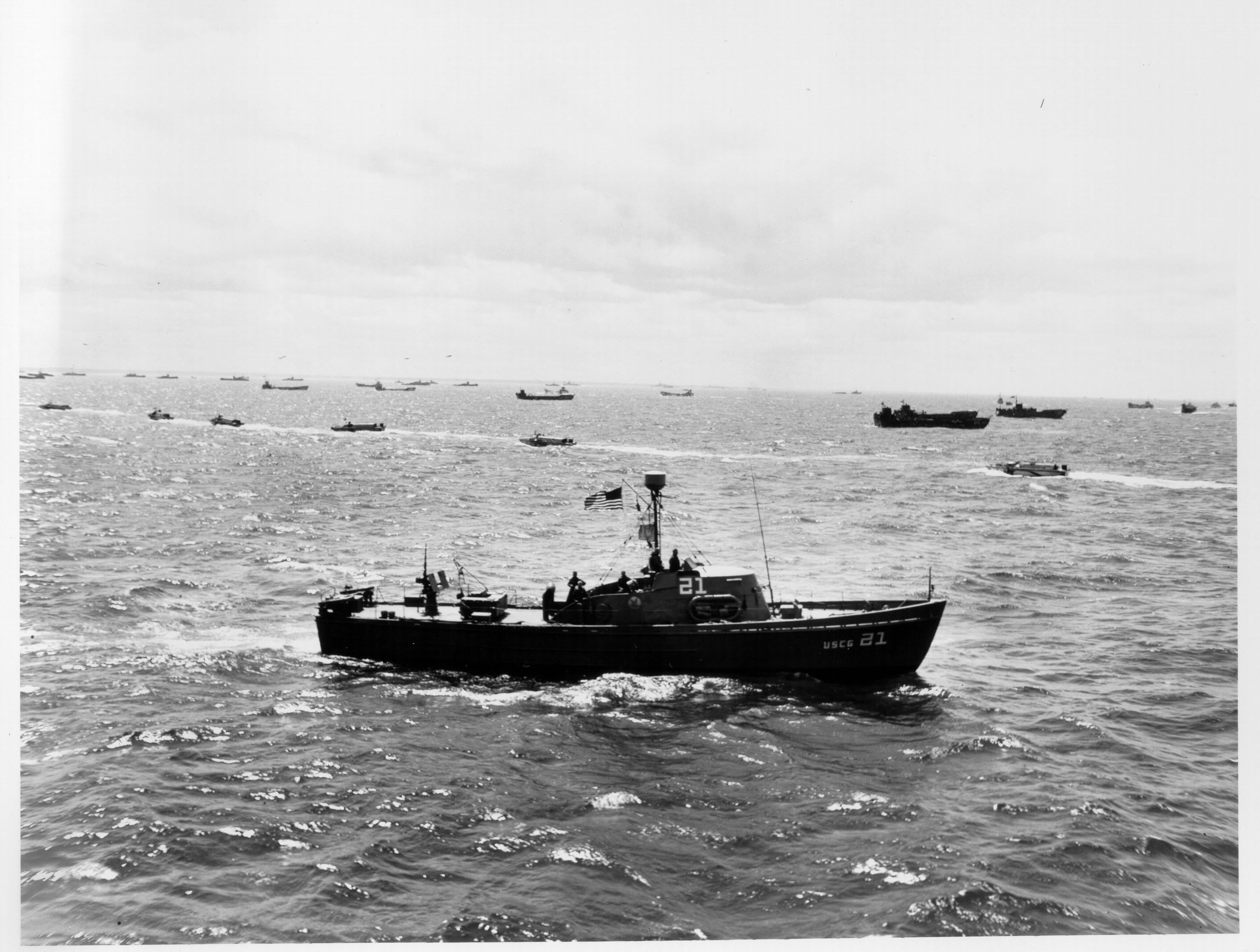
USCG 83 ft patrol boat, probably June 1944. Photographer unknown.

“While China makes Pacific islands tour, US Coast Guard is already on patrol” –CNN

U.S. Coast Guard Cutter Munro is tied up in Suva, Fiji, during a visit to the port city April 22, 2022.  The port call was part Operation Blue Pacific, that aims to counter illegal, unreported and unregulated fishing, and strengthen relationships to enhance maritime sovereignty and security throughout the Indo-Pacific. (U.S. Coast Guard photo courtesy of Office of the FMSRCC, Republic of Fiji Navy)

The Coast Guard got some national recognition for its work in the Western Pacific from CNN. It is being recognized as a counter to increasing Chinese influence in the region.

The Coast Guard’s website shows cutters have spent hundreds of days and steamed thousands of miles in the past two years helping Pacific island nations.

I have not seen this website, but I would like to. I found this one, but it is not a Coast Guard website.

The story mentions the Coast Guard’s role in the administration’s Indo-Pacific Strategy, which goes well beyond fisheries. The Strategy was discussed here.

“U.N. campaign targets illicit fishing” –Indo-Pacific Defense Forum

A picture taken on November 16, 2011 from a South Korean helicopter shows Chinese fishermen wielding sticks to stop an attack by South Korean coastguard commandoes armed with clubs aboard rubber boats during a crackdown on alleged illegal fishing in South Korean waters in the Yellow Sea off the southwestern coast county of Buan. South Korea’s coastguard mobilised 12 ships, four helicopters and commandoes for a special three-day crackdown on illegal fishing by Chinese boats this week. REPUBLIC OF KOREA OUT AFP PHOTO / DONG-A ILBO (Photo credit should read DONG-A ILBO/AFP/Getty Images)

The Indo-Pacific Defense Forum reports that today is the United Nations’ “International Day for the Fight Against Illegal, Unreported and Unregulated Fishing.”

The humanitarian and economic fallout of illicit fishing is significant in the Indo-Pacific and elsewhere. Each year it deprives the world’s oceans of 11 million to 26 million metric tons of fish and other seafood worth an estimated U.S. $10 billion to $23 billion.

IUU fishing accounts for 1 in 5 fish caught worldwide, the U.N. Food and Agriculture Organization (FAO) reports.

The short report provides an overview of the problem, identifies the Chinese fishing fleet and the most agrediuous perpetrator, and discusses what is being done to address the problem.

One of the recent steps taken is the Indo-Pacific Partnership for Maritime Domain Awareness (IPMDA) discussed here. Perhaps an additional step could be something like my proposal for a Combined Maritime Security Task Force.

“USCG Discloses 90% Interdiction Success Rate For Pursuits Over The Last Three Years” –Naval News

A low-profile go-fast vessel is shown next to the Coast Guard Cutter James in mid-May, 2020 in the Pacific Ocean off the coast of Central America. The James’ crew interdicted 3,100 pounds of cocaine and four suspected smugglers aboard the boat. (U.S. Coast Guard photo.)

Naval News reports the Coast Guard’s response to a question regarding, how the U.S. Coast Guard tackles the problem of high speed pursuits?

Not surprisingly the response pointed out that “… it’s their smaller RHIBs, the Long-Range Interceptor II and the Cutter Boat Over-the-Horizon IV, that often pursue and come close to the (small) high-speed targets.” I might add that includes the 22 foot Cutter Boat Large on WMEC 210s that are not equipped with the larger 26 and 35 foot boats and air-borne use of force is sometimes require to provide disabling fire.

The new information, I had not seen before was, the 90% interdiction rate sited in the title. Of course, as noted, this refers to success once pursuit is initiated. Gross interdiction rates are much much lower.

Each maritime pursuit chase is unique, and factors such as ambient lighting and sea state, target speed and actions, and the target’s proximity to land directly influence interdiction results. Despite these myriad factors, the Coast Guard has an approximately 90% interdiction success rate, once starting pursuit operations, over the last three years. (emphasis applied–Chuck) Enhanced pursuit capabilities, including unmanned aerial surveillance, in combination with changes in pursuit tactics, like airborne use of force, and refinement of tactical geometry assessments may have increased the recent level of interdiction success,” Lieutenant Kneen said.

“Coast Guard accepts delivery of 49th Fast Response Cutter Douglas Denman” –D17 Press Release

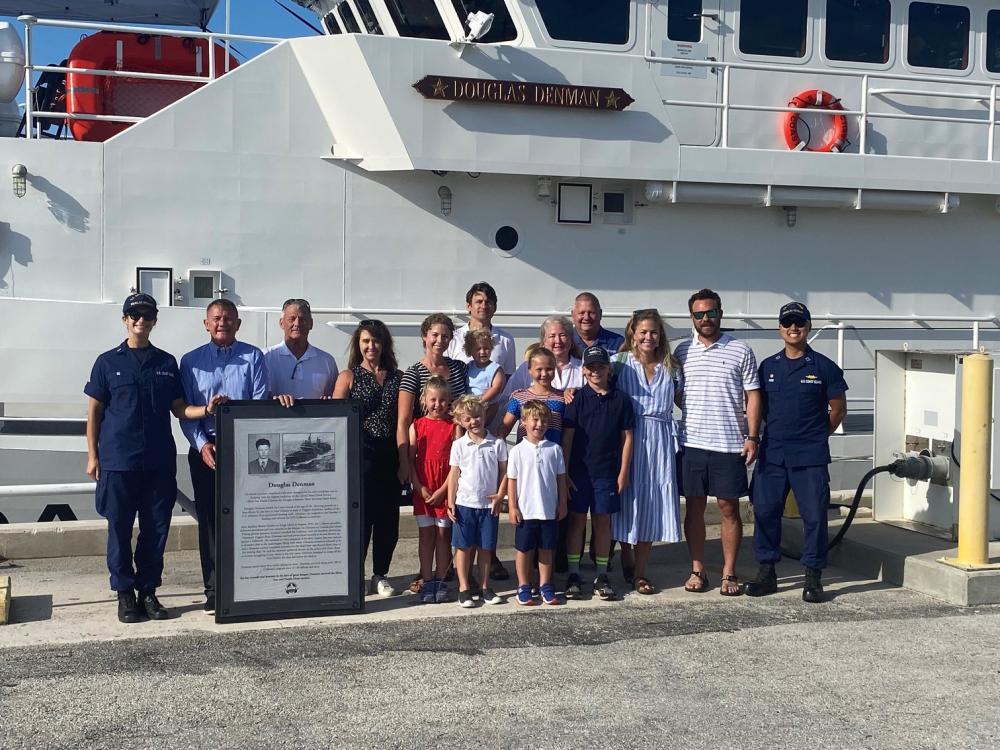
The Coast Guard accepts delivery of 49th Fast Response Cutter Douglas Denman, in Key West, Florida, May 26, 2022. The cutter will be homeported in Ketchikan, Alaska. (U.S. Coast Guard photo)

Below is a press release reporting the acceptance of the 49th Webber class Fast Response Cutter. (There is an error in that this is reported to be the “24th Fast Response Cutter built by Bollinger Shipyards” while all 49 have been built by Bollinger)

This will be the third FRC based in Ketchikan. Normally I would simply add this news as a comment on a previous post, but there is news here that I had not picked up on previously.

Earlier this year, President Joe Biden signed the Consolidated Appropriations Act for Fiscal Year 2022, which included a $130 million increase for two additional FRCs, continuing the program beyond its 64-vessel program of record. This is the second time Congress has added FRCs beyond the original 58 vessel program of record.

Bollinger typically delivers five FRCs a year, so we can expect the 17 additional FRCs to be delivered for over the next three and a half years.

The additional cutters now make it almost certain we will see FRCs based in America Samoa. Additionally we may see them in a second additional new Western Pacific base.

Photo Release

U.S. Coast Guard 17th District Alaska

Coast Guard accepts delivery of 49th Fast Response Cutter Douglas Denman
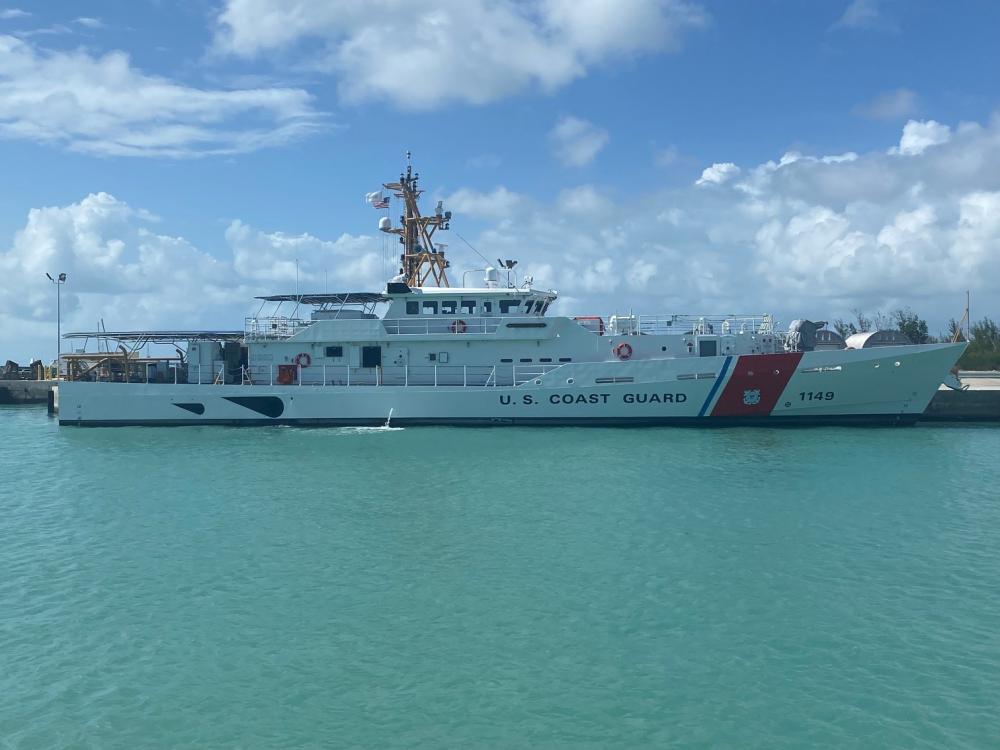
The Coast Guard accepts delivery of 49th Fast Response Cutter Douglas Denman, in Key West, Florida, May 26, 2022. The cutter will be homeported in Ketchikan, Alaska. (U.S. Coast Guard photo)

The Coast Guard accepts delivery of the 49th Fast Response Cutter Douglas Denman, in Key West, Florida, May 26, 2022, alongside the Denman family. The cutter will be homeported in Ketchikan, Alaska. (U.S. Coast Guard photo)

Editors’ Note: Click on images to download high resolution version.

 KEY WEST, Fla. — The Coast Guard accepted the Coast Guard Cutter Douglas Denman (WPC 1149), the 24th Fast Response Cutter built by Bollinger Shipyards, during a May 26 ceremony at Coast Guard Sector Key West.

“We were honored to have Douglas Denman’s son, Doug Jr. and daughter, Karen there for the momentous occasion,” said Lt. Paul Kang, commanding officer of the cutter. “In addition to that, two of Douglas Denman’s granddaughters drove down from Georgia with their families.”

The cutter, which is 154-feet long and has a crew complement of 24, will be homeported in Ketchikan, Alaska.

The Douglas Denman is scheduled for commissioning in September in Ketchikan. It is the third Fast Response Cutter to be stationed in the Coast Guard’s 17th Coast Guard District, which covers the state of Alaska and the North Pacific. The Denman will join the John McCormick (WPC 1121) and the Bailey Barco (WPC 1122), which arrived in Alaska in 2016 and 2017.

Born in Tallapoosa, Georgia, the cutter’s namesake joined the U.S. Coast Guard in 1940 and was eventually assigned as a coxswain to the USS Colhoun (DD-85), a Wickes-class destroyer in the U.S. Navy during World War I and later re-designated APD-2 in World War II. On Aug. 30, 1942, the Colhoun was positioned off the coast of Guadalcanal when it was attacked by hostile aircraft. Denman was seriously wounded during the attack but remained at his duty station. When the order was given to abandon ship, Denman and another crew member helped evacuate the crew and get life jackets to those already in the water. Because of Denman’s selfless actions, 100 of the 150 officers and staff survived the attack and sinking of Colhoun. Denman received the Silver Star and Purple Heart medals for his heroic efforts. He served for 20 years in the Coast Guard, retiring as a senior chief petty officer in 1961.

The Fast Response Cutter is replacing the aging Island-class 110-foot patrol boats and features advanced command, control, communications, computers, intelligence, surveillance, reconnaissance equipment, and an over-the-horizon cutter boat. The cutter features advanced seakeeping capabilities and can achieve more than 32 mph (28 knots). The cutter has an endurance of five days. The Coast Guard is in the middle of the FRC acquisition program.

Earlier this year, President Joe Biden signed the Consolidated Appropriations Act for Fiscal Year 2022, which included a $130 million increase for two additional FRCs, continuing the program beyond its 64-vessel program of record. This is the second time Congress has added FRCs beyond the original 58 vessel program of record.

Douglas Denman is designed for multiple missions, including law enforcement, fisheries enforcement, waterways and coastal security, search and rescue, and national defense.

For more information about this cutter, please contact 17th District Public Affairs at D17-DG-PublicAffairs@uscg.mil or Douglas Denman’s executive officer at Alicen.T.Re@uscg.mil.

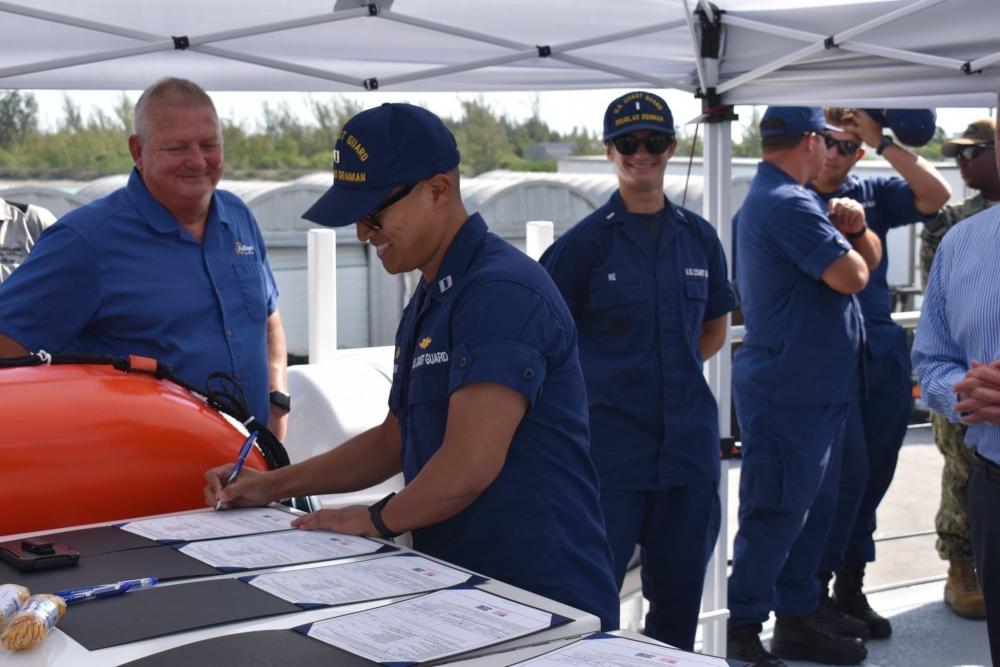
Coast Guard Lt. Paul Kang, commanding officer of Cutter Douglas Denman, accepts delivery of the 49th Fast Response Cutter Douglas Denman, in Key West, Florida, May 26, 2022. The cutter will be homeported in Ketchikan, Alaska. (U.S. Coast Guard photo)

The President Spoke at the Commandant’s Change of Command

Adm. Linda Fagan relieves Adm. Karl Schultz as the 27th commandant of the Coast Guard during a change of command ceremony at Coast Guard headquarters June 1, 2022. Fagan is the first woman service chief of any U.S. military service. U.S. COAST GUARD / Petty Officer 1st Class Travis Magee

The Navy League’s on line magazine reported on yesterday’s change of command ceremony.

It is a land mark event that a woman has become commandant, but it was also significant that the President chose to be at the event. This may be seen as an exploitation of the novelty of the transition, but it also seems to reflect the increased visibility of the Coast Guard in national security affairs.

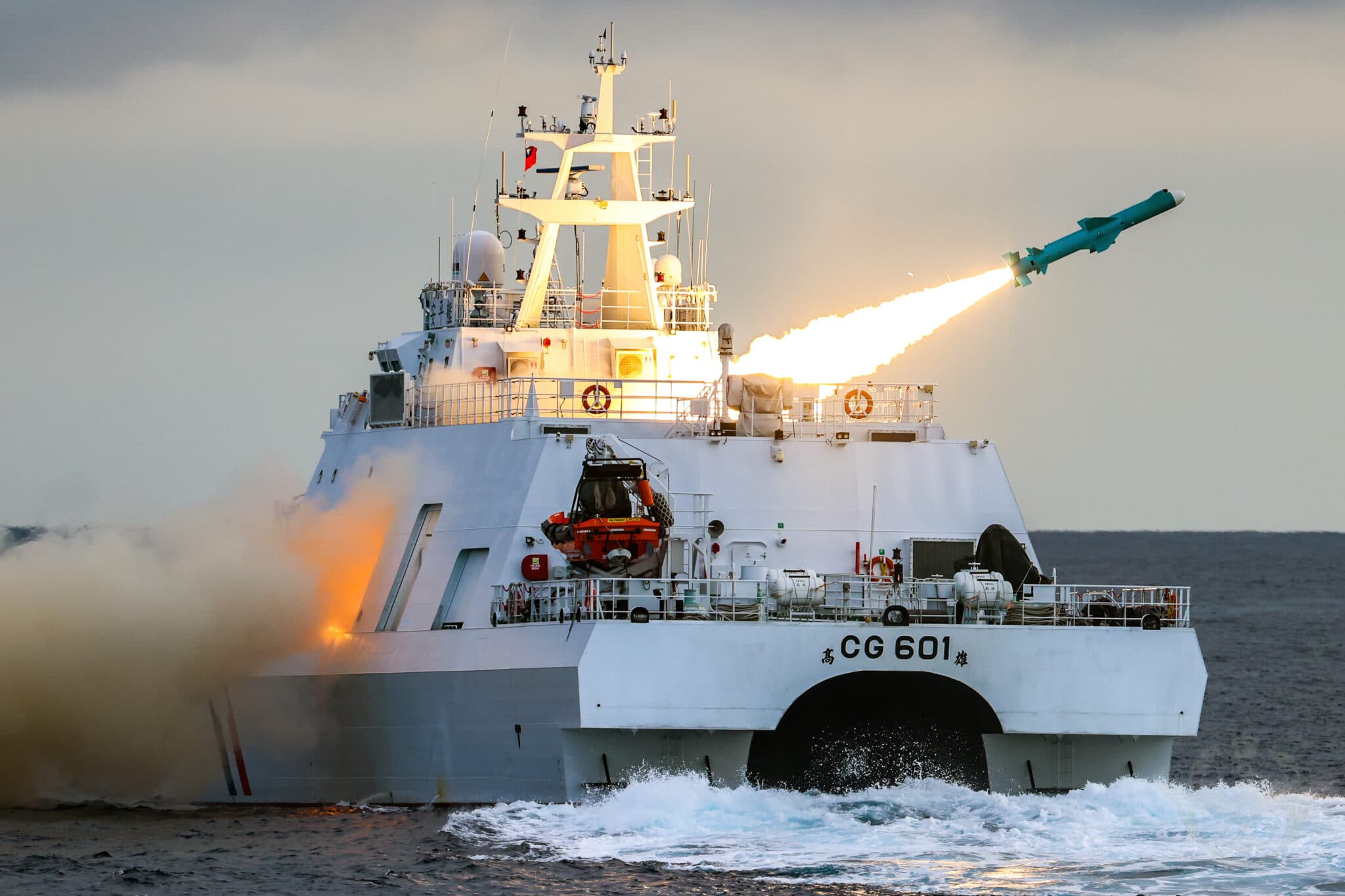
“Taiwan’s Coast Guard Tests Its Ability To Turn Cutters Into Ship Killers” –The Drive

Taiwan Coast Guard Vessel Anping firing missile

The Drive/The War-Zone reports,

During the test conducted on May 23, officials said that the HF-2 missiles were launched from the cutter off the coast of the Jiupeng Base and successfully hit a target ship that was located 62 miles off the coast of Lanyu, near Orchid Island. According to Taiwan’s Liberty Times Net reporter Zheng Jingyi, “this live ammunition firing specifically verifies the integration of the naval forces and sea cruisers under the ‘peace-to-war conversion.’”

This was a test and the missile launch equipment was removed immediately after the test. The launch and control was conducted by Taiwanese Navy personnel, temporarily assigned for the test.

Since the cutters are a version of a missile equipped Taiwanese Navy corvette, there would seem little reason to believe the test would not have been successful.

Reportedly twelve corvettes and twelve cutters are planned, but the prototype Navy corvette was commissioned in 2014, the second not until 2021, and none since. On the other hand four of the cutters have entered service beginning 2020 with two more under construction.

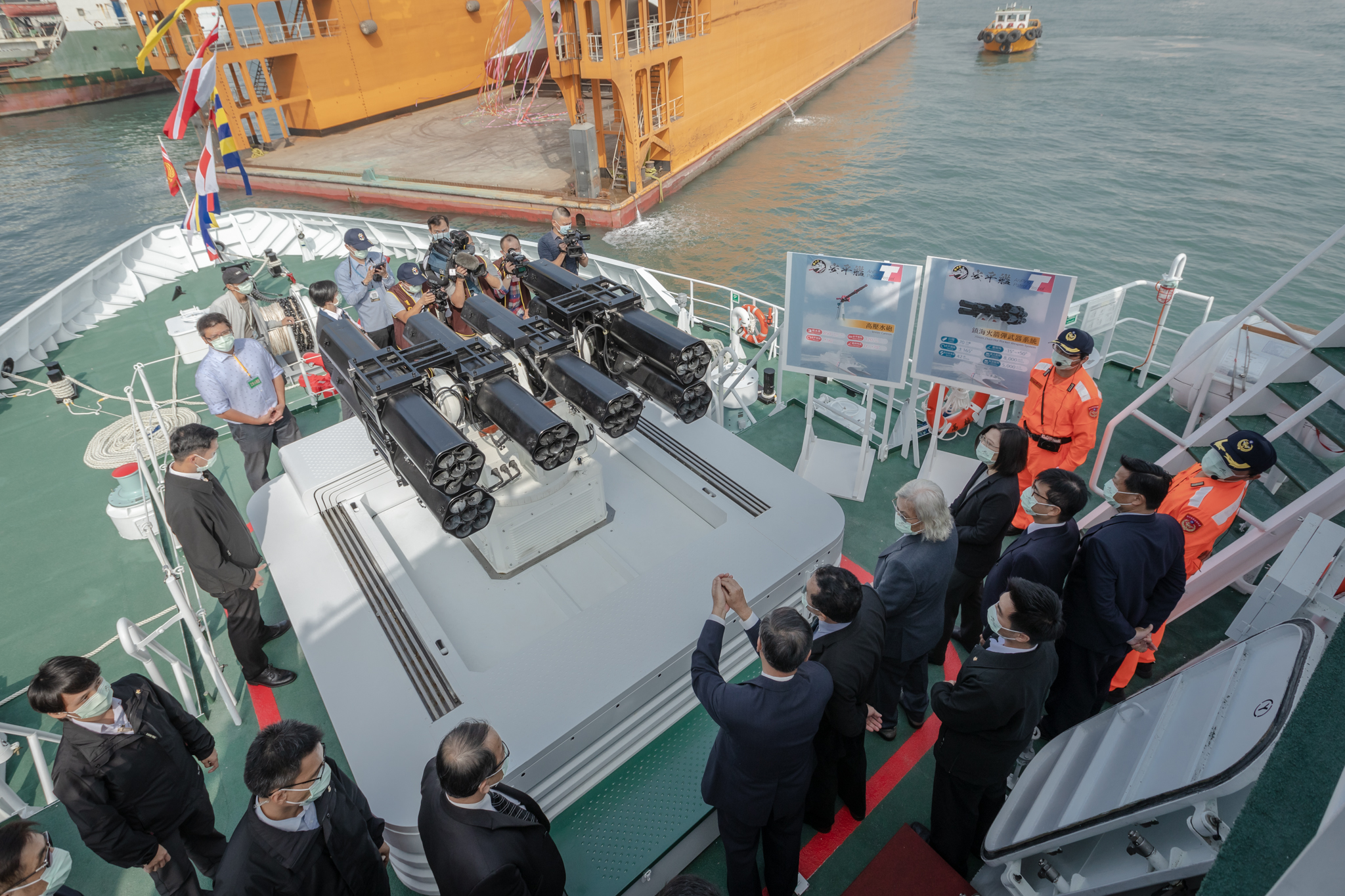
The normal armament of these and other Taiwanese cutters includes an unusual 42 round, remote controlled, “Zhenhai” 70mm/2.75″ rocket launcher. It is unclear if these rockets have a guidance system like APKWS. Photos below from Wikipedia.

Taiwan Anping-class offshore patrol vessel onboard multi-barrel Zhenhai rocket system

Anping-class offshore patrol vessel onboard 42-barrel Zhenhai rocket system, looking forward

“THREE ROUNDS OF COERCION IN PHILIPPINE WATERS” –CSIS

China CG Cutter 5203

The Center for Strategic and International Studies’ Asia Maritime Transparency Initiative brings a report of Chinese tracking and harassing vessels conducting legitimate activities in the Philippine’s Exclusive Economic Zone (EEZ) on three occasions.

There are some things worth noting about these three encounters:

  • In the first the Taiwanese Coast Guard was successful in allowing the research vessel to complete its task. In the second encounter, the Philippines appears to have surrendered preemtively while the Chinese vessel came no closer than 0,9 miles. In the third, the two Philippine vessels were successfully intimidated and turned away by China Coast Guard vessels supported by maritime militia vessels.
  • While Chinese vessels approached these vessels and came with 100 meters in the third incident, there was no indication that they attempted to ram or block movement, though blocking did appear to be the ultimate intent in the third incident. Chinese vessels have intentionally rammed in the past, but I cannot recall a Chinese government vessel ramming another government’s vessel. Chinese maritime militia have employed this tactic.
  • In the first encounter the Taiwanese Coast Guard used some of their largest ships as escorts. 5001 is more than 5000 tons full load, larger than the Bertholf class ships (4,500 tons full load). Taiwan Coast Guard’s CG129 is also relatively large at 120 meters (394 ft). It is nominally 3,000 tons, but probably over 4,000 tons full load. China Coast Guard (CCG) 5203 is reportedly 102 meters (335 ft) in length and 14 meters of beam.  It is probably around 3,000 tons full load.
  • The two Philippine Coast Guard cutters mentioned, BRP Capones and BRP Cape Engaño were both Parola class patrol boats, built in Japan and delivered in 2017 and 2018 respectiely. These 44 meter/146 ft vessels are just a bit smaller and slower than the Webber class. They were much smaller than the CCG vessels.
  • Only the Chinese employed vessels were armed with medium caliber naval guns. I was unable to find specs or photographs of CCG 5303 or 5304 but at least CCG 5203 was armed with a modern 3″ gun. The Taiwanese vessels were armed with auto-cannon of up to 40mm. The Philippine CG vessels were armed with nothing larger than .50 cal.
  • Taiwanese and Philippine CG vessels appear to have had a speed advantage, but the CCG had a speed advantage over the vessels being escorted. In the third incident any speed advantage was also largely negated by the larger number of Chinese vessels.

It should be clear that if the Philippines intends to operate in their EEZ, in areas included in the “Nine Dash Line,” they should expect the Chinese will confront them. If they intend to operate there, they need to decide to either support the effort strongly or operate not at all. Being chased out repeatedly strengthens China’s position.

Should the Philippines decide to operate in the disputed waters, it does have some advantages at least for operations of short duration. While the China CG is much larger, the Philippines has the advantage of proximity. Far from their bases, the Chinese cannot reinforce quickly. The Philippines can surge large numbers of units the short distance from their bases quickly.

The Philippines has been pushed around. Perhaps it is time to push back. Not an escalation, but a reponse in kind.

A coordinated sweep of Chinese fishing vessels fishing illegally should be possible.

To deter shouldering, size is important, so the Philippine CG should include their largest ships.

To deter the Chinese from resorting to weapons, Philippine law enforcement vesssels should be supported by Philippine Navy vessels. It would not hurt if Philippine light attack aircraft were airborne.

It would also help if vessels of other nations, including the US, were on scene to witness the encounter.

BRP Capones in Davao Gulf. Philippine Information Agency.

Thanks to Paul for bringing this to my attention.