“VESSEL REVIEW | FELIX SAND – FAST COASTAL RESPONSE BOAT FOR GERMAN SEA RESCUE SERVICE” –Baird Maritime

Response boat Felix Sand, German Maritime Search and Rescue Service (Deutsche Gesellschaft zur Rettung Schiffbruchiger; DGzRS), a maritime search and rescue (SAR) charity.

Baird Maritime reports delivery of a large and very capable, self-righting SAR boat.

The Coast Guard is in the market for replacements for the 52 foot MLBs. Now this is, at 90 feet long, a good deal larger than the 64 foot maximum length replacement currently envisioned. At 120 tons, its larger than the 87 foot, 91 ton Marine Protector class WPBs, but in many ways, it’s probably more capable than either.

Compared to the 52 foot MLB’s planned replacement, it has longer range, probably higher sustained speed in adverse conditions, greater towing capacity, and a daughter boat capable of getting into the shallows. It also has a fire monitor and medical facilities.

Compared to the 87-footer, it appears more seaworthy. Though nominally slower than the Marine Protector class, it is probably capable of maintaining higher speed in rough conditions. It carries more fuel, 18,000 liters (4,755 gallons) vs 9464 liters (2,500 gallons), giving it a greater range at a higher speed, 900 nautical miles at 15 knots vs 882 at 10. Perhaps more impressive is the claim of a 600 nautical mile range at 24 knots. It also has bow thruster.

Something like this could replace both the 52-foot MLBs and at least some of the 87-foot WPBs. In addition to the Pacific NW, they would be a welcomed addition in Alaska or along the Maine coast.

The remarkable thing I see in the specs, is the crew, only four, about the same as the 52-footers. That would be a substantial savings relative to the ten-person crew of the WPBs.

Incidentally Fassmer is the designer of an apparently very successful class of Offshore Patrol Vessels used by Colombia, Chile, and Germany.


“World’s First Methanol-Fuelled Towboat To Launch In 2023” –gCaptain

gCaptain reports,

“Maritime Partners in cooperation with Elliott Bay Design Group,  e1 Marine, and ABB, today announces that the M/V Hydrogen One, the world’s first methanol-fuelled towboat, will join Maritime Partners’ fleet and become available for charter in 2023 to meet the pressing demand for sustainable towboat operations.”

I have been hearing more lately about use of Methanol as a source for hydrogen to be used in fuel cells. If this works economically in a commercial setting like a tow boat, we are going to see a lot more of this. Including perhaps on future Coast Guard vessels. Sounds like it may make air independent submarines a lot easier as well.

ALCOAST 388/21 – OCT 2021 VOLUNTEER SOLITICIATION FOR U.S. COAST GUARD ACADEMY ADMISSIONS PARTNER (AAP) AND ACADEMY MINORITY OUTREACH TEAM (AMOT) PROGRAM

Wanted to pass this along.

ALCOAST 388/21 – OCT 2021 VOLUNTEER SOLITICIATION FOR U.S. COAST GUARD ACADEMY ADMISSIONS PARTNER (AAP) AND ACADEMY MINORITY OUTREACH TEAM (AMOT) PROGRAM

R 201239Z OCT 21
FM COMDT COGARD WASHINGTON DC
TO ALCOAST
BT
UNCLAS
ALCOAST 388/21
SSIC 1136
SUBJ: VOLUNTEER SOLITICIATION FOR U.S. COAST GUARD ACADEMY
ADMISSIONS PARTNER (AAP) AND ACADEMY MINORITY OUTREACH TEAM
(AMOT) PROGRAM
1. The AAP program is a volunteer network dedicated to supporting
the recruiting and outreach mission of the United States Coast
Guard Academy Admissions office. Since 2006 Academy
Admissions Partners have worked alongside Admissions staff to
educate, recruit and assist the future cadets and officers of the
United States Coast Guard. Our volunteer organization consists of
1,185 members, made up of Active Duty and Reserve members, CGA
Alumni, AMOT, parents of cadets and graduates, USCG Auxiliary, and
friends of the Academy. Volunteer today and give back to America’s
premier maritime Academy by identifying our next generation of
leaders.
2. AMOT is a segment of the AAP program that is comprised of 114
dedicated minority officers and retirees, many of whom graduated
from the Coast Guard Academy. This dedicated group of volunteers
includes African Americans, Asian, and Hispanic officers and
civilians focused on enhancing recruitment efforts and retention
programs for the Academy. Over the last several years, the role
of AMOT has become more influential across every Academy Division
and has expanded beyond recruitment and Admissions outreach support.
Most recently, efforts have crossed into mentoring and retention
efforts at the Academy and in support of the Coast Guard Academy
Scholars (CGAS) program. This renewed direction has held a
significant lasting impact on the overall goal of improving the
cultural competency of the Academy and the Coast Guard. In this
expansion of efforts, in addition to enhancing the recruitment
reach, purposeful and lasting mentoring relationships have been
created with the presence of AMOT volunteers to support retention
of under-represented minority officers at the Academy and in the
fleet after graduation.
3. Normally, AAP and AMOT participants will outreach with local
schools, participate in college fairs, the Academy Introduction
Mission, CGC EAGLE events, USCGA workshops, USCGA Campus Program
events, conduct applicant interviews and present appointments to
accepted students. Realities of COVID-19 have limited personal
interaction, but virtual options exist for Partners and AMOT to
contribute a minimum of two to four hours of volunteer service
each year.
4. Requirements to become an AAP and AMOT member are as
follows: interested Active Duty, Reserve or civilian participants
must pass a basic background investigation or be in good military
standing as an Active Duty and Reserve member. Prospective Partners
must complete the required training and pass an indoctrination test
with an 85 percent or higher. AMOT members will have the option to
take the indoctrination test or attend an annual training session
held by the CGA Admissions office.
5. Interested participants registering for the AAP or AMOT program
are asked to create a profile on the CGA website at:
(Copy and Paste URL Below into Browser)

https://urldefense.proofpoint.com/v2/url?u=http-3A__www.uscga.edu
_partners&d=DwIGAg&c=tnPw9yRHa20_HV5YVoVFtg&r=iweUoGvREbTXYJTAmo
jhygUnTtWgUIWa_NzooIEDasY&m=LjK3atJ-_zT39TfnKDN-ThAQoy3ggnr9wbK9y
NXr6oY&s=fZI3lzvbMtn1vyhW81ZLxels6KdOINellcgq07OG0CM&e=

6. AAP and AMOT registrants will be notified of their Partner status
via email, so prospective Partners and AMOT members should use
an email account that they regularly monitor (personal or .mil
address).
7. For more information about Academy Admissions Partners, visit:
(Copy and Paste URL Below into Browser)

https://urldefense.proofpoint.com/v2/url?u=http-3A__www.uscga.edu_
partners&d=DwIGAg&c=tnPw9yRHa20_HV5YVoVFtg&r=iweUoGvREbTXYJTAmojhy
gUnTtWgUIWa_NzooIEDasY&m=LjK3atJ-_zT39TfnKDN-ThAQoy3ggnr9wbK9yNXr6
oY&s=fZI3lzvbMtn1vyhW81ZLxels6KdOINellcgq07OG0CM&e=

8. Personnel interested in becoming an Admissions Partner should
notify Mr. Alex Eames, Alexander.G.Eames@uscga.edu or
(860) 701-6385.
9. Personnel interested in becoming an AMOT Member should notify
Ms. Katy Robbins, Katy.A.Robbins@uscga.edu.
10. RDML M. W. Raymond, Acting Deputy for Personnel Readiness
(CG-DCMS-DPR), sends.
11. Internet release is authorized.

“Sunday Ship History: Operation Market Time Vietnam 1965 – 1973” –EagleSpeak

North Vietnamese 100′ Trawler burns on a South Vietnamese beach after being forced ashore by USCGC POINT LEAGUE, on 20 June 1966. It was carrying an estimated 250 tons of supplies for the Viet Cong. USN 1116663

Mark Tempest’s EagleSpeak has a short post about the Vietnam War Operation Market Time. It included a couple of links I have added to my Heritage page.

Particularly the first provides a good overview of how much combat the Coast Guard was actually in.

“The Long Blue Line: Charleston—over 230 years of Coast Guard service and growth in South Carolina!” –MyCG

Coast Guard Base Charleston. The Base is moving from this location to the former Charleston Navy Base

MyCG has another in the Long Blue Line series, The Long Blue Line: Charleston—over 230 years of Coast Guard service and growth in South Carolina!

I have added it to my Heritage Page, but there was an interesting note in the next to last paragraph discussing the recent past and future of Base Charleston,

“In October 2015, the North Charleston cutter base was officially commissioned as Coast Guard Base Charleston with new National Security Cutters Hamilton and James replacing the old Gallatin and Dallas. The recently commissioned National Security Cutter Stone has joined its two sister cutters and future plans see the facility becoming a “super base” supporting two more NSCs, as well as units of the new medium-endurance class of Offshore Patrol Cutters and, possibly, one or two new Polar Security Cutters.” (Emphasis applied–Chuck)

We have begun to see indications of an intent to base icebreakers on the Atlantic side, but I had assumed these would be the Medium Icebreakers (Arctic Security Cutters). This may reflect an anticipation the Coast Guard will have more than three Polar Security Cutters.

When you realize that, in relationship to the Eastern Pacific Drug Transit Zone, Charleston is about 1,000 nautical miles closer than San Diego and about 1,400 nautical miles closer than Alameda, you can understand why the Coast Guard decided to base five Bertholf class NSCs there. Its why 4th Fleet, which is responsible for all of South America is an Atlantic Fleet Command.  Add to that the lower cost of living and it makes a lot of sense.

The U.S. Coast Guard Cutter James arrives at its new homeport of Charleston, S.C. Aug. 28, 2015. (U.S. Coast Guard photo by Petty Officer 1st Class Melissa Leake)

26/11

Taj Mahal Palace hotel, Mumbai Terrorist Attack,

In the US the date 9/11 has special meaning, but in India it is November 26, which they refer to as 26/11.

The 2008 Mumbai attacks (also referred to as 26/11) were a series of terrorist attacks that took place in November 2008, when 10 members of Lashkar-e-Taiba, an Islamist terrorist organisation from Pakistan, carried out 12 coordinated shooting and bombing attacks lasting four days across Mumbai. The attacks, which drew widespread global condemnation, began on Wednesday 26 November and lasted until Saturday 29 November 2008. A total of 175 people died, including nine attackers, and more than 300 were wounded.

Nearly all the killing and all the television coverage was on land, but it should not be forgotten, the terror came by boat.

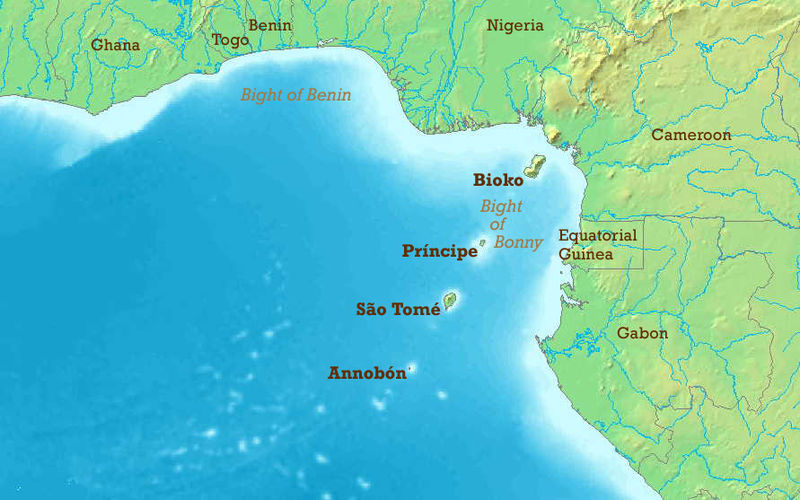
“Danish Navy Frigate Kills 4 Pirates in Gulf of Guinea Anti-Piracy Mission” –USNI

Gulf of Guinea, from Wikipedia

The US Naval Institute reports an incident off the West African Coast in which a Danish Frigate, the HDMS Esbern Snare (F342), while engaged in a counter piracy operation, observed a suspicious vessel and attempted to investigate. This led an exchange of gunfire.

“By the evening, Esbern Snare was close enough to launch rigid-hulled inflatable boats (RHIBs) carrying Danish naval special forces personnel and called on the boat to halt and permit boarding, the news release said. When the boat refused to respond to the call, warning shots were fired, with the pirates responding by firing directly at the personnel in the RHIBs. A brief firefight then ensued, in which no Danish personnel were hit but five pirates were shot, with four of them killed and one wounded.”

The USCG cutter operate in this area periodically, doing “capacity building.” Its not impossible a cutter will find itself in a similar situation.

The imbalance of the results of the firefight, 5-0, which probably would have looked fairly even on paper, speaks volumes for the equipping and training of the Danish boat crew and boarding party.

“Ohio River Bomb Spree Shows Need For New Coast Guard Waterways Commerce Cutters” –Forbes

USCGC Smilax (WLIC-315)

Craig Hooper has another pro-Coast Guard post in Forbes.

It talks about a domestic terrorism incident as a justification for the Waterways Commerce Cutter program.

The program already seems to be progressing well with essentially no opposition.

The article goes a bit beyond advocating for the program as it exists now.

“—the emerging threat of domestic terrorism suggests that these vessels may need to enhance their disaster response capabilities faster than the Coast Guard expects. Better communications, better situational awareness resources and better resources to keep crew safe may be quite useful over the three or four decades. Fittings for chemical sensors, extra protective gear storage, unmanned platform capabilities, and better decontamination resources all ensure these Cutters will be viable over the long-term.”

Take a look. I am not enthusiastic about Hooper’s suggested upgrades, but I have a lot of respect for his opinion, so would not dismiss them out of hand.

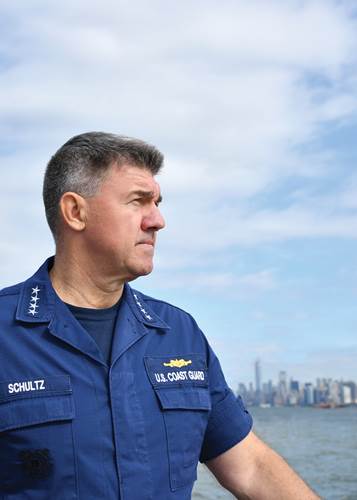
“WEB EXCLUSIVE: Q&A With Adm. Karl Schultz, Commandant of the Coast Guard” –National Defense

Coast Guard Commandant Adm. Karl Schultz. U.S. Coast Guard photo by Petty Officer 1st Class Jetta Disco.

National Defense has an interview with the Commandant. There is a lot of discussion about COVID and how the Coast Guard has adapted to the reality of annual continuing resolutions (CR).

There is a good deal of discussion here about icebreakers. Polar Security Cutter construction is the program most effected by COVID and the first of class is now not expected until 2025. The Commandant actually wants more than six icebreakers, perhaps as many as nine, including some for the Atlantic side, more than three PSCs, and (for the first time I have heard this) we are also looking at something less than a medium icebreaker.

 “I’ve been having a conversation for most of my tenure that we really need a minimum of six icebreakers. Of that six, three will be Polar Security Cutters. We’ll have a hot production line, I hope that conversations is really about more than three Polar Security Cutters, but we’re also talking about maybe something a little less than a medium icebreaker. We’ve done some work at the behest of the last National Security Council in the Trump administration that has played forward for this administration. They seem very interested. So, I think we’re having the right conversations about a fleet of maybe six or nine that can work in the high latitudes both the High North and down in Antarctica.”

There was brief discussion of armament for the icebreakers. The Commandant noted that the PSC design included space, weight and power for upgrades (type unspecified), but no intention to make those upgrades now. There was no mention of Antarctica in that discussion.

There is a discussion about the Coast Guard in the Western Pacific in regard to both the Webber class FRCs and deployment of National Security Cutters to the far Western Pacific.

The interviewer seemed to be pushing the Commandant to acknowledge that the hardware elements of the Deepwater program were essentially complete. The Commandant’s response was more muted, noting that the Offshore Patrol Cutters are the “backbone” of the recapitalization and that program has essentially only just begun.

There was only one question that mentioned unmanned systems and the Commandant’s response made no mention of them. There was also no discussion of replacement of the H-65s with H-60s.