“Coast Guard Cutter Hamilton offloads approximately $504 million in cocaine, marijuana at Port Everglades” –D7

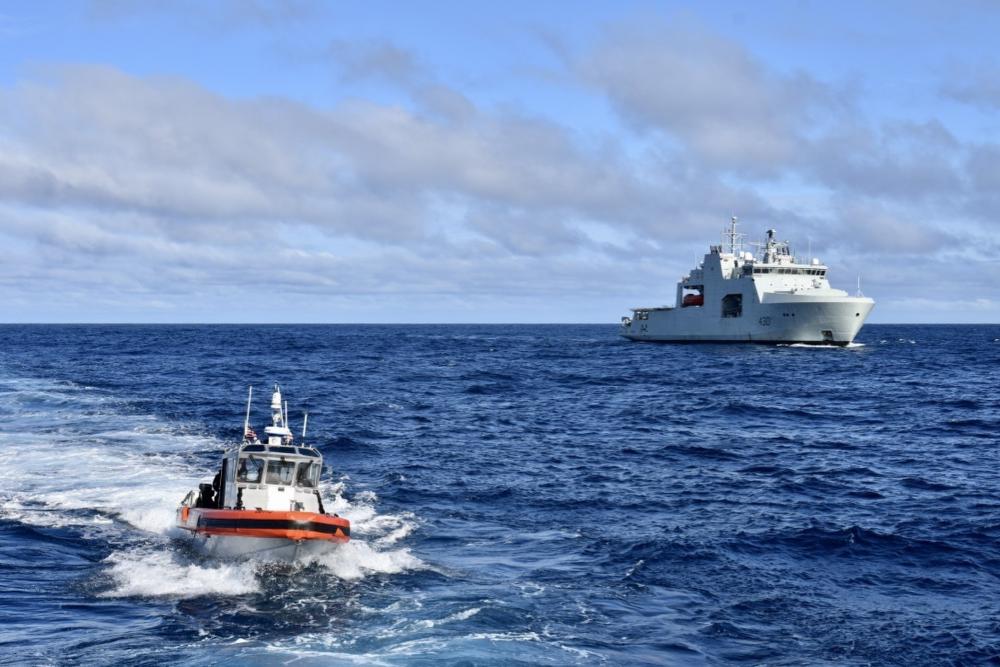
U.S. Coast Guard Cutter Hamilton’s (WMSL 753) crew conduct small boat operations with HMCS Harry DeWolf (AOPV 430) in the Pacific Ocean, Nov. 14, 2021. Harry DeWolf is the Royal Canadian Navy’s newest Arctic and Offshore Patrol Ship, while on her maiden voyage, circumnavigating North America. (U.S. Coast Guard photo)

Below is a news release from D7. It may seem routine, but this does mark something of a debut for an asset new to drug interdiction operations, Canada’s Arctic Offshore Patrol Ships.  They are much larger and more capable than the Kingston class coastal defense ships Canada has previously used in support of our drug interdiction efforts. HMCS Harry DeWolf is making a circumnavigation of North America.
united states coast guard

News Release

U.S. Coast Guard 7th District Southeast

Coast Guard Cutter Hamilton offloads approximately $504 million in cocaine, marijuana at Port Everglades

U.S. Coast Guard Cutter Hamilton’s (WMSL 753) crew conduct small boat operations with HMCS Harry DeWolf (AOPV 430) in the Pacific Ocean, Nov. 14, 2021. Harry DeWolf is the Royal Canadian Navy’s newest Arctic and Offshore Patrol Ship, while on her maiden voyage, circumnavigating North America. (U.S. Coast Guard photo)U.S. Coast Guard Cutter Hamilton’s (WMSL 753) small boat crews interdict a Low-Profile Vessel (LPV) while on patrol in the Eastern Pacific Ocean, Oct. 23, 2021. The Hamilton is homeported in Charleston, South Carolina. (U.S. Coast Guard photo)U.S. Coast Guard Cutter Hamilton (WMSL 753) on scene with a Low-Profile Vessel (LPV) in the Pacific Ocean, Nov. 15, 2021. The Hamilton is homeported in Charleston, South Carolina. (U.S. Coast Guard photo)U.S. Coast Guard Cutter Hamilton’s (WMSL 753) crewmembers conduct Vertical Replenishment (VERTREP) training with a Coast Guard Air Station Jacksonville MH-65 Dolphin helicopter aircrew from the Helicopter Interdiction Squadron (HITRON) while on patrol in the Eastern Pacific Ocean, Nov. 15, 2021. The Hamilton is homeported in Charleston, South Carolina. (U.S. Coast Guard photo)Coast Guard Cutter Hamilton’s (WMSL 753) crew wraps bails at Port Everglades, Florida, Nov. 22, 2021. The Hamilton is homeported in Charleston, South Carolina. (Coast Guard photo by Petty Officer 3rd Class Jose Hernandez)A pallet of seized contraband is hoisted during a drug offload from the Coast Guard Cutter Hamilton (WMSL 753) in Port Everglades, Florida, Nov. 22, 2021. The drugs were interdicted in international waters of the Eastern Pacific Ocean off the coasts of Mexico, Central and South America, including contraband seized and recovered during 8 interdictions of suspected drug smuggling vessels by 3 American and Canadian ships. (U.S. Coast Guard photo by Petty Officer 3rd Class Jose Hernandez)A U.S. Customs and Border Protection officer waiting for a pallet wrapped with bails to be forklifted at Port Everglades, Florida, Nov. 22, 2021. The Coast Guard, Navy, Customs and Border Protection, FBI, Drug Enforcement Administration, and Immigration and Customs Enforcement, along with allied and international partner agencies, allow for a unity of effort to disrupt transnational crime organizations, which threaten America and our partners. (U.S. Coast Guard photo by Petty Officer 3rd Class Jose Hernandez)The Coast Guard Cutter Hamilton’s (WMSL 753) crew poses with approximately 26,250 pounds of cocaine and 3,700 pounds of marijuana at Port Everglades, Florida, Nov. 22, 2021. The largest drug interdiction in the ship’s history. (U.S. Coast Guard photo by Petty Officer 3rd Class Jose Hernandez)

Editor’s Note: Click on images to download high-resolution version.

MIAMI— Coast Guard Cutter Hamilton’s crew offloaded approximately 26,250 pounds of cocaine and 3,700 pounds of marijuana worth approximately $504 million, Monday, at Port Everglades, which is the largest drug interdiction in the ship’s history.

The Coast Guard’s strong international relationships, with key partners like Canada along with our specialized capabilities and unmatched authorities, allow for a unity of effort to disrupt transnational crime organizations, which threaten America and our partner nations.

The drugs were interdicted in international waters of the Eastern Pacific Ocean off the coasts of Mexico, Central and South America, including contraband seized and recovered during eight interdictions of suspected drug smuggling vessels by three American and Canadian ships:

“I could not be prouder of this crew and their determination to keeping more than 26,000 pounds of cocaine from reaching the shores of Central and North America,” said Capt. Matthew Brown, commanding officer Coast Guard Cutter Hamilton. “It has been a dynamic two and half months for this ship with some very difficult law enforcement cases. But at the core of these capabilities is a true culture of trust and respect for each other which enabled the safe apprehension of 14 suspected traffickers. Each one of our cases represented the teamwork and partnerships not only domestically but with our partners in the Western Hemisphere.” 

Numerous U.S. agencies from the Departments of Defense, Justice and Homeland Security cooperated in the effort to combat transnational organized crime. The Coast Guard, Navy, Customs and Border Protection, FBI, Drug Enforcement Administration, and Immigration and Customs Enforcement, along with allied and international partner agencies, play a role in counter-drug operations. The fight against drug cartels in the Eastern Pacific Ocean requires unity of effort in all phases from detection, monitoring and interdictions, to criminal prosecutions by U.S. Attorneys in districts across the nation.

During at-sea interdictions, a suspect vessel is initially detected and monitored by allied, military or law enforcement personnel coordinated by Joint Interagency Task Force-South based in Key West, Florida. The law enforcement phase of counter-smuggling operations in the Eastern Pacific is conducted under the authority of the Coast Guard 11th District, headquartered in Alameda, California. The interdictions, including the actual boardings, are led and conducted by members of the U.S. Coast Guard.

The fight against drug cartels in the Eastern Pacific Ocean and the Caribbean Sea requires unity of effort in all phases from detection, monitoring and interdictions, to criminal prosecutions by international partners and U.S. Attorneys’ Offices in districts across the nation. The law enforcement phase of counter-smuggling operations in the Eastern Pacific Ocean is conducted under the authority of the Coast Guard 11th District, headquartered in Alameda, California, and the law enforcement phase of operations in the Caribbean is conducted under the authority of the Coast Guard 7th District, headquartered in Miami. The interdictions, including the actual boardings, are led and conducted by members of the U.S. Coast Guard. 

The Coast Guard Cutter Hamilton is a 418-foot national security cutter homeported in Charleston, South Carolina. The Coast Guard Cutter Vigilant is a 210-foot medium endurance cutter homeported in Port Canaveral, Florida. Her Majesty’s Canadian Ship (HMCS) Harry DeWolf is a 340-foot Arctic and Offshore Patrol Ship (AOPS) home ported in Halifax, Canada.

For more breaking news follow us on Twitter and Facebook.

“U.S. patrol boats sent to beef up Ukrainian Navy near Black Sea” –Reuters

U.S. flagged general cargo ship Ocean Grand, carrying two former U.S. Coast Guard cutters, sails in the Dardanelles, on its way to the Black Sea, in Canakkale,Turkey November 20, 2021. REUTERS/Yoruk Isik

Reuters report.

Serious concern Russia may be preparing to attack Ukraine. The Ukrainians are apparently planning some upgrades, but it is definitely a David and Goliath situation.

“British Navy tests new .50 machine gun mounting system ASP” –Updated, Its made in the US

After publishing my initial post about this stabilized gun mounting system, a comment from Secundius provided much better, more detailed photos of the system and gave me the manufacturer’s name, FlexForce. The FlexForce website told me they were headquartered in Portland, Oregon, and that the system is available on GSA schedule.

Their “News” page indicates the mount will be at the Work Boat Show in New Orleans,Booth 3877 aboard Lake Assault Custom Boats FP-M boat (33 foot US Navy Force Protection, Medium) December 1-3. If this becomes a standard USN system, it would make it more readily available, perhaps at Navy expense.

Below is their data sheet for maritime applications. The Coast Guard obviously knows about this mount. The first photo below is obviously of the system mounted on a Webber class WPC.

Click to access 20190115-ASP-Maritime-Datasheet.pdf

There is another better photo of the mount on a Webber class here and a photo of it mounted on a Coast Guard 25 foot boat here.

The Coast Guard has been looking for ways to make their weapons more accurate for some time. Unfortunately some of the links are broken, but I did this report back in 2014. Back in 2017, when I was able to do a tour of the Bailey Barco, the gunners mate told me they had done some weapons testing with Navy and Marine as well as Coast Guard observers aboard.

The Electro-Optic options should also help with targeting, especially at night. The remote option essentially makes this a remote weapon station meaning the operator need not be an obvious target. Significantly FlexForce claims the system is effective against UAS.

Hopefully this system or something like it will start showing up on Coast Guard cutters, most immediately those assigned to PATFORSWA.

(I wonder if it might be possible to mount the Fletcher APKWS launcher on this (with the remote option)?

Up-Gunning the China Coast Guard–Add 22 New Type 056 Corvettes

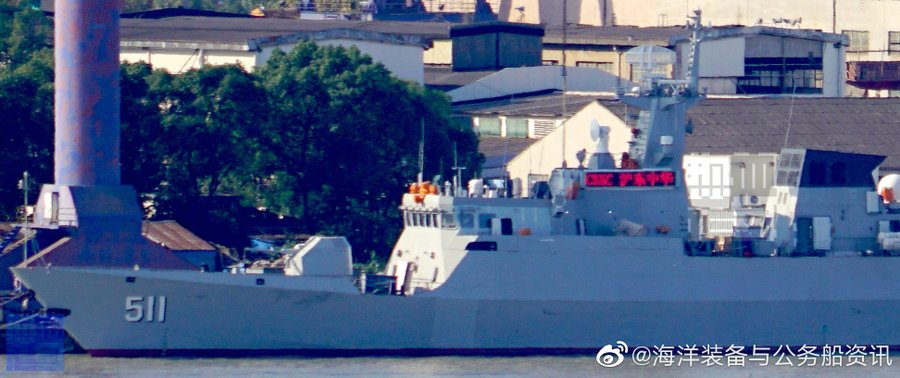
Type 056 corvette, credit 樱井千一

We have a report from Defence.PK, that 22 PLAN Type 056 corvettes are being transferred to the China Coast Guard. These ships are the early models that were completed without the more sophisticated anti-submarine warfare capabilities of the Type 056A. Rather than upgrade them, the Chinese Navy will build 22 additional Type 054A Frigates.

Reportedly they are adding a LED billboard and the missiles are being removed. Probably the torpedoes as well. But that still leaves a 120 round/minute 76 mm gun and a pair of 30mm Guns.

The China Coast Guard already has more large cutters than the US Coast Guard, despite of the fact that their EEZ is less than 20% that of the US, even if all their outrageous claims were accepted. But most of these cutters have no guns of 20mm or larger. 22 AK-176 76mm guns and 44 30mm Guns will substantially increase the China Coast Guard’s firepower.

These 1500 ton 25 knot ships are a handy size for an area like the South China Sea.

Unlike the US Coast Guard, the China Coast Guard tends to operate their cutters in groups. Three of these, snuggled up to you, at close range, could be very intimidating even to a DDG like those the US Navy uses for Freedom of Navigation Exercises. For relatively unarmed Asian Coast Guard cutters, it would be much more so.

Chinese Naval Forces don’t have a lot of naval victories in their past so the Battle of Paracel Islands, where they defeated the Vietnamese by opening fire at very close range, must assume outsized importance in their imagination.

Image

I note, the cutters China used when they recently turned back a Philippine resupply effort in the South China Sea, included at least one armed with a 76mm gun.

In case you missed it, below is a statement from the US Ambassador to the Philippines (and to China).

“British Navy tests new .50 machine gun mounting system ASP” –Navy Recognition

Russian Vyborg Shipyard laid the Purga ice class coastguard ship of project 23550 925 001

British navy sailor fires burst using gun mounting system ASP (Agile, Small-deflection, Precision) armed with a .50 heavy machine gun. (Picture source British Royal Navy)

If we don’t replace the .50 caliber machine gun and we don’t put it in a remote weapons station, we may still do something to improve its accuracy as a crew served weapon.

Navy Recognition reports the Brits have been testing a new mount.

Over a week of trials, the team put down nearly 5,000 .5 caliber rounds – 3,500 fired using the new mounting, 1,450 from a heavy machine-gun on a traditional ‘soft’ mounting to allow for comparisons. They conducted more than three dozen gunnery shoots in different scenarios and weather conditions to give both mountings a comprehensive workout.

Seven of Argyll’s ship’s companies were taught how to fire a .50 cal loaded onto the new mount. They found it easy to use – and their gunnery improved as the trials went on.

I would at least be curious about their test results.

Steel Cut for DDG Honoring Coast Guard Hero

A graphic illustration of the future Arleigh-Burke class guided-missile destroyer USS Quentin Walsh (DDG 132). (U.S. Navy photo illustration by Mass Communication Specialist 1st Class Paul L. Archer/Released)

Dmitry Shulgin reports,

The U.S. Navy and General Dynamics (GD) Bath Iron Works (BIW) marked the start of fabrication for the future USS Quentin Walsh (DDG-132) with a ceremony at BIW’s Structural Fabrication Facility in East Brunswick, Maine, November 16.

This earlier post tells the story of this Coast Guard Hero.

“Media Advisory: Coast Guard Cutter Healy returns to Seattle from 133-day trip around North America” –D13

Passing along this Press release. There is a link at the bottom to a lot of good photos.

Welcome back home Healy.

united states coast guard

Media Advisory

U.S. Coast Guard 13th District Pacific Northwest

Media Advisory: Coast Guard Cutter Healy returns to Seattle from 133-day trip around North America

WHO: U.S. Coast Guard Cutter Healy and crew.

WHAT: Return to homeport following a 22,000-mile, 133-day deployment circumnavigating North America. The commanding officer will be available for interviews following the cutter’s mooring.

WHEN: Saturday, Nov. 20, 2021 at 12 p.m. estimated ship arrival.

WHERE: Pier 36, 1519 Alaskan Way S, Seattle, WA 98134.

Healy deploys annually to the Arctic in support of oceanographic research and Operation Arctic Shield, the Service’s annual operation to execute U.S. Coast Guard missions, enhance maritime domain awareness, strengthen partnerships, and build preparedness, prevention, and response capabilities across the Arctic domain.

Commissioned in 2000, Healy is one of two active polar icebreakers in the Coast Guard’s fleet. Healy is capable of breaking 4 feet of ice continuously and up to 8 feet of ice while backing and ramming.

The U.S. Coast Guard is recapitalizing its polar icebreaker fleet to ensure continued access to the Polar Regions and protect the country’s economic, commercial, environmental, and national security interests.  The Coast Guard and U.S. Navy, through an integrated program office, on April 23, 2019, awarded VT Halter Marine Inc., of Pascagoula, Mississippi, a fixed-price incentive contract for the detail, design and construction of the lead Polar security cutter with contract delivery planned for 2025.

Additional photos from Healy’s deployment are available here.

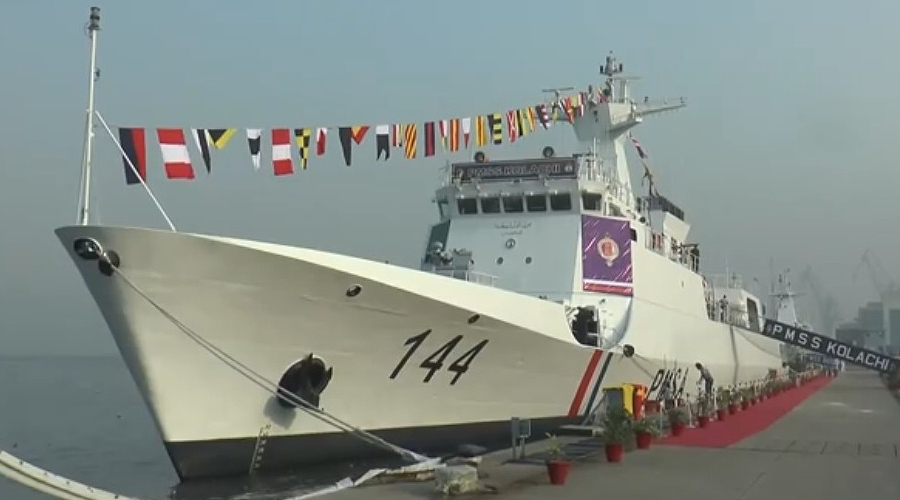
“VESSEL REVIEW | KOLACHI – NEW LARGE PATROL VESSEL FOR PAKISTAN MARITIME SECURITY AGENCY” –Baird Maritime

Photo: PMSA

Baird Maritime reports delivery of a Chinese designed Offshore Patrol Vessel to the Pakistan Maritime Security Agency (PMSA), the maritime safety and law enforcement arm of the Pakistan Navy. This second ship was reportedly built in Pakistan while the first was produced in China.

This ship may look a bit familiar. It appears to be a variant of the Type 056 corvette. 72 of the corvettes were inducted into the Chinese PLA Navy between 2013 and 2019. Variants of the class also serve with the Bangladeshi and Nigerian Navies and the China Coast Guard.

There is a Pakistani Coast Guards distinct from the PMSA, but it falls under the authority of the Pakistani Army and functions more like Customs and Border Protection and its Air and Marine Unit, being limited to operations on shore and within the 12 mile limit.