Just passing this along.
“U.S. Coast Guard, Marine Rescue Service Russian Federation meet in Anchorage” –D17
Reply

Just passing this along.

“Coast Guard Cutter Forward and Coast Guard Cutter Bear, homeported in Portsmouth, Virginia, finish an at-sea transfer while underway on a two-month patrol. Coast Guard Cutter Forward returned to homeport on April 10, 2021.” (U.S. Coast Guard photo)
Below is a news release offering media access to a triple change of homeport ceremony.
USCGC Spencer (WMEC-905), Seneca WMEC-906), and Escanaba (WMEC-907) are changing homeport from Boston to Portsmouth, VA. Seneca has actually been there for about a year, but guess the ceremony makes it official. It means there are now nine 270 foot WMECs homeported in Portsmouth. The other units of the class are homeported in Kittery, ME/Portsmouth, NH–Naval Shipyard (908, 909) and Key West, FL (910, 913).
Why the change? I suspect to move the ships closer to the Eastern Pacific drug transit zones, to consolidate maintenance for the type, and to put the crews in a lower cost area.
There is also the fact that at least some of the 270s will be going through a service life extension program. When that happens, crewmembers will be transferred either individually or as a unit, and if all the units involved share the same homeport it will be much easier on the crew members and their families, and less costly for the service.
We last looked at homeports here.

| Media Advisory |
U.S. Coast Guard 5th District Mid-Atlantic |
Coast Guard to hold joint change-of-homeport ceremony in Portsmouth, Virginia
PORTSMOUTH, Va. — The Coast Guard is scheduled to hold a change-of-homeport ceremony at 10:30 a.m., Wednesday at Coast Guard Base Portsmouth.
WHO: Rear Adm. Laura Dickey, Coast Guard Fifth District commander, Capt. John Dewey, commanding officer of Base Portsmouth, Capt. Marc Brandt, master of ceremony, Cmdr. Benjamin Spector, commanding officer of USCGC Escanaba and Cmdr. Corey Kerns, commanding officer of USCGC Spencer.
WHAT: The Coast Guard is holding a joint change-of-homeport ceremony for the U.S. Coast Guard Cutters Escanaba, Spencer, and Seneca.
WHEN: Wednesday, Sept. 8, 2021, at 10:30 a.m.
WHERE: Coast Guard Base Portsmouth, 4000 Coast Guard Blvd., Portsmouth, Va., 23703
Media interested in attending this event are asked to contact the Atlantic Area Command Public Affairs Office at (757) 641-0763.
The USCGC Escanaba (WMEC 907) is a medium endurance cutter previously based in Boston. The ship was launched on Feb. 6, 1985, and formally commissioned on Aug. 29, 1987, in Grand Haven, Michigan, its predecessor’s homeport. Its predecessor, the USCGC Escanaba (WPG 77), sank during WWII and was originally named for the Escanaba River in Escanaba, Michigan.
The USCGC Spencer (WMEC 905) is a medium endurance cutter previously based in Boston. On April 17, 1984, the ship was launched and commissioned on June 28, 1986, in Middletown, Rhode Island. It was named after its predecessor, the USCGC Spencer (WPG 36), a Treasury-class cutter named after John Canfield Spencer, United States secretary of the treasury from 1843 to 1844, who served during World War II was first used for search and rescue off Alaska’s fishing grounds.
The USCGC Seneca (WMEC 906) is a medium endurance cutter also previously based in Boston. On June 16, 1984, the ship was launched and commissioned on May 9, 1987, in Middletown, Rhode Island. It was named after its predecessor, the USRC Seneca (CG 17), a derelict destroyer with the mission to locate and destroy abandoned shipwrecks that were still afloat and a hazard to navigation.
The Famous-class cutters are responsible for various Coast Guard missions, including search and rescue, enforcement of laws and treaties, maritime defense, and protection of the environment. The versatility of the cutter makes it a cost-effective platform in carrying out national objectives.
Media planning to participate in the event must arrive no later than 9:45 a.m. Wednesday and must follow proper CDC guidelines for COVID-19.

“marauder2048” included a link to this DOD Ordnance Technology Consortium web page in a comment on my earlier post, “Remember the ALaMO,” noting a contract to conduct a “Demonstration Against Unmanned Aerial Systems (UAS) Targets” using the 57mm ALaMO round. But looking through the web site there were some other contract awards that I found interesting, including indications the 50mm program is still progressing. The list includes contracts for both FY 2020 and FY2021.
The following 50mm contracts, totaling $64.39M, were awarded to ATK (Northrop Grumman) in FY2020.
The following 50mm contracts were awarded to GD-OTS, General Dynamics Ordnance and Tactical Systems, in FY2021:
There are some interesting awards in other categories as well. There are these contracts for 30mm systems that do not appear related to the 30mm Mk46 currently in the USN inventory. These sales, late in FY2020, could be for foreign military sales:
Then there is this:
This is apparently in reference to the 40mm Mk19 Grenade machine gun, which is, I believe, on the PATFORSWA Webber class WPCs. This could mean it is to be used as a hard kill system against small Unmanned Air Systems, though the Mk19, with its very low muzzle velocity, seems a strange choice for an anti-air weapon.
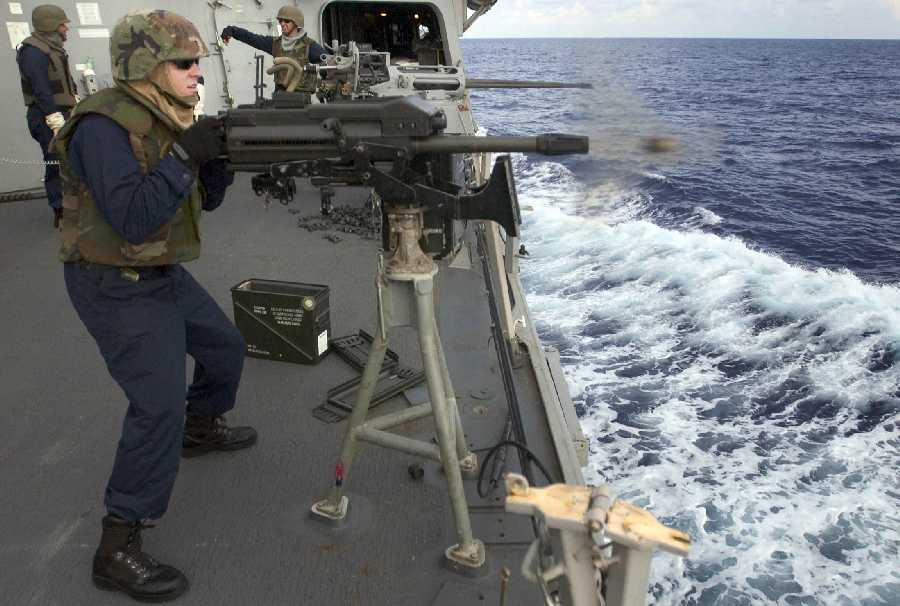
40 mm Mark 19 on USS Hopper DDG-70 in September 2006. Note the 25 mm Mark 38 in the background. U.S. Navy Photograph 060906-N-9851B-002.

August 26, JS OUMI conducted joint training with USCGC Munro in the East China Sea.
The US Naval Institute’s News Service reports on recent Coast Guard activity in the Western Pacific, apparently based primarily on a conversation with Vice Admiral Michael McAllister, Commander Pacific Area and Commander, Coast Guard Defense Force West.
They talk primarily about USCGC Munro’s operations with Japanese and Philippine forces. These included first time underway logistics support provided by the Japanese Maritime Self Defense Force, but there was more. They also discussed cooperation with the China Coast, but the Pacific Area Commander made one particular statement that may portend a new base in the Western Pacific,
“McAllister also provided an update on Coast Guard operations in the Pacific Islands since the July commissioning in Guam of Coast Guard Fast Response Cutters Myrtle Hazard (WPC 1139), Oliver Henry (WPC 1140) and Frederick Hatch (WPC 1143), and the re-designation of Coast Guard Sector Guam to Coast Guard Forces Micronesia Sector Guam.” (emphasis applied–Chuck)
There would not seem to be a reason to apply the designation “Coast Guard Forces Micronesia Sector Guam” unless there were Coast Guard forces in Micronesia somewhere beside Guam. Right now there are none that I am aware of.
I hope to publish something soon to discuss there those forces might be based.
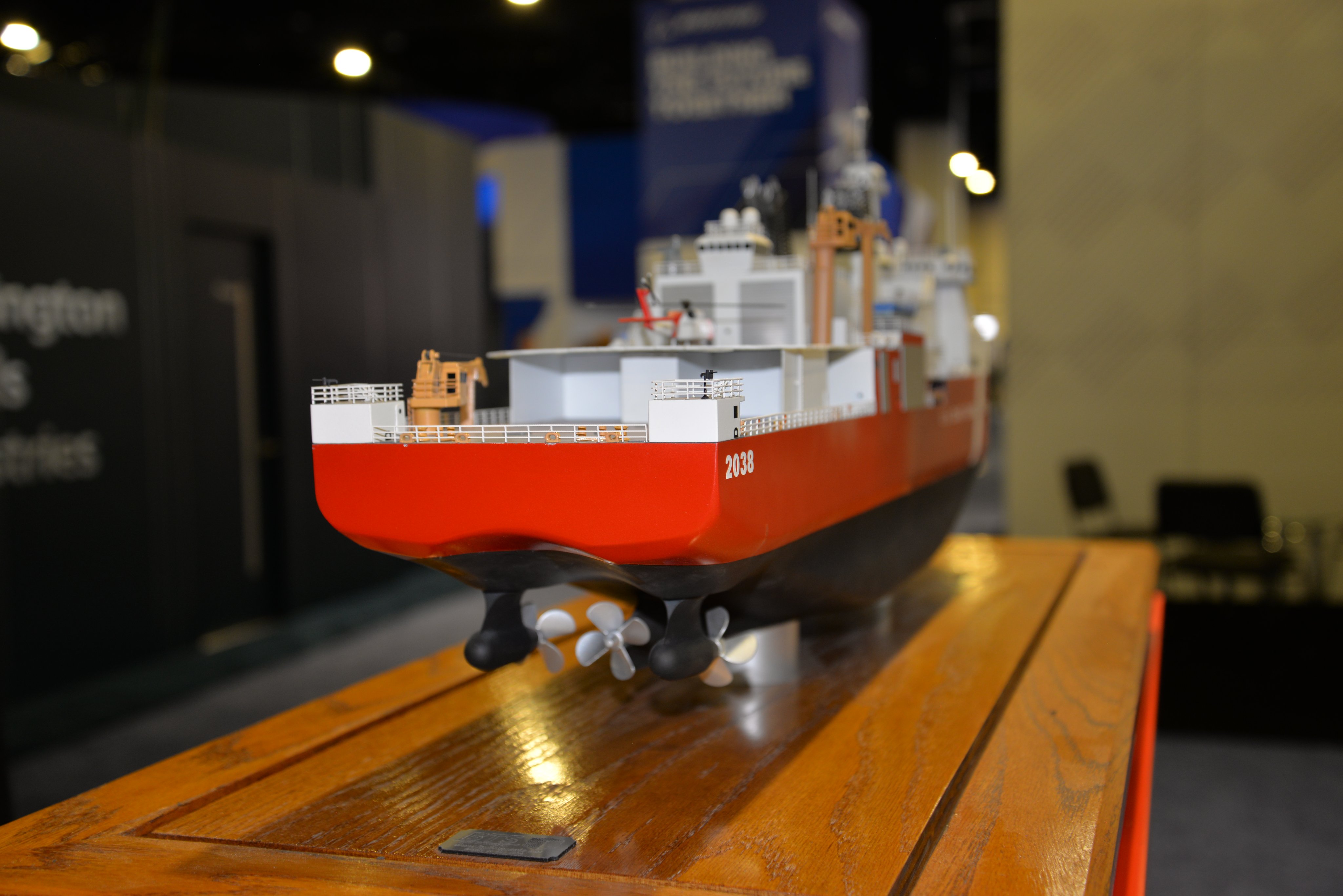
Photo of a model of Halter Marine’s Polar Security Cutter seen at Navy League’s Sea-Air-Space Exhibition have surfaced. Photo credit Chris Cavas.
The Congressional Research Service has once again updated their look at the Polar Security Cutter (heavy icebreaker) program. (See the latest version here.) My last look at this evolving document was in regard to the August 17, 2021 revision.
It appears this new edition was prompted by an update to the projected cost for the program. The following is a note attached to Table 1 (page 6), which I have also reproduced below.
Source: U.S. Navy information paper on PSC program, August 18, 2021, received from Navy Office of Legislative Affairs, August 31, 2021, which states that costs shown are from the PSC program 2020 Life Cycle Cost Estimate.
Table 1. Estimated PSC Procurement Costs
(In millions of then-year dollars)
Cost element 1st PSC 2nd PSC 3rd PSC Total
Target contract price 746 544 535 1,825
Program costs (including GFE) 218 175 228 621
Post-delivery costs 46 47 49 142
Costs for Navy-Type, Navy- 28 28 29 85 Owned (NTNO) equipment
TOTAL 1,038 794 841 2,673
There was also this additional note attached to Table 1.
Notes: Target contract price includes detail design, construction, and long lead-time materials (LLTM), and does not reflect potential costs rising to the contract ceiling price. GFE is government-furnished equipment— equipment that the government procures and then provides to the shipbuilder for installation on the ship. NTNO equipment is GFE that the Navy provides—such as combat weapons systems, sensors and communications equipment and supplies—for meeting Coast Guard/Navy naval operational capabilities wartime readiness requirements. (For additional discussion, see Coast Guard Commandant Instruction (COMDTINST) 7100.2G, May 16, 2013, accessed August 31, 2021, at https://media.defense.gov/2017/Mar/15/2001716816/-1/-1/0/ CI_7100_2G.PDF.)
Below is the one page summary:
Summary
The Coast Guard Polar Security Cutter (PSC) program is a program to acquire three new PSCs (i.e., heavy polar icebreakers), to be followed years from now by the acquisition of up to three new Arctic Security Cutters (ASCs) (i.e., medium polar icebreakers). The PSC program has received a total of $1,754.6 million (i.e., about $1.8 billion) in procurement funding through FY2021, including $300 million that was provided through the Navy’s shipbuilding account in FY2017 and FY2018. With the funding the program has received through FY2021, the first two PSCs are now fully funded.
The Coast Guard’s proposed FY2022 budget requests $170.0 million in procurement funding for the PSC program, which would be used for, among other things, procuring long leadtime materials (LLTM) for the third PSC.
The Navy and Coast Guard in 2020 estimated the total procurement costs of the PSCs in then year dollars as $1,038 million (i.e., about $1.0 billion) for the first ship, $794 million for the second ship, and $841 million for the third ship, for a combined estimated cost of $2,673 million (i.e., about $2.7 billion). Within those figures, the shipbuilder’s portion of the total procurement cost is $746 million for the first ship, $544 million for the second ship, and $535 million for the third ship, for a combined estimated shipbuilder’s cost of $1,825 million (i.e., about $1.8 billion).
On April 23, 2019, the Coast Guard-Navy Integrated Program Office for the PSC program awarded a $745.9 million fixed-price, incentive-firm contract for the detail design and construction (DD&C) of the first PSC to VT Halter Marine of Pascagoula, MS, a shipyard owned by Singapore Technologies (ST) Engineering. VT Halter was the leader of one of three industry teams that competed for the DD&C contract. The first PSC is scheduled to begin construction in 2021 and be delivered in 2024, though the DD&C contract includes financial incentives for earlier delivery.
The DD&C contract includes options for building the second and third PSCs. If these options are exercised, the total value of the contract would increase to $1,942.8 million (i.e., about $1.9 billion). The figures of $745.9 million and $1,942.8 million cover only the shipbuilder’s costs; they do not include the cost of government-furnished equipment (GFE), which is equipment for the ships that the government purchases and then provides to the shipbuilder for incorporation into the ship, post-delivery costs, costs for Navy-specific equipment, or government program management costs.
The operational U.S. polar icebreaking fleet currently consists of one heavy polar icebreaker, Polar Star, and one medium polar icebreaker, Healy. In addition to Polar Star, the Coast Guard has a second heavy polar icebreaker, Polar Sea. Polar Sea, however, suffered an engine casualty in June 2010 and has been nonoperational since then. Polar Star and Polar Sea entered service in 1976 and 1978, respectively, and are now well beyond their originally intended 30-year service lives. The Coast Guard plans to extend the service life of Polar Star until the delivery of at least the second PSC. The Coast Guard is using Polar Sea as a source of spare parts for keeping Polar Star operational.
On August 18, 2020, an electrical fire occurred in one of Healy’s main propulsion motors as the ship was 60 miles off Seward, AK, en route to the Arctic. As a result of the fire, the ship’s starboard propulsion motor and shaft became nonoperational. The ship canceled its deployment to the Arctic and returned to its homeport in Seattle for inspection and repairs.

HMCS Harry DeWolf in ice (6-8 second exposure)
The August, 2021 issue of US Naval Institute Proceedings has an article, that is the first I have seen to discuss the roles that should be expected of the “Arctic Security Cutters,” the Coast Guard’s planned Medium Icebreakers.
The article is available on line. I am not sure if or for how long it will be accessible to non-members.
The thrust of the article is that these ships should not be limited to deployments in the Arctic. That they have important roles in Antarctica and might also be used for domestic icebreaking, particularly in the Great Lakes during unusually severe winters, or if the Great Lakes icebreaker Mackinaw should suffer a casualty. I have suggested something similar before. It is also likely we will have reasons to operate in the Arctic entering from the Atlantic side.
This would require a homeport on the East Coast, perhaps Newport, Boston, or Kittery, ME. It would mean the ship would have to fit through the locks from the St. Lawrence to the Lakes and between the lakes.
To qualify as a “Medium Icebreaker” in the Coast Guard lexicon, the ships would have to have propulsion motors totaling 20,000 HP or more, meaning it will be more powerful than the Canadian DeWolf class Arctic Offshore Patrol Ships, like the one pictured above.
The author suggests a design evolved from the Wind class Icebreakers. These were very successful ships, but the design is about 80 years old, so we can certainly do better. Even so, the successful use of the Wind class globally shows what can be done with a design smaller than the planned Polar Security Cutters.
That the Coast Guard continues to claim a requirement for a medium icebreaker class rather than simply building more Polar Security Cutters may mean they have recognized a need for a smaller ship, perhaps one that could operate in the Lakes or in shallower water than might be accessible to the PSC.
Questions remain regarding the expectations of the class. How will it be armed, and what sensors will it be equipped with? I would anticipate an outfit similar to that of the Offshore Patrol Cutters, but that is yet to be seen. Should it be capable of operating more than a single helicopter? UASs? USVs? Space and utilities to support containerized systems? Space for a SCIF? I look forward to hearing more about this class.

U.S. Coast Guard Cutter Munro (left) and Philippine Coast Guard Offshore Patrol Vessel Gabriela Silang (right) render honors to each other following bilateral operations and exercises Aug. 31, 2021, in the West Philippine Sea. The Munro and crew are currently deployed to the Western Pacific Ocean to strengthen alliances and partnerships and improve maritime governance and security in the region. (U.S. Coast Guard photo by Marine Corps Sgt. Kevin G. Rivas)
Passing along a Pacific Area news release. More photos here. Recently read USCGC Munro had completed an Underway Refueling from a Japanese Maritime Self Defense Force Vessel (Thanks to Paul). Of course this upset the Chinese. They seem to be perpetually upset.

U.S. Coast Guard concludes training with Philippine maritime agencies
Editors’ Note: Click on images to download high resolution version. ALAMEDA, Calif. — The U.S. Coast Guard Cutter Munro (WMSL 755) arrived in Subic Bay, Philippines, Tuesday following operations and exercises in the West Philippine Sea with the Philippine Coast Guard and the Philippine Bureau of Fisheries and Aquatic Resources. Munro’s crew participated in bilateral operations, professional exchanges, search-and-rescue and communications exercises, small boat operations, multi-vessel maneuvering, and maritime domain awareness drills while at sea. “As the maritime security challenges in the Indo-Pacific region become increasingly complex, partnering with our Philippine Coast Guard and fisheries counterparts is vital to our shared interest in a free and open maritime environment,” said Munro’s Commanding Officer Capt. Blake Novak. “We thoroughly enjoyed our Philippine hosts’ professionalism and hospitality, and we look forward to future bilateral operations to further our longstanding relationship.” The search-and-rescue exercise simulated the agencies’ bilateral response to a vessel in distress. During the exercise, the Munro, PCG, and BFAR practiced searching for the distressed vessel, shipboard firefighting techniques, and recovering and treating persons in the water. As part of the exercise, members of the PCG joined USCG members aboard Munro as they launched the cutter’s Small Unmanned Aircraft System to aid in the search-and-rescue response. The day’s exercises and operations provided opportunities for each involved agency to learn from each other. “The success of the joint maritime exercise between the PCG and USCG will not only strengthen international partnerships for immediate response to calamities and disasters but will also ensure that our personnel could effectively perform their mandated functions in countering terrorism and other acts of lawlessness in our country’s waters,” said Admiral George V. Ursabia JR., PCG commandant. The USCG has a long history of cooperation with the PCG. In 2019, the Coast Guard Cutter Bertholf conducted engagements with the PCG as part of its Western Pacific deployment, focusing on search and rescue, maritime security, and law enforcement capabilities. Munro, a 418-foot national security cutter, departed its homeport of Alameda, California, in July for a months-long deployment to the Western Pacific. Operating under the tactical control of U.S. 7th Fleet, the cutter and crew are engaging in professional exchanges and capacity-building exercises with partner nations and are patrolling and conducting operations as directed. National security cutters like Munro feature advanced command and control capabilities, aviation support facilities, stern cutter boat launch, and increased endurance for long-range patrols, enabling the crews to disrupt threats to national security further offshore. “The Coast Guard shares deep and abiding interests with our allies and partners, who, like us, have long endorsed a rules-based international order,” said Vice Adm. Michael F. McAllister, commander, U.S. Coast Guard Pacific Area. “Partnering with the Philippines to enhance maritime governance, including important missions such as search and rescue and enforcement of fisheries laws and treaties, is essential to the security, stability and prosperity of all nations.” As both a federal law enforcement agency and an armed force, the USCG is uniquely positioned to conduct defense operations in support of combatant commanders on all seven continents. The service routinely provides forces in joint military operations worldwide, including the deployment of cutters, boats, aircraft, and deployable specialized forces. More photos from Munro’s Western Pacific deployment are available here. Subscribe here to receive notifications when new photos are added. |

Forbes brings us a reality check on the future of Unmanned Surface and Subsurface systems, including considerations that apply to the Coast Guard as well as the DOD.
At sea, robots certainly offer the potential for lots of new and exciting capabilities. But that will mean nothing, if, in the race to chase new capabilities, the Pentagon overlooks the harsh operational realities facing any brave robot sent out to cruise our big and increasingly contested oceans all alone.
This is probably less of a problem for the Coast Guard, because as a very conservative and tight fisted organization, it is less inclined to overreach, and tends to allow other services to go through the development process before jumping in. We really have a very small R&D budget.
There is a lot of information in the article about the successes and failures (that we don’t hear so much abour) of the Saildrone program. A program the author holds in high regard.
As the principle support organization for buoys, our own and NOAA’s, perhaps the Coast Guard has experience that the Navy might benefit from.
I do have one question. If the Navy has engines that can run a Large Unmanned Surface Vessel for months without anyone on watch and without maintenance, why haven’t they put them on manned vessels?
Perhaps a second question. I was surprised to see that vandalism was such a problem for our buoys. If we have warships with no one on board, what is to stop the many bored Chinese fisherman from vandalizing our unmanned warships?
Below is a news release from PteroDynamics.
This looks like it might be an interesting aircraft type to operate from cutters. If it can carry cargo it can also carry sensors.
A small, unmanned version might provide patrol boats with search and identification capabilities currently available only to much larger cutters.
A larger version might replace helicopters while providing greater range and speed.
An even larger version, operating from shore or the largest cutters, might combine both search and rescue functions now provided by fixed wing search aircraft and rotary wing rescue aircraft. Combining those functions probably should be a long term Coast Guard objective. Not that the Coast Guard can fund manned aircraft development, but it seems likely the capability will be developed.
Apparently the Navy thinks the concept is promising enough to put at least some money into small prototypes.
—
COLORADO SPRINGS, Colo.–PteroDynamics, an aircraft design and manufacturing company that develops innovative vertical take-off and landing (VTOL) aircraft, is today announcing it has secured a contract with Naval Air Warfare Center Aircraft Division (NAWCAD) to deliver 3 VTOL prototypes for the Blue Water Maritime Logistics UAS (BWUAS) program.
“Our design is well suited for operations on ships where windy conditions and tight spaces challenge other VTOL aircraft during takeoffs and landings.”
In 2018, Military Sealift Command and Fleet Forces Command identified a need for the United States Navy to develop a capability to autonomously deliver cargo with an unmanned aerial system (UAS) to and from ships at sea. Their analysis found that 90% of critical repair cargo delivered at sea by helicopters and V-22 aircraft weighed less than 50 pounds. A VTOL UAS can fill this critical need and free the manned aircraft to perform other higher priority missions.
“We are honored to be selected for this important project,” said Matthew Graczyk, PteroDynamics’ CEO. “This contract is the start of an important partnership, and we look forward to delivering the prototypes to NAWCAD.”
“This is an exciting milestone for our distinctive VTOL aircraft,” added Val Petrov, PhD, PteroDynamics’ founder and CTO. “Our design is well suited for operations on ships where windy conditions and tight spaces challenge other VTOL aircraft during takeoffs and landings.”
“Using unmanned, autonomous aircraft for delivery of these critical payloads is an important capability for the Navy to have,” said Blue Water’s project lead, Bill Macchione. “The innovative design of PteroDynamics offers significant potential for both military and civilian missions.”
About PteroDynamics
PteroDynamics is an aircraft design and manufacturing company that has developed a novel VTOL aircraft design that folds its wings during flight to transition between rotorcraft and fixed-wing configurations. Protected by three issued and five pending U.S. and international patents, Transwing® aircraft have improved controllability in takeoff and landing and typically require 1/3 of the ground footprint as compared to other aircraft with the same wingspan. Transwing®’s clean aerodynamic shape also allows it to fly faster and further than competitive designs. PteroDynamics is venture-backed by Kairos Ventures.
About NAWCAD
NAWCAD conducts research, development, test, evaluation, and sustainment for all United States Navy and United States Marine Corps aircraft and aircraft systems. Its diverse workforce of more than 10,000 military, civilian, and contractor engineers, scientists, testers, and other professionals support an evolving battlespace through research, development, test, and evaluation of both fielded and not-yet fielded naval and marine corps platforms and technology. Headquartered in Patuxent River, Maryland, the warfare center collaborates across its sites in St. Inigoes, Maryland; Lakehurst, New Jersey; and Orlando, Florida to ensure America’s warfighter always goes into conflict with significant advantage.
Kayla Jones
Media@PteroDynamics.com
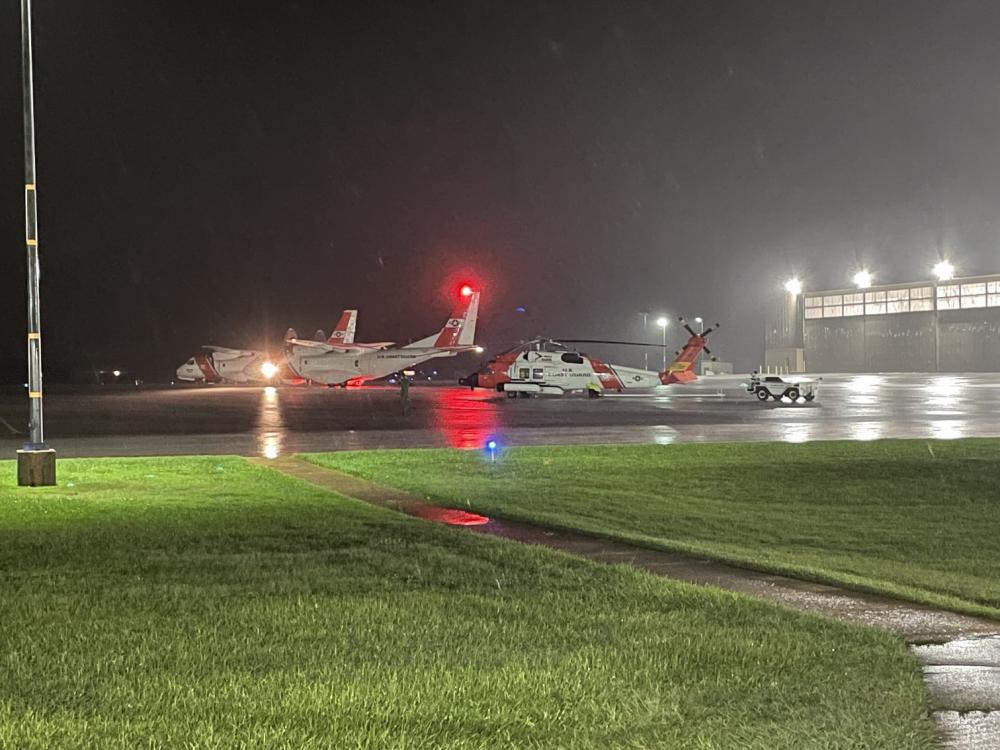
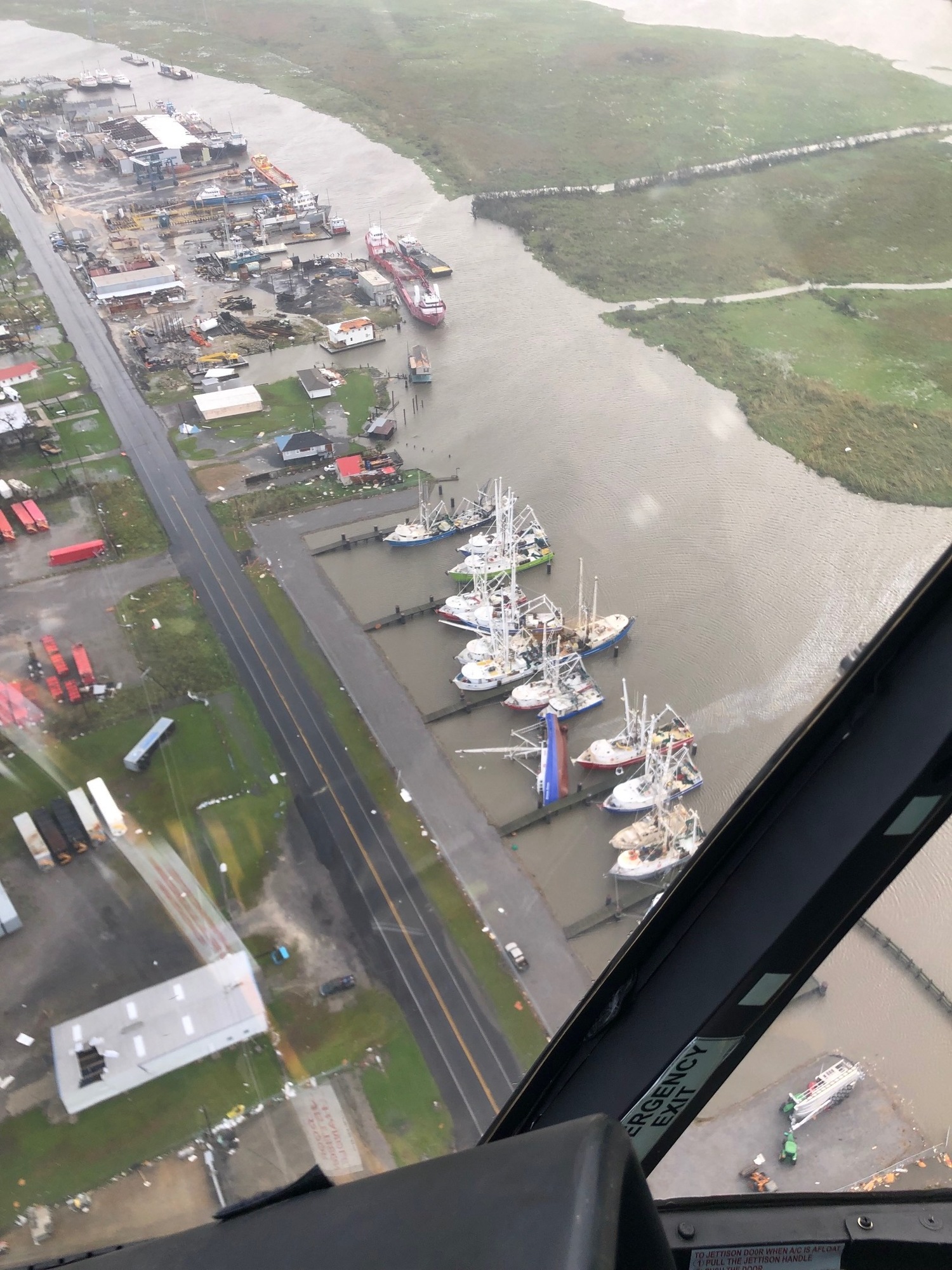
The Coast Guard conducts Hurricane Ida post-storm overflights along the Gulf Coast on August 30, 2020. Assets conducted critical incident search and rescue overflights and assessing for damage along the Gulf Coast Region of Louisiana following Hurricane Ida. (U.S. Coast Guard courtesy photo)
Passing along a Coast Guard District 8 news release.

Coast Guard conducts Hurricane Ida post-storm overflights along the Gulf Coast
Editors’ Note: Click on images to download high-resolution versions. NEW ORLEANS —The Coast Guard is conducting critical incident search and rescue overflights and assessing for damage Monday along the Gulf Coast Region of Louisiana following Hurricane Ida. The Coast Guard has brought to bear more than 28 aviation assets and nearly 21 shallow-water response assets to respond to flooded and damaged areas. “The Coast Guard will continue to provide search and rescue capabilities, assess the damage done by Hurricane Ida, repair aids-to-navigation, and ensure the ports along the Gulf Coast can be safely reopened for the flow of maritime commerce,” said Capt. Tracy Phillips, area commander for the Ida response. |





 Chuck Hill's CG Blog