U.S. Coast Guard Shares “Lessons Learned” from Polar Star’s Arctic Voyage, Coast Guard Headquarters Provides Insight –by Peter Ong

Guest author Peter Ong has been asking some questions about Polar Star’s recent, unusual Arctic Winter deployment. –Chuck

“The Coast Guard has a long and rich history of conducting operations around the world, and international demand for increased Coast Guard capability and presence has never been greater.  The Coast Guard’s diverse set of statutory missions provides the Service with unique authorities, capabilities, and partnerships that support national security and foreign policy objectives around the globe. — U.S.C.G. spokesperson, Headquarters, Washington D.C.

The Coast Guard Cutter Polar Star (WAGB 10) enjoys brief ice liberty on the frozen Bering Sea in below freezing temperatures, Saturday, Jan. 30, 2021. The 45-year-old heavy icebreaker is underway to project power and support national security objectives throughout Alaskan waters and into the Arctic, including along the Maritime Boundary Line between the United States and Russia. U.S. Coast Guard Photo by Petty Officer 1st Class Cynthia Oldham From USCGC Polar Star Facebook

The U.S. Coast Guard’s sole remaining active-duty heavy Polar icebreaker, the 45-year-old USCGC Polar Star (WAGB 10), returned home to Seattle on Saturday, February 20, 2021.  America’s aging icebreaker left homeport Seattle in December 2020

Originally scheduled for “Operation Deep Freeze” to resupply McMurdo Station in the Antarctic, the Polar Star sailed north because of COVID-19 restrictions in Antarctica. This was the first time since 1982, nearly 40 years, that a heavy U.S. Coast Guard icebreaker ventured north to “Show the Flag” and support America’s presence in the Arctic.  While sailing in the Bering Sea, the heavy icebreaker was armed with two .50cal M2HB heavy machine guns, armament that normally would not be mounted on an Antarctic voyage.  

CGC POLAR STAR is the Nation’s only operational heavy icebreaker and is capable of year-round deployments in the Polar Regions. Typically, CGC POLAR STAR supports the annual resupply of McMurdo Station as part of Operation Deep Freeze; however, the Coast Guard can redirect limited assets based on mission needs and priorities.” — U.S.C.G. spokesperson, Headquarters, Washington D.C.

The reason for the Polar Star’s trip was because the Coast Guard’s only medium Arctic icebreaker, 21-year-old USCGC Healy, suffered an engine room fire and starboard drive breakdown during its Arctic voyage in August 2020.  Healy has since completed repairs at Mare Island Dry Dock, Vallejo, California, and has sailed back to homeport Coast Guard Station, Seattle, where it shares the docks with the heavy icebreakers Polar Star and the inactive Polar Sea (the Polar Sea suffered a crippling engine malfunction that has keep her inactive since 2010, and engine repairs were deemed too costly for the Polar Sea to ever sail again).

“CGC HEALY’s emergency dry dock is complete. Main motor repairs are continuing at CGC HEALY’s homeport in Seattle, WA to facilitate planned maintenance work. The Coast Guard anticipates all repairs will be completed by May 2021 in advance of CGC HEALY’s next scheduled deployment.”  — U.S.C.G. spokesperson, Headquarters, Washington D.C.

We made it home! Work on the motor continues, but we reached a point where we could finish the job in Seattle. We also just started an intensive maintenance period to get ready for our next mission.” Seattle, Washington, February 13, 2021.” From USCGC Healy Facebook

The U.S. Coast Guard Shares “Lessons Learned” on the Polar Star’s Arctic Trip

As the first heavy U.S. icebreaker to sail into the Arctic in almost forty years (and the first US icebreaker in the Arctic during the Winter in a very long time–Chuck), what lessons have the Coast Guard and the crew of the 45-year-old icebreaker learned?  When the Polar Star departed, the ship was forty-four years old; she turned forty-five over the Christmas Holidays.

U.S. Coast Guard Headquarters, Washington D.C., responded to questions via email. “Overall, this was an incredibly successful patrol for CGC POLAR STAR, as the cutter remained 100% fully mission capable for the duration of the deployment.  The extreme Arctic winter environment forced the crew of CGC POLAR STAR to perform unanticipated engineering maintenance, as limitations associated with working in sub-zero temperatures affected operations. For example, extremely cold temperatures in the engine room impacted the designed operation of several engineering systems, which required innovative adjustments to standard procedures. The deployment also identified cold-weather limitations of the MK-IV Over-the-Horizon (OTH) cutter boat. Lessons learned from operating the MK-IV OTH in these temperatures are now informing the development of operational requirements for the next generation of Polar Region small boats. Finally, the winter deployment revealed the potential need to adjust electronic sensor systems to operate in extremely cold weather.”

Over-the-horizon-IV cutter boat from Coast Guard Cutter Valiant Sept. 12, 2017. Polar Star operated a similar boat in the Arctic and the openness of the Mk IV to the freezing temperatures, rough Arctic surf, and the weather is clearly evident. U.S. Coast Guard photo

Since the USCGC Healy’s repairs are planned to finish in May, 2021, the Polar Star may return to its usually Antarctic duties, pending COVID restrictions, although Coast Guard Headquarters, Washington D.C., did not confirm this.

When asked if the U.S. Coast Guard plans to lease any private icebreakers for Arctic duties to make up for the shortage in available U.S. government icebreakers, the Coast Guard spokesperson replied, “The Coast Guard is working with the Navy to identify potential bridging strategies that would increase U.S. surface presence in the Arctic prior to delivery of the first Polar Security Cutter.”


Chuck’s comments. Thanks to Peter Ong for sharing this with us.

I was a bit surprised by this, “… the heavy icebreaker was armed with two .50cal M2HB heavy machine guns, armament that normally would not be mounted on an Antarctic voyage.” There is no reason the Polar Star should not carrier her .50 machine guns when going to Antarctica. This is what the Treaty says.

Article I

1. Antarctica shall be used for peaceful purposes only. There shall be prohibited, inter alia, any measures of a military nature, such as the establishment of military bases and fortifications, the carrying out of military maneuvers, as well as the testing of any types of weapons.

2. The present Treaty shall not prevent the use of military personnel or equipment for scientific research or for any other peaceful purpose.

There is no prohibition in the Treaty against using armed vessels in the Arctic. Historically armed Icebreakers operated in the Antarctic after ratification of the Treaty.

Under Article VII,

“All areas of Antarctica, including all stations, installations and equipment within those areas,
and all ships and aircraft at points of discharging or embarking cargoes or personnel in Antarctica, shall be open at all times to inspection by any observers designated in accordance with paragraph 1 of this article.

but there are really no security concerns about the 100 year old technology of the .50 cal. M2. It is not that they are likely to be needed, but we seem to be imposing limitations that really don’t exist. False presumptions may unnecessarily limit our future options.

“Damen Launches First Of Three MMIPV Patrol Vessels For South African Navy” –Naval News

Damen StanPatrol 6211 (62 meters long, 11 meter beam)

Naval News reports the launch of the first of three “Multi Mission Inshore Patrol Vessels” (MMIPVs) designed by Damen and built by Damen Shipyards Cape Town for the South African Navy.

The report refers to these as over 600 tons, but that must be a light displacement. Based on Damen’s specs, these are about the same size as a 210, six feet shorter but with greater beam and draft.

  • Length: 204′ (62.2 meters)
  • Beam: 37.7′ (11.5 meters)
  • Draft: 13.1′ (4 meters)
  • Gross Tonnage: 1,031 tons

A June 2020 report provides some additional detail.

DSCT is supplying three 62×11 metre Stan Patrol 6211 vessels, which have a maximum speed of 26.5 knots, a range of 4 000 nautical miles, and a crew of up to 62. Combat equipment will include a combat management system, radar, forward gun position and heavy machinegun positions. Reutech is supplying 20 mm Super Sea Rogue turrets, as well as RTS 3200 Optronics Radar Tracker (FORT) systems and communications systems.

The vessels will each carry one 7 metre long RHIB and one 9 metre long RHIB for boarding operations. Container fittings on the aft deck will be available for fastening on mission equipment.

They have no flight deck. The South African ships did not exercise all the options available on the design. Damen’s spec indicate these ships may have up to three boats with two 11 meter on davits and a third 7.5 meter in a stern ramp, engines totaling up to 14,400 KW (19,311 HP), speeds up to 30 knots, and a range of up to 5,000 miles at 12 knots.

In 2015 Damen Shipyards Cape Town built a pair of similar but smaller ships to the Stan Patrol 5009 design that replaced the 4708 design in their portfolio. The 4708 design was the basis for the Webber class FRCs. South Africa also has three patrol vessels based on the 4708 design.

Earlier there was a 2017 report that South Africa would build 1800 ton Damen designed Offshore Patrol Vessels. The larger vessels are now in doubt for budgetary reasons. They may find these “Inshore Patrol Vessels” meet their needs, since they are a good deal larger than their current OPVs.

“Almost Overnight, New Ships Make U.S. Coast Guard A Big Geopolitical Player” –Forbes

Ships from the U.S. Coast Guard and Japan Coast Guard conducted exercises near the Ogasawara Islands of Japan, Feb. 21, 2021. The U.S. Coast Guard Cutter Kimball and Japan Coast Guard Ship Akitsushima, two of the respective services’ newest and most capable vessels, operated alongside helicopters and unmanned aerial vehicles to practice interdicting foreign vessels operating illegally inside Japanese waters. (U.S. Coast Guard photo courtesy of the Coast Guard Cutter Kimball/Released)

A look at how others are seeing new possibilities in the Coast Guard from a national financial magazine.

“U.S. NAVAL INSTITUTE’S COAST GUARD ESSAY CONTEST” –ALCOAST

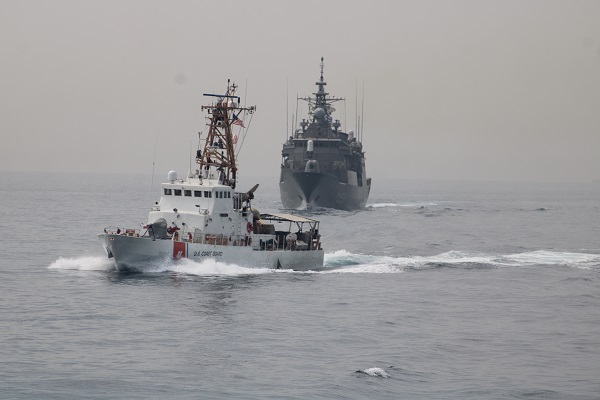
ARABIAN GULF (Feb. 25, 2021) The U.S. Coast Guard cutter USCGC Maui (WPB 1304) and the Greek navy guided-missile frigate HS Hydra (F452) participate in a passing exercise in the Arabian Gulf, Feb. 25, 2021. U.S. Coast Guard Patrol Forces Southwest Asia (PATFORSWA) is comprised of six 110-foot cutters, the Maritime Engagement Team, shore-side support personnel, and is the Coast Guard’s largest unit outside of the U.S. playing a key role in supporting Navy security cooperation, maritime security, and maritime infrastructure protection operations in the U.S. 5th Fleet area of operations. (U.S. Coast Guard photo)

Below is an ALCOAST. I have made minor changes to format.

united states coast guard

R 231811Z MAR 21
FM COMDT COGARD WASHINGTON DC
TO ALCOAST
BT
UNCLAS
ALCOAST 112/21
SSIC 5726
SUBJ:  DEADLINE FOR THE U.S. NAVAL INSTITUTE’S COAST GUARD ESSAY CONTEST
A. Coast Guard External Affairs Manual, COMDTINST M5700.13 (series)

1. This ALCOAST announces the U.S. Naval Institute’s Coast Guard Essay contest.

2. Overview. Located at the U.S. Naval Academy in Annapolis, MD, the U.S. Naval Institute (USNI), a private, non-profit, non-partisan organization, has provided an open forum for rigorous debate, informed discussion, thought leadership, and professional development for members of the Naval Services since 1873. The vision and mission of the USNI is to give a voice to those who seek the finest Navy, Marine Corps, and Coast Guard by providing an independent forum for those who dare to read, think, speak, and write to advance the professional, literary, and scientific understanding of sea power and other issues critical to global security. USNI is known for its flagship magazine, Proceedings, and a variety of historical and professional books.

3. Summary. The Naval Institute’s Coast Guard Essay Contest is open to all personnel: active duty, reservists, veterans and civilians from any of the nation’s sea services. It provides members
an opportunity to identify areas to make the Coast Guard stronger.

4. The Challenge. What can the U.S. Coast Guard do today to be more effective tomorrow? No subject is too large or too small. All topics are welcome, one might consider: changes required to meet new global missions, barriers preventing the USCG from fully executing its missions and how to remove them, how best to integrate the USCG’s unique authorities, capabilities and partnerships with other sea services, innovative ideas to help make the Coast Guard a more capable and resilient instrument of national security globally, or how to leverage partnerships to more cooperatively defend and secure the homeland.

    a. Eligibility: Open to all contributors – active-duty, military, reservists, veterans and civilians. The essay must be original and not published or being considered for publication elsewhere.

    b. Length: 2,500 words maximum, excluding notes and sources.

    c. Prizes: First prize – $5,000. Second prize – $2,500. Third
prize – $1,500.

    d. Submission Deadline: the deadline for entries is 30 April 2021. Note: essays are submitted directly to USNI and the U.S. Coast Guard plays no role in selecting the winning essays. Applicants must ensure entries conform to Chapter 6, sections (A) through (C) of REF (A). Essays must be original and not previously published or being considered for publication elsewhere.

    e. Additional details: submit the essay as a word document online at: www.usni.org/cgessay by 30 April 2021. Include the word count on the title page, but do not include your name on the title page or within the essay.

    f. The Proceedings staff members will evaluate every essay and screen the top essays to a special Essay Selection Committee of at least six members who will include two members of the Naval Institute’s Editorial Board and four subject matter experts. All essays are judged in the blind; the Proceedings staff members and judges will not know the authors of the essays.

5. Other Essay Contests and Writing Opportunities.

    a. Essay Contests. USNI hosts essay contests throughout the year on a variety of topics including: Coast Guard, Cyber, Enlisted Perspectives, Innovation & Risk, International Navies, Leadership, Marine Corps, Naval History, Naval Intelligence, Naval Mine Warfare, and Naval Postgraduate School Foundation/USNI. For details see: https://www.usni.org/essay-contests.

    b. Other Writing Opportunities. Authors can also submit articles for publication in Proceedings or Naval History magazines, USNI Today (online), and USNI’s Blog (online). For details see:
https://www.usni.org/periodicals/proceedings-magazine/submission- guidelines.

6. POC: LCDR Karen Love Kutkiewicz, USNI Executive Fellow, at (206) 460-3399 or e-mail at kkutkiewicz@usni.org.

7. RDML Scott W. Clendenin, Assistant Commandant for Response Policy (CG-5R), sends.

8. Internet release is authorized.

“SHOWING UP IS HALF THE BATTLE: U.S. MARITIME FORCES IN THE INDIAN OCEAN” –War on the Rocks

War on the Rocks has a good treatise on the growing importance of the Island nations of the Indian Ocean and why the US should take more interest. The author contends that while forming a new First Fleet Command, something the Navy is contemplating, would be a good start, there is much more that needs to be done, and the Coast Guard has an important part to play. The author mentions the Coast Guard fifteen times in the article. I have reproduced the portion of the article specific to the Coast Guard below, but read the entire article for context.

When USCGC Hamilton escorts the first two Webber class WPCs to Bahrain, hopefully Hamilton will have some time to do some capacity building in the Indian Ocean. Perhaps PATFORSWA will also be involved in a continuing effort.

A Coast Guard Initiative

Finally, Washington should look to its Coast Guard in maximizing its interactions with small island nations. While the Coast Guard plays a significant role in training Pacific island nations’ maritime forces, they are rarely seen in the Indian Ocean. As with the Pacific, the islands of the Indian Ocean, too, face similar non-traditional security issues as their primary challenges. Interactions between, and trainings conducted with, the Coast Guard and Indian Ocean island nations might carry more value at the operational and tactical level. Recognizing resource constraints and its limited capacity to deploy in the region, Coast Guard initiatives can come in the form of training and capacity building efforts. Many island nations such as Maldives, Mauritius, and Comoros have a coast guard tasked with both law enforcement and defense of their sovereign territories. Given the nature of their primary threats — such as illegal fishing, drug smuggling, and human trafficking — training with the U. S. Coast Guard will be a significant step forward for many of the island nations of the Indian Ocean. Such engagements could also help offset an overreliance on military trainings in Beijing, including interpretation of customary law and the U.N. Convention for the Law of the Sea. Chinese interpretation of customary and international laws at Sea are notably different than those of the U.S. and its allies.  However, these interactions should be extended to islands and littorals across the region, instead of limiting them to Sri Lanka and Maldives only.

The U.S. Coast Guard could potentially utilize some of its lessons and experiences from the Pacific in interacting with, and training, the islands of the Indian Ocean on a range of issues from law enforcement to surveillance to disaster response. Washington could perhaps borrow from its interactions as a member of the Pacific Quad, prioritizing engagements with island nations and their security concerns as a model for the Indian Ocean too. If the Coast Guard is to take on this additional mission, it will require additional resources, which may require a willingness to cut some Department of Defense resources previously devoted to ground wars in the Middle East and redirect them to the Coast Guard.

An Indian Ocean deployment leveraging all its maritime forces allows Washington to address two immediate concerns in the region. First, it would provide a singular node, or a specific agency, tasked with engaging with the region as a whole to bridge the gap resulting from the divided combatant commands. Second, a burden-sharing model with close partners and allies leveraging the Coast Guard and the Marine Corps aids the already extended U.S. Navy and its role in the Indian Ocean. This could help conceptualize a framework that allows Washington to deploy and engage its maritime forces in the region in a meaningful and, more importantly, an achievable way.

“ROYAL NAVY REVIVES DAYS OF SAIL WITH TRAINING ON TALL SHIP” –UK Royal Navy

Photo: Training Ship Tenacious under sail.

The Royal Navy reports,

For the first time in decades Royal Navy sailors are learning the art of seafaring on a traditional tall ship.

The use of the Jubilee Sailing Trust’s Tenacious is helping to plug the gap left by the closure of the Navy’s command and leadership school in the Brecon Beacons due to the pandemic.

“In a difficult period for Royal Navy training due to the pandemic, the use of the Jubilee Sailing Trust has allowed us to continue to provide top quality core leadership and team training in a maritime context,” said Commander Adrian Coulthard from the Navy’s training organisation.

Information on the ship here. Remarkably she is a wooden ship completed in 2000.

(Contrary to the claim in the Wikipedia article, she is not the largest wooden ship afloat, unless both USS Constitution and USS Constellation happen to be in dry dock at the same time.)

Exercise Tenacious Wave
Royal Navy sailors are setting sail on a traditional tall ship as part of Exercise TENACIOUS WAVE. Working in partnership with the Jubilee Sailing Trust, junior sailors are put to sea on Sailing Vessel Tenacious to continue their naval training.
This opportunity provides early exposure to maritime life, teaching about routines on board a ship and developing skills through a series of leadership exercises.

“Coast Guard Commissions newest National Security Cutter” –News Release

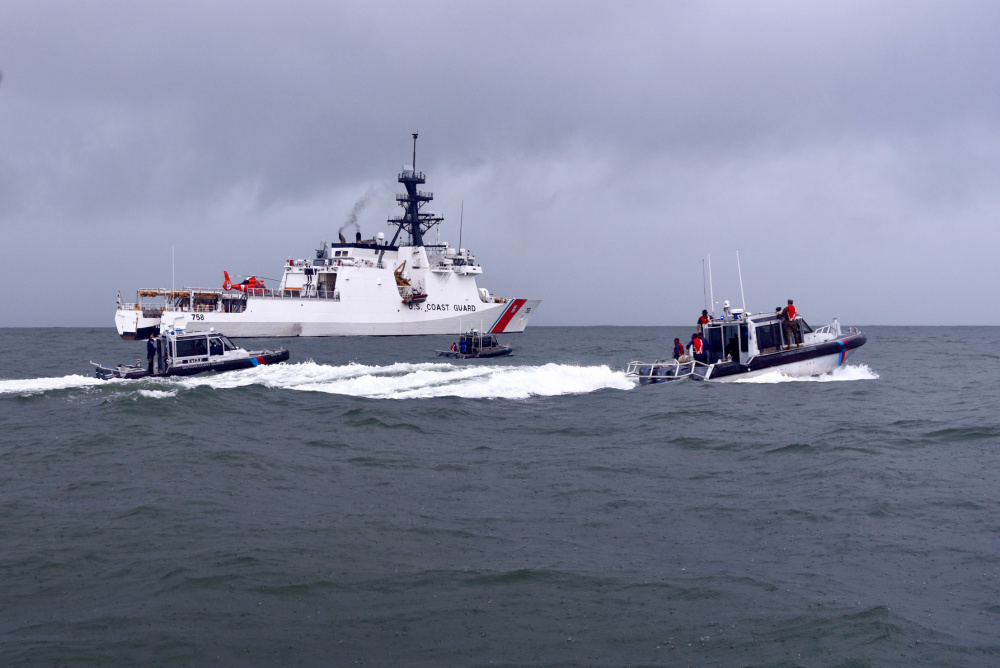
Guyana coast guard small boats patrol alongside the USCGC Stone (WMSL 758) off Guyana’s coast on Jan. 9, 2021. The U.S. and Guyana governments enacted a bilateral agreement on Sep. 18, 2020, to cooperatively combat illegal marine activity in Guyana’s waters. (U.S. Coast Guard photo by Petty Officer 3rd Class John Hightower)

Below is a LANTAREA news release marking the commissioning of USCGC Stone, the ninth National Security Cutter. The Cutter did not even wait to be commissioned to be useful. She has already had a remarkable patrol into the waters of the South Atlantic (here, here, and here).

united states coast guard

News Release

U.S. Coast Guard Atlantic Area
Contact: Coast Guard Atlantic Area Public Affairs
Office: (757) 398-6521
After Hours: (757) 641-0763
Atlantic Area online newsroom

 Coast Guard Commissions newest National Security Cutter

Coast Guard Cutter Stone Commissioning Ceremony

Fellow Aviators pay tribute to the USCGC Stone (WMSL- 758) during the commissioning ceremony at Coast Guard Base Charleston, S.C., Mar. 19, 2021. The cutter’s namesake is the late Cmdr. Elmer “Archie” Fowler Stone, who in 1917 became the Coast Guard’s first aviator and, two years later, was one of two pilots to successfully make a transatlantic flight in a Navy seaplane landing in Portugal. (U.S. Coast Guard photo by Petty Officer 3rd Class Vincent Moreno)

Coast Guard Cutter Stone Commissioning Ceremony

The crew of USCGC Stone (WMSL- 758) prepare to bring the ship to life during a commissioning ceremony at Coast Guard Base Charleston, S.C., Mar. 19, 2021. The cutter’s namesake is the late Cmdr. Elmer “Archie” Fowler Stone, who in 1917 became the Coast Guard’s first aviator and, two years later, was one of two pilots to successfully make a transatlantic flight in a Navy seaplane landing in Portugal. (U.S. Coast Guard photo by Petty Officer 3rd Class Vincent Moreno)

NORTH CHARLESTON, S.C., — The USCGC Stone (WMSL 758) became the Coast Guard’s newest national security cutter during a commissioning ceremony Friday at Coast Guard Base Charleston.

Adm. Karl Schultz, the commandant U.S. Coast Guard, presided over the ceremony.

Ms. Laura Cavallo, the grandniece of the ship’s namesake and ship’s sponsor, was also in attendance.

The cutter’s namesake comes from Cmdr. Elmer “Archie” Fowler Stone, who in 1917 became the Coast Guard’s first aviator and, two years later, was the pilot of the NC-4, a Navy airplane, which in 1919 was the first aircraft to accomplish a trans-Atlantic flight, landing in Portugal.

The Stone is the ninth legend-class national security cutter in the Coast Guard’s fleet. The Legend-class, national security cutters can execute the most challenging national security missions, including support to U.S. combatant commanders.

They are 418 feet in length, 54 feet in beam, and 4,600 long tons in displacement. They have a top speed of more than 28 knots, a range of 12,000 nautical miles, an endurance of up to 90 days, and can hold a crew of up to 150. These new cutters are replacing the high endurance Hamilton-class cutters in service since the 1960s.

The Stone launched on Oct. 4, 2019, for sea trials. Following sea trials, the crew conducted their maiden voyage Operation Southern Cross, a patrol to the South Atlantic supporting counter illegal, unreported, and unregulated fishing.

Taking the newly-accepted cutter on its shakedown cruise, Stone’s crew covered over 21,000 miles (18,250 nautical miles) over 68 days. A mutual interest in combating IUUF activities offered an opportunity to collaborate for Stone’s crew. They interacted with partners in Guyana, Brazil, Uruguay, and Portugal, strengthening relationships and laying the foundation for increased partnerships to counter illicit maritime activity.

Ship commissioning is the act or ceremony of placing a ship in active service.

\

“Top US Commander Warns ‘Front Line’ With China Now South of Border” –Voice of America

Voice of America reports remarks by SOUTHCOM Commander, Admiral Craig Faller, regarding the growth of Chinese influence in the Western Hemisphere, including criminal activity and Illegal, Unreported, and Unregulated fishing.

This isn’t new. Through contributing author, Sanjay Badri-Maharaj (here and here),I have been following what has been happening in Trinidad and Tobago. I am sure similar interaction is happening elsewhere in the Western Hemisphere. Here is some background:

China’s Growing Influence in the Caribbean | Manohar Parrikar Institute for Defence Studies and Analyses (idsa.in)

China, Trinidad and Tobago pledge to consolidate friendship – CGTN

PM and Chinese President Xi Jinping engage in bilateral talks | Loop News (looptt.com)

“New Coast Guard Team to Flesh Out Unmanned Systems Requirements” –National Defense


MQ-9B Seaguardian during the maritime capabilities demonstration flight over Southern California waters in September 2020. GA-ASI picture.

National Defense reports that during a round table following the Commandant’s State of the Coast Guard address, he stated that the Coast Guard would be standing up an unmanned systems requirements office in headquarters. Unmanned surface and sub-surface systems will be considered in addition to air systems.

“We learned that the future of our unmanned systems strategy will most likely rely on more diverse systems and effective integration of machine learning to unlock actionable data for Coast Guard operators,” he said. “These are valuable lessons as we stand up an unmanned systems element within our Coast Guard requirements shop to consider how unmanned technology can augment our future fleet…It’s really a UxS office,” he said of the new group that will be set up to look at requirements.

Thanks to Lee for bringing this to my attention. 

“Japan-U.S. alliance ‘cornerstone of peace and prosperity’ in Indo-Pacific” –Indo-Pacific Defense Forum

Ships from the U.S. Coast Guard and Japan Coast Guard conducted exercises near the Ogasawara Islands of Japan, Feb. 21, 2021. The U.S. Coast Guard Cutter Kimball and Japan Coast Guard Ship Akitsushima, two of the respective services’ newest and most capable vessels, operated alongside helicopters and unmanned aerial vehicles to practice interdicting foreign vessels operating illegally inside Japanese waters. (U.S. Coast Guard photo courtesy of the Coast Guard Cutter Kimball/Released)

Some recognition for what the Kimball has been doing in the Western Pacific from the Indo-Pacific Command web site Indo-Pacific Defense Forum, including a really nice photo.