“Republic Of Singapore Navy Stands Up New Maritime Security And Response Flotilla” –Naval News

Note the graphic may be distorted here, click on it for a better view. 

Naval News reports that the Singapore Navy has formed a new “Maritime Security and Response Flotilla.”

“As part of the restructured Maritime Security Command, the new MRSF is set up to better trackle evolving maritime threats that have grown in scale and complexity, particularly in the Singapore strait area. According to a recent French Navy report on worldwide maritime piracy and robbery, robbery is on the rise in South East Asia, particularly in the Straits of Singapore and Malacca.”

Aside from a pair of tugs, the primary assets of the new flotilla are four renovated and renamed Fearless Class patrol craft that will fill the function until a new class is completed (expected in 2026).

Perhaps most interesting, are the changes made to the vessels for their new role. These include enhanced communications equipment, a long range acoustic device and laser dazzler system, installation of a fender system, and modular ballistics protection–and a red racing stripe.

The Fearless Class patrol craft: Twelve vessels commissioned 1996-98. All out of service by the end of 2020, replaced by eight Littoral Missions Ships.

  • Displacement: 500 tons fl
  • Length: 55 m (180 ft)
  • Beam: 8.6 m (28.2 ft)
  • Draft: 2.2 m (7.2 ft)
  • Speed: 36 knots
  • Propulsion: 16,860 HP, two KaMeWa waterjets
  • Range 1,800@15 knots

Singapore also has a Police Coast Guard as part of its Police Force with patrol craft of up to 35 meters in length.

Norway’s Coast Guard Jan Mayen-class vessel

Norway’s Coast Guard Jan Mayen-class vessel (Picture source: Vard)

We have some new information on Norway’s three new very large ice capable Arctic patrol ships. Naval News reports they will be equipped with inertial navigation systems and we have the artist’s concept above I had not seen previously.

“We’re very proud to be supporting the Norwegian Coast Guard in securing Norway’s exclusive economic zone (EEZ), internal and territorial waters.”, states Regis Blomme, Sales Director at iXblue. “The arctic zone, in which the new vessels will operate, is a very challenging environment and our Fiber-Optic Gyroscope (FOG) based INS and Netans NDDCS have already proven to offer highly accurate, resilient, and secure navigation in such Northern latitudes. We particularly want to thank Vard for their strong vote of confidence in our technology and look forward to our collaboration with them.”

As we noted earlier,

“Deliveries of the three vessels are scheduled from Vard Langsten in Norway in 1Q 2022, 1Q 2023 and 1Q 2024 respectively. The hulls will be built at Vard’s Tulcea, Romania, shipyard…”

Specifications are:

  • Displacement: 9,800 tons
  • Length: 136.4 meters (447.4 ft) loa
  • Beam: 22 meters (72.16 ft)
  • Draft: 6.2 meter (20.3 ft)
  • Speed: 22 knots.

Note–VARD is also the designer for the Offshore Patrol Cutters.

Bryant’s Maritime Consulting to Cease Daily Blog

“Dennis L. Bryant graduated from the US Coast Guard Academy in 1968 and served 27 years active duty, retiring as a Captain. During that career, he made Arctic cruises back when there was real ice there. He attended law school, served as the USCG Law of the Sea officer, advised on international affairs, and supervised the Coast Guard’s implementation of the Oil Pollution Act of 1990 (OPA 90). After leaving the Coast Guard, he joined a law firm, serving as Senior Maritime Counsel. Since 2009, he has operated an independent consultancy, advising clients worldwide.”

Dennis L. Bryant’s blog “Bryant’s Maritime Consulting” has been on my recommended blogs list for many years. I have tried to read it every week day because it has been such a good source of information. Many of my posts have been prompted by his reports. He reports (quote below) he will no longer maintain his blog after 31 May, but asked if anyone is “interested in picking up the mantle.” Any “M types” interested?

He will be missed.

“After more than 20 years writing and distributing my maritime newsletter and almost 20 years writing a monthly column for Maritime Reporter & Engineering News (MREN), I will be stepping back effective 31 May 2021. I have enjoyed both and have had the opportunity to meet numerous new friends, particularly Greg Trauthwein, MREN’s Editor and Associate Publisher, who has endured my ramblings, which often got far afield. Unfortunately, those missions have become very time-consuming and increasingly expensive. I will be turning my attention more to my family (including my very patient wife of over 50 years), my maritime consulting practice, and to my writing. I have recently completed (if anything is ever completed) a novel and now begin my search for an agent and a publisher. I do not intend to quit paying attention to maritime matters nor closing my maritime consulting practice, but I will quit polluting your in-boxes on an almost daily basis. If anyone is interested in picking up the mantle, please contact me.”

DHS Nominee

DHS nominee Alejandro Mayorkas

This is the President’s nominee for Secretary of the Dept. of Homeland Security, Alejandro Mayorkas. Wikipedia bio here.

He had an interesting early life,

His father was a Cuban Jew of Sephardic background who owned and operated a steel wool factory in Havana. His mother was a Romanian Jew whose family escaped the Holocaust and fled to Cuba in the 1940s. The Cuban Revolution marked the second time his mother would be forced to flee a country she considered home.

He is not new to the Department, having been first Director of U.S. Citizenship and Immigration Services and then Deputy Secretary DHS during the Obama administration. 

“Q&A: Rear Adm. Paul Schlise, Director, Surface Warfare Division, N96, Office of the Chief of Naval Operations” –Seapower

7.62 mm Chain Gun as Coax as optionally installed on 25 mm Mark 38 Mod 3. Image copyrighted by NAVSEA Dahlgren.

The Navy League’s on line magazine has an interview with the Navy’s director N96. Most of it, is not Coast Guard related, although, in the future, we may see some CG applications of the lower powered laser systems being developed and CG personnel may use of some of the simulators being discussed.

There was a paragraph that may have near term significance to the Coast Guard,

“In addition to extended missile ranges, we’re also increasing our close-in battlespace lethality. The updated Mk38 Mod 4 Gun Weapon System provides an updated electro-optical sensor system with combat system integration for improved accuracy and close-in engagements against fast-attack craft and fast inland attack craft threats. In the near future, these guns will be paired with other weapon systems for greater lethality against close- in air threats as well.(Emphasis applied–Chuck)

Since we have versions of the Mk38 Gun Weapon Systems on all our Webber class WPCs and will have them on all our Offshore Patrol Cutters, this could be significant.

I will speculate that he may be referring to adding APKWS to the mount. Weapon systems was plural so Hellfire/JADM and Stinger are also possibilities.

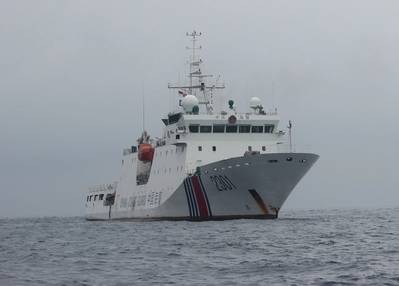
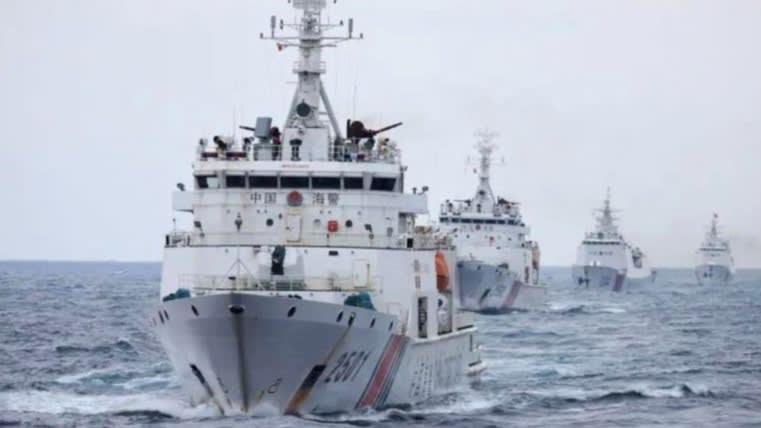
Looking at the China Coast Guard, What Has Xi Wrought?

Photo: William Colclough / U.S. Coast Guard

The photo above, which looks so much like a National Security Cutter, headed a Marine Link report “China Authorizes Coast Guard to Fire on Foreign Vessels if Needed.” It prompted me to look again at the Wikipedia entry for “Equipment of the China Coast Guard.”

According to Wikipedia, the China Coast Guard has very few aircraft, “a handful of Harbin Z-9 helicopters (their version of the Eurocopter AS365 which is very similar to the H-65–Chuck), and a maritime patrol aircraft based on the Harbin Y-12 transport.”

Their total number of personnel is only about a third that of the USCG.

But when you look at their fleet of large cutters, it is a very different story.

This Chinese coast guard ship is equipped with weapons believed to be 76-millimeter guns. © Kyodo

The China Coast Guard (CCG) has about three times the number of large cutters (1,000 tons or larger) as the USCG. They have well over 100, including at least 60 larger than the 270s. This, in spite of the fact that their EEZ, even including their “Nine Dash Lines” claims disputed by Taiwan and other nations is less than a fifth that of the US. Their internationally recognized EEZ is less than 8% of that of the US.

Virtually all these cutters were acquired in the last 15 years. While most CCG cutters are lightly armed, that is changing rapidly, with 76mm guns and 30mm Gatling guns becoming increasingly common. Many of the new cutters are built on the same hulls as PLAN frigates and corvettes.

“As of July 1, 2018, the China Coast Guard was transferred from civilian control of the State Council and the State Oceanic Administration, to the People’s Armed Police, ultimately placing it under the command of the Central Military Commission”

The CCG does not do buoy tending or icebreaking. Primary responsibility for SAR and maritime regulatory activities are invested in other agencies. There is a 25,000 member China Maritime Safety Administration, which has a few large cutters of its own, and a 10,000 member China Rescue and Salvage Bureau with its own cutters.

I think it is fair to say the China Coast Guard is much more focused on its para-military role than the US Coast Guard. Should China attempt to invade Taiwan, I feel sure the China Coast Guard will be transporting troops and providing naval gunfire support. They might even undertake small scale surprise landings own their own, perhaps in multiple locations simultaneously.

“The great lakes are freezing at a glacial pace” –CNN

Beset in ice, the M/V Stewart J. Cort and three other Great Lakes vessels await the assistance of an icebreaker on Lake Superior–not from this year.

The weather reported here will certainly have an effect on this year’s Great Lakes icebreaking requirements and may ultimately effect what seems to be the perpetual push for another Great Lakes icebreaker.

“…Great Lakes are currently dealing with record low ice. According to the Great Lakes Environmental Research Laboratory (GLERL), the Great Lakes total ice coverage right now is sitting at 3.9%. This same time last year, it was sitting at 11.3%, and the year before at 18.5%…”The Great Lakes region is experiencing warmer-than-usual weather, and the max ice cover is projected to be 30%, way below the average of 53%…”

“Ship Repair: Inside the $60m Refit of RV Roger Revelle” –Marine Link

Marine Link has a very interesting look into the mid-life renovation of the research vessel Roger Revelle.  This is a Coast Guard cutter sized ship (bigger and now more powerful than a 270), and the changes are extensive, reflecting lessons learned since the ship was built. Changes include installation of an integrated propulsion and ship’s service electricity generation system system and a novel repositioning of the sonar systems. Replacement of the bow thruster system not only reduced noise that was detrimental to the science missions, but also improved living conditions on the ship.

“The original ship contract value was for $35 million to take care of specific ship systems – propulsion, controls, HVAC, piping, ballast water management – and steelwork to extend the life of the ship another 15 years or more…But “we knew that other issues on the ship needed to be addressed, or the primary users of the vessel just wouldn’t be satisfied.” That’s where the upgrades to science systems came in, adding another $25 million to the project.”

“Coast Guard awards hull contract as part of MH-60T sustainment effort” –CG-9

Below is a news release from the Acquisitions Directorate, CG-9. This is how the Coast Guard intends to keep the H-60s going until the “Future Vertical Lift” aircraft arrive. Also looks like the H-60, which have already been with the Coast Guard for 30 years, could continue in service for another 30. 


The Coast Guard today awarded a contract to Sikorsky Aircraft Corporation of Stratford, Connecticut, for new H-60 helicopter hulls as part of a program to sustain existing MH-60T helicopter hulls reaching the end of their service life. The indefinite-delivery, indefinite-quantity contract extends through April 2025 and has a potential value of $850 million.

As part of the contract award, the Coast Guard placed an initial order for 25 new hulls. The initial order, with a total value of nearly $207 million, includes non-recurring engineering costs, which enables Sikorsky to produce the hulls in the Coast Guard MH-60T configuration. The first three hulls will be used for validation of Sikorsky’s production processes and Coast Guard hull assembly procedures before moving to full rate production of the next 22 hulls. Delivery of the first new hull is anticipated in early 2023, with subsequent hulls scheduled for delivery at approximately one per month starting in late 2023.

The Coast Guard’s H-60 helicopters have been in service since 1990, and the first helicopters in the fleet are set to reach their 20,000-hour service life limit in 2023. The new hulls being delivered under this contract will replace the hulls in the legacy airframes and provide an additional 20,000 flight hours of service. These new hulls, combined with existing programmed service life extension activities, will enable the Coast Guard to align operations with the timeline for future fleet recapitalization in conjunction with the Department of Defense’s joint Future Vertical Lift program. The service plans to complete the program on a one-for-one basis as the existing helicopters reach their maximum flight hours, thereby maintaining the fleet size of 45 helicopters.

Hull replacement is just one component of the MH-60T sustainment effort. In addition to hull replacement, replacement of select dynamic components, such as main rotor blades, as well as full replacement of electrical wire harnesses will take place. Aircraft production – assembly of the hulls, installation of dynamic components, and wire harness replacement – will be completed at the Coast Guard Aviation Logistics Center in Elizabeth City, North Carolina.

For more information: MH-60T Sustainment program page

“CONVOY ESCORT: THE NAVY’S FORGOTTEN (PURPOSE) MISSION” –War on the Rocks

An Allied convoy heads eastward across the Atlantic, bound for Casablanca, in November 1942. U.S. Navy (photo 80-G-474788), Post-Work: User:W.wolny – This media is available in the holdings of the National Archives and Records Administration, cataloged under the National Archives Identifier (NAID) 520948.

War on the Rocks has a post entitled, “Convoy Escort: The Navy’s Forgotten (Purpose) Mission

Since it has been a Coast Guard mission and may be again, it might be of interest.

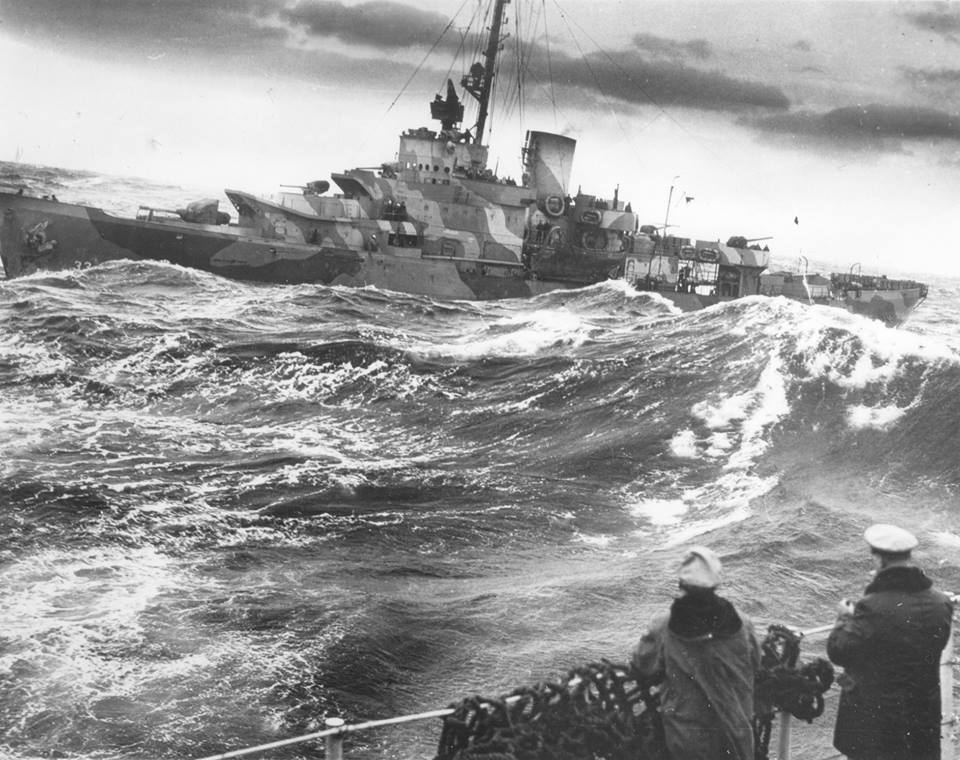
Contrary to the impression you may get, most of the North Atlantic convoy work during WWII was done by Great Britain’s Royal Navy and the Royal Canadian Navy. The US Navy played a relatively minor role until mid 1943.

USCGC Duane on North Atlantic Convoy Duty