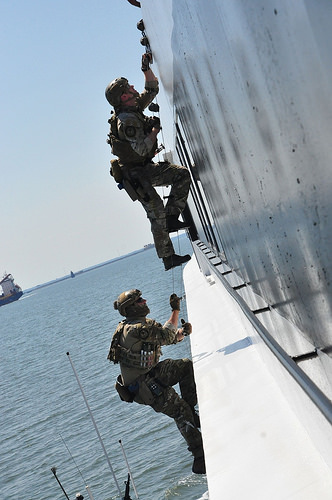
“The Pentagon isn’t the only one with special operators. Here are the 5 most elite forces outside the Defense Department” –Business Insider

Business Insider brings us a look at five “Special Operations” forces employed by non-DOD organizations.

  • FBI’s Hostage Rescue Team
  • Coast Guard’s Maritime Security Response Teams
  • DEA’s Special Response Teams
  • Dept. of Energy’s Special Response Teams
  • CIA’s Special Operations Group

What I noticed in the descriptions of these groups, is that the Coast Guard’s qualification process is the longest, “almost 18 months,” while the other four groups seem to rely heavily on recruiting former military special operations force members. DEA’s course is only two weeks in addition to prior training.

“Dutch Navy To Test Hull Vane Hydrofoil On HNLMS Zeeland OPV” –Naval News

HNLMS Zeeland (P841) Source: kees torn

Naval News reports that the Dutch Navy is going to install a Hull Vane device on the stern of a Holland Class Offshore Patrol Vessel, HNLMS Zeeland (P841), during its next major maintenance . This is a large offshore patrol vessel, almost as large as the Offshore Patrol Cutter or the Bertholf class NSCs. Perhaps significantly, like the NSCs, it has a stern ramp.

The Hull Vane is an 11-meter-wide hydrofoil installed below the stern of the ship. The biggest advantage is the 10% fuel saving it provides. With a reduced resistance, the ship can also achieve a higher top speed with the same engine power. In addition, the modification ensures a reduced wake and therefore fewer waves. This is tactically important, because the ship is less visible from the air.

In addition to the tactical and cost-saving advantages, there is also an operational gain: the Hull Vane means that the aft deck fluctuates less and the helicopter deck is more stable. This makes it easier for the helicopter to land. RHIB boats can also more easily embark and disembark on the slipway. Finally, the modification reduces slamming and therefore increases the comfort for passengers.

If this does half of what is claimed, it would be worth looking into. I’m sure the Dutch would be happy to share their results. We have talked about this innovation a number of times. Here in 2015 after initial studies and modeling. Here in 2017 after a conference presentation. Finally in 2018 after a French patrol vessel was fitted with the device. Results of that modification included a “comparison with the benchmark sea trials – conducted in January in exactly the same conditions – by CMN’s sea trial team showed a reduction in fuel consumption of 18% at 12 knots, 27% at 15 knots and 22% at 20 knots. The top speed increased from 19.7 knots to 21 knots.”

There is a lot of good information in these earlier post and the associated comments.

Hull Vane hydrofoil solution integrated on a Holland-class OPV model (Credit: Dutch Ministry of Defense)


Japan Coast Guard and JMSDF Planning to Use UAVs for Ocean Surveillance” –Naval News

Naval News reports on the Japan CG’s test the MQ-9B and background on the decision to pursue an unmanned solution to Maritime Domain Awareness.

“The JCG’s decision to consider the introduction of UAVs was prompted by the Japanese government’s decision in December 2016 to adopt a new policy for maritime security. The policy is designed to strengthen the functioning of the JCG in response to the recent activity of Chinese fishing and government vessels in the waters around Japan. Therefore, it was decided to consider the introduction of UAVs for the purpose of continuous monitoring of these foreign vessels, especially those operating within Japan’s vast Exclusive Economic Zone (EEZ).In fact, Japan’s territorial waters, plus its EEZ, are the sixth largest in the world, and it would be difficult to keep watch of such a vast area with manned aircraft and patrol vessels alone.”

Significantly, the Japan Coast Guard will be sharing information from their UAS with the Japanese Maritime Defense Force (their navy).

Seems the Japanese started much later on this than the USCG, but is now moving much faster.

Perhaps significantly the MQ-9B has a submarine detection capability using sono-buoys.


COVID strikes USCGC Stratton

USCGC Stratton moored in San Diego, California. Photo by BryanGoff

Below is a PacArea news release. 


united states coast guard

News Release

Nov. 18, 2020
U.S. Coast Guard Pacific Area
Contact: Coast Guard Pacific Area Public Affairs
D11-DG-M-PACAREA-PA@uscg.mil
Pacific Area online newsroom

Coast Guard cutter returns home after crewmembers test positive for COVID

ALAMEDA, Calif — The U.S. Coast Guard Cutter Stratton (WMSL-752) returned to its homeport Wednesday at Coast Guard Island in Alameda after 11 crew members tested positive for COVID-19 during the deployment. 

The affected crew members reported mild symptoms and are receiving medical care. 

The cutter was met by Coast Guard medical staff, who conducted testing of the entire crew.  Following testing, the crew went into quarantine.  The cutter will continue to meet all inport watchstanding requirements while at homeport. 

“The crew’s health and safety is my highest priority,” said Capt. Bob Little, Stratton’s commanding officer.  “Stratton has a highly resilient crew, always dedicated to the mission.  Our mission today is to get healthy so we can continue our service to the nation.”  

The Stratton departed Alameda Oct. 28 to begin a counter-narcotics patrol in the Eastern Pacific.  Prior to getting underway, the crew underwent a restriction-of-movement period where members were required to self-quarantine and pass two COVID tests.  

On Nov. 11 and Nov. 12, several crew members began to develop COVID symptoms and were administered rapid testing kits.  All affected personnel and close contacts were identified and quarantined.  

“The safety of our people and the public remain my top priority,” said Vice Adm. Linda Fagan, U.S. Coast Guard Pacific Area commander.  “We continue to perform all statutory missions while taking the necessary precautions to protect our members and the public. We are committed to maintaining our operational readiness and will continue to perform critical missions that protect our national interests, promote economic prosperity and ensure public safety.”

“GPS unreliability” –Maritime Reporter & Engineering News – November 2020

A short explanation of why we need to get on with providing a terrestrial alternative to the GPS system by Dennis L. Bryant, Capt. USCG (retired).

Reportedly GPS can be spoofed for as little as $300.

With the Coast Guard’s increasing use of drones that use GPS navigation, its not unlikely drug smugglers will start spoofing GPS. We should be ready to detect such efforts and perhaps home in on them. Maybe need an inertial navigation alternative on our UAVs? (Not really sure what we are using right now.)

“Military activity is picking up in the quiet waters between the US and Russia” and a Deep Water Port at Nome

Northeast Russia and Alaska are in close proximity and the U.S. Coast Guard will interact more and more as Russian maritime activity in the Arctic grows. Photo: Shutterstock

Business Insider gives us a post about the strategic importance of the Bering Sea and Aleutians. In addition, there is some news about the proposed “Arctic” deepwater port.

The US Army Corps of Engineers recently approved plans to expand the port of Nome, on Alaska’s Bering coast. That “will not only help from a national-security perspective but … help [local communities] to reduce the cost of living,” Alaska Sen. Lisa Murkowski said at another event in October.

CRS, “Coast Guard Cutter Procurement: Background and Issues for Congress Updated November 11, 2020”

It has been only four days since we last looked at this document, but Congressional Research Service’s Ronald O’Rourke has come out with another revision. (You can always find the latest edition in full here.) The latest revision added Senate action on the DHS Appropriations Act (H.R. 7669/S. XXXX). Unlike the House Appropriations Committee, the Senate Appropriations Committee would fund two rather than four Webber class FRCs (Providing $160M rather than $260M) and seems to close the door on the possibility of a twelfth Bertholf class NSC.

Table 2 (page 23) provides a Summary of Appropriations Action on FY2021 Procurement Funding Request. Figures are in millions of dollars, rounded to nearest tenth. HAC=House Appropriations Committee. SAC=Senate Appropriations Committee. No final action has been take as of publication. The table is reproduced below.

______________Request__HAC__SAC___Final
NSC program         31            31        31
OPC program      546           546      546
FRC program        20           260      160
TOTAL                 597           837      737

We are now eleven weeks into FY2021. The continuing resolution ran out 11 November. Hopefully we will see this move to final action soon.

I have reproduced the section regarding Senate Appropriations Committee action below. (From pages 23/24, there are some minor format changes.)


Senate

The Senate Appropriations Committee, in the explanatory statement for S. XXXX that the committee released on November 10, 2020, recommended the funding levels shown in the SAC column of Table 2.

The explanatory statement states (emphasis added):

Full-Funding Policy.—The Committee again directs an exception to the administration’s current acquisition policy that requires the Coast Guard to attain the total acquisition cost for a vessel, including long lead time materials [LLTM], production costs, and postproduction costs, before a production contract can be awarded. This policy has the potential to make shipbuilding less efficient, to force delayed obligation of production funds, and to require post-production funds far in advance of when they will be used. The Department should position itself to acquire vessels in the most efficient manner within the guidelines of strict governance measures. The Committee expects the administration to adopt a similar policy for the acquisition of the Offshore Patrol Cutter [OPC] and heavy polar icebreaker.

Domestic Content.—To the maximum extent practicable, the Coast Guard is directed to utilize components that are manufactured in the United States when contracting for new vessels. Such components include: auxiliary equipment, such as pumps for shipboard services; propulsion equipment, including engines, reduction gears, and propellers; shipboard cranes; and spreaders for shipboard cranes. (Pages 71-72)

The explanatory statement also states:

National Security Cutter [NSC].—The Committee is disappointed that the Coast Guard has not officially conveyed to the Committee a determination on whether a twelfth NSC is required; based on the lack of direct communication and the inclusion of a proposed rescission of funds provided in fiscal year 2020 in the budget request, the Committee infers that an additional vessel is not required at this time. While funding a twelfth NSC would undoubtedly allow the Coast Guard to better conduct its mission operations and likely result in the prevention of thousands of tons of contraband from reaching the United States, the Committee is not positioned to recommend funding for another vessel when faced with budgetary constraints and additional requests for vessel classes well short of the Coast Guard’s program of record. The Committee directs that the remainder of funding provided above the request in 2020 for this program shall support the NSC fleet.

Offshore Patrol Cutter [OPC].—The Committee notes that the Coast Guard has declared the OPC as its highest recapitalization priority and provides the requested amount of $546,000,000 to continue construction, procurement of LLTM, and related program management costs. While the Committee supports OPC procurements, the Committee remains concerned about costs for the program and continues the requirement directing the Coast Guard to brief the Committee within 1 week prior to taking any procurement actions impacting estimated costs for the OPC program.

Fast Response Cutter [FRC] Program.—In accordance with the Coast Guard’s  recapitalization plan, the Committee has supported the replacement of legacy 110-foot
Island Class patrol boats with FRCs that will operate similarly in the coastal zone. The
Committee is aware of the need for four additional FRCs to sustain the Coast Guard’s
critical mission in support of the Department of Defense in Patrol Forces Southwest Asia; however, the budget request did not include any funding for new FRCs. The Committee recommends an additional $140,000,000 for two additional FRCs and directs the Coast Guard to negotiate favorable pricing for each vessel. (Pages 72-73)

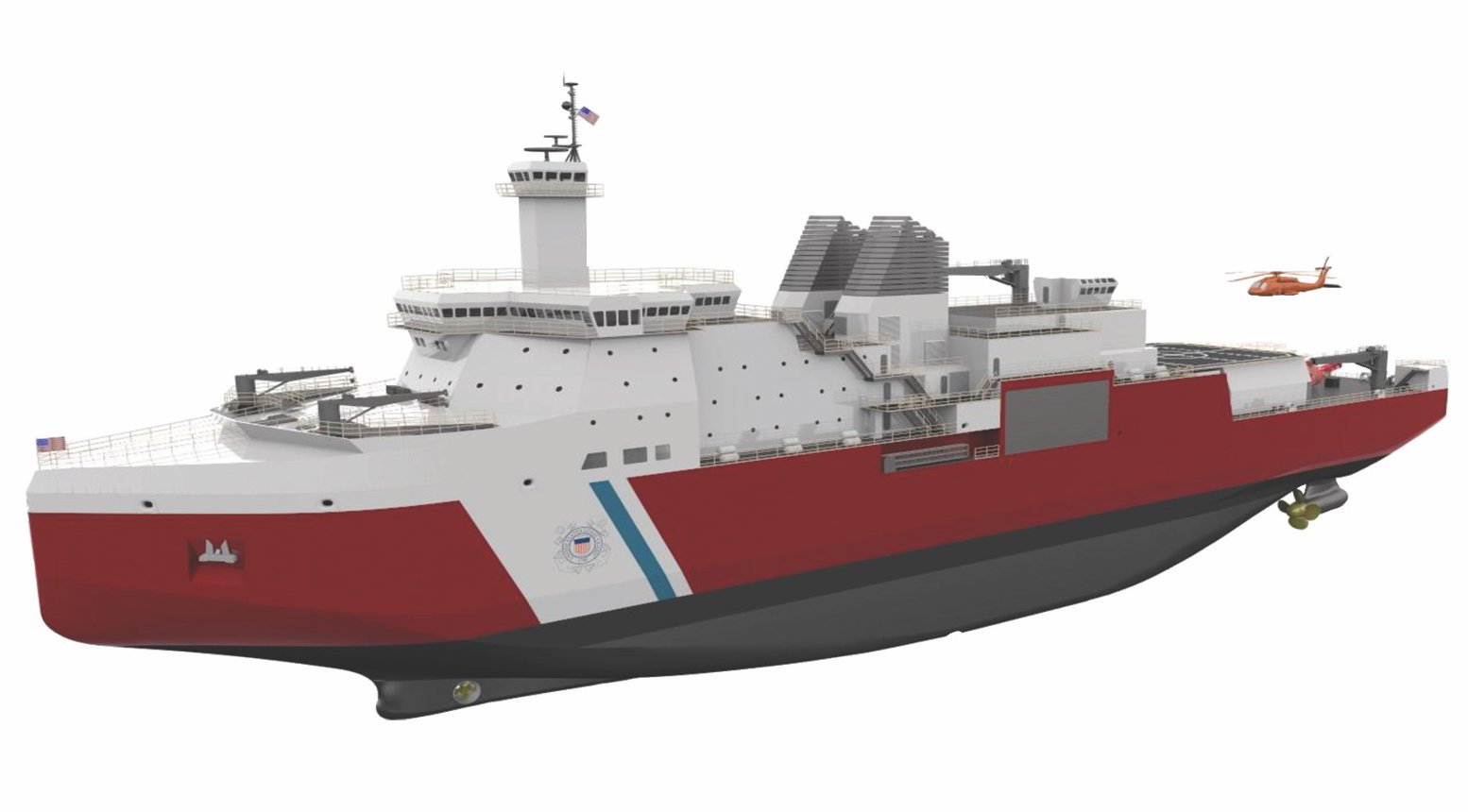
CRS, “Coast Guard Polar Security Cutter (Polar Icebreaker) Program: Background and Issues for Congress Updated November 11, 2020”

Since our last look at this report, there have been four updates. (See the latest version here.)

We now have the Senate Appropriations Committee’s (SAC) views on this part of the FY2021 DHS Appropriations Act. The Senate committee, like its counterpart in the House, has recommended approval of the Administration request for $555M that would fund the second Polar Security Cutter.

I have reproduced the section on Senate Activity (page 25/26) below. Note there is also mention of renovation of the Polar Star and acquisition of a future Great Lakes icebreaker as well:


Senate

The Senate Appropriations Committee, in the explanatory statement for S. XXXX that the committee released on November 10, 2020, recommended the funding level shown in the SAC column of Table 2.

The explanatory statement states (emphasis added):

Full-Funding Policy.—The Committee again directs an exception to the administration’s current acquisition policy that requires the Coast Guard to attain the total acquisition cost for a vessel, including long lead time materials [LLTM], production costs, and postproduction costs, before a production contract can be awarded. This policy has the potential to make shipbuilding less efficient, to force delayed obligation of production funds, and to require post-production funds far in advance of when they will be used. The Department should position itself to acquire vessels in the most efficient manner within the guidelines of strict governance measures. The Committee expects the administration to adopt a similar policy for the acquisition of the Offshore Patrol Cutter [OPC] and heavy polar icebreaker.

Domestic Content.—To the maximum extent practicable, the Coast Guard is directed to
utilize components that are manufactured in the United States when contracting for new
vessels. Such components include: auxiliary equipment, such as pumps for shipboard
services; propulsion equipment, including engines, reduction gears, and propellers;
shipboard cranes; and spreaders for shipboard cranes. (Pages 71-72)

The explanatory statement also states:

Great Lakes Icebreaking Capacity.—The recommendation includes $4,000,000 for preacquisition activities for the Great Lakes Icebreaker Program for a new Great Lakes
icebreaker that is as capable as USCGC MACKINAW. The Coast Guard shall seek
opportunities to accelerate the acquisition and request legislative remedies, if necessary. Further, any requirements analysis conducted by the Coast Guard regarding overall Great Lakes icebreaking requirements shall not assume any greater assistance rendered by Canadian icebreakers than was rendered during the past two ice seasons and shall include meeting the demands of United States commerce in all U.S. waters of the Great Lakes and their harbors and connecting channels. (Page 72)

The explanatory statement also states:

Polar Ice Breaking Vessel.—The Committee recognizes the value of heavy polar icebreakers in promoting the national security and economic interests of the United States in the Arctic and Antarctic regions and recommends $555,000,000, which is the requested amount. The total recommended for this program fully supports the Polar Security Cutter program of record and provides the resources that are required to continue this critical acquisition.
Polar Star.—The recommendation includes $15,000,000 to carry out a service life extension program for the POLAR STAR to extend its service life as the Coast Guard continues to modernize its icebreaking fleet. (Page 73)

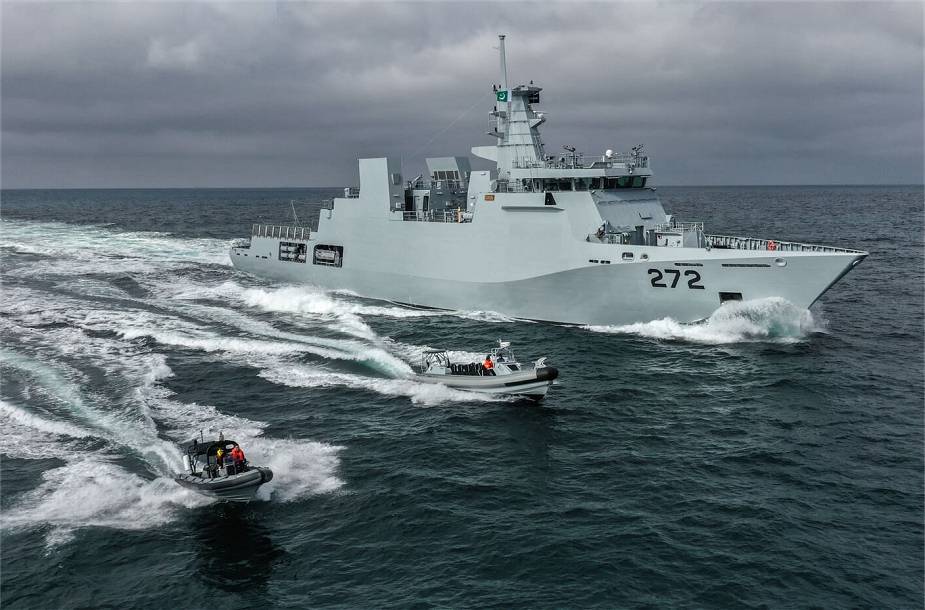
“Pakistan Navy commissioned its new PNS Tabuk Damen corvette OPV 1900” –Navy Recognition

PNS Tabuk during sea trials. (Picture source Damen)

NavyRecognition reports the commission of the second of two Damen designed offshore patrol vessels (OPV) built in Romania for the Pakistani Navy.

The Damen OPV 1900 has a hull-length of 90 m, a maximum speed of 22 knots, and a full-load displacement of 1,900 tons. The ship can launch two high-speed RHIBs of 11.5 meters and 6.5 meters simultaneously and also has the capability to accommodate two TEUs for special mission-based operations. The rear deck of the ship is able to transport both a helicopter and a UAV.

According to Janes, the ships are 2,300 tons (presumably full load), 91.3 meters (299.5′) in length, with a beam of 14.4 m (47.2′), a draft of 4 m (13.1′), and a complement of 138.

Below is a video shot on the first ship of the class. You can see that it also includes a hangar. Weapons and additional sensors are to be fitted in Pakistan. The video indicates the ship will be equipped with two 30mm cannon and anti-ship cruise missiles. The model, seen in the video at time 1m30s, shows the vessel equipped with what appears to be a single barrel mount similar to the Mk38 forward, but the mount on the aft starboard corner of the superstructure, looks like a Chinese Type 730 CIWS that includes a seven barrel Gatling gun. That weapon is currently in service with the Pakistani Navy. You would think the same weapon would be used in both positions, but the more sophisticated CIWS might not take kindly to the green water that is likely to come over the bow. The model also shows launchers for eight anti-ship cruise missiles, presumably of Chinese origin, like the C-802. The ships are also reportedly being given an ASW capability.