“MQ-9B SeaGuardian Maritime UAV: Which Missions ? Which Customers ?” –Naval News

MQ-9B Seaguardian during the maritime capabilities demonstration flight over Southern California waters in September 2020. GA-ASI picture.

NavalNews reports on the Maritime version of the Predator UAV, the MQ-9B Seaguardian, including its sensors and market success.

In addition to different sensors, this model is different from the MQ-9s that the Coast Guard has flown with Customs and Border Protection (CBP) in that they are intended to operate in civilian airspace. CBP has been operating MQ-9 UAVs for 15 years.

Congress seems not only willing to support Coast Guard operation of land based medium altitude long endurance (MALE) UAVs like the Seaguardian. They are actually pushing the Coast Guard. They can not seem to understand why we have not done it already.

In addition to the possibilities of use in the drug transit zones, these long range, long endurance aircraft could be especially useful in detecting IUU activity in the Western Pacific where there normally are no Coast Guard air assets.

“Court martial concludes following death of Coast Guard member in Alaska” –News Release

Just passing this along. No comments please.

united states coast guard

News Release

U.S. Coast Guard Pacific Area
Contact: Coast Guard Pacific Area Public Affairs
Sept. 18, 2020
(510) 816-1700
D11-DG-M-PACAREA-PA@uscg.mil
Pacific Area online newsroom

Court martial concludes following death of Coast Guard member in Alaska

ALAMEDA, Calif. — A general court martial concluded Thursday for a Coast Guard member accused of violating various articles under the Uniform Code of Military Justice related to the death of a Coast Guard member in Alaska in January 2019.

The court martial of Seaman Ethan Tucker, convened by the U.S. Coast Guard Pacific Area commander, commenced Sept. 8.  A military judge found Tucker not guilty of Article 119, involuntary manslaughter, and Article 134, negligent homicide. The judge found Tucker guilty of: one specification of Article 107, false official statement; one specification of Article 128, assault consummated by a battery; one specification of Article 92, violation of a general order for consuming alcohol underage; and one specification of Article 134 for doing or failing to do certain acts that contributed to a Coast Guard member’s death which was to the prejudice of good order and discipline in the Armed Forces. 

Tucker was sentenced to a bad conduct discharge, reduction to paygrade E-1, and 14 months confinement.

“Arktika Nuclear-Powered Icebreaker Completes Sea Trials” –Naval News

The lead nuclear icebreaker “Arktika”, project 22220 (LK-60Ya), built at Baltic Shipyard JSC (part of United Shipbuilding Corporation JSC) for Atomflot FSUE, is entering the first stage of sea trials. St. Petersburg, 12.12.2019 (c) JSC United Shipbuilding Corporation

Naval News reports that the world’s largest icebreaker, “Arkika,” has completed sea trials. This is the first of five Project 22220 nuclear powered icebreakers.

This class is quite remarked for its number of ships, their size, their speed, their power, and for their small crew size.

These are dual displacement icebreakers designed to operate in rivers as well as the Arctic Ocean, using huge amounts of ballast water.

Dimensions:

  • Displacement:33,530 t (33,000 long tons) (dwl) 25,540 t (25,140 long tons) (min)
  • Length: 173.3 m (569 ft) (overall), 160.0 m (525 ft) waterline
  • Beam: 34 m (112 ft) (maximum), 33 m (108 ft) waterline
  • Draft: 10.5 m (34 ft) (dwl) 8.65 m (28 ft) (minimum; operational)
  • Propulsion: three shafts, total 60 MW (80,461 HP)
  • Speed: 22 knots.
  • Crew: 75

Even larger Project 101510 ships, capable of breaking up to 4-metre-thick (13 ft) ice, are under construction. They will be 209 metres (686 ft) in length, with a beam of 47.7 metres (156 ft) with four shafts providing 120 megawatts (161,000 hp).

“RELEASE OF THE CG ILLEGAL, UNREPORTED, AND UNREGULATED FISHING STRATEGIC OUTLOOK” DCO

The Deputy Commandant for Operations (DCO) has released the “Illegal, Unreported, and Unregulated Fishing Strategic Outlook.” You can see the 40 page strategy document here. There is a short summary here.

The strategy promotes three “lines of effort.”

  • Promote Targeted, Effective, Intelligence-Driven Enforcement Operations.
  • Counter Predatory and Irresponsible State Behavior.
  • Expand Multilateral Fisheries Enforcement Cooperation.

A press release is quoted below. Make no mistake, this is a very big deal, and it is pointed directly at China’s predatory practices that are impoverishing coastal states dependent on fisheries.

united states coast guard

R 171209 SEP 20
FM COMDT COGARD WASHINGTON DC//DCO//
TO ALCOAST
UNCLAS //N16000//
ALCOAST 347/20
COMDTNOTE 16000
SUBJ:  RELEASE OF THE CG ILLEGAL, UNREPORTED, AND UNREGULATED FISHING STRATEGIC OUTLOOK
1. Today the Commandant promulgated the Coast Guard’s Illegal, Unreported,
and Unregulated (IUU) Fishing Strategic Outlook, which emphasizes IUU fishing as a
pervasive security threat to U.S. national interests. IUU fishing, if left unchecked,
will result in deterioration of fragile coastal States and increased tension among
foreign-fishing nations threatening geo-political stability around the world.
Tackling IUU fishing requires experienced, capable, and trusted leadership. The U.S.
Coast Guard is a well-respected global leader in maritime safety and security; able to
lead a unified force to cement positive change and promote enhanced maritime governance.
This Strategic Outlook outlines the Service’s vision to strengthen global maritime
security, regional stability, and economic prosperity with the following Lines of Effort:
   a. LOE 1 Promote Targeted, Effective, Intelligence-Driven Enforcement Operations.
The U.S. Coast Guard will lead global efforts to detect and deter IUU fishing on the high
seas and in the exclusive economic zones (EEZs) of partner nations. Through the innovative
use of intelligence, technology, data analysis, and information sharing, we will identify,
target, and interdict illicit actors in the maritime domain in order to disrupt corrupt
cycles of influence that enable illegal operations.
   b. LOE 2 Counter Predatory and Irresponsible State Behavior. The U.S. Coast Guard will
prioritize operations and engagement in areas where our efforts are most critical to
demonstrate U.S. commitment and model responsible behavior. The U.S. Coast Guard will
shine a light on the activities of those who violate international rules-based order,
exposing and holding accountable the most egregious predatory actors.
   c. LOE 3 Expand Multilateral Fisheries Enforcement Cooperation. The U.S. Coast Guard
will build and maintain lasting cooperation with key partners to empower regional resource
conservation and management. Working with U.S. and international partners, the U.S. Coast
Guard will assist at-risk coastal States and like-minded nations to develop and maintain
their own robust counter-IUU fishing capacity, bolstering their governance and enforcement
systems and affirming the United States as a preferred partner. Through targeted, persistent,
and collaborative efforts, we will sustain and strengthen connections with partner nations
supporting international oceans governance.
2. Each line of effort depends on Unity of Effort, Partnership, Investment in the Future,
and Innovation to succeed.
3. Under this IUU Fishing Strategic Outlook, the U.S. Coast Guard will apply our broad
authorities, capabilities, capacities, and partnerships to be a global leader in the fight
against IUU fishing. Working with partners in the National Oceanic and Atmospheric
Administration (NOAA), the Department of State (DOS), the Department of Defense (DOD),
and others, the U.S. Coast Guard will uphold a whole-of-government effort to advance
national interests in the maritime domain and promote economic prosperity. Through enhanced
engagement with like-minded nations and key maritime stakeholders, the U.S. Coast Guard
is ready to spearhead the global fight against IUU fishing.
4. More information and copies of the strategy can be found at: www.uscg.mil/iuufishing/.
5. POCs: CDR James Binniker at (202) 372-2187 or James.A.Binniker@uscg.mil.
6. VADM Scott A. Buschman, Deputy Commandant for Operations, sends.
7. Internet release is authorized.


“When COVID-19 sidelined 18 members of a Coast Guard cutter crew, cadets stepped in” –Task and Purpose

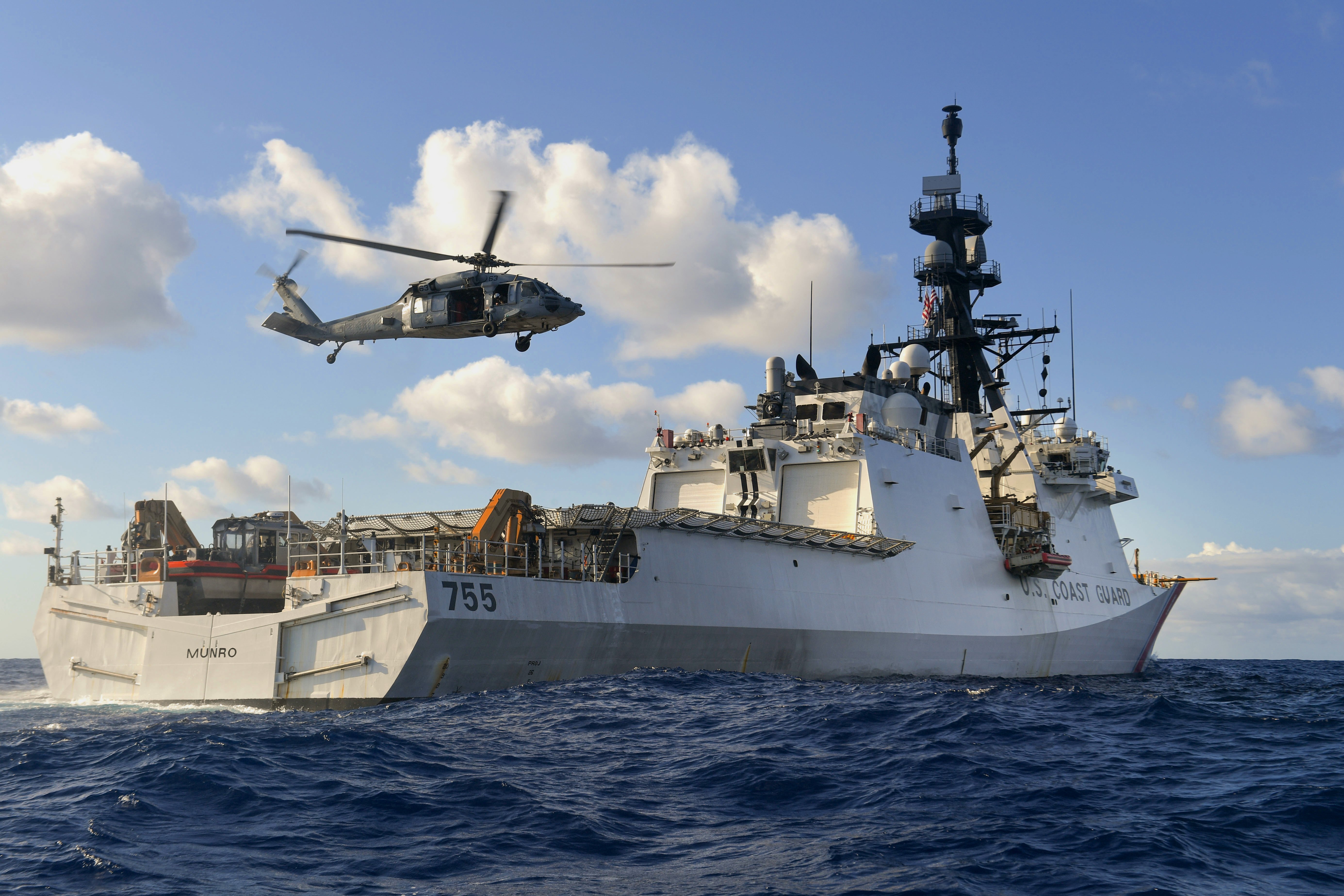
An MH-60S Knight Hawk Helicopter assigned to Helicopter Sea Combat Squadron (HSC) 21 conducts ‘touch and go’ drills aboard U.S. Coast Guard Legend-class cutter USCGC Munro (WMSL-755) during exercise Rim of the Pacific (RIMPAC) 2020 on Aug. 25, 2020. US Navy Photo

Task and Purpose reports on an unexpected summer cruise for CG Academy third class brought on when USCGC Munro crewmembers came down with COVID19. A little ALPAT and RIMPC 2020.

IUU Enforcement

As if to prove the new emphasis on IUU is not just a paper exercise, we have a report of a National Security Cutter and a C-130 involved in a multi-national fisheries enforcement operation in the Western Pacific.

united states coast guard

News Release

U.S. Coast Guard 14th District Hawaii and the Pacific
Contact: 14th District Public Affairs
Office: (808) 535-3230
After Hours: HawaiiPacific@uscg.mil
14th District online newsroom

Coast Guard cutter returns to Hawaii after completing multi-country operation targeting illegal fishing in the South Pacific Ocean

Coast Guard Cutter Kimball and Air Station Barbers Point HC-130

Editors’ Note: Click on images to download a high-resolution version.

HONOLULU — The Coast Guard Cutter Kimball (WMSL 756) returned to Honolulu Sunday following its nearly two month patrol supporting the multi-country maritime Operation Nasse throughout Oceania.

Operation Nasse is an annual Pacific Quadrilateral Defense Coordination Group operation consisting of assets from the United States, Australia, France, New Zealand, and Pacific Island Forum Fisheries Agency which completed August 23.

“This is the first time the Coast Guard has sent a surface asset to participate during the Pacific Quadrilateral Defense Coordination Group’s operation,” said Lt. j.g. Joseph Fox, an assistant combat systems officer aboard the Kimball. “Service members from the Coast Guard Cutter Kimball and an Air Station Barbers Point HC-130 aircrew conducted joint missions with their multi-national counterparts to achieve the common goal of preventing illegal, unreported, and unregulated fishing in the Pacific.”

The purpose of this year’s operation was to investigate the effect COVID-19 had on fishing activities on the high seas and to identify fishing vessels not complying with the Western and Central Pacific Fisheries Commission (WCPFC) conditions. Illegal, unregulated or unreported (IUU) fishing undermines a nation’s sovereignty, threatens its economic security, and weakens global rules-based order.

Each participating country provided assets to support the operation including flights by RNZAF P3K Orions based out of Auckland, Australian Maritime Border Command Dash 8s based out of Brisbane, and French Guardians from Noumea.

The partner’s cooperation provided a significant reach in surveillance which allowed the French patrol boat “La Glorieuse” and the Kimball to hone in on specific vessels identified as possibly being of interest to confirm their activities were within regulations.

Air and sea surveillance, and maritime intelligence sharing provided an opportunity for the participants to work collaboratively to detect, deter, suppress, and report potential IUU fishing activity.

In addition to Operation Nasse, the crew of the Kimball also conducted a high seas patrol off American Samoa and Fiji.

Working closely with their Fijian counterparts, the crew supported U.S.-Fiji bilateral agreements and enforced partner nations respective Exclusive Economic Zones while promoting legal, sustainable fisheries.

In the Pacific, annual Tuna catch is estimated at over $5 billion and provides a significant percentage of the income of many of the South Pacific Nations. Ensuring that vessels operating on the high seas are complying with WCPFC regulations to protect fish stocks and other marine life resulting in these valuable resources remaining sustainable for future generations.

All asset crews were working to national rules regarding COVID-19 which were implemented to keep all personnel as safe as possible while still being able to achieve many of the operational goals.

Coast Guard IUU Strategy to be Published

Chinese fishing vessel fleet (Photo: The Maritime Executive)

The Coast Guard is coming out with its first ever strategy to counter Illegal, Unreported, Unregulated (IUU) fishing. The Commandant talks about it in a US Naval Institute Podcast.

The Commandant makes it clear the Coast Guard is not going to become the World’s fish cops. Apparently the Coast Guard will look to increased intelligence and information exchange, enforcement modeling/training/capacity building, and working with NGO. There was a suggestion, we might have some law enforcement “fish dets.”

Interestingly one remark was, “We don’t know what we don’t know.” That sounds like the first order of business.

IUU has been a problem in South East Asia and off the East and West coasts of Africa. Increasingly it is becoming serious problem for Latin America.  For a recent example, CIMSEC just published a piece regarding Chile’s response to IUU, “ILLEGAL FISHING IN THE SOUTH PACIFIC: WHAT CAN THE CHILEAN NAVY DO?”

The Commandant kept referring to the recent operation of Bertholf in support of Ecuadorian enforcement efforts. We discussed this earlier here.

This is a serious world wide problem. The US Coast Guard is going to see what they can do.

When the strategy is published, I will provide a link.

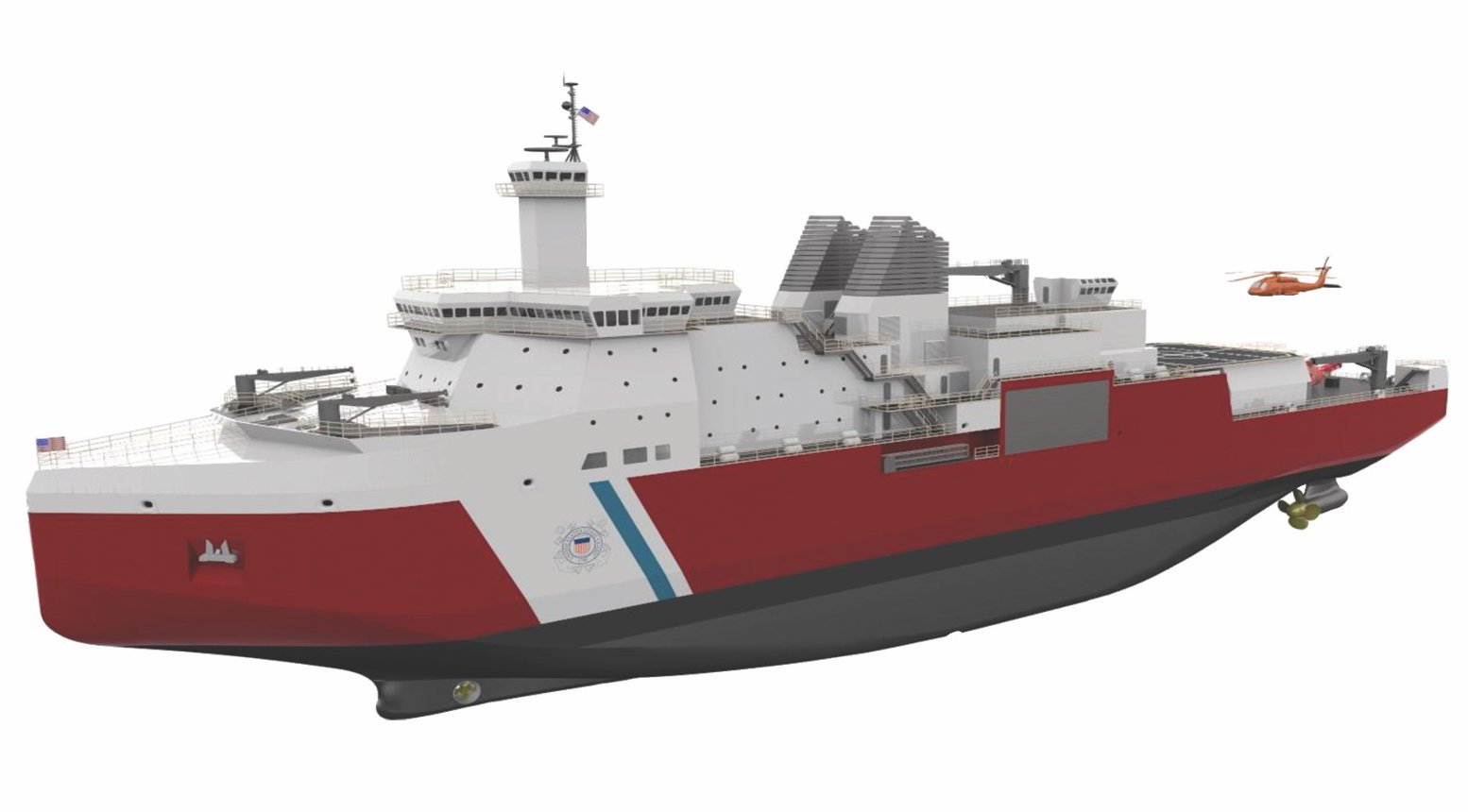
Polar Security Cutters and Coast Guard ASW

The US Naval Institute Proceedings web page has a couple of Coast Guard related articles that did not appear in the print version of Proceedings,

I have reproduced my comments on these topics below.


In regard to arming the Polar Security Cutters (the author seemed fixated on cruise missiles. We did discuss this topic earlier here)

There are limits to what we want to put on ships bound for Antarctica, since they have to be open for inspection. On the other hand if we ever do have a near peer conflict involving the Arctic or Antarctic, these will become rare and essential naval auxiliaries. As such they will probably operate with other vessels, including more powerful warships if appropriate, but that does not mean they should not be able to defend themselves against the possibility of leakers. We need to make provision for last ditch defense with systems like SeaRAM.

Meanwhile the fact that they are law enforcement vessels means they should be able to forcibly stop any private or merchant vessel regardless of size. So far it seems they will have at most, 25mm Mk38 Mod3 guns.

The follow on Medium Icebreakers or Arctic Security Cutters, which are unlikely to go to Antarctica, are more likely to be more heavily armed from the start.


Coast Guard ASW (comments were generally surprisingly adverse):

It is a fact that in WWII most U-boats were sunk by aircraft, but about a third (about 230) were sunk by surface vessels, primarily those of our allies Britain and Canada.

Even when surface vessels did not sink U-boats, they often performed valuable service in blocking access to convoys and in rescuing mariners from sunken ships.

US Naval vessels only sank about 38 U-boats. Coast Guard cutters and Coast Guard manned Navy ships were involved in sinking a disproportionate number of those (ten) for various reasons. Most of the US Navy effort went into the Pacific and most of the USN effort in the Atlantic at least through mid-1943, was in escorting high speed troop convoys than largely avoided contact with U-boats.

Circumstances we will face in any near peer conflict may be very different.

The advantages provided by code breaking in WWII are unlikely.

The advantages provided by radar equipped aircraft detecting U-boats charging their batteries or transiting the Bay of Biscay on the surface during the night no longer exists.

The Chinese surface and air threat would divert the most capable USN assets from ASW tasks.

Unlike the Japanese during the Pacific campaign, the Chinese are likely to make a concerted effort to disrupt our logistics train.

We simply do not have enough ASW assets.

Augmenting Coast Guard cutters to allow them to provide ASW escort and rescue services for ships that are sunk by hostile subs, in lower threat areas, is a low cost mobilization option that can substantially increase the number of escorts at low cost.

This could be facilitated by augmenting cutter with USN Reserves. Navy reserve ASW helicopter squadrons could be assigned to fly from cutters.
LCS ASW modules could be placed on cutters and manned by reactivated Navy reservists with LCS ASW module experience.

Our few US merchant ships need to be protected and when inevitably, some are sunk, we need someone to rescue those mariners, because they have become a rare and precious commodity.
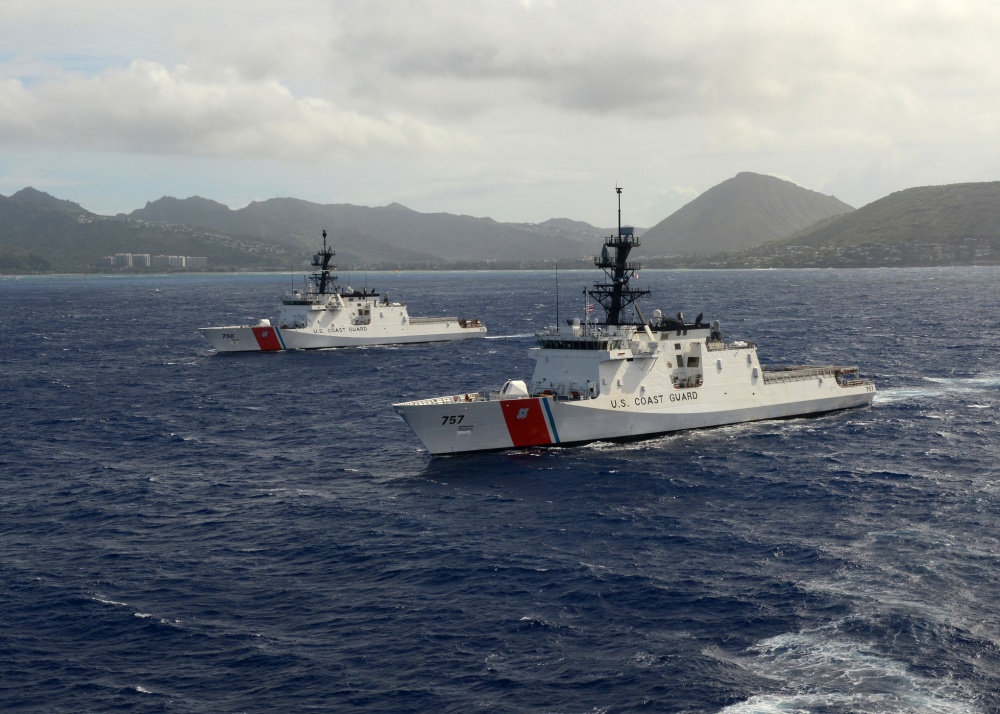
The crews of the Coast Guard Cutters Midgett (WMSL 757) and Kimball (WMSL 756) transit past Koko Head on Oahu, Hawaii, Aug. 16, 2019. The Kimball and Midgett are both homeported in Honolulu and two of the newest Coast Guard cutters to join the fleet. (U.S. Coast Guard photo by Petty Officer 3rd Class Matthew West/Released)


In answer to this comment from James M

Add : For (millions)

ASIST : 6.263
Mk 32 SVTT : 3.237
SLQ-25 Nixie: 1.727
AN/SRQ-4 LAMPS III: 4.625
VDS/MFTA combo: 14.802
ASW Combat Suite: 33.684
64.338 total. I am sure something could be arrived at for less. I look at this as what it takes to fit out an NSC the whole way. For one, OPC will never fit that VDS/MFTA on its stern. At best it would be a Nixie, maybe a container towed sonar we don’t yet use, and the mods for MH-60R. It would be good to know the plan for MUSV as it might help the equation. After all, the 64.338 would buy 2 MUSVs without payload. It could also buy an additional FRC.

So, we could equip ASW equip all eleven projected Bertholf class National Security Cutters (NSC) for less than the cost of a single frigate.

Why do you believe the VDS/MFTA would not fit on the Offshore Patrol Cutter? It is fully as large as the NSCs and does not have the boat launch ramp cut into the stern. They are also substantially larger than the LCSs.

OPC “Placemat”