1846 Secretary of Treasury Walker assigned Revenue Captain John A. Webster to control movements of vessels assigned to Army and to cooperate with the Navy in the War with Mexico.
U.S.R.C. Gresham, flagship of the patrol fleet, America’s Cup races, 1901, Library of Congress.
1896 Congress authorized the Secretary of Treasury to patrol regattas.
U.S.R.C. Onondaga, America’s Cup races, 1901. Library of Congress.
1921 Congress passed the “Emergency Immigration Act of 1921” (ch. 8, 42 Stat. 5), a quota law that limited the number of migrants in any year to three percent of the number of residents from that country already residing in the U.S. as of 1910.
Future USCGC Argus at launch Eastern Shipyard, Oct 27, 2023.
It has been almost 19 months since the future USCGC Argus was launched and more than five years since the keel was laid, but still have no news about progress on the ship. It is in the water but no reports of sea trials, no videos of the ship underway. This is not normal!
Not only that, but no news on any of the other three ships contracted to Eastern. The most recent public report is that Eastern started cutting steel for the fourth OPC on October 18, 2022. Chase was supposed to be a year behind Argus, but no indication when it will be launched. Eastern’s own web site “LATEST OPC NEWS STORIES” lists only a story about the launch and christening of Argus.
Concerns with the Offshore Patrol Cutter Program remain as we prepare for the lead ship to be delivered at the end of this year — four years late, and with a host of non-compliant parts. In addition, new problems have developed with the last hulls in the National Security Cutter Program, and we could receive one ship less than what Congress appropriated.
Hopefully the remark, “we could receive one ship less than what Congress appropriated” refers to the 12th NSC rather than the 11th.
I have more confidence in the capabilities of Austal. They successfully completed large contracts for Independence class Littoral Combat Ships and Expeditionary Fast Transports and the Navy has given them a contract for five Navajo class Towing, Salvage, and Rescue (T-ATS) ships.
From Austal’s website,
“Through continual capital investments, over $500 million to date, Austal USA has expanded its capability and capacity to enable concurrent production of aluminum and steel ships. The company recently broke ground on a new assembly building which will provide 192,000 square feet of new covered manufacturing space. The building will consist of three bays, two of which will be sized specifically to erect the OPC.”
These delays and uncertainties only reinforce my opinion that we need to seek an alternative to replace at least some of the planned 25 OPCs.
The world has changed substantially since the requirements for OPCs were formulated about 12 years ago.
We need more than the 36 large patrol cutters currently planned. We have not had so few since before World War II, until very recently. Meanwhile, demand for Coast Guard presence has been increasing. The FRCs have taken on missions that used to be performed by medium endurance cutters but they do have limited endurance and seakeeping.
Because some time in their, probably 40 year, life new cutters, missions will change and there is a good chance the US will be engaged in a major war, the design of our ships needs to flexible enough to take on additional missions and incorporate additional weapon systems. OPCs and NSC don’t have mission bays or container space that might allow greater flexibility. They don’t seem to be designed to take on any particular wartime missions. The low speed of the OPCs will limit their tactical utility.
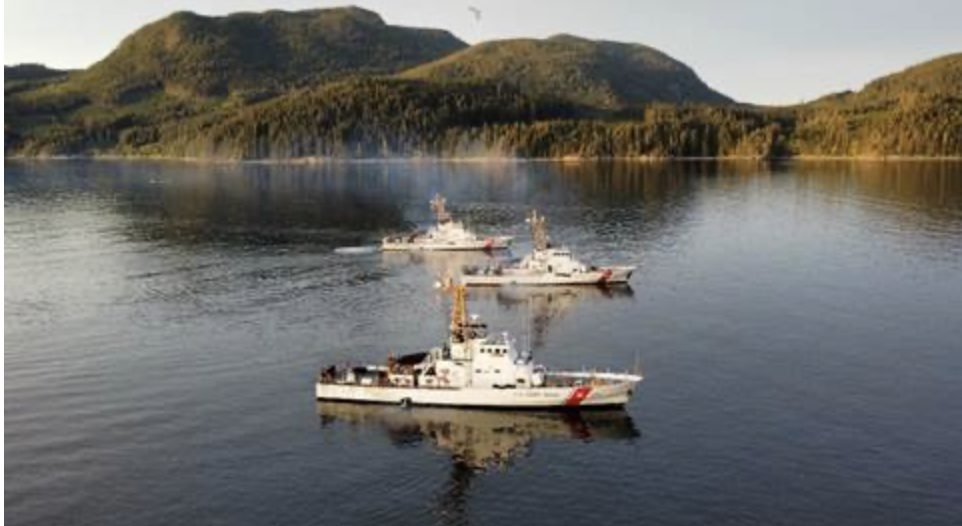
U.S. Coast Guard Cutters Naushon (WPB 1311), Mustang (WPB 1310), Liberty (WPB 1334) transit through Seymour Narrows in British Columbia, Canada, May 2025. Through the Excess Defense Articles program, these boats will find a second life with the Colombian navy. (U.S. Coast Guard photo courtesy of USCGC Mustang)
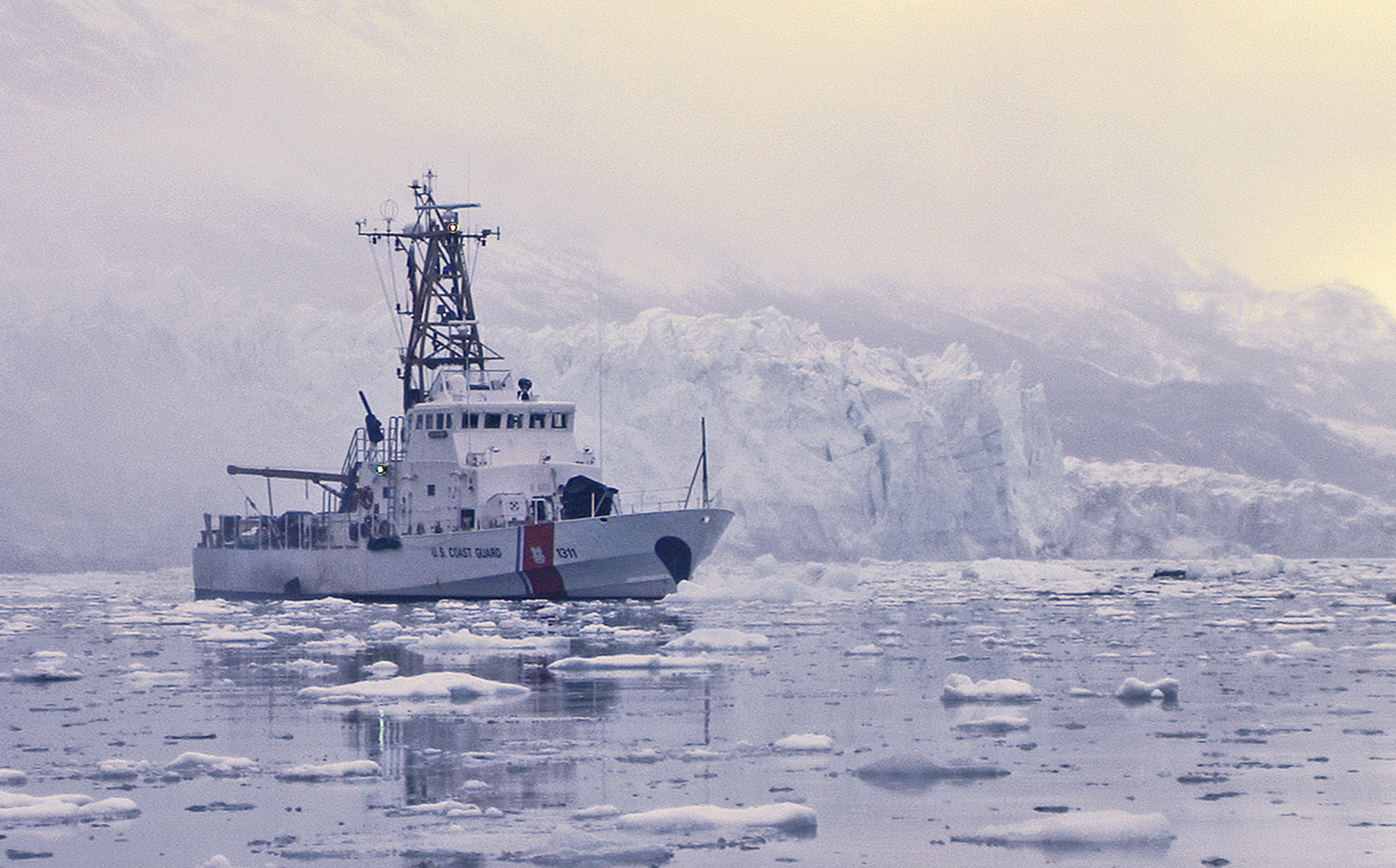
USCGC Naushon (WPB 1311) conducts a familiarization patrol in Glacier Bay, Alaska, Oct. 21, 2008. Patrols like this one demonstrate the Coast Guard’s dedication to ports, waterways and coastal security, regardless of the wind, water or seas. This photo won second place in the 2009 Coast Guard Photo Contest. (U.S. Coast Guard photo by Petty Officer 3rd Class Logan Wright)
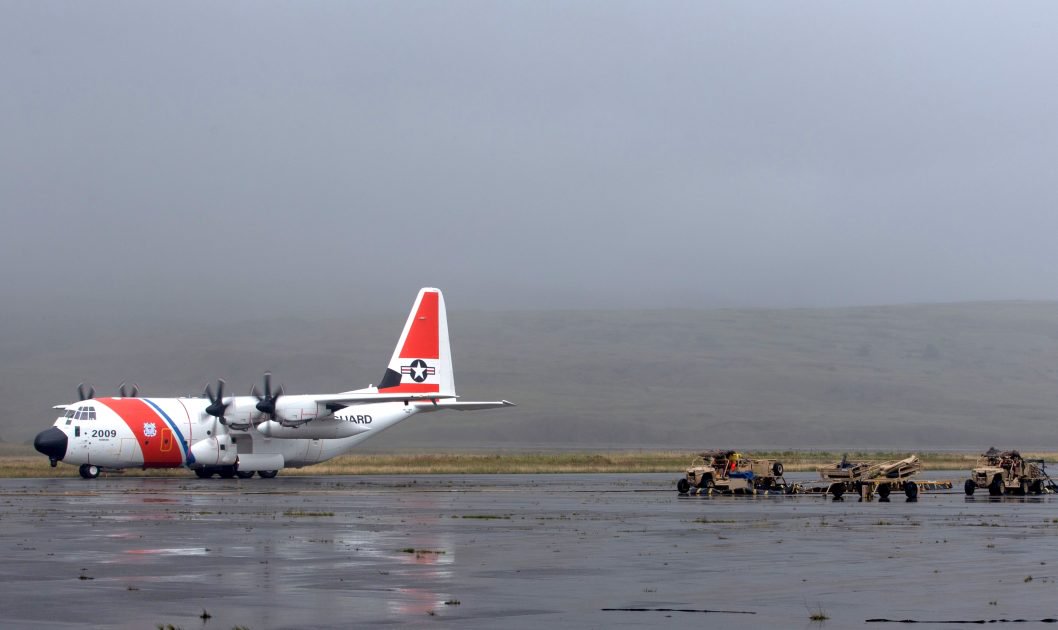
A U.S. Coast Guard C-130 participates in forward arming and refueling point (FARP) operations during Arctic Expeditionary Capabilities Exercise (AECE) in Adak, Alaska on Sept. 18, 2019. US Marine Corps Photo
I am seeing strong indications that DOD may reopen the former US Naval Air Station Adak.
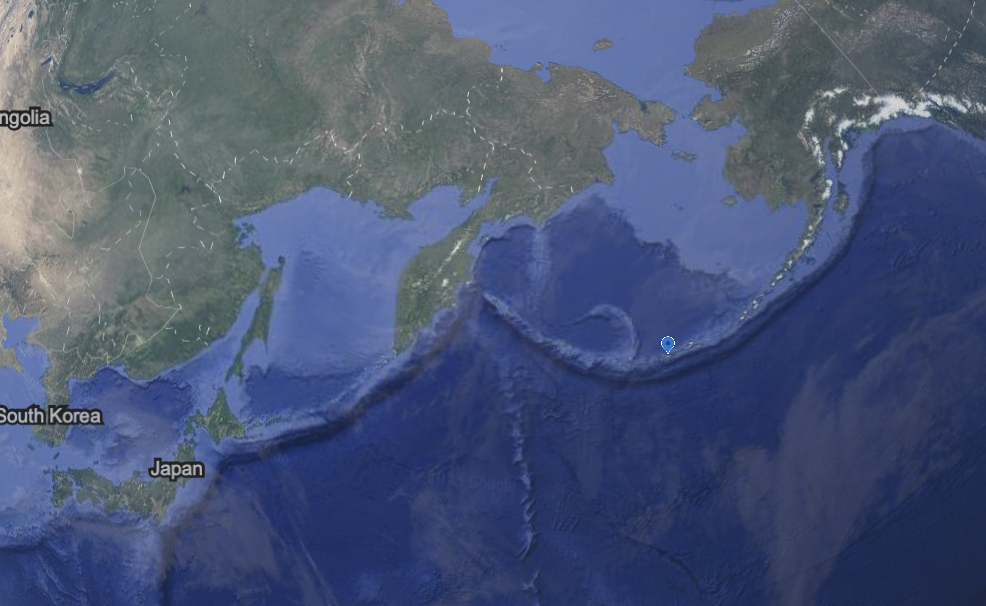
Adak, one of the Aleutian Islands, approximately 877 nautical miles South of the Bering Strait. About 901 nmi from Kodiak, about 2075 imi from Vladivostok.
Why do we care?
For the Coast Guard, it is a potential forward operating base for fixed wing aircraft monitoring fishing in the Bering Sea, and a fueling/replenishment stop for cutters on Alaska Patrol.
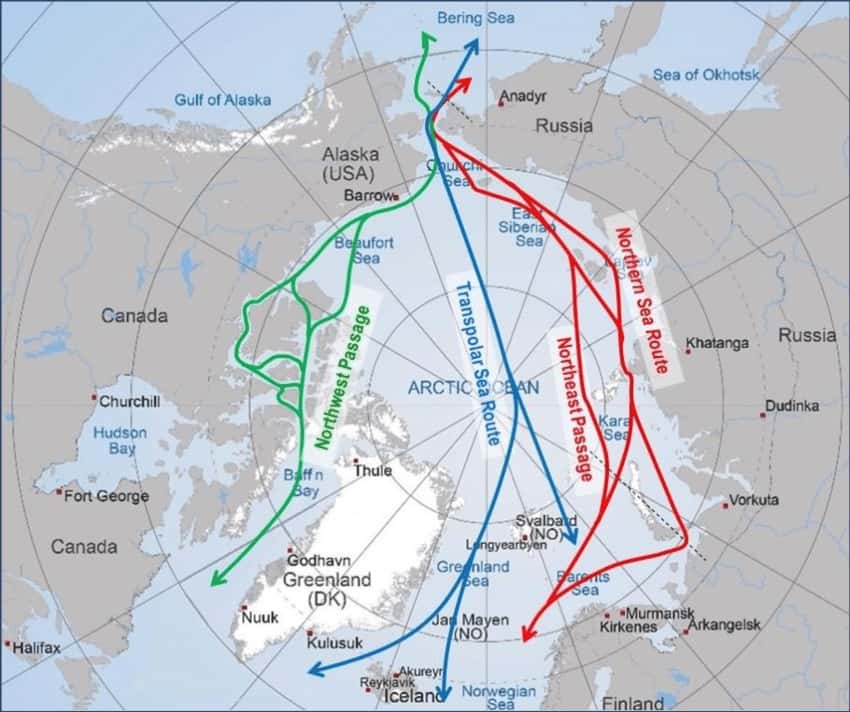
For Defense it puts assets in place to protect allied shipping and movements between the US and Asia and to prevent the passage of potentially enemy shipping and movements between the Russian Arctic and China, North Korea, and Russia ports in Asia via the Northern Sea Route and the Bering Strait.
The Coast Guard and DHS should add their voices in support of the idea.
Ports along the Northern Sea Route have seen a quadrupling of cargo since 2003 from 26.4 million tons in 2003 to 104.8 million tons by 2019 (if slipping to 96 million tons last year (2020) due to Corona). They now handle as much cargo every year as the entire Baltics, which have stagnated for more than a decade.
1846 Eleven cutters were assigned to cooperate with Army and Navy in the Mexican War. Cutters McLane, Legare,Woodbury, Ewing, Forward, and Van Buren were assigned to the Army. Cutters Wolcott, Bibb, Morris, and Polk were assigned to the Navy.
1888 Secretary of Treasury was authorized to establish anchorage grounds New York Harbor, adopt suitable rules, and “take all necessary measures” for their enforcement.
1963 The Honorable Douglas Dillon, Secretary of the Treasury, at a ceremony at Cape May Receiving Center, awarded Life-Saving Medals to three enlisted men of the Coast Guard in recognition of their heroic action and performance of duty at the risk of their own lives. Boatswain’s Mate First Class John C. Webb, coxswain of CG-36455 was awarded the Gold Life-Saving Medal and his crewmen, Engineman Third Class Anthony D. Lloyd and Seaman Ray Dwayne Duerre were each awarded a Silver Life-Saving Medal. The awards were based on their rescue of three persons from a stranded pleasure craft disabled approximately two miles northwest of Cape Alava, Washington, on June 1, 1962.
May 17
1999 The Coast Guard “kept the peace” when the Makah Indian tribe hunted and killed a gray whale in Neah Bay, Washington. The Makah were guaranteed the right to hunt whales in their 1855 treaty with the U.S.
May 18
1920 Coast Guard officers and enlisted personnel were granted the same pay, allowances and increases as the Navy.
1820 Congress declared the foreign slave trade to be piracy and instituted the death penalty for any U.S. citizen engaged in the slave trade.
USRC Naugatuck/aka E. A. Stevens (1862) Photo #: NH 58871 Line engraving published in Harper’s Weekly, circa spring 1862, when the gunboat was operating in the Hampton Roads area, Virginia. U.S. Naval Historical Center Photograph. http://www.history.navy.mil/photos/sh-usn/usnsh-n/naugatck.htm
1862 Semi-submersible ironclad USRC Naugatuck participated in bombardment of Drewry’s Bluff (James River) after accompanying USS Monitor in its engagement with CSS Virginia and engaging in an attack on Sewell’s Point. USRC Naugatuck would continue in service until 1889.
US Coast Guard Academy, New London, CT. Hamilton Hall center foreground.
1931 Treasury Secretary Andrew W. Mellon laid the cornerstone of Hamilton Hall, the first building under construction at the “new” Coast Guard Academy in New London, Connecticut.
The Cunard-White Star limited liner RMS Olympic, sister to the Titanic, passes very close aboard to the LV-117 on the Nantucket station in early January 1934. The light ship had been rammed already once that year in the fog, and the following May the Olympic actually collided with LV-117 and sent it to the bottom in seconds. Four crewmen went down with the ship while the Olympic rescued the remaining seven crewmen. Three of these men died later from injuries and exposure. The British Government paid for the construction of LV 112 as reparation for the accident. ref: US coast Guard
1934 The White Star Line passenger vessel RMS Olympic, in a dense fog, rammed and sank the lightship LV-117 on the Nantucket Shoals station. Olympic, which had been homing in on the lightship’s radio beacon very accurately, failed to steer clear in time. Seven of the lightship’s 11 crewmen were killed. The White Star Line agreed to fund a new lightship.
USS Forsyth (PF-102) Tacoma Class frigate. As a weather ship, she would have had the after 3″ gun replaced by a balloon shelter.
1945 On 12 May, the Coast Guard-manned frigate USS Forsyth (PF-102) was called off her weather station to search through haze and fog for a German submarine that was attempting to surrender. Three days later Forsyth joined Sutton (DE-771) in accepting the surrender of U-234 at 46º 39′ N. x 45º 39′ W. This submarine was carrying a German technical mission and supplies, including a cargo of uranium, to Tokyo. Earlier, two Japanese passengers on board committed suicide rather than surrender.
USS/USCGC Bangor (PF-16/WPF-16) Photographed in 1945-1946, while configured as a weather reporting ship with a balloon hangar aft. Courtesy of Donald M. McPherson, 1974. U.S. Navy photo NH 78996. USS Forsyth would have looked like this at the time.
USCGC Modoc
1975 USCGC Modocseized the Polish fishing vessel Kalmar 10 miles off Monterey, California, for fishing inside the 12-mile limit and escorted her to San Francisco.
USCGC Gallatin WHEC -721 (378), USCGC Rockaway WHEC-377 (311), and USCGC Spencer WHEC-36 (327) moored at Governor’s Island
1996 The Coast Guard formally closed Governors Island. The Army left the base in the early 1960s and the Coast Guard took it over on June 3, 1966 as a way to consolidate its operations in the New York Area. At the height of Coast Guard involvement on the island over 4,600 people lived and worked there.
Governors Island U.S. General Services Administration map; indicates U.S. Coast Guard usage, 1995
1997 Coast Guard Auxiliarist Frank Mauro, while assigned to Coast Guard UTB 41351, rescued nine victims who had been forced into the water after the strong current crushed their boat. He was awarded the Gold Lifesaving Medal for his heroic actions.
Naval News has an interesting post which includes the Video above. While the primary focus is on Singapore’s new class of “Multi-Role Combat Vessel,” there is also discussion about two classes of vessels that might provide inspiration for future cutter designs, Singapore’s “Littoral Mission Vessel” and Finland’s ice capable corvette. and how carbon fiber is used in these ships.
Singapore has been very successful in efforts to reduce manning requirements, and their contractor SAAB is a leader in carbon fiber structures.
1908 An Act of Congress (35 Stat. L., 160, 162) delegated to the Lighthouse Board the duty of caring for and maintaining the anchorage buoys previously placed by the United States in the harbors of New York and Philadelphia.
The United States Navy flagship USS Valcour (AGF-1) shown in her final configuration, in a photograph released in November 1972. It may look familiar to Coast Guard old timers like myself since she was a member of the Barnegat class. In the 50s and most of the 60s, the Coast Guard had 18 ships of this class. The last, USCGC Unimak was not decommissioned until 1988.
1951USS Valcourwas rammed by the collier Thomas Tracy. CGC Cherokee responded and assisted in extinguishing the resulting fires and towed the Valcour to Norfolk. Thirty-seven Navy sailors perished.
On the morning of 14 May 1951, two months after she returned to Norfolk from her second Middle East tour, Valcour headed out to sea for independent ship exercises. While passing the collier SS Thomas Tracy off Cape Henry, Virginia, she suffered a steering casualty and power failure. As she veered sharply across the path of the oncoming collier, Valcour sounded warning signals. Thomas Tracy attempted to make an emergency turn to starboard but her bow soon plowed into Valcour‘s starboard side, rupturing an aviation gasoline fuel tank. An intense fire soon broke out aboard Valcour and, fed by the high-test aviation gasoline, spread rapidly. To make matters worse, water began flooding into Valcour‘s ruptured hull. Although fire and rescue parties on board Valcour went to work immediately, the gasoline-fed inferno forced many of Valcour‘s crew to leap overboard into the swirling currents of Hampton Roads to escape the flames that soon enveloped Valcour‘s starboard side. The situation at that point looked so severe that Valcour‘s commanding officer, Captain Eugene Tatom, gave the order to abandon ship.
USS Valcour (AVP-55) moored pierside, circa 1948-51, prior to collision, location unknown. Photo from 1952 cruise book. Photo credit: Carl Musselman via Navsource
Coast Guard Cutter Cowslip, a bay-class buoy tender underway in Astoria. The Cowslip was decommissioned December 2002.
1997 The 757-foot containership Ever Grade collided with USCGC Cowslip 10 miles upriver from the mouth of the Columbia River near Astoria, Oregon. The buoy tender suffered significant damage from a glancing blow along her port side. Visibility at the time was less than 20 yards due to thick fog in the area. The Cowslip was repaired and returned to service.
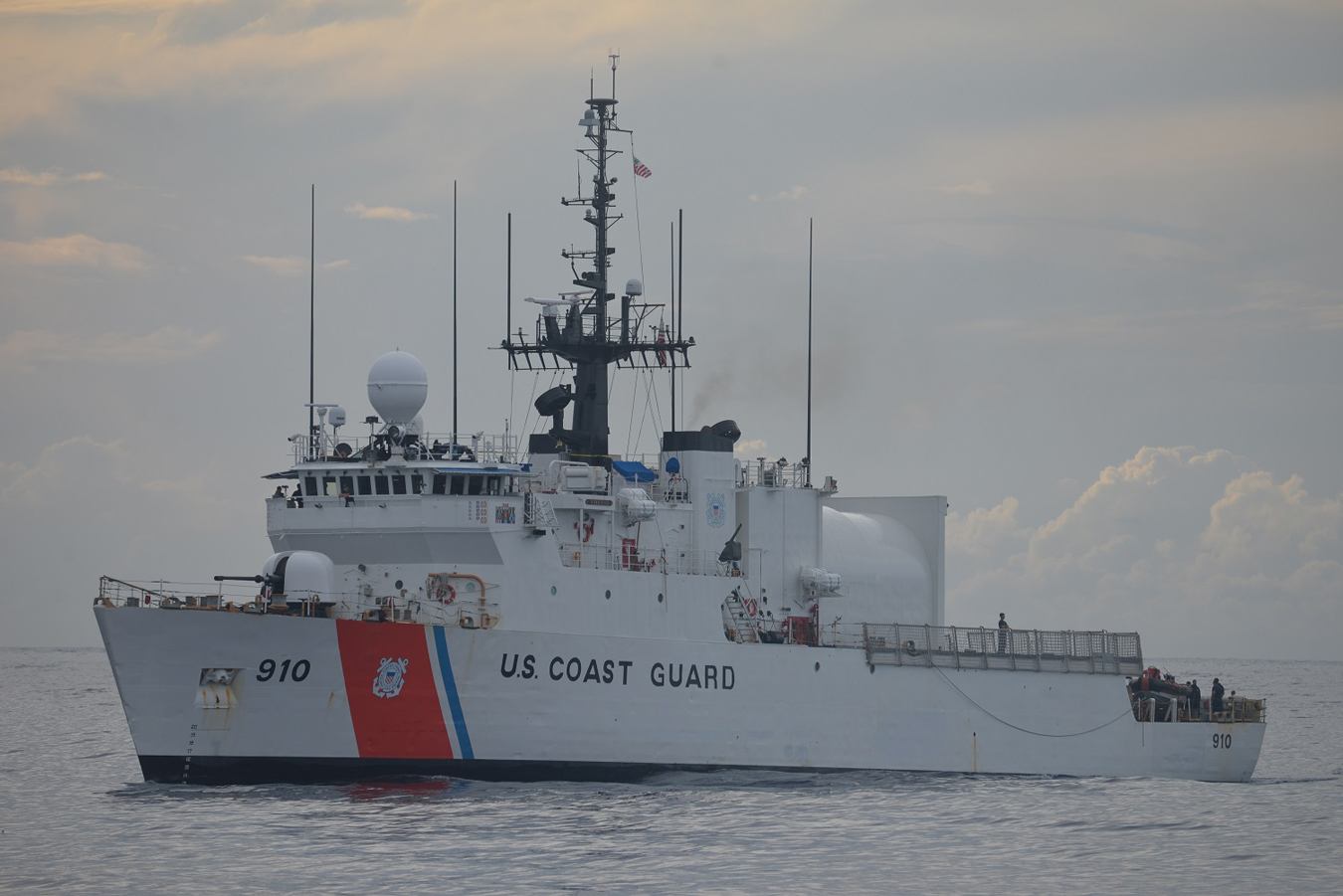
U.S. Coast Guard Cutter Thetis (WMEC 910) a 270-foot Famous-class cutter, conducts a counter-narcotics patrol in the Caribbean Sea, June 19, 2022. The Cutter Thetis is homeported in Key West. Florida. (U.S. Coast Guard photo)
2020 The Coast Guard Cutter Thetis (WMEC-910) and crew returned to Key West on May 14, 2020, after a 65-day Caribbean Sea patrol in support of Coast Guard 7th District. Thetis worked with Coast Guard cutters Spencer (WMEC-905), Resolute (WMEC-620), Raymond Evans (WPC-1110), Kathleen Moore (WPC-110), Richard Etheridge (WPC-1102), and Coast Guard Air Station Miami. The cutter Thetis’s crew was part of an increased Coast Guard presence along the north coast of Haiti, Cuba, and Dominican Republic to prevent a surge of illegal immigration and human smuggling that could be fueled by COVID-19. Employing an Air Station Miami MH-65 Dolphin helicopter crew, the Thetis crew deterred vessels from attempting an illegal exodus. The cutter Thetis crew responded to two search and rescue cases and acted as on-scene commander in the search for a man reported missing off the Motor Tanker Jialong Spirit over 200 miles north of Dominican Republic. The cutter Thetis crew also assisted in the successful evacuation of a crew member with a medical emergency off the Motor Tanker Maersk Batam over 100 miles southwest of Puerto Rico. The cutter Thetis crew also conducted training with Coast Guard Air Station Clearwater MH-60 Jayhawk helicopter aircrews to qualify pilots for shipboard operations in preparation for the upcoming hurricane season and with U.S. Army MH-6 Little Bird helicopter aircrews from the Special Operations Aviation Training Battalion in Jacksonville, FL.
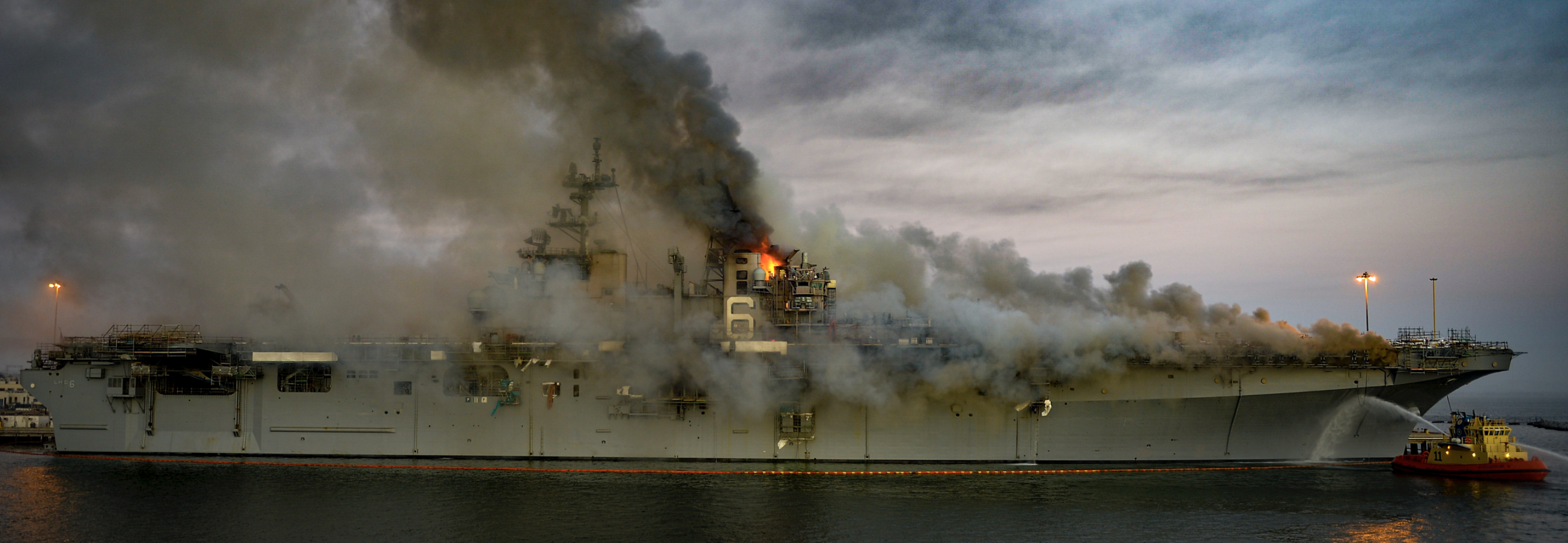
The War Zone has an interesting post about the vulnerability of conventionally powered ships during yard periods with a focus on the loss of USS Bonhomme Richard and the contrasting policies applied to nuclear powered ships.
SAN DIEGO (July 12, 2020) The U.S. Navy amphibious assault ship USS Bonhomme Richard (LHD-6) on fire at Naval Base San Diego, California (USA), on 12 July 2020. On the morning of 12 July, a fire was called away aboard the ship while it was moored pier side at Naval Base San Diego. Base and shipboard firefighters responded to the fire. Bonhomme Richard was going through a maintenance availability, which began in 2018. The fire was extinguished on 16 July.
Coast Guard ships are subject to the same hazards and potentially might benefit from the same safeguards.
1905 An Executive Order extended the jurisdiction of the Lighthouse Service to the noncontiguous territory of Guam Island.
1952 The Coast Guard announced the establishment of an Organized Reserve Training Program, the first in U.S. Coast Guard history. Morton G. Lessans was sworn in as the first member of the Organized Air Reserve on December 12, 1951.
1986 CGC Manitou stopped the 125-foot Sun Bird in 7th District waters and her boarding team discovered 40,000 pounds of marijuana hidden aboard. The boarding team then located the vessel’s builder’s plate and learned that the Sun Bird was the decommissioned “buck-and-a-quarter” cutter Crawford. The former cutter and her 14-man crew were taken into custody. A newspaper article describing the incident noted: “If Crawford was a person, Miami would have probably seen it blush…The ex-Coast Guard cutter received more publicity for smuggling the drugs than for its 20-year Coast Guard career.”




 Chuck Hill's CG Blog