What Frustrates Me? –an Apparent Lack of Transparent Long Term Planning

A reader recently asked me, “What frustrates you, Chuck? … what is the one or two key areas that you think the USCG needs?  A new ship design, up-arming, or missiles?”
My answer, actually it is the apparent failure to plan.

Rant to Follow

Maybe there is a plan, but if there is, it has not been shared with the Congress or the public. Consequently there has been no opportunity to build support for the plan.

Despite direction from Congress to provide a 25 year shipbuilding plan, none has been provided. Is the hold up in the Coast Guard or the Department? Who knows.

Our shipbuilding “Program of Record” (POR) was last baselined in 2005, as part of the defuncted “Deepwater” program. It was based not on need, but on expected funding.

An examination of need was made, in the form of an “Offshore and Aviation Fleet Mix Study.” A report was completed in 2009. It was reevaluated in 2011, resulting in lower requirements that still indicated that we needed assets far in excess of the program of record. Results were not made public until 2012.
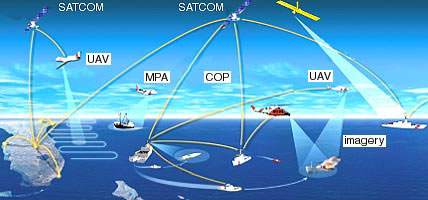
There has been no reexamination of our needs since then, in spite of the fact that the Fleet Mix Study was based on an assumption of the use of the “Crew Rotation Concept” on the National Security Cutter and Offshore Patrol Cutter. It also anticipated deployment of shore based Unmanned Air Systems (UAS), large vertical take off ship based UAS, and networking that would provide a common tactical picture. So far, no land based UAS, only a much smaller less capable ship based UAS, and no real common tactical picture. The only pleasant surprise has been the utility of the Webber class cutters.
I have a half assed Operations Research background. It pains me to see that we are apparently not using the planning tools that are available.
When we present a well considered and fact based plan, the Congress has been responsive. They have supported the program of record, and are funding icebreakers in response to the High Latitude Study.
  • We sorely need an updated Offshore and Aviation Fleet Mix Plan.
  • From this and consideration of other needs we need to develop a 30 year Shipbuilding and Aviation Procurement Plan.
  • We need to update these planning tools on a regular basis. We can expect that they will get better with each iteration.
Normally the leadership changes every four years. It is reasonable that we have a planning cycle that follows this pattern. We can give the new Commandant and his staff a year to work with his predecessor’s planning products before initiating a new cycle. A year in he should initiate a new Fleet Mix Plan. Using it and other inputs, a new 30 year Shipbuilding and Aviation Procurement Plan should be completed well before the new Commandant is selected. 
Only tangentially related, but a budget document we seldom see, is the Coast Guard’s unfunded priority list. Almost three years ago, I did one of my own. Not much has changed.
Thanks to Peter for kicking off this line of thought. 

“Metal Shark set for full-rate production of Navy’s next-gen patrol boats” –MarineLog

MarineLog reports that the Metal Shark Defiant 40 foot patrol boat, selected by the Navy to replace its Force Protection patrol boats is nearing completion of its Operational Test and Evaluation phase and is now ready for full rate production (one every four weeks).

Earlier we discussed this boat and compared it to the RB-M. Significant features are a remotely operated weapons system and ballistic protection for the crew.

“Davie to become Canada’s third National Shipbuilding Strategy strategic partner” –Marine Log

To no one’s surprise MarineLog reports that Davie Shipbuilding, Lauzon, Quebec, Canada’s largest shipyard, has been selected as the third shipyard partner in Canada’s “National Shipbuilding Strategy” and will build six icebreakers for the Canadian Coast Guard.

“Coast Guard releases draft request for proposal for industry studies, announces Offshore Patrol Cutter Industry Day” –CG-9

I am passing this along, but have to say that, since this came out Dec. 20, 2019, it seems a bit confusing. The significant news is that the Request for Proposal is expected to be issued by the end of the year.

D

The Coast Guard released a draft request for proposal (RFP) for industry studies Dec. 4 to support offshore patrol cutter (OPC) follow-on production. Responses to the draft industry studies RFP will be used to inform development of a final RFP, which is scheduled for release before the end of calendar year 2019.

Today’s action complements the release of the Coast Guard’s draft statement of work (SOW) for OPC industry studies. The draft RFP and SOW are available at the following here.

The Coast Guard also announced that the service will host an OPC Industry Day on Dec. 11, 2019, at 9:00 a.m. EST at the Coast Guard Yard in Baltimore, Maryland.

The industry day announcement can be found at the following here.

An RSVP is required to attend. Attendees must RSVP no later than 12:00 p.m. Monday, Dec. 9, 2019. Please see the industry day announcement for detailed RSVP instructions and location information.

The Coast Guard’s overall goal for the OPC Industry Day is to refresh awareness and understanding of industry capabilities and provide an opportunity for potential offerors to gain insight into OPC industry studies and other follow-on acquisition activities. The industry studies draft RFP will be a focal point of the industry day event; attendees are strongly encouraged to review the contents of the draft RFP and come prepared to discuss it with Coast Guard officials.

Addendum: The Coast Guard updated the Industry Day announcement Dec. 13, 2019, based on discussions with interested vendors.

Addendum: The Coast Guard released a revised draft RFP Dec. 20, 2019, in support of the OPC follow-on production, based on discussions with interested vendors.

For more information: Offshore Patrol Cutter program page

“Set ThreatCon Delta. Active Shooter Reported in Building 12!” –USNI

A petty officer pulls another to safety during a 2015 active shooter exercise at the Coast Guard Training Center in Cape May, N.J. Photo: U.S. Coast Guard (Lauren Simmons)

The Dec. 2019 edition of the US Naval Institute Proceedings has an article expressing concern about the Coast Guard’s readiness to deal with active-shooter/hostile-event response (ASHER)? The article is available on line and is written by Commander Thomas J. Hughes, U.S. Coast Guard (Retired), currently head of the Exercise Support Division of Coast Guard Force Readiness Command as a career Federal employee.

It is thought provoking. How much time, money, training, and priority is appropriate in the face of competing demands?

“House Passes FY 2020 Coast Guard Funding Bill Backs Icebreaker, Limits OPC Program” –USNI

The US Naval Institute news service reports the House has passed the Department of Homeland Security budget including,

“The FY 2020 total is $49.8 million less than what the service received a year ago but is $846.7 million more than what was initially proposed in President Donald Trump’s FY 2020 budget request, according to a statement from the House Appropriations Committee.”

The 2020 budget request was discussed here. The FY2019 budget as enacted is discussed here.

It is worth noting that this bill has already been coordinated with the Senate, so it should advance without significant changes.

“The funding was part of a $1.4 trillion spending bill Senate and House negotiators created that avoids a possible federal government shutdown at the end of this week. The spending bill still needs Senate approval and Trump’s signature before becoming law.”

The Good News:

As expected the Congress bumped up the purchase of Webber class patrol craft from two units to four. ($140M requested, $260M in the bill, the FY 2019 budget provided six units for $360M). Congress has been pretty consistent in increasing the number purchased annually. This will fund FRCs #57-60. That leaves only four more units to complete the expected 64 total units anticipated for the class (58 in the program of record and six for PATFORSWA).

An additional $100M for long lead time items for the second Polar Security Cutter was added.

Congress also added another $105M for the HC-130J program. Congress also has a history of doing this as well. A similar amount was in the FY2019 budget.

The Bad News: 

The total amount in the budget is less than FY2019, and that was less than FY2018. That trend is not good.

Since the requested amount for Procurement, Construction, and Improvements (PC&I) was $1.2B, it seems likely that even with these additions, the total Budget may be well under both the $2M the Coast Guard has been saying they need annually and last year’s $2,248.26M total, but we will not know for sure until we get more detail.

There is no provision for a much talked about National Security Cutter #12, even though money was included in the FY2019 budget for long lead time items for #12.

The Not Unexpected: 

The requested amount for the Offshore Patrol Cutter (OPC) program, $457 million for the construction of OPC #3 as well as long lead time materials for OPCs #4 and #5, was cut by $14M. That may represent nothing more than deletion of long lead time materials for OPC #5. Construction of #5 is now in the distant future, since the decision to grant Eastern Contract Relief and re-compete the contract for OPCs #5-15. This does seem to indicate Congress will allow DHS and the Coast Guard to continue with contract relief and that Eastern will construct the first four OPCs as previously announced.

“The Chinese Navy Is Building An Incredible Number Of Warships” –Forbes

Image Analysis of photo of Chinese shipyard showing multiple warships at various stages of … [+]H I Sutton, with permission from @Loongnaval, (This is not a naval base just one of several shipyards-Chuck)

Forbes provides a reminder of the rate at which the Chinese Navy is overtaking the US Navy.

We did discuss this earlier, “Comparison, the Chinese Navy of 2030 and USN.”

The Chinese have begun building large surface combatants (destroyers and/or cruisers) at rate faster than that of the US (The US generally commissions two per year). The number the Chinese are expected to have commissioned in 2019 and 2020, as many as twelve, is staggering. Their first very large aircraft carrier equipped with catapults and arresting gear is expected to be commissioned in 2022, only three years after their first (smaller) domestically built aircraft carrier (The US builds one every five years). They seem to have begun building large amphibious warfare landing ships at about the same rate as the US. In addition they have built types with no counterpart in the US Navy including 60 Type 022 missile armed fast attack craft and Type 056 corvettes, 64 ordered to date, with about 8 built per year. They also have about 60 conventionally powered submarines and about 54 frigates while the US has neither type currently. 

If you would like to look into this in more detail. I would suggest the following Congressional Research Service Report.
“Table I, Numbers of Certain Types of Ships Since 2005,” on page 20 is particularly illustrative. You can see the trend with total number of Chinese vessels growing while the number of USN ships has remained relatively stable. It notes that the number of Chinese ships does not include auxiliary and support ships while the USN figure does not include patrol craft (the number given for 2015 actually does include the 13 Cyclone class patrol craft). If we counted the USN ships in the same way the Chinese ships are counted, by subtracting auxiliaries and support ships, and adding in the 13 Cyclone class Patrol Craft, the numbers for 2019 would be China 335, USN approximately 239. It is also worth noting that the Chinese fleet is younger than the US Navy fleet.
The US Navy is still larger in terms of both personnel and tonnage and has an overwhelming advantage in aircraft. The USN still has far more carriers (11 of which 5 are more than 30 years old), nuclear submarines, and destroyers and cruisers. But here, as elsewhere, the trend is against the US. (The number of USN nuclear submarines is actually expected to decline, but should exceed those of the Chinese Navy for the foreseeable future.)
Thus far the Chinese have succeeded in creating a situation where the USN operating inside the “First Island Chain” during hostilities would be exceedingly difficult. They clearly intend to have a local superiority. It the imbalance in ship construction continues they may achieve an absolute superiority.
They have now begun creating a Blue Water Navy with the capability to intervene virtually anywhere, following the USN model. This will give them the option of insuring that all those preditory loans they have been making are repaid or the collateral handed over.
China ultimately plans to bring Taiwan back into the fold, by force if necessary, but ferrying the necessary number of troops would be a herculean task, not unlike the Normandy invasion. The force of 38 large amphibious warfare ships that has, for many years, been the US Marine Corps stated objective, would have lifted only two brigades, not the multiple divisions that would likely be required to take Taiwan. Their large Coast Guard (248 ships according to the CRS report and growing) and maritime militia is as likely to be as instrumental in any invasion as the large amphibs they are currently building.


I’ve Been Slimed

The Maritime Vessel Stopping Occlusion Technologies, or MVSOT, team at the Naval Surface Warfare Center Panama City Division investigates natural hagfish slime as an inspiration for a non-lethal capability (Credit: NAVSEA/Courtesy)

Naval News reports that the Naval Surface Warfare Center, Panama City Division has been working on non-lethal ways to stop or slow vessels that appear to be behaving in a threatening manner.

Non-lethal means of stopping, or at least slowing, a ship are always interesting.

110 foot WPBs as Missile Boats –for Ukraine

USCGC_Maui_(WPB-1304)

Defense News has a story about the Congress authorizing sale of Coast Defense and Anti-Ship missiles to the Ukraine.

A surprising comment was that these might be fitted on the 110 foot WPBs that have been transferred to Ukraine

Speaking at the German Marshall Fund on Friday, Dmytro Kuleba, Ukraine’s Deputy Prime Minister on European and Euro-Atlantic Integration, indicated that the weapons would be ideal fits for a pair of Island-class patrol boats Ukraine has received from Washington.

Those boats were “supplied without anything on them,” said Kuleba, the first member of the current Ukrainian government to visit Washington. “So we will continue working on obtaining more boats of that class, and hopefully with some of the equipment you mentioned.”

This might refer to Harpoon, but I think it is more likely that this is in reference to the Naval Strike Missile which has already been used in land based coast defense batteries.

Frankly, I think Ukraine would be better off truck mounting the missiles, in that they would be harder to target, but since many nations will be receiving retired Island class WPBs, a standard conversion might be desired by a number of nations.


“Coast Guard releases request for information for Polar Star service life extension project” –CG9

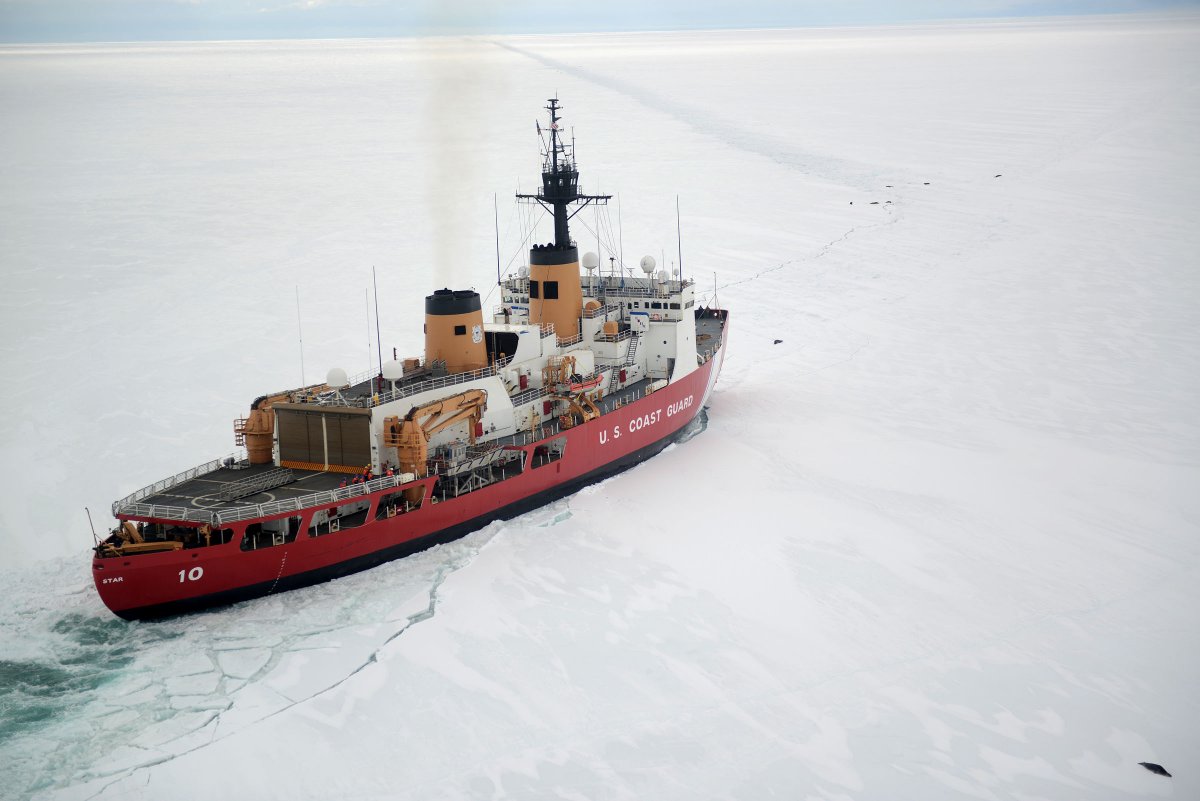
The Coast Guard Cutter Polar Star cuts through Antarctic ice in the Ross Sea near a large group of seals as the ship’s crew creates a navigation channel for supply ships, January 16, 2017. The resupply channel is an essential part of the yearly delivery of essential supplies to the National Science Foundation’s McMurdo Station.US Coast Guard photo by Chief Petty Officer David Mosley

A news release. Dec. 20 is a very short deadline.

The Coast Guard released a request for information (RFI) Nov. 27 seeking industry input and feedback on the draft solicitation for the Coast Guard Cutter Polar Star service life extension project (SLEP) as part of the In-Service Vessel Sustainment program (ISVS). The SLEP effort will recapitalize a number of major systems and extend the service life of the cutter by approximately four years. This future contract will include SLEP work items and recurring maintenance in a five-year phased production schedule between 2021 and 2025.

The RFI is available here. The deadline to submit responses is Dec. 20 at 4 p.m. EST.

Polar Star, the Coast Guard’s only active heavy icebreaker, is scheduled to conduct ice breaking operations to create an ice channel for which cargo vessels will be escorted to resupply the National Science Foundation’s McMurdo Station in Antarctica. This marks the seventh time the cutter has been at the center of Operation Deep Freeze since the cutter was reactivated in 2013.

The 399-foot cutter – commissioned in 1976 – supports nine of the 11 Coast Guard statutory missions.

For more information: In-Service Vessel Sustainment program page