“U.S. Coast Guard National Security Cutter visits Fiji” –News Release

U.S. Coast Guard Cutter Stratton (WMSL 750) takes on fuel and supplies in Honolulu prior to departing on the cutter’s Western Pacific patrol, June 18, 2019. Operating under the tactical control of commander, U.S. 7th Fleet, Stratton and crew will engage in professional exchanges and capacity building exercises with partner nations and patrol and conduct operations as directed. U.S. Coast Guard photo by Petty Officer 2nd Class Jasmine Mieszala

Below is a Coast Guard press release. As you probably know Stratton is on the way to the Western Pacific, replacing the Bertholf in support of PACOM missions to build capacity and reinforce norms of international behavior. We have a long standing obligation to the island nations of the Micronesia. Good to see them getting more attention. Western Pacific also includes a very large chunk of the US EEZ, which has been underserved in the past. 

LAUTOKA, Fiji — Crew members aboard the U.S. Coast Guard Cutter Stratton (WMSL 752) moored Thursday in Lautoka, marking the cutter’s first international port call of their Western Pacific patrol.

Stratton, a 418-foot National Security Cutter, departed its homeport of Alameda, California, June 5 for a months-long deployment to the Western Pacific. Operating under the tactical control of commander, U.S. 7th Fleet, the cutter and crew are engaging in professional exchanges and capacity building exercises with partner nations and patrolling and conducting operations as directed.

While underway, Stratton’s crew exercised the recently signed Fiji-U.S. bilateral shiprider agreement, which allows enforcement authorities from the two nations to jointly counter illicit activity at sea. Together, Stratton’s crew and an embarked Fijian fisheries officer, Josaia Maiwai, patrolled the United States and Fijian Exclusive Economic Zones.

“The United States is firmly committed to building on our countries’ shared interest in governance and security in the maritime commons,” said Capt. Bob Little, commanding officer of the Stratton. “Fiji has proven to be a strong partner in our efforts to counter transnational criminal activity in the Pacific such as illegal, unreported and unregulated fishing. We are making great strides in our ability to jointly protect our sovereign resources from those who do not recognize international laws.”

While in port, the crew will have opportunities to explore Fiji and interact with local citizens through cultural and professional exchanges, community relations projects and island tours.

“House Committee Passes Two-Year Coast Guard Authorization Act” –USNI, Includes Provision for Government Shutdown Pay

US Capital West Side, by Martin Falbisoner

The US Naval Institute News Services reports the Coast Guard reauthorization bill out of committee. Significantly it includes language that would allow Coast Guard personnel to be continued to be paid, even if there is another government shutdown.

“The House committee authorizing Coast Guard activities approved a measure that would guarantee the service’s active duty and civilian personnel are paid in the event of a federal government shutdown, as part of a two-year spending authorization bill.”

This is only the action of a committee, but it is likely to pass since this two year authorization bill enjoys bipartisan support and is not nearly as contentious as a budget bill.

There was also language supporting a new Great Lakes icebreaker. That in turn was supported by some earlier criticism, that really reflects the shortage of operating funds the current Commandant has been talking about.

“The reliability [of Coast Guard icebreaking] was abysmal last year,” James Weakley, president of the Lake Carriers Association, said last week during a hearing before House Transportation subcommittee on the Coast Guard and maritime transportation. “Five of the nine icebreakers [assigned to the Great Lakes] were inoperable.”

NSC #11 to Go to Charleston

USCGC Stratton moored in San Diego, California. Photo by BryanGoff

The following is a Coast Guard HQ news release. It appears the final laydown for the NSC fleet is Charleston five, Alameda four, Honolulu two. I am a bit surprised more did not go to the Pacific but Charleston is closer to the Eastern Pacific drug transit zones than Alameda.

U.S. Coast Guard announces homeport of newest National Security Cutter

WASHINGTON – The U.S. Coast Guard today announced that Charleston, South Carolina will be the home of the Service’s newest National Security Cutter.

“I am pleased to announce that Charleston, South Carolina will be the home of the Coast Guard’s 11th National Security Cutter,” said Admiral Karl L. Schultz, Commandant of the Coast Guard. Construction on the 11th National Security Cutter is scheduled to begin by Spring of 2020. Charleston is already home to two of the Coast Guard’s National Security Cutters, the JAMES and HAMILTON. In 2017, the Coast Guard announced that the ninth and tenth National Security Cutters, currently under construction at Huntington Ingalls Shipyard in Pascagoula, Mississippi, will join the Charleston-based National Security Cutter fleet in the coming years. Admiral Schultz further noted: “I am confident that the Charleston community is the right place for our Coast Guardsmen and their families to base these highly capable National Security Cutters with the global reach to respond to complex maritime threats and challenges.”

National Security Cutters are the most technologically-advanced vessels in the Coast Guard. They are capable of supporting maritime homeland security and defense missions. They safeguard the American people and promote our security in a complex and persistently-evolving maritime environment.

Grouping cutters of the same class is one critical variable in selecting homeports. Grouping cutters in the same location improves maintenance proficiency, streamlines logistics, and provides increased personnel flexibility.

The cutter is scheduled to arrive in 2024; its name has not yet been selected. This will be the fifth National Security Cutter assigned to Charleston.

“Antigua, Sprawling “Chinese Colony” Plan Across Marine Reserve Ignites Opposition” –The Guardian

Map of the Caribbean Sea and its islands. Antigua can be seen on the NE corner of the Caribbean. Photo credit: Wikipedia Commons, author–Kmusser, all data from Vector Map.

There has been an interesting development in an area the Coast Guard frequents. The Guardian reports the Chinese are developing a part of the island of Antigua. Critics contend it will operate as a state within a state.

The 2000 acre development will include a seafood harvesting company.

“The master plan includes up to seven resorts, a shipping port (emphasis applied–Chuck), the country’s first four-lane highway, offshore “wealth management” centres, hospital and university facilities, a school, bank and a luxury golf community on adjacent uninhabited Guiana Island. The 400-acre industrial section includes steel and ceramic tile factories.”

The way the Chinese do things incrementally, this sounds suspiciously like it might be beginnings of a base.

At one time, Antigua was the site of NAVFAC Antigua, decommissioned 4 February 1984, an underwater listening station, part of the Surveillance System (SOSUS) and the Integrated Undersea Surveillance System (IUSS), which were used to track Soviet submarines.

“What Is the US Coast Guard’s Role in the Indo-Pacific Strategy?” –The Diplomat

The Coast Guard Cutter Stratton passes underneath San Francisco’s Bay Bridge as Stratton and the crew depart on a months-long deployment to the Western Pacific in support of the U.S. Indo-Pacific Command, June 12, 2019. Operating under the tactical control of the U.S. 7th Fleet commander, Stratton and crew are scheduled to engage in professional exchanges and capacity-building exercises with partner nations in the Western Pacific and to patrol and operate as directed. U.S. Coast Guard photo by Petty Officer 1st Class Matthew S. Masaschi.The Diplomat reports on rationale for the increasing presence of the US Coast Guard in the Western Pacific. The piece is written by a Philippine Coast Guard Officer and he credits the Japanese with developing the effective use of White Ships to provide influence in this region.

“MAST Asia: Mitsui Unveils OPV Design Proposal for JMSDF OPV Requirement” –Naval News

At MAST Asia 2019, the defense exhibition and conference currently held near Tokyo, Japan, local shipbuilder Mitsui Engineering & Shipbuilding (Mitsui E&S) unveiled its OPV design currently competing for a JMSDF requirement.

Naval News reports on a proposal to meet Japanese Maritime Self Defense Force requirement for Offshore Patrol Vessels

This looks like a pretty typical modern Offshore Patrol Vessel if a bit larger and faster than most, with its medium caliber gun, two remote weapon stations for heavy machine guns and helo deck. In fact it looks very much like an improved L’Adroit with it 360 degree vision bridge, integrated mast, and two boats launched from stern ramps .

The real surprise is the crew of 23, one less than the crew of a Webber class. This might not be quite representative of how the Coast Guard would figure the crew size since there is a possibility the law enforcement officers of the boarding party and the aviation support personnel that are part of a USCG crew, may be handled as visiting detachments rather than as crew by the Japanese. Still the crew is going to be less than half of that of a 270.

Since the crew is a large part of the life cycle cost of a ship, there is a natural desire to cut the size of the crew. In operating a ship, frequently there is no reason the size of the ship should be reflected in the size of the crew, if the tasks the crew performs are the same. Still, 23 hardly provides a decent damage control party. Can they operate the helicopter and both boats simultaneously? Having junior personnel aboard in an apprentice role has much to recommend it. The experience of the Navy in attempting to man the LCSs with a minimum crew looks like a cautionary tale. I just hope they are including some provisions for adding personnel.

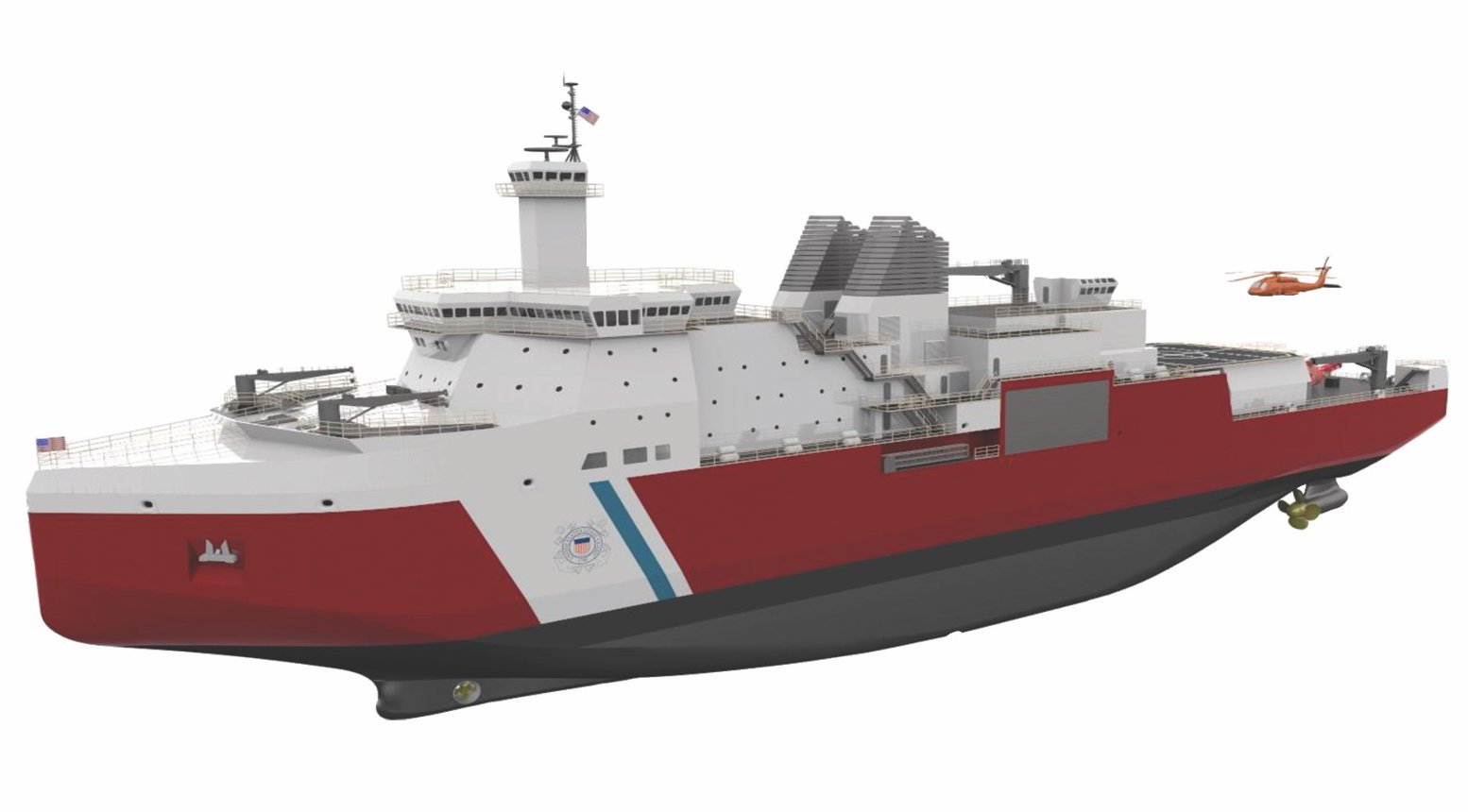
Seattle to be Homeport for Polar Security Cutter

Not surprisingly the Coast Guard has announced that Seattle is the planned homeport for the new Polar Security Cutter (heavy polar icebreaker). Below is the press release. 

U.S. Coast Guard announces homeport of newest Polar Security Cutter

WASHINGTON – The U.S. Coast Guard today announced that Seattle, Wash. will be the home of the service’s new Polar Security Cutters.

“I am pleased to announce that Seattle, Washington will be the home of the Coast Guard’s new Polar Security Cutters,” said Admiral Karl L. Schultz, Commandant of the U.S. Coast Guard.  “The Pacific Northwest has been the home of our icebreaking fleet since 1976, and I am confident that the Seattle area will continue to provide the support we need to carry out our critical operations in the polar regions.”

The U.S. Coast Guard is the nation’s lead agency responsible for providing assured surface access in the polar regions.  The addition of the Polar Security Cutters in Seattle will support the United States’ ability to conduct national missions, respond to critical events, and project American presence in the high latitudes.

The Coast Guard conducted a detailed analysis to identify locations that could accommodate the Polar Security Cutter. Based on operational and logistical needs, Seattle was determined to be the appropriate homeport for the first three Polar Security Cutters.

In April 2019, VT Halter Marine, Inc. of Pascagoula, Mississippi, was awarded a contract for the detail design and construction of the Coast Guard’s Polar Security Cutter class.

Attack on Tankers in Gulf of Oman

Image reportedly showing smoke coming from one of the tankers said to have been attacked, May 13, 2019 © AFP PHOTO / HO / IRIB

You have probably heard about the recent attack on two tankers in the Gulf of Oman. The State Department has concluded that Iran is responsible.

We are not privy to all their sources, but the US has been fooled before. Military Times discusses why responsibility may not be clear. Just the fact that the price of oil went up 4% would mean that fore knowledge of the attack could have been worth a fortune in the futures market. Any number of people could be beneficiaries. Lots of folks would like to see the US take Iran down a notch or two. Even if Iranians did it, they might not have been acting on behalf of the central government. The cargoes were destined for Taiwan, could that mean the Chinese did it?

The Middle East is never short of intrigue. It is a place made for conspiracy theories.

Eaglespeak, who does think the Iranians are behind the attack, has a good summary of the situation including information on a recent fire that destroyed or damaged several ships in an Iranian port that I had not heard about before.

I would not be surprised to see units for the Coast Guard’s PATFORSWA keeping an eye on this area.

Webber Class for the Navy?

The US Naval Institute News Service has a short post that discusses LCS funding, but there is also something there about the possibility of the Navy buying Webber class Fast Response Cutters as well.

“Meanwhile, the HASC approved a requirement for the Navy to study the prospect of buying a version of the Coast Guard’s Fast Response Cutter, submitted by Rep. Donald Norcross (D-N.J.). chair of the tactical air and land forces subcommittee.

“The idea is for the Navy to consider basing these smaller patrol vessels in Bahrain where they would operate in the littoral waters of the Persian Gulf. The U.S. Coast Guard is already planning to base four fast response cutters in Bahrain, to replace the aging Island-class patrol boats the service currently has patrolling the Persian Gulf.”

Stratton Goes To 7th Fleet, Waesche Goes South, All Four Alameda NSCs Underway

The Coast Guard Cutter Stratton passes underneath San Francisco’s Bay Bridge as Stratton and the crew depart on a months-long deployment to the Western Pacific in support of the U.S. Indo-Pacific Command, June 12, 2019. Operating under the tactical control of the U.S. 7th Fleet commander, Stratton and crew are scheduled to engage in professional exchanges and capacity-building exercises with partner nations in the Western Pacific and to patrol and operate as directed. U.S. Coast Guard photo by Petty Officer 1st Class Matthew S. Masaschi.

The following is a PACAREA press release 

ALAMEDA, Calif. – The Coast Guard Cutters Stratton and Waesche set sail Wednesday for months-long deployments to opposite ends of the Pacific. With their departure, all four of the national security cutters homeported in Alameda are currently on patrol.

The crew aboard the Waesche departed for a months-long deployment to the Eastern Pacific Ocean to conduct counterdrug operations. Earlier this year, Waesche returned to Alameda following a 95-day counterdrug patrol where the crew had two at-sea interdictions, seizing more than 6,300 pounds of cocaine.

Stratton deployed to the Western Pacific Ocean where the Alameda-based Coast Guard Cutter Bertholf has been since departing the Bay Area in January. Stratton will operate in support of U.S. Indo-Pacific Command, which oversees military operations in the Western Pacific.

Operating under the tactical control of U.S. 7th Fleet, Stratton is scheduled to engage in professional exchanges and capacity-building exercises with partner nations and to patrol and operate as directed.

“The Coast Guard’s deployment of resources to the Indo-Pacific directly supports the United States’ goal to strengthen maritime governance, safety, and security across the region, and we do that by working with, and learning from, our many partners and partner nations in the region,” said Vice Adm. Linda Fagan, commander, Coast Guard Pacific Area, who oversees the cutter.

“The United States is a Pacific nation, and the Coast Guard has been operating in the pacific for over 150 years. We have developed long-standing partnerships with nations in the region, and we share a strong commitment to a free and open Indo-Pacific governed by a rules-based international system that promotes peace, security, prosperity, and the sovereignty of all nations.”

As both a federal law enforcement agency and an armed force, the Coast Guard is uniquely positioned to conduct defense operations in support of combatant commanders on all seven continents. The service routinely provides forces in joint military operations worldwide, including the deployment of cutters, boats, aircraft and deployable specialized forces.

“We are a military service, we are also a law enforcement organization, a regulatory agency, a first response agency, and a member of the intelligence community,” said Fagan. “We are at all times a military force and at all times a law enforcement force. This duality of our authorities provides an incredible degree of flexibility and access and authority. The Coast Guard’s distinct authorities and missions means that we provide a mix of expertise and capabilities that no other U.S. agency can.”

Coast Guard Island in Alameda is the homeport to four Coast Guard legend class national security cutters. NSCs are 418-feet long, 54-feet wide, and have a 4,600 long-ton displacement. They have a top speed in excess of 28 knots, a range of 12,000 nautical miles, endurance of up to 90 days and can hold a crew of up to 170. These multi-mission cutters and crew are capable of operating from the Bering Sea to the Eastern Pacific Ocean to the South China Sea.

National security cutters feature advanced command and control capabilities, aviation support facilities, stern cutter boat launch and increased endurance for long-range patrols enabling the crews to disrupt threats to national security further offshore.

The Coast Guard is scheduled to commission its seventh and eighth national security cutters, the Coast Guard Cutters Kimball and Midgett, in August. Both cutters will be homeported in Honolulu and enhance the Coast Guard’s presence throughout the Indo-Pacific region.