“Navy Mk38 Gun Systems Gaining Co-Axial Small-Caliber Machine Gun” –Seapower

7.62 mm Chain Gun as Coax as optionally installed on 25 mm Mark 38 Mod 3. Image copyrighted by NAVSEA Dahlgren.

The Navy League’s online magazine Seapower is reporting that ” The Navy is installing a co-axial 7.62 mm machine gun on the mounts of its Mk38 chain gun systems, a Northrop Grumman official said….the addition of the co-axial Mk52 machine gun gives the gunner another “right-sized” option for countering a small target, such as pirates or terrorists on jet skis…Northrop Grumman is installing the Mk52 guns in the Mk38 under an indefinite delivery/indefinite quantity contract.”

This has been proposed for several years now, but this is the first indication it is happening. The proposed weapon, the 7.62mm Mk52, is in fact an electrically powered chain gun like the 25mm Mk242. (The article appears to be incorrect in this regard.)

The article also discusses the possibility of upgrading the Mk38 by replacing the 25mm gun with guns of 30 or 40mm.

I think the Coast Guard could make a good argument for upgrading its Mk38s to 40mm. The change would make very little difference to a DDG, also equipped with a 5″ gun and anti-ship missiles, but the Mk38 is the largest weapon available on about 75 Coast Guard cutters and these cutters could at any moment be required to face a vessel much larger than the Iranian boats the Navy has been fixated on. We already know the 30mm is a quantum leap in capability compared to the 25mm. Effectiveness is closely related to projectile weight. The 30mm projectile weighs about twice that of the 25mm. The 40mm projectile will weight three to four times as much as the 25mm. Since the rate of fire for these guns is similar, the 40mm is likely to be at least three times as effective against more difficult targets and also has a greater effective range.

Addendum:

The Coast Guard plans to install the Mk 38 on 64 Webber class and 25 Offshore Patrol cutters. The older crew served version of the Mk38 is on the remaining 378s, the 210s, and the remaining 110 foot Island class WPBs. I expect we may see the Mk38 on the Polar Security Cutters and the 87 foot Marine Protector class WPB replacement when they are built.

This would of course be less important if the vessels had something like the Long Bow Hellfire, which would be more effective than any of these guns against virtually any size targets.
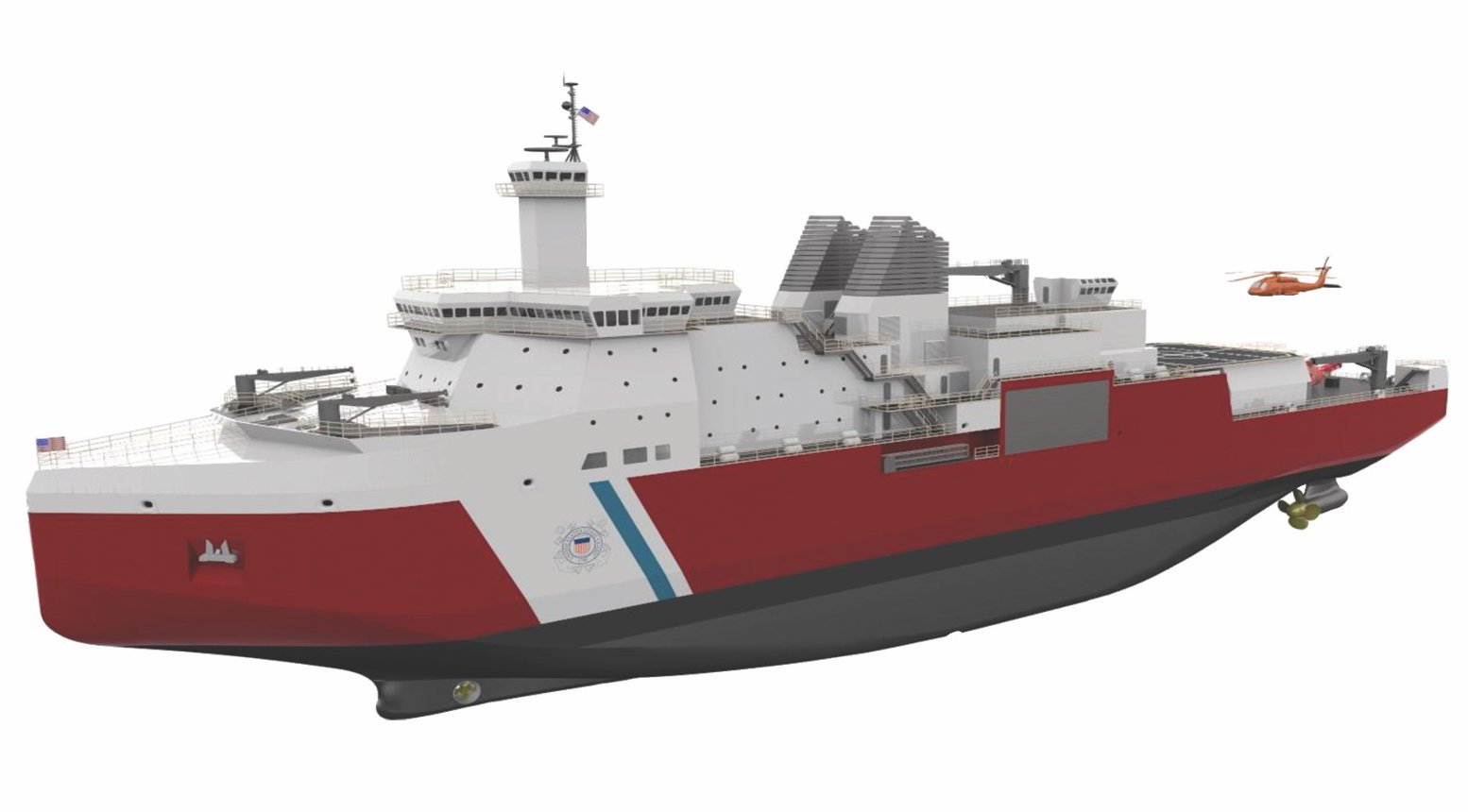
 

“Coast Guard Polar Security Cutter (Polar Icebreaker) Program: Background and Issues for Congress, Updated May 9, 2019”

The Congressional Research Service has updated their report on the Polar Security Cutter Program. This is the first revision since the award of the contract, so there are significant changes, including a section on the selected design found on pages 5-9.

“U.S., Philippine Coast Guards Conduct Joint Search-and-Rescue Exercise” –Seapower

The U.S. Coast Guard Cutter Bertholf (left) moves in formation with Philippine coast guard vessels Batangas (center) and Kalanggaman during an exercise on May 14. U.S. Coast Guard/Chief Petty Officer John Masson

The Navy League’s Seapower is reporting that USCGC Bertholf is conducting SAR exercises with the Philippine Coast Guard.

“The crew of Bertholf also will participate in other joint events with members of the Philippine coast guard during the ship’s Manila port call. The events include a series of engagements on operational subjects such as damage control and search and rescue as well as sporting and social events. The activities are designed to improve interoperability and strengthen the ties between the two countries.”

Navy is Exercising in the Gulf of Alaska

171121-N-IA905-1120 PACIFIC OCEAN (Nov. 21, 2017) The aircraft carrier USS Theodore Roosevelt (CVN 71) which is participating in Exercise Northern Edge 2019 (U.S. Navy photo by Mass Communication Specialist Seaman Morgan K. Nall/Released)

Seventeenth District units may see a rare sight this week, as Navy units are participating in Exercised Northern Edge 2019. The US Naval Institute News Service reports,

USS Theodore Roosevelt (CVN-71) is underway in the Gulf of Alaska. The carrier will participate in the joint training exercise, Northern Edge 2019 from May 13 to 24. U.S. Navy ships participating Roosevelt with embarked Carrier Air Wing (CVW 11), guided-missile destroyer USS Russell (DDG-59), USS Kidd (DDG-100), USS John Finn (DDG-113) and fleet oiler USNS Henry J. Kaiser (T-AO-187).

“Personnel from U.S. military units stationed in the continental United States and from U.S. installations in the Indo-Pacific will participate with approximately 250 aircraft from all services, and five U.S. Navy ships. For the first time in 10 years, a Pacific Fleet aircraft carrier will be participating in the exercise,” according to a statement from the U.S. Pacific Fleet.
“Participants will serve as part of a joint task force, which will help enhance multi-service integration and exercise a wide range of joint capabilities.”

The US Pacific Fleet news release linked above is quoted below,

JOINT BASE PEARL HARBOR-HICKAM, Hawaii – Approximately 10,000 U.S. military personnel are participating in exercise Northern Edge 2019 (NE19), a joint training exercise hosted by U.S. Pacific Air Forces, on and above central Alaska ranges and the Gulf of Alaska, May 13-24.

NE19 is one in a series of U.S. Indo-Pacific Command exercises in 2019 that prepares joint forces to respond to crises in the Indo-Pacific. The exercise is designed to sharpen participants’ tactical combat skills, to improve command, control and communication relationships, and to develop interoperable plans and programs across the joint force.

Personnel from U.S. military units stationed in the continental United States and from U.S. installations in the Indo-Pacific will participate with approximately 250 aircraft from all services, and five U.S. Navy ships. For the first time in 10 years, a Pacific Fleet aircraft carrier will be participating in the exercise.

Participants will serve as part of a joint task force, which will help enhance multi-service integration and exercise a wide range of joint capabilities.

Major participating units include: U.S. Indo-Pacific Command, U.S. Pacific Air Forces, U.S. Pacific Fleet, Marine Corps Forces Pacific, Air Combat Command, Air Mobility Command, Air Force Materiel Command, U.S. 3rd Fleet, Air National Guard, Air Force Reserve and U.S. Naval Reserve.

NE19 is the largest military training exercise scheduled in Alaska this year with virtual and live participants from all over the United States exercising alongside live players.

Follow the Northern Edge Defense Visual Information Distribution Service (DVIDS) feature page for full coverage of the exercise.

Note: U.S. Navy ships participating in Northern Edge include Carrier Strike Group 9, USS Theodore Roosevelt (CVN 71) with embarked Carrier Air Wing (CVW 11), USS Russell (DDG 59), USS Kidd (DDG 100), USS John Finn (DDG 113), and USNS Henry J. Kaiser (T-AO 187).

Notably missing is any mention of Coast Guard participation, although I suspect Coast Guard units in fact are participating. Would appreciated any comments on actual Coast Guard participation.

North Korean Cargo Vessel Connected to Sanctions Violations Seized by U.S. Government

You may have seen a report that the US had seized a North Korean bulk cargo ship, the M/V Wise Honest (great name for a smuggler?). The first report I saw was from GlobalSecurity.org. It seemed to have left off a lot of details like where was it seized and by whom,

“On or about March 14, 2018, the Wise Honest was loaded with coal in Nampo, North Korea. On or about April 2, 2018, foreign maritime authorities intercepted and detained the Wise Honest. Maritime regulations require vessels like the Wise Honest engaged in international voyages to operate an automatic identification system (“AIS”) capable of providing information about the vessel to other ships and coastal authorities. However, despite its March 2018 voyage from North Korea, the Wise Honest had not broadcast an AIS signal since August 4, 2017.”

The report did mention the Coast Guard.

Mr. Demers and Mr. Berman (Assistant Attorney General for National Security and U.S. Attorney–Chuck) praised the outstanding investigative work of the FBI and its New York Field Office, Counterintelligence Division, and thanked the Department of Justice’s Money Laundering and Asset Recovery Section and Office of International Affairs; the United States Coast Guard; and the Department of State for their assistance.

This CourtHouseNews report provides more background. The ship was seized by Indonesian Authorities. and is currently en route American Samoa.


Vard explores concepts for Canadian Coast Guard future fleet

MarineLog reports,

“Vancouver, B.C., based Vard Marine, Inc. reports that the Canadian Coast Guard has awarded it an engineering services contract to explore concepts for the Coast Guard’s future fleet renewal program.

“…The work is intended to explore requirements for multiple future fleet ship types and could stretch over several years.

Vard was of course a designer of the Offshore Patrol Cutter.

Waterways Commerce Cutter Update

USCGC Smilax (WLIC-315), commissioned 1944

Here is a link to a power point style update on the Waterways Commerce Cutter apparently given at the Navy League’s Sea-Air-Space Exposition, 7 May, 2019.

They are hoping for initial operational capability for the new vessels in FY2024 and full operational capability (which I interpret as all the new vessels in commission FY2030.

Thanks to Lee for bring this to my attention. 

“VT Halter releases more details of winning Polar Security Cutter design” –Marine Log

Marine Log provides some additional details on the specifications for the Polar Security Cutter (Heavy Polar Icebreaker) construction project, recently contracted to VT Halter.

Projected delivery dates, 2024, 2025, 2027.

  • Displacement, Full Load: 33,000 tons (later corrected to 22,900 tons–Chuck)
  • Length: 460 ft (140 meters)
  • Beam: 88 ft (26.8 meters)
  • HP: 45,200
  • Accommodations: 186
  • Endurance: 90 days

For comparison, USCGC Polar Star is:

  • Displacement: 13,623 long tons (13,842 t) (full)
  • Length: 399 ft (122 m)
  • Beam: 83 ft 6 in (25.45 m)
  • HP: (3 × 25,000 hp (19,000 kW))
  • Accommodations: 187

Thanks to Secundius for bringing this to my attention

“Nearing a ‘tipping point,’ Coast Guard needs lasting change” –The Hill

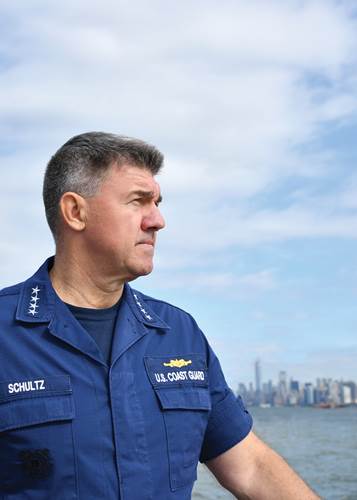
Coast Guard Commandant Adm. Karl Schultz visits with Coast Guard crews stationed in New York City. U.S. Coast Guard photo illustration by Petty Officer 1st Class Jetta Disco.

The Commandant has an opinion piece in “The Hill” explaining the effects of continued short falls in the Coast Guard’s Operating budget.

Because of unplanned maintenance and supply shortages, we lost the operating equivalent of two major cutters and seven helicopters last year, adversely impacting mission performance. In addition, the Coast Guard has delayed shore infrastructure repairs to such a degree that we now have a $1.7 billion backlog of urgent projects. Simply put, cuts from within have hollowed Coast Guard readiness.

He points to what appears to be a misinterpretation of the Budget Control Act.

A less-recognized impact developed when the lower sequester spending limit took effect in 2013. The BCA originally established the two primary categories of discretionary spending as “security” and “non-security.” However, once sequestration was enacted, the categories automatically changed to “defense” and “non-defense.” This means that DHS, with a military service — the Coast Guard — in its arsenal and national security as its primary responsibility, is limited under an annual non-defense discretionary cap of roughly $49 billion and forced to compete with all other non-DOD agencies for funding. Yet, under a “security” classification, DHS would be included with DOD under budget caps that recently exceeded $600 billion.

He suggests a phased solution.

The fix seems simple, and it is. The near-term solution is to increase the Coast Guard’s share of Defense funding — without penalizing DHS’s budget cap — to more appropriately resource us with necessary equipment, training, people and operating funds. Phased increases of $200 million per year, or 0.0003 percent of DOD’s 2019 budget, would begin to close the gap between our current Defense funding and actual Defense contributions.

The long-term solution is to recognize the Coast Guard’s crucial role in maintaining our national security and fund us as a military service. The appropriations structure should return to the “security” and “non-security” classifications, the original and arguably “just” intent of the BCA. This would ensure the Coast Guard is funded in parity within the same category as all U.S. Armed Forces and allow for consolidated oversight of all national security spending.

My Take

Let us be frank. We are not taken seriously as an armed force. We should be. In terms of personnel and number of ships, the Coast Guard is larger than the Royal Navy. If we want the Congress and the Administration to see us as a Defense asset, we need to do more than talk the talk, we need to walk the walk. We need missions and weapons. We need to identify the threats, how we can compliment the Navy, and the additional capabilities we need, not just in the case of a terrorist attack, but also in case of a major conflict with a near peer adversary.

The capacity building which we do, and I believe is important, can be perceived as more law enforcement than defense. These operations may even be seen by some, as an indication we actually have more assets than we need, since we have taken on this extra task, which is outside our normal mission areas.

We seem to argue that we are funded for peacetime and our readiness for war comes as a free good. We need to change that argument and that perception, which we have unfortunately cultivated. Our Defense Readiness needs to be paid for.

On the other hand, we can argue that, unlike other armed services, the Coast Guard gives the country a double payback. When we are funded the Coast Guard’s readiness for war, the country also gets better results in peacetime. It means more capable platforms, better communications and intelligence, and more secure ports.

“Coast Guard Hopes to Have 3 Polar Security Cutters Fielded by 2028” –USNI

The US Naval Institute reported on the Commandant’s remarks from the service chiefs panel at the Navy League’s annual Sea Air Space conference regarding the Polar Security Cutter program.

“right now my sense is we enjoy support from the administration, we enjoy bipartisan, bicameral support” in Congress, he said

The first ship is supposed to deliver to the Coast Guard in 2023..The Commandant did not speculate on the future funding profile, saying only that he expected three PSCs operational by 2028. USNI noted,

…buying the second and third ships in FY 2021 and 2023, respectively – would allow for all three to be in the fleet by 2027 or 2028.

Chief of Naval Operations Adm. John Richardson also remarked on Freedom of Navigation Operations in the Arctic and the Navy’s intention to operate in the Arctic.