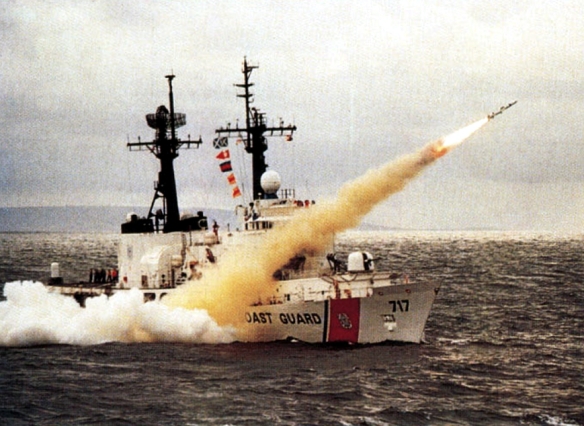
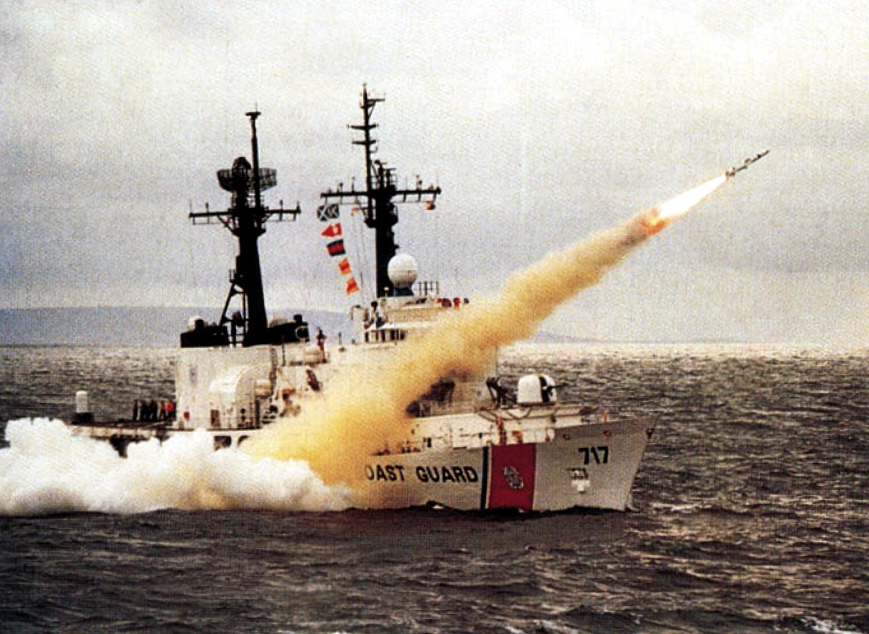
USCGC Mellon seen here launching a Harpoon anti-ship cruise missile in 1990.
The US Naval Institute Blog has a post by Cdr. Shawn Lansing, USCG, that addresses the question of the Coast Guard’s proper place in the Federal government, specifically countering arguments proposing moving the Coast Guard to the DOD. The author also spoke against increasing the military readiness of Coast Guard assets, so let me address the two issues separately.
Should the Coast Guard be part of the DOD?
Here we agree with a resounding NO. Most of the Coast Guard’s missions are outside the DOD’s sphere of interest. (I do think it might be better if the Coast Guard’s budget were considered outside the DHS budget since half of the Coast Guard’s missions are outside the DHS sphere)
Most of the arguments in favor have as their underlying assumption, the DOD is awash in money so the Coast Guard will be well funded. Since Sequestration began in 2013, short term, the Navy seems to have done better in the budget battles than the Coast Guard, but taking the long view I see it otherwise.
I can remember when the Navy was, in terms of personnel, 22 times larger than the Coast Guard. Now it is only about eight times larger. I could not find figures to support the 22 times figure. It was about 50 years ago. It was during the height of the Cold War and the Vietnam War; the Navy had about 900 ships, but looking back at some of my older books, I found personnel figures for 1982, 1999, and 2013. (Numbers of Navy ships by year and type are available here.)
In 1982 the Navy had 555 ships and a total of 548,475 active duty uniformed personnel, the Coast Guard 33, 799, meaning the Coast Guard was 6.15% the size of the Navy, or the Navy was 16.3 times as large as the Coast Guard.
In 1999 the Navy had 336 ships and a total of 372,696 active duty uniformed personnel, the Coast Guard 35,511, meaning the Coast Guard was 9.53% the size of the Navy, or the Navy was 10.5 times as large as the Coast Guard.
In 2013 the Navy had 285 ships and a total of 317,464 active duty uniformed personnel, the Coast Guard 42,190, meaning the Coast Guard was 13.3% the size of the Navy, or the Navy was 7.5 times as large as the Coast Guard.
The Navy has been in a long and steady decline, while the Coast Guard had enjoyed moderate growth. Over the 31 years from 1982 to 2013 the number of personnel in Navy fell 42% while the comparable number for the Coast Guard went up 25%.paralleling a US population growth of 36.5% for the same period.
Somehow I cannot imagine that if the Coast Guard had been part of the DOD during that period, that they would have grown the Coast Guard while the Navy and Marine Corps shrank.
Should the Coast Guard increase its Naval Mission Capabilities?
The author quotes the Coast Guard’s first Commandant, Commodore Ellsworth Bertholf,, “the Coast Guard does not exist solely for the purpose of preparing for war. If it did there would be, of course, two navies—a large one and a small one, and that condition, I am sure you will agree, could not long exist.”
For some reason the author seems to think that this idea rules out a more combat ready Coast Guard. Combat readiness is not the Coast Guard’s reason for being, but it is one of our missions.
Naval tasks are not the reason the Coast Guard exist, but the Coast Guard will do them because it is a ready asset that can be diverted from its normal missions when an urgent need exists, just as the Navy sometimes does humanitarian missions because it is a ready asset that exists for other reasons. To do them when required, with any expectation of success requires planning and preparation.
It is true that combat readiness has a cost. It may require additional personnel and additional training, but the cost of adding a combat capability to a Coast Guard asset that would exist for other reasons, is far less than providing the same capability in an additional Navy asset in addition to a Coast Guard asset without that capability.
It is logical that the degree of effort the Coast Guard puts into readiness will vary with the apparent threat. That is why I find the decision to remove the Harpoon anti-ship missiles and ASW capabilities from the 378s after the collapse of the Soviet Union was logical. Now the situation is changing. The situation in the Pacific is starting to bare an uncanny resemblance to the situation in the late 1930s, except that China is potentially a much more dangerous adversary than Japan ever was. Unlike Japan prior to 1945, China has an industrial capability that approaches and in some respects, particularly ship building, exceeds that of the US. Russia is not the Soviet Union. It is now China’s junior partner, but if its weight is added to that of China, the balance looks even more challenging, and the trend line looking to the future does not look good.
So far the Navy and Coast Guard have not done much about planning the Coast Guard’s role in a near peer conflict. Creative use of Navy owned equipment on cutters and augmentation by Navy Reserves could lessen the impact on the Coast Guard budget. We could see a lot more synergy between the Coast Guard and the Navy Reserve. Planning the use of Navy Reserve ASW helicopters and crew augmentation by Navy Reserve sonar techs and ASW trained officers seem appropriate. They could also augment Coast Guard assets during more routine operations to exploit Navy capabilities such as towed array sonars for law enforcement operations.
There is also the side benefit that the sensors required for Naval roles may make the cutters more capable in low enforcement, migrant interdiction, and SAR.
The Coast Guard proudly claim to be a military service at all times, once again it is time to act like one.
Bertholf’s argument, quoted above, did not mean he did not send cutters to escort convoys in WWI.





 Chuck Hill's CG Blog