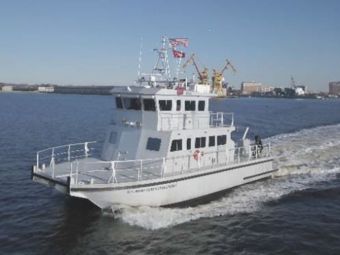
Saudis Buying 39 High Speed (45 knot) 106 foot Patrol Boats–WPB Replacement?

NavyRecognition is reporting award of a contract for 39 high speed 32.2 meter vessels that will probably be going to the Saudi Coast Guard.

In view of the need to replace the 87 foot Marine Protector class in the not too distant future, (The oldest, USCGC Barracuda (WPB-87301) was commissioned 20 years ago today, 24 April 1998.) this class might be worth a look. It is an example of the possible.

This is a CMN (French) design. CMN his a long history of building high speed vessels including the Israeli SA’AR 1, 2, and 3 missile boats and the widely used La Combattante series of fast attack craft.

Characteristics are reported as follows:

Length Overall : 32.20 m (105.6 ft)
Beam Overall : 7.00 m (23 ft)
Maximum draught : 1.40 m (4.6 ft)
Maximum speed : 43 Knots
Range at 12 Knots : 800 NM
Range at 33 Knots : 580 NM
Crew : 12
Fuel : 21 m3
Fresh water : 1 m3
Hull & Superstructure : Aluminium
Classification : Bureau Veritas

4.8 m outboard RHIB mounted on stern ramp

Three diesel engines

Three Waterjets : Two steering & one booster

Two main generators

Yes, it is larger than the Marine Protector class 87 foot WPBs by 19 feet, but the Webber class are 44 feet longer than the 110s they replaced, so the gap between new generation vessels would be greater than the previous generation 48 feet vice 23 feet.

Range, endurance, and crew size are similar to that of the Marine Protector class.

If you have been reading this blog for a while, you know I think the Webber class WPCs are, and are being used as, more small cruising cutter than as a “Fast Response Cutter” sitting in port waiting for a SAR call. These could be the real “fast response cutter,” and in many cases, they could beat a helicopter to the scene.


Mexico Naval Upgrades–Eight MH-60R

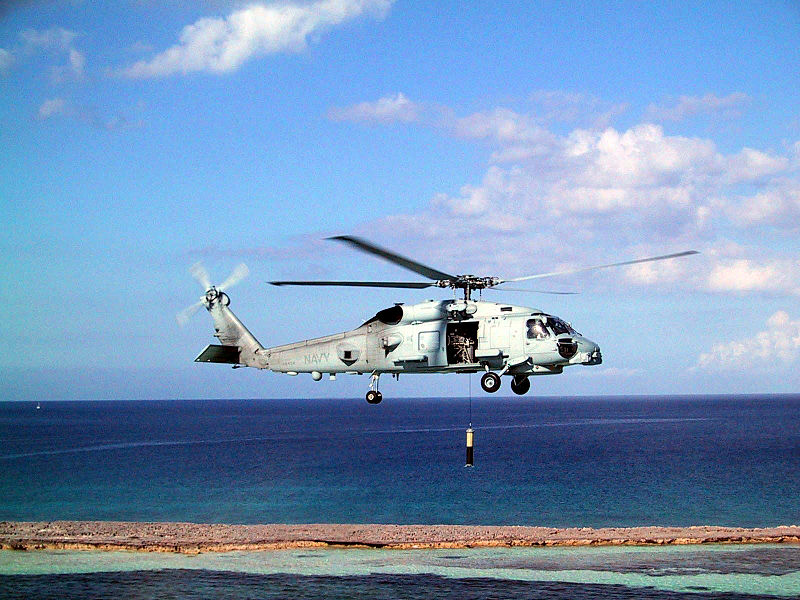
Navy photo. MH-60R “Knighthawk” helicopters conducts an airborne low frequency sonar (ALFS) operation during testing and evaluation

The Defense Security Cooperation Agency has released the following notice of approval for the sale of eight MH-60R ASW helicopters with associated equipment and weapons for the Mexican Navy valued at $1.2B.

Media/Public Contact:
pm-cpa@state.gov
Transmittal No:
18-06

­­­WASHINGTON, Apr. 19, 2018 – The State Department has made a determination approving a possible Foreign Military Sale to Mexico of MH-60R Multi-Mission Helicopters for an estimated cost of $1.20 billion.  The Defense Security Cooperation Agency delivered the required certification notifying Congress of this possible sale on April 18, 2018.

The Government of Mexico has requested to buy eight (8) MH-60R Multi-Mission Helicopters, equipped with:  twenty (20) T-700 GE 401 C engines (16 installed and 4 spares); sixteen (16) APS-153(V) Multi-Mode radars (8 installed, 8 spares); ten (10) Airborne Low Frequency Systems (ALFS) (8 installed and 2 spares); fourteen (14) AN/APX-123 Identification Friend or Foe transponders (8 installed and 6 spares); twelve (12) AN/AAS-44C Multi-Spectral Targeting Systems Forward Looking Infrared Systems (8 installed, 4 spares); twenty (20) Embedded Global Positioning System/Inertial Navigation Systems (EGI) with Selective Availability/Anti-Spoofing Module (16 installed and 4 spares); thirty (30) AN/AVS-9 Night Vision Devices; one thousand (1,000) AN/SSQ-36/53/62 Sonobuoys; ten (10) AGM-114 Hellfire missiles; five (5) AGM-114 M36-E9 Captive Air Training missiles; four (4) AGM-114Q Hellfire training missiles; thirty eight (38) Advanced Precision Kill Weapons System (APKWS) II rockets; thirty (30) Mk -54 Lightweight Hybrid Torpedoes (LHTs); twelve (12) M-240D machine guns; twelve (12) GAU-21 Machine Guns (an improved .50 cal. evolved from the M2–Chuck).  Also included are twelve (12) AN/ARC-220 High Frequency radios; spare engine containers; facilities study, design, and construction; spare and repair parts; support and test equipment; communication equipment; ferry support; publications and technical documentation; personnel training and training equipment; U.S. Government and contractor engineering, technical and logistics support services; and other related elements of logistical and program support.  The total estimated value is $1.20 billion.

This proposed sale will support the foreign policy and national security of the United States by helping to improve the security of a strategic regional partner.  Mexico has been a strong partner in combating organized crime and drug trafficking organizations.  The sale of these aircraft to Mexico will significantly increase and strengthen its maritime capabilities.  Mexico intends to use these defense articles and services to modernize its armed forces and expand its existing naval and maritime support of national security requirements and in its efforts to combat criminal organizations.

The proposed sale will improve Mexico’s ability to meet current and future threats from enemy weapon systems.  The MH-60R Multi-Mission Helicopter will enable Mexico to perform anti-surface and anti-submarine warfare missions and secondary missions including vertical replenishment, search and rescue, and communications relay.  Mexico will use the enhanced capability as a deterrent to regional threats and to strengthen its homeland defense.  Mexico will have no difficulty absorbing this equipment into its armed forces.

The proposed sale of this equipment and support will not alter the basic military balance in the region.

The principal contractor will be Lockheed Martin Rotary and Mission Systems in Owego, New York.  There are no known offset agreements in connection with this potential sale.

Implementation of this proposed sale will require the assignment of additional U.S. Government and/or contractor representatives to Mexico.

There will be no adverse impact on U.S. defense readiness as a result of this proposed sale.

This notice of a potential sale is required by law and does not mean the sale has been concluded.

All questions regarding this proposed Foreign Military Sale should be directed to the State Department’s Bureau of Political Military Affairs, Office of Congressional and Public Affairs, pm-cpa@state.gov.

Indonesia Uses Google to Stop Fish Pirates

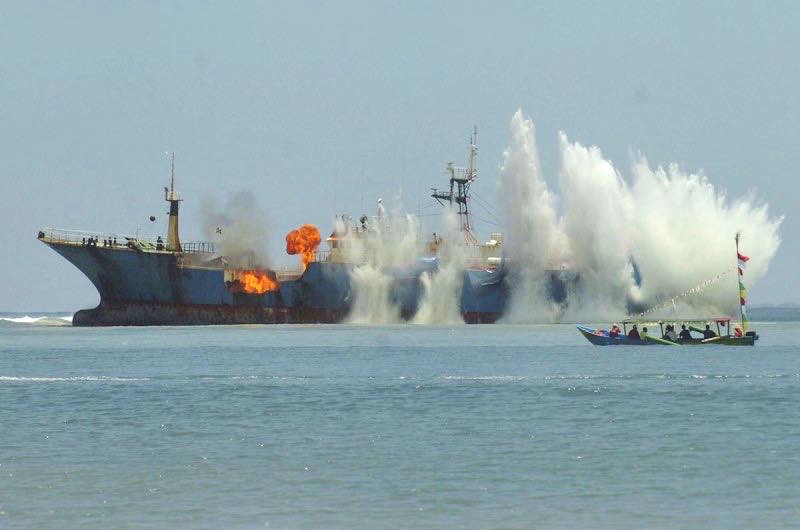
The Indonesian Navy and the Ministry of Maritime Affairs and Fisheries blow up an illegal fishing vessel near Tanjung Batumandi, Pangandaran, West Java, on March 14, 2016. Photo credit: REUTERS/Adeng Bustomi/Antara Foto

gCaptain reports Indonesia has had great success in using Google to crack down on Illegal, Unreported, and Unregulated (IUU) fishing.

“After hunting down violators and blowing up their boats in public spectacles, Pudjiastuti’s approach has become more sophisticated. In a global first, the minister has teamed up with Google to use satellites to spot illegal fishermen from space. It’s paying off: Indonesia’s fish stocks have more than doubled in two years, and an industry plundered by foreigners for decades is once again contributing to economic growth, which Widodo has pledged to boost to 7 percent.

“See Also: Scientists Use AIS Data to Map Global Fishing Activity in Extraordinary Detail

“In a sprawling archipelago of 17,000 islands, the potential is vast. While fishing currently accounts for just 2.6 percent of Indonesia’s gross domestic product, that portion has grown about 40 percent since Pudjiastuti started her role. At that time, there were some 10,000 foreign vessels fishing illegally in Indonesia’s territory. She says they’re now all but gone.

Here is an earlier post on the Google system.

Antarctic Resupply at McMurdo–After the Icebreaker

MSC M/V Ocean Giant at the ice pier, McMurdo Station

The Military Sealift Command has given us a three part series on their operations to resupply McMurdo Station

“Military Sealift Command’s Expeditionary Port Unit 114 Gets Operation Deep Freeze 2018 Underway On Time”

“Military Sealift Command Chartered Ship Arrives in Antarctica in Support of Operation Deep Freeze 2018”

“MSC Operation Deep Freeze 2018 Fuel Delivery Operations begin at McMurdo Station With Arrival of M/T Maersk Peary

Thanks to Lee for bringing this to my attention. 

Coast Guard to Recieve Two Satellites, Launch Expected This Year

Cube shaped satellite, 100mm (3.9″) on a side. This photo shows the Norwegian student satellite NCUBE2 ready for shipment to the Netherlands for integration with the ESA student satellite SSETI-Express, photographer, Bjørn Pedersen, NTNU.

National Defense is reporting that the Air Force is building two “Polar Scout” SAR satellites for the Coast Guard, expected to be launched this year.

An earlier post referenced a Acquisitions Directorate report on this R&D Center project.

These satellites, or “cubesats,” are capable of detecting transmissions from emergency position indicating radio beacons (EPIRBs), which are carried on board vessels to broadcast their position if in distress. The Coast Guard will deploy the cubesats in cooperation with the Department of Homeland Security (DHS) Science and Technology Directorate’s Polar Scout program, the Air Force Operationally Responsive Space Office, and the National Oceanographic and Atmospheric Administration (NOAA).

These two satellites will only provide intermittent coverage of EPIRB signals from the polar regions so more satellites may follow.

This appears to be first fruit of a growing cooperation between the Coast Guard’s R&D Center and the Air Force Research Laboratory which has been formalized by a recent Memorandum of Understanding (MOU) signed by the heads of the two organization on April 12, 2018.


New Hull Form

Milkor high-speed 12 meter interceptor

NavyRecognition brings us a report of a proposed craft based on an innovative full form, a hydrofoil assisted catamaran.

There is more info on the design from the originator here.

They claim a 54 knot top speed. They also claim five days endurance, but it doesn’t look like that is a reasonable expectation for normal operations, since it has a crew of only four and only two bunks. It is only 12 meters (40 feet) long with a beam of 4.8 meters (15.7′).

Still this new tech is not just vaporware. The Corps of Engineers has taken delivery of a survey vessel using this technology, S/V Ewell.

All aluminum S/V Ewell has a 61 ft 4 in length overall and 24 ft beam.

“Designed and built to Lloyd’s Register Special Service Craft rules, the Ewell is equipped with twin 985 bhp MAN V8 propulsion engines which each turn a Hamilton waterjet allowing for quick mobilization and response at high speeds in excess of 34 knots and survey speeds up to 10 knots.”

Like most aspects of Naval Architecture, there are compromises. This hull form is for vessels that can be kept light and will spend a lot of time at high cruise speeds.

A final note: The MILKOR design includes a 40mm grenade launcher as its main armament. Having tested a 40mm grenade launcher as a naval weapon, I found they are unsuitable for use against another vessel. They might be OK for laying down suppressive fire against an enemy on shore, but their long time of flight and high trajectory means they are very inaccurate against moving point targets.

Commander, Pacific Area Talks About Operating Budget

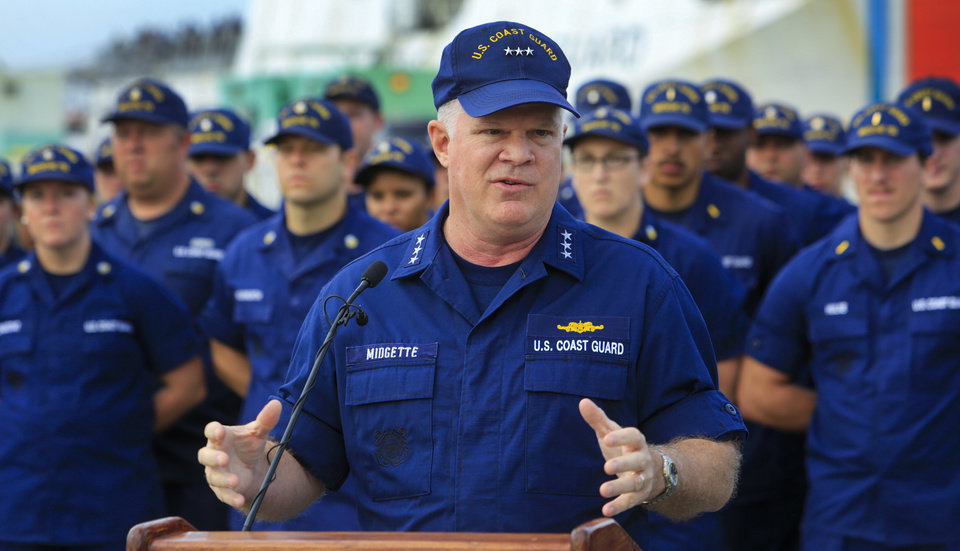
At Naval Base San Diego, Coast Guard Vice Admiral Fred Midgette, Commander, Pacific Area, Commander, Coast Guard Defense Force West answers questions during a press conference where he announced that 39,000 pounds of cocaine had been seized during the Coast Guard Cutter Waesche’s current deployment, Thursday, Oct. 27, 2016, in San Diego. The Coast Guard cutter on Thursday off-loaded narcotics that were confiscated in 25 separate busts that took place off the coasts of Central and South America over the past fiscal year. (Howard Lipin/The San Diego Union-Tribune via AP)

The San Diego Union-Tribune reports an address by Pacific Area Commander and Commander Coast Guard Defense Force West, Vice Admiral Fred M. Midgette, discussing the need to address operating budget short falls.

Incidentally, VAdm. Midgette has spent some time afloat.

“Vice Admiral Midgette has served afloat on both coasts and the Great Lakes, earning designation as a Coast Guard Cutterman and a U.S. Navy Surface Warfare Officer. He has commanded four Coast Guard cutters and served afloat on the CGC TANEY (Portsmouth, VA); USS FIFE (San Diego, CA); CGC POINT LEDGE (Fort Bragg, CA); CGC POINT WINSLOW (Eureka & Morro Bay, CA); CGC KATMAI BAY (Sault Ste. Marie, MI); CGC HARRIET LANE (Portsmouth, VA); CGC FORWARD (Portsmouth, VA); and America’s Tall Ship – the Coast Guard Barque EAGLE (New London, CT). He is the 14th Gold Ancient Mariner of the Coast Guard – an honorary position held by an officer with over ten years of cumulative sea duty who has held the qualification as a Cutterman longer than any other officer.”

Nice to see a 327 sailor made good.