Fincantieri’s Icebreaker Design Team Emerges

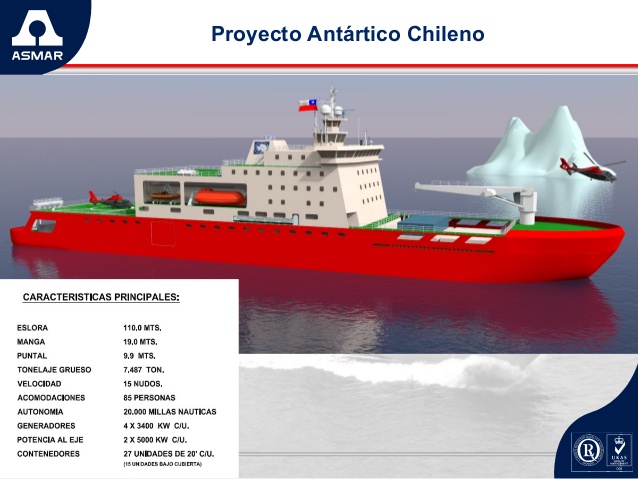
Photo: VARD designed icebreaking supply vessel for Chile. 

MarineLog is reporting, “APRIL 6, 2017—Philly Shipyard, Philadelphia, PA, is teaming with Fincantieri Marine Group (FMG) to compete for the detail design and construction of the next generation heavy polar icebreaker for the United States Coast Guard (USCG).”

“Over the next year, FMG and Philly Shipyard, along with the naval architecture and marine engineering firm, Vard, will develop a baseline icebreaker design, cost estimate and project schedule and then refine them based on the results of the technical studies and corresponding feedback from the USCG.”

This is in response to a contracted awarded to five shipbuilders on Feb. 22, 2017, for preliminary design studies and analysis. Contracts were awarded to Bollinger Shipyards, LLC, Lockport, LA; Fincantieri Marine Group, LLC, Washington, DC; General Dynamics/National Steel and Shipbuilding Company, San Diego, CA; Huntington Ingalls, Inc., Pascagoula, MS; and VT Halter Marine, Inc., Pascagoula, MS, totalling approximately $20M.

Fincantieri is building a 9000 ton research icebreaker for Norway and Vard has designed an icebreaking supply vessel for Chile.

“Best Cutters of the Best Coast Guard”–Claw of Knowledge

I’ve mentioned the “Claw of Knowledge” before, here and here. Now this Coastie blogger with a light touch is working on his second book and is asking for help in the form of a “kick starter.” The book, “The Best Cutters of the Best Coast Guard,” will tell the story of thirteen cutters. So far we know these will include Bear, Eagle, Northland, Storis, Point Welcome, and Campbell.

Here is his recent story on Point Welcome.


WWI Centenial–Coast Guard Compass


The Coast Guard Compass has begun the first of a series on the Coast Guard in World War I.

The war cemented the service’s role as a military agency. Nearly 9,000 Coast Guard men and women would participate in the war. This number included over 200 Coast Guard officers, many of whom served as warship commanders, troop ship captains, training camp commandants and naval air station commanders. In all, Coast Guard heroes received two Distinguished Service Medals, eight Gold Lifesaving Medals, almost a dozen foreign honors and nearly 50 Navy Cross Medals, dozens more than were awarded to Coast Guardsmen in World War II.

Looks like it might be interesting.

Admiral Papp Interviewed–OPC/Inland AtonN/Budget

Former Commandant, Admiral Papp, has been at the Sea-Air-Space EXPO representing Eastern Shipbuilding. He has given a couple of interviews, the one above and a second one here.

Of the two, I think the one you can view above is by far the more interesting, and his comments were not limited to the Offshore Patrol Cutter, discussing the inland tender fleet and the CG budget in general as well. There were a couple of notable details in the interview.

Admiral Papp stated explicitly that the expected crew size for the OPC would be 126 (I suspect this might actually refer to the planned accommodations rather than the crew). That is considerably more than the crew of the WMECs they replace. These ships are actually a third again larger than the 378s and much more capable than the ships they replace, so this should not be a great surprise. I do think this is more than the nominal crew of the National Security Cutter, although probably less than they actually sail with.

He also stated that the electric motors in the hybrid propulsion system would be good for at least nine and perhaps as much as 13 knots. All along I had assumed the hybrid system had been adopted as a means of meeting the range requirement, but since it is apparent they do not expect to be able to reach 14 knots using the electric motors, then the claimed range of 10,200 miles at 14 knots must be achievable using the Main Propulsion diesels. This suggest the range at lower speeds using only the ship’s service generators and electric motors may actually be considerably more.

Admiral Papp also suggested that there may be a possibility of exporting Eastern built ships because of its projected cost, well under $350M per ship.

Thanks to Luke for bringing this to my attention. 

Draft Polar Icebreaker Specs Issued

The Acquisitions Directorate (CG-9) is reporting that they have issued draft specifications for the Polar Icebreaker. The following is a verbatim copy of the press release.

The Coast Guard released its draft heavy polar icebreaker system specifications in a request for information (RFI) today. The request seeks questions, comments and feedback related to heavy polar icebreaker technology risks, sustainability, producibility and affordability. The RFI can be found here.

This RFI is part of ongoing market research conducted with the Navy and includes the draft specifications for icebreaker hull structure, propulsion and electrical plants, command and surveillance systems, weaponry, outfitting and auxiliary systems. Industry sources are invited to submit responses by June 16, 2017, at 11 a.m. Eastern time.

Following market research, the Coast Guard plans to release a request for proposal for detail design and construction of a heavy polar icebreaker in fiscal year 2018. The service plans to begin production activities in 2020.

For more information: Polar Icebreaker program page

We don’t have access to the specifications.

“Due to size limitations, the draft HPIB System Specification will be posted to FedBizOpps (FBO) via multiple document packages which will be deemed “limited access” and “export controlled.” All vendors must be granted “explicit access” by USCG in the FBO system in order to gain access to these limited access or export controlled packages.”

Playing Politics

Cdr Salamander has an interesting perspective on how the service leadership interacts with successive administrations and the dangers of being to closely associated with the agenda of a particular administration.

Actually I think the current leadership has been very consistant in identifying real priorities, but we haven’t always been so clear and consistant. Its worth considering.

Thanks to Lee for bringing this to my attention.

U.S. Coast Guard Selects FLIR and Raymarine–MarineLink

MarineLink reports, 

FLIR Maritime announced recently that it has been awarded a $50 million indefinite delivery, indefinite quantity contract to provide marine electronics systems under the U.S. Coast Guard’s Scalable Integrated Navigation Systems 2 (SINS-2) program over a five-year period providing the purchaser a right to extend delivery for an additional five years.

FLIR will provide electronics systems that will be standard fit on over 2,000 U.S. Coast Guard vessels, ranging from small-class boats through large cutter-class vessels. The systems include Raymarine multi-function navigation displays, radars, sonars, remote instrument displays, and autopilots.