The Rand Corporation has issued an interesting post regarding the increased use and aggressiveness of Asian Coast Guards. It is based on a study of the Chinese, Japanese, Vietnamese, and Philippine Coast Guards. The full text of the study is here. in pdf format.
The growth of these four Coast Guards has been remarkable. According to the report, between 2010 and 2016 the China Coast Guard vessel tonnage has increased 73%, the Japan Coast Guard increased 50%, the Vietnamese CG by 73%, and the Philippine CG by 100%.
The growth is largely driven by China’s pushiness using its newly formed Coast Guard, but it is also because of Japan’s new willingness to provide security assistance, at least in the form of Coast Guard vessels, to nations who, like them, must confront Chinese aggressiveness.
There also seems to have been a tacit acceptance of the idea that gray hulls should not mix it up with white hulls. This has played into the hands of the Chinese who have by far the largest fleet of white hulls in the world. In fact there are really only two kinds of vessels, private and government, and when fishing vessels act under government orders they are defacto government vessels
The full report has some figures I had not seen before.
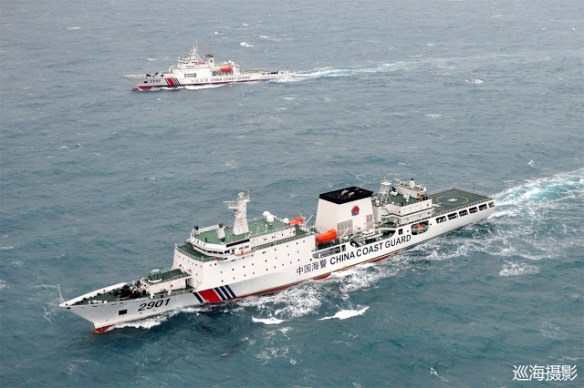
Despite the fact that its missions apparently do not include Aids to Navigation, China’s CG is by far the largest:
“China’s investment has yielded a total fleet size of around 215 vessels, of which 105 are considered large (more than one-thousand-tons displacement) and 110 small (less than one thousand tons). In terms of total tonnage, China boasts the largest coast guard in the world at roughly 190,000 tons, enjoying substantial quantitative overmatch over its Asian competitors.” (The CCG reportedly has 17,000 members.)
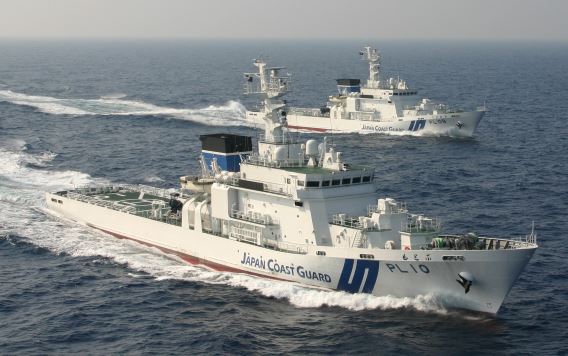
Japan Coast Guard had a head start, it has grown less but still has more ships than the USCG.
In terms of fleet size, the U.S. Office of Naval Intelligence estimates that Japan has approximately fifty-three large and twenty-five small vessels in operation. The largest vessels in the JCG fleet include two PLH-class vessels with a displacement of 6,500 tons (9,000 tons fully loaded) and two Mizuho-class vessels of 5,200 tons. For comparison, the largest and most capable destroyers in the JMSDF, the Kongo-class vessels, displace approximately 9,500 tons. Most of the medium-to-high-endurance JCG vessels are equipped with deck-mounted autocannon that range in caliber from 20 to 40 mm, and most JCG officers carry light firearms for self-defense. Notably, the PLH-class cutters are only equipped with two Oerlikon 35–40 mm autocannon and two M61 Vulcan 20 mm six-barrel Gatling-style guns, compared with the 76 mm cannon on China’s largest cutter, Haijing 3901.
In terms of aviation assets, the JCG has by far the largest fleet in Asia, second only to the U.S. Coast Guard in the world, boasting twenty-six fixed-wing aircraft and forty-eight helicopters. Finally, the JCG has roughly 13,500 personnel, second most among coast guards in Asia.
Vietnam has also recently formed a Coast Guard.
The VCG has approximately fifty vessels: five large (the largest displaces 2,500 tons) and forty-five small. Soon after the Haiyang Shiyou 981 (HYSY 981) incident in 2014, Vietnamese prime minister Nguyen Tan Dung announced the allocation of U.S.$540 million to build thirty-two new coast guard ships and hundreds of aluminum fishing vessels that can withstand ramming better. With the delivery of two five-hundred-ton TT400TP-class patrol vessels in January 2016 and the addition of six one-thousand-ton patrol craft pledged from Japan, Vietnam will boast the largest coast guard fleet in Southeast Asia. Most VCG vessels have light-caliber deck-mounted autocannon or machine guns (ranging in size from 14.5 to 23 mm) or both, and most crewmembers carry light firearms for self-defense. The VCG has three fixed-wing CASA C-212 Aviocar patrol aircraft. The VCG has approximately 5,500 total personnel.
The Philippine Coast Guard:
The PCG maintains a small fleet of eight medium-endurance patrol craft, mounted with 50 mm autocannon; four buoy tenders; and roughly thirty-two small patrol vessels. Japan’s announcement that it plans to sell eight medium endurance cutters to the Philippines will mean an almost doubling of the PCG medium-endurance-cutter fleet. The PCG has only two operational aircraft— one fixed wing and one helicopter—but it is slated to receive two helicopters from France within the next few years. Finally, there are roughly 9,000 personnel in the PCG, with plans to expand to 13,500 by 2020.
A final note:
It is not clear what type of displacement the study used. I try to consistently use full load, but Asian nations tend to try to minimize displacement and frequently report only light displacement.
The total displacement of the US Coast Guard’s ships is also going up, but it is not because of more ships, it is because the ships are larger. The total full load displacement for the program of record, 8 NSCs (36,000 tons), 25 OPCs (about 100,000 tons), and 58 FRCs (21,170 tons) is about 157,170 tons. The NSCs are 50% larger than the 378s. The OPCs are a third larger than the 378s and four times the size of the 210s. The FRCs are three times the size of the 110s they replace.
It might be assumed that a Country’s Coast Guard’s size should be related to the size of the country’s EEZ. It doesn’t seem to have worked that way. The size of the EEZs for the countries is
China: 877,019 km2 (plus disputed claims for 3,000,000 km2 )
Japan: 4,479,388 km2
Philippines: 2,263,816 km2
Vietnam: 748,875 km2
USA: 11,351,000 km2




 Chuck Hill's CG Blog