
If you are looking for Coast Guard photos, you might want to check out this Flickr page. https://www.flickr.com/photos/coast_guard/
Ran across this thanks to Bob Connelly’s post on the Coast Guard Aviation Association Facebook page.

If you are looking for Coast Guard photos, you might want to check out this Flickr page. https://www.flickr.com/photos/coast_guard/
Ran across this thanks to Bob Connelly’s post on the Coast Guard Aviation Association Facebook page.

Marine Log reports recognition of “OV Bøkfjord as the Danish Ship of the Year 2016.”
OV Bøkfjord is multifunctional with the ability to operate as both a buoy and beacon maintenance vessel on a daily basis, as well as an oil recovery vessel for Kystverket in Norway.
It is designed for fast response time and fitted with specialized equipment, i.e. surface oil skimmers and dedicated holding tanks, etc. The vessel has an advanced diesel-electric hybrid propulsion system integrated into the vessel’s compact design.
These little 144 foot (44 meter) ships, intended to operate off Northern Norway, have several interesting features.
“We’ve developed a complex ramp system allowing the vessel to approach smaller islands and also to use the ramps for dynamic positioning during repairs at sea. These, as well as oil sweepers, holding tanks, offshore crane etc., have been integrated in the design whilst also making space for a battery pack, as Kystverket wanted the vessel to have diesel-electric hybrid propulsion.”
The following is a news release:
The Coast Guard released a request for information (RFI) for the polar icebreaker acquisition program today. The request seeks feedback on the program’s notional acquisition approach and schedule, and includes a draft statement of work for industry studies on heavy polar icebreaker technology risks, sustainability, producibility and affordability. The RFI can be found here.
The Coast Guard requests that respondents submit a plan of action and milestones for meeting the acquisition program schedule and identify risks and potential opportunities to accelerate the heavy polar icebreaker acquisition.
The RFI also includes a draft statement of work for future industry studies that will inform efforts to promote affordability and minimize risk.
The deadline to submit responses is Nov. 10, 2016, at 11:00 a.m. Eastern time.
Following the completion of the industry studies, the Coast Guard plans to release a request for proposals for detail design and construction of a heavy polar icebreaker in fiscal year 2018. The service plans to begin production activities in 2020.
For more information: Polar Icebreaker program page
NavyRecognition reports that DARPA has tested a combination of two of their projects that we have previously discussed, the Active Continuous Trail Unmanned Vessel (ACTUV) and the Towed Airborne Lift of Naval Systems (TALONS). This is a bit of departure for the ACTUV since it is designed to track submarines, but it might be applicable to counter drug operations in the Eastern Pacific.
“TALONS’ surface-track radar extended its range by 500 percent—six times—compared to its range at sea level. Its electro-optical/infrared scanner doubled its observed discrimination range. The TALONS team plugged in a commercial handheld omnidirectional radio; that radio’s range more than tripled.”
SOUTHCOM has been advocating using his area of operations as a testing ground. Perhaps DARPA would like to try this in the drug Transit Zone.
This is potentially high tech like our computers and cell phones, works better, cost less.
“TALONS is part of DARPA’s Phase 1 research for Tern, a joint program between DARPA and the U.S. Navy’s Office of Naval Research (ONR). Now that at-sea demonstration is complete, DARPA is transitioning TALONS to the Navy.”
Wonder if it might fit on the Webber class WPCs? They are larger than the ACTUV.
Here is the DARPA news release.
 Thales RAPIDSeaGuardian Naval Gun System
Navy recognition is reporting the announcement of a new 40mm naval gun system, based on an existing land based system (pdf). It is claimed to be “a new generation CIWS effective against super sonic seaskimming missile thanks to the airburst ammunition, as well as against asymmetric threats…” while having about the same “footprint and weight as a 25mm system.”
The system is interesting, but the star of the show is the gun and its innovative ammunition. The ammunition is “Case Telescoped” meaning that the shell is embedded in the casing and surrounded by the propellent. The gun and its ammunition are products of CTA International, an equal-shares joint venture company between defence companies Nexter (France) and BAE Systems. The resulting round is very short and shaped like a cylinder rather than the typical double tapered shape of most fixed (one piece) ammunition.

The short length of the ammunition means that the portion of the gun inside the mount can be very compact. In the illustration below, the 25mm M242 Bushmaster used in the Mk38 mount is at top right and the Case Telescoped (CT) 40mm is at the bottom right. It’s very compact breech mechanism is apparent.

Image source: thinkdefence.co.uk
If this gun could replace our 25mm guns on the Webber class WPCs and the Offshore Patrol Cutters, either by replacing the mount or perhaps by replacing the gun in the Mk38 mod2/3 mounts (also a BAE product), it would give us improvements in range, accuracy, impact, and particularly penetration. Rates of fire for the two systems are the same.
Range:
The effective range of the Mk38 has been variously reported as 2500 or 3000 yards. This has been a matter of concern to me because when approaching a suspicious vessel that might be being used to make a terrorist attack, I believe a cutter should remain at a distance such that improvised armaments cannot target specific critical equipment on the cutter (like its one gun mount). Improvised armaments might include heavy machine guns, anti-tank guided missiles, or Soviet era anti-aircraft or anti-tank guns of up to 130mm. From my observations and research, in order to preclude targeting critical systems, the cutter should initially approach no closer than 4,000 yards while its boarding party investigates. .
The NavyRecognition post reports a claim of 4,000 meters (4,373 yards) for CTA’s 40mm. While I have not been able to find a claimed max range for the CTA 40mm, the maximum range for the ballistically similar Bofors 40mm/70 is 13,675 yards (12,500 m). The M242 25mm used in the current Mk38 mod2 has a max range of 7,450 yards (6,800 m). Assuming the effective range is proportional to the maximum range, the CTA 40mm should be able to effectively engage from beyond 4000 yards (3,659m).
Penetration:
The image below, from thinkdefence, shows a comparison of effectiveness against armor using armor piercing fin stabilized fin stabilized discarding sabot (APFSDS) rounds.

To me, greater armor penetration translates into being able to penetrate the hull and go on to wreck a larger diesel engine than the smaller round.
As far as I can tell, while there is an armor piercing fin stabilized discarding sabot (APFSDS) round for the 25mm, the Mk110 57mm has no round comparable to the APFSDS round offered for the CT 40mm, which has a muzzle velocity of 1,640 meters/second or approximately 5,379 feet/second. The 57mm round would explode shortly after penetrating the skin of the ship, likely before it reached the engine.
Impact:
Because the 40mm round is about twice as big as the 25mm round, its effective radius is considerably larger.
The image below (also from Thinkdefence) shows a fragmentation comparison between a 30mm airburst round (left) and the 40mm GPR-AB (40mm airburst). The lethal area for the airburst nature at 1,500m is 125m2. Apparently there is no airburst projectile for the 25mm because it is considered to small to be effective.
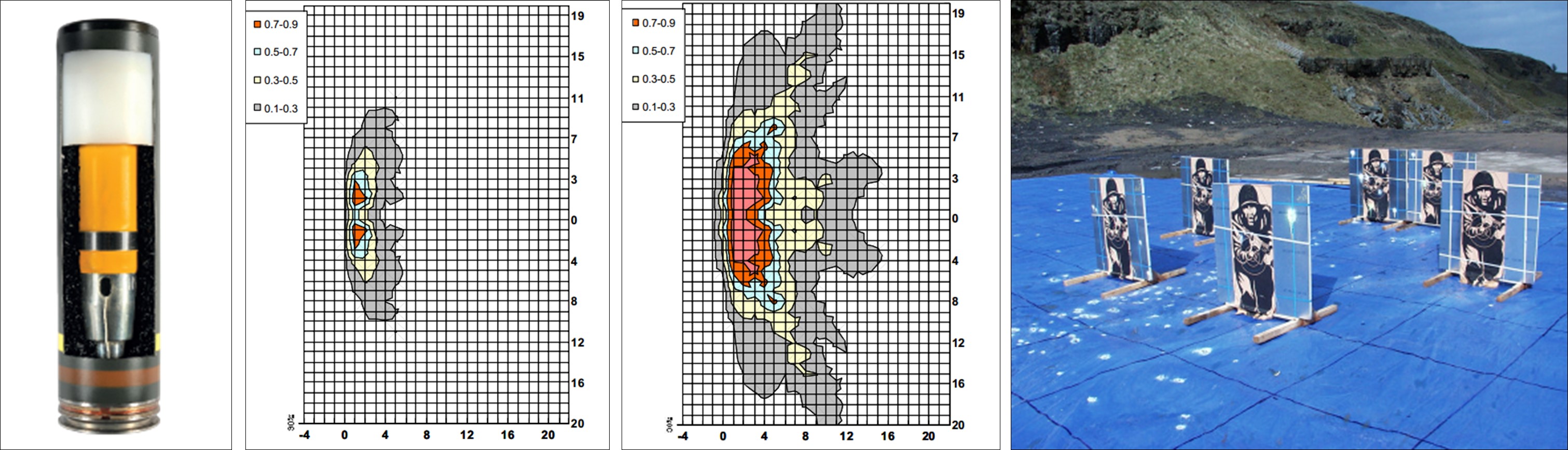
Is this gun really ready for “primetime?”
Our friend at thinkdefence.co.uk has done an extensive examination of the development of this weapon.
The gun has been adopted by the British Army for installation on two types of armored vehicles and the French are also planning on using it in one of their armored vehicles.
Apparently the gun is a success and will probably find additional application, including, hopefully, a version of the Mk38.

Russian Coast Guard Naval Ensign
DW.com reports there has been a violent encounter between the Russian Coast Guard and a North Korean fishing vessel.
Reportedly, the North Korean vessel was boarded inside the Russian Exclusive Economic Zone (EEZ). After the boarding party found illegal catch, the F/V, with a crew of 48, attempted to resist the boarding party, take their weapons, and flee the Russian EEZ with the boarding party still aboard.
The Russian Coast Guard enforcement vessel used disabling fire into the North Korean vessel. One member of the boarding party sufffered a head injury and nine North Koreans were injured, one of whom subsequently died.
Clearly fishing is taken very seriously in Asia. This and previous incidents may point to increasing desperation on the part of fishermen as a result of overfishing.
Thanks to Luke for bringing this to my attention.
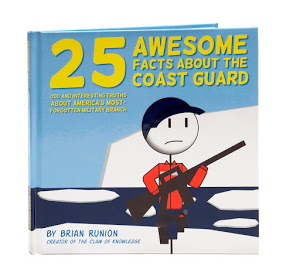
The Claw of Knowledge is a very different sort of Coast Guard web site with a very light hearted view.
The author has published a book you might want to consider:
http://shop.clawofknowledge.com/products/25-awesome-facts-about-the-coast-guard-1
I have not seen the book, but I think this will give you a good idea of the author’s style.
He also has a great story about the Bear.
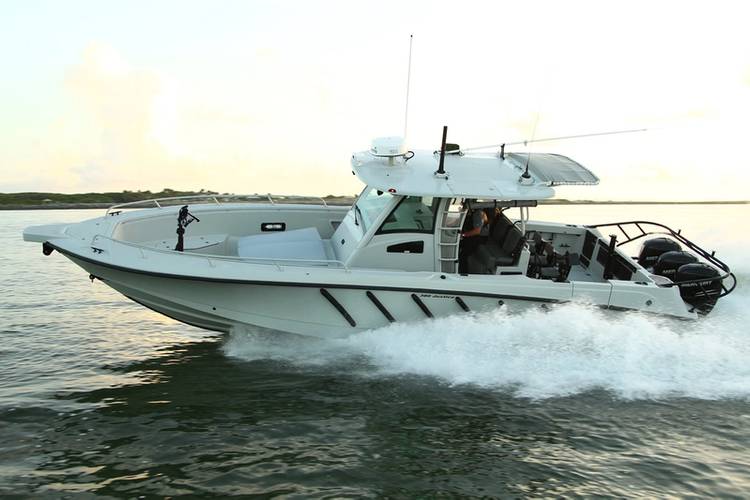
Photo: BCGP
MarineLink is reporting award of a potentially $72M contract to Brunswick Commercial & Government Products (BCGP).
“The single-award, indefinite-delivery/indefinite-quantity contract is for both 32-foot and 37-foot Boston Whaler Justice boats and will include spare parts, maintenance and training support for The United States Southern Command (SOUTHCOM) area of responsibility, which includes Central America, South America and Caribbean nations…. To date, BCGP has delivered 38, 37-foot and 17, 32-foot Boston Whaler Justice boats.”
Any one know how these are being used? Gifted to our partner nations?

NavyRecognition reports award of a $125.6 million follow-on contract to General Dynamics Mission Systems to support Rescue 21, a system that uses VHF radio direction finders to determine the origin of distress calls. The post also provides a quick overview of the system except it doesn’t seem to include Alaska and the Western Rivers (Mississippi, Missouri, and Ohio river valleys) which are also now included in the system.
This is how the Acquisitions Directorate describes the system:
“Rescue 21 replaces the National Distress and Response System, which has been in use since the 1970s. Rescue 21 can more accurately identify the location of callers in distress via towers that generate lines of bearing to the source of VHF radio transmissions, thereby significantly reducing search time. Rescue 21 extends coverage out to a minimum of 20 nautical miles from the coastline. It improves information sharing and coordination with the Department of Homeland Security and other federal, state and local first responders, and can also identify suspected hoax calls, conserving valuable response resources.”
You can trace the history of the system in a series of news releases here.
October 13, 1775 is the day the Navy claims as their birthday makiing this the 241st anniversary of its founding. They have a proud history, and really the Coast Guard and its preceeding services have had a role in that history. Perhaps that is why we are included in the video above. If you look at the video above, at time 0:46 you will see a pair of Coast Guardsmen on the foc’sle of an 82 foot WPB firing an M-16 and an over and under 81mm/.50 caliber in an apparent Vietnam firefight. The Navy also used a number of the over and under mounts on “Swift Boats” but they were mounted aft.
Happy birthday US Navy.
 Chuck Hill's CG Blog