Today we celebrate Coast Guard Day. The Coast Guard can point to many achievements over its history, but for me, our greatest achievement was the Coast Guard’s response to Katrina. I was out of the service by then, but I watched the news reports and felt immense pride in being associated with the service.
Katrina was ten years ago this month and a documentary will be aired late this month on PBS stations in Alabama, Mississippi, and Louisiana. The film is not a lavishly produced summer blockbuster, it is a student film, but was apparently a labor of love, the idea of a “Coast Guard brat.” You can learn more about the film and its genesis here and here.
Navyrecognition reports that a successful test of modified Hellfire missiles for use in the Surface to Surface Missile Module (SSMM) planned for the Littoral Combat Ship has paved the way for operational deployment of the system in late 2017.
We have talked about these missiles before. They seem to be an ideal way to deal with the threat of small, fast, highly maneuverable boats that might be employed by terrorists, and absent more effective weapons, may provide some capability against even large vessels. Unlike gun systems, they promise high first round accuracy and lethality, with very little chance of a round going astray and hitting something unintended.
The projected SSMM would provide storage and launch facilities for up to 24 rounds. 24 rounds would weigh only about 2500 pounds. The launcher and support systems is unlikely to weigh more than that, suggesting and all up weight of about 5000 pounds, far less than either the 76mm Mk75 gun or the 57mm Mk110 (two and a half tons compared to eight or nine tons). Both of these guns are commonly used on missile and patrol boats smaller than the Webber class WPCs. Also unlike a gun system, the SSMM is unlikely to require any significant deck reinforcement. It would almost certainly fit on all large cutters and perhaps the WPCs and WPBs as well. (It should be included on Offshore Patrol Cutters from day 1.) If the 24 round system is too large to be comfortably carried by smaller cutters, it is likely a smaller, say four round, system could be quickly and economically developed for Coast Guard use and perhaps for the Navy’s MkVI patrol boat as well.
If we take the Ports, Waterways, and Coastal Security mission seriously we really should be looking seriously at acquiring these systems, not just for the new ships as they are built, but also for the existing fleet with the idea that the systems would be transferred to the newer ships as the older ones are replaced.
The Navy should be willing to pay for these systems under existing inter-service agreements.
As noted before, if we need to stop a terrorist attack, we are far more likely to have a WPC or WPB on scene than a larger cutter. For this reason, arming some the Webber class in each homeport should be the first priority. Unfortunately the Webber Class are not geographically wide-spread, so we should look at mounting systems on existing MECs and WPBs to insure all potential targets have some protection until the entire fleet is armed.
I would say there are places where they might be mounted on Coast Guard stations ashore, to act as gate keepers for the ports against clandestine attacks, but coast defense is still an Army mission. Perhaps this is something we should be talking about too. If not Coast Guard manned defenses (which is probably the proper solution), then perhaps placement of unused SSMMs with their associated Navy crews on Coast Guard facilities or small detachments of army troops with their weapons to perform this function.
gCaptain is reporting that, since 2012, the Irish Naval Service has been experimenting with using kite sails to give their ships a fuel saving boost and to hoist aloft surveillance equipment up to 300 meters (1000 feet) into the air. They now consider the technology mature enough to be commercialized.
Putting sensors at 1000 feet gives a horizon distance of 38.7 miles compared with 8.7 miles for a more typical height of 50 feet.
The Irish Naval Service, their missions, and their ships look more like the US Coast Guard than the US Navy. This technology might have applications for the Coast Guard. Perhaps it is worth a look by the Research and Development Center.
It looks like the Navy may be working on something that looks similar, TALONS, but is only intended to hoist sensors, not improve fuel economy.
The title is not really the thrust of the article. It features the experiences of a man who served on the ship when she was in the German Navy and later came to find her in the US.
BairdMaritime is reporting the five nations bordering the Arctic Ocean have agreed to prohibit fishing in the “doughnut hole” that lies outside the EEZ of any of the five nations.
“A declaration has been signed by the five countries that surround the Arctic Ocean, to prevent unregulated commercial fishing of the 1.1 million-square-nautical mile “doughnut hole” which falls outside of any country’s jurisdiction.
“Canada, the US, Greenland, Norway and Russia have signed a document stating that they will not allow any vessels to conduct any commercial fishing until one or more international mechanisms are in place to manage fishing in accordance with recognised international standards.”
This really isn’t an issue now, because there is no fishing there now. Still I wonder how we can regulate fishing outside the EEZ. Still, good to see they are out ahead of the problem.
MarineLink has a short post about a European effort to use networked Unmanned Air and Surface Vehicles (UAVs and USVs) to do SAR. I don’t find their particular scenario persuasive, but there probably are roles for these systems.
Unmanned systems have some potential advantages over Manned assets although they are unlikely to ever replace them.
It may be possible to have UAVs more widely distributed than manned CG Air assets.
UAVs operating from SAR stations might also be able to get into the air more quickly than manned aircraft because they do not have to contend with other air traffic that may be operating on the field.
At least for some applications they may be cheaper to operate.
I have a hard time visualizing a use for Unmanned Surface Vessels (USV), but perhaps there might be a benefit in dropping a USV to a distressed vessel or person(s) in the water either from a fixed wing or a UAV.
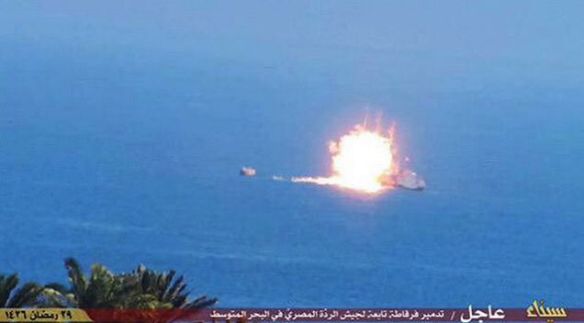
gCaptain reports that an Egyptian Coast Guard vessel has been attacked by a militant group, Egypt’s Islamic State affiliate, “Sinai Province.”
Other reports identified the vessel as a frigate, and the weapon as a guided missile. It does appear that the vessel is smaller and the missile was probably an anti-tank weapon rather than an anti-ship cruise missile.
Reportedly the vessel had been engaging elements ashore.
This is the type of extemporaneous weaponry the Coast Guard could expect a terrorist organization to use against the USCG if they attacked the US. We should be particularly concerned that they not be able to target specific critical systems on our cutters. Currently I consider 4000 yards to be a reasonable standoff distance to minimize this possibility.
USNI news service has posted a copy of the Congressional Research Services latest take on the Coast Guard Vessel recapitalization program, “Coast Guard Cutter Procurement: Background and Issues for Congress.” As usual their “Specialist in Naval Affairs,” Ronald O’Rourke, has done an excellent job and by simply stating the facts has made a strong case for recapitalization.
There are some criticisms implicit in the recitation of events thus far. I think it is apparent that the Crew Rotation Concept is proving an embarrassment, in that while we have now had three operational “National Security Cutters” for some time, there has been no attempt to validate the concept, and no attempt to repudiate this relic of the Deepwater program. The concept is a non-starter we have discussed several times. Ships are not cars in a motorpool. You cannot swap entire crews and expect good results. Time to piss or get off the pot. This bad news is not going to get better with age.


 Chuck Hill's CG Blog