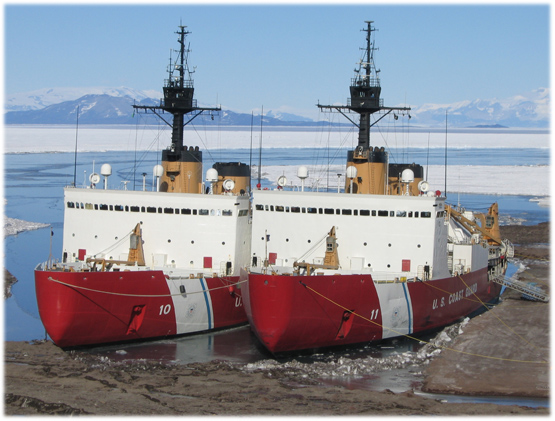
Sister Service Problems

The Navy is facing some hard questions regarding the declining numbers and readiness of its surface fleet. This post actually puts the best face on a hearing that has not gone well for the Navy.

Coast Guard implications?

  • I still see the Coast Guard making favorable references to “optimal manning,” but it has become a dirty word in the Navy resulting in deferred maintenance, poor morale, and declining readiness.
  • This is why the Department of Homeland Security can’t blithely say the Coast Guard does not need new ships because the Navy can do those jobs.

Ops in the Western Pacific

Coast Guard Cutter Galveston Island receives fuel from Bertholf in an astern refueling evolution

Coast Guard Cutter Galveston Island receives fuel from Bertholf in an astern refueling evolution. U.S. Coast Guard photo.

The Coast Guard Compass has a new post “From the Bridge of the Bertholf: Hawaii Patrol.” There are a couple of things I really like seeing in the report, first that they are working in the Western Pacific EEZ, and second that they are working jointly with patrol boat Galveston Island.

A larger cutter operating with a smaller one (or two) opens up a lot of options potentially almost doubling the effectiveness of the large ship, with the smaller cutter providing another 24/7 radar and lookout node, as well as an independent high endurance boarding platform to cover a different geographic area. The Fast Response Cutters with their larger crew and better seakeeping should make this an even more attractive option. (In the article they are doing an astern refueling. I would think that an alongside method could be developed that would be quicker and safer.)

As I noted earlier, the Fourteenth has by far the largest EEZ (5,800,889 sq kM), even larger than the Seventeenth’s EEZ surrounding Alaska  (3,770,021 sq. kM). My impression is that we don’t spend enough time patrolling there and when we do, we always seem to find egregious violations.

New Port Security Boats

This from Workboat.com

“Kvichak Marine wins 80-boat contract to supply Coast Guard Transportable Port Security Boats for five years
By WorkBoat Staff
6/2/2011

“SEATTLE – Kvichak Marine Industries Inc. was recently awarded a five-year contract by the U.S. Coast Guard for the construction of up to 80 Transportable Port Security Boats (TPSB). This contract was originally awarded to ACB, Bellingham, Wash., before the company shut its doors in November. The all-aluminum vessels are operated by a crew of four and include shock mitigating seats to minimize crew fatigue on extended missions. Ballistic armor protection and up to four mounted weapons provide increased mission capability and crew safety during tactical operations, according Kvichak. The 32’9” vessels will replace the USCG’s current aging fleet of smaller, outboard-powered fiberglass boats.

“Powered by twin Yanmar 315 hp diesel engines with Bravo 1-XR outdrives the TPSB will provide security, maritime law enforcement and search-and-rescue operations in coastal areas worldwide. The TPSB can maneuver in as little as 24” of water and can operate safely in 8’ seas and up to 30 knots of wind.

“Current orders have deliveries beginning in August, with 30 boats schedule for delivery by January 2012.”

(Thanks to Lee for bring to my attention.)

July 7, 1798, The Quasi-War with France

Today marks the anniversary of the start of the Quasi-War with Republican France in 1798. As most of us know, the Navy was virtually non-existent. The first three frigates were being completed just as the war began. New cutters with more potential as warships were replacing the original ten and Cutters Pickering and Eagle proved particularly useful. Eagle captured or assisted in the capture of 22 vessels and Pickering captured or recaptured 18 including four privateers. Pickering’s capture of the l’Egypte Conquise was particularly notable because the French privateer was much more heavily armed and had a crew reported as large as 350 compared to Pickering’s crew of about 70. Ultimately Pickering was lost with all hands in a hurricane in  September 1800 that also sank the frigate Insurgent which had been captured by the Constellation and taken into US service.

The Coast Guard History web site has an excellent article (pdf), “Benjamin Hiller & the Cutter Pickering in the Quasi-War with France.” William Thiesen, Sea History 122 (Spring, 2008), pp. 24-27; published with the permission of the National Maritime Historical Society.

Perhaps it is time to have cutters named for Benjamin Hiller and the Revenue Cutter Pickering.


Piracy Update, July 6, 2011

This is coming relatively soon after the last update, but there have been several interesting developments:

As a result of a pirate attack, a 144,000 ton Very Large Crude Carrier has been set afire and abandoned in the Gulf of Aden, 20 miles south of Yemen. The crew of 26 was rescued by the cruiser USS Philippine Sea. This occurred in the area most heavily patrolled by counter piracy forces.

Britain like the Netherlands is considering allowing their merchant ships to arm themselves.

There is a prediction that the pirates will start using heavier weapons. This sort of escalation has been predicted in the past, we’ll see.

Information dissemination has provided a grim and thought provoking post on the future of Africa and Al-Qaeda that touches on piracy, Somalia, and Al Shabaab. It provides a lot of background for USCG efforts in Nigeria, Yemen, and Djibouti and African Partnership station in general.

ADDENDUM:

The UN has informed Reuters there is a financial link between some pirate organizations and Al Qaeda’s affiliate in Somalia, Al Shabaab. Not that the terrorist group is engaged in piracy itself, but rather it seems to be “taxing” Somalia’s most profitable industry. This may be viewed as making it illegal to pay ransom. Comment here and here.


VBSS Equipment–Chinese Style

China Defense Blog reports Chinese Peoples’ Liberation Army Marine Corps (PLAMC) Visit, Boarding, Search, and Seizure (VBSS) teams en route to waters off Somalia will be wearing new, safer equipment.

Notable is that the armored equipment vest incorporates a quick release feature.

“Clear Duty VBSS body armor vest is being tested by the PLAMC for boarding party. It’s made by a local Chinese private company. VBSS stands for Visit, Board, Search, and Seizure operation.

“The CD VBSS is more comfortable and offers quick-release that the standard issued Type 06 body armor lacks. The quick-release is a life saver if a boarding team member fall into the water. All he needed it is just pull the quick-release to remove the vest (which will be loaded down with hard plates, ammo, pistol, comm & other gears) and swim to the surface.

“The vest uses Kevlar material and has large SAPI size hard plate pocket in the front and back. — Timothy Yan” (More detail and photos at China Defense Blog)

Public Perception of the Coast Guard

Raymond Pritchett, who writes under the pseudonym, Galrahn, over at “Information dissemination” recently wrote a post contrasting the Navy’s poor Gallup poll numbers with the high numbers recorded for the Marine Corp with respect to two metrics:

most important to national defense.gif

most prestigious.gif

(Note: The Coast Guard was not included in the survey in 2001.)

That the Coast Guard is not considered “most important to national defense” is certainly not surprising, but I thought we might have done better with regard to prestige and status.

Pritchett attributes the disparity between perception of the Navy’s failure to tell it’s story in a compelling way, and to take on tasks the public sees as relevant.

“The story must discuss the positive benefits of the US Navy, and by extension actions must align with words. The mismatch of budget, actions, and words by the US Navy is the single most obvious discrepancy the US Navy must overcome if they wish to be seen as more relevant by the American people.”

The Marines seem to do it better and at least part of that is the fact that NCOs rather than officers are most frequently the face of the Marines.

Marines also take on whatever job they are given and do it well, while,

“…the surface fleet refuses to take on the difficult challenges of this era (stuff like piracy and narcotics submersibles) and is instead focused on meeting some enormous threat that may or may not materialize in the decades ahead. The surface fleet is the most distributed, thus visible force in the Navy, and the refusal by leadership to use the surface fleet today in the actual protection of commerce (see piracy) or in coastline defense (see narcotics smuggling) puts the Navy visibly out of step with what they say when explaining their strategic concept – 21st Century Seapower.”

It is an interesting dicussion, and while I recommend the article, it fails to explain the CG numbers. The CG is constantly taking on and dealing with new missions and frequently the “Coast Guard spokesperson” is the enlisted on the scene doing the job.

One thing the discussion over at Information Dissemination did suggest to me, is that, we need to find a way for the Coast Guard enlisted engineers to tell the story of what the Coast Guard’s aging fleet is doing to them.

I do think a lot of the “status” figure is due to public perception of who sacrifices and places themselves in danger on our behalf.

The public knows Marines and Soldiers are getting shot at on a daily basis, so they deserve our respect. Most people still see the Coast Guard as “safe.” For the most part it is, but you could say the same for the Air Force, the Navy, and for large parts of the Army and Marines.

What could elevate perception of the Coast Guard as a profession? The humanitarian and environmental conservation aspects have to be appreciated by some. The degree of authority and autonomy given our junior people is remarkable compared to the other services. Ultimately, the Coast Guard’s small size may make it impossible to communicate as well as the other services have. We simply don’t have as many veterans returning home and telling their stories.

Coast Guard completes 25,000 “Rescue 21” case.

gCaptain is reporting the Coast guard has completed its 25,000 rescue mission using “Rescue 21.”

The article also talks about the new Sector San Francisco hosted Interagency Operations Center (IOC) on Yerba Buena Island, in San Francisco Bay.

More info here.

Interagency Operations Centers are another way the Coast Guard is making itself indispensable. The question remains, who provides this sort of facility inland?

(Thanks to Ryan for the heads up.)