The FY2012 AC&I Budget Request for Vessels

The FY 2012 budget for “vessels” is a year without major funding for the National Security Cutter (NSC) project. It only includes $77M to finish funding the fifth ship. Consequently, even though vessel funding dropped from $851.7M in the FY2011 request to only $642M, we see the start of a program to update 140-foot WTGBs, 225-foot WLBs and 175- foot WLMs, beginning with the oldest WTGB and funding of five Mission Effectiveness Projects (MEP) for 270 foot WMECs. We also see an acceleration of the Response Boat-Medium and Fast Response Cutter Programs.

But of course the plan has been to complete the NSC program before starting the OPC program and having the first OPC delivered in 2019. I don’t see how this can happen without a major bump in AC&I funding or at least a major diversion from other areas. The funding for the first five NSCs was spread over eleven years. In the last ten budgets, from FY 2003-2012, NSC funding has averaged $312M. Only in FY 2011 did funding for the program approach the full cost of an NSC ($615M requested compared to a projected cost of $697M for NSC#5), that year, there was no funding for the Fast Response Cutter Program. The Coast Guard is unlikely to get $1.2B it needs in FY 2013/14/15 to complete the “In Service Vessel Sustainment” and WMEC Mission Effectiveness Projects and each year build:

  • one NSC (approx. $700M)
  • six FRC (approx. $350M)
  • 40 Response Boat-Medium (approx $100M)

Short of canceling one or more of the NSCs (my preferred alternative), the only way to deliver an OPC by 2019 is to build the NSCs and OPCs in parallel.

Continue reading

Russian Coast Guard Involved in Dispute with Japanese.

Another island territorial dispute, and as usual, a coast guard is in the middle of it.

The Russian Coast Guard denied Japanese media reports on Wednesday that it had opened fire on a Japanese fishing vessel off the disputed South Kuril islands. (The Russian Coast Guard did shoot into a Japanese fishing vessel about a year ago.) Continue reading

How much do the National Security Cutters Cost?

Earlier I asked this question regarding NSC #5 (WMSL 754 James), because what I had seen recently seemed out of line with the prices I had seen reported for #4 (WMSL 753 Hamilton). Someone from Headquarters was good enough to point me to a helpful 3,311 page document, the DHS 2012 budget justification (this is a large pdf), and even told me where to look (see page 1622 of the pdf). Turns out the total costs are pretty close. Continue reading

LEDET, This Could be Your Ride

Another interesting ship coming from Austal, the makers of the trimaran Littoral Combat Ship, Independence (sometimes referred to as the Klingon Battlecruiser). This is the Joint High Speed Vessel (JHSV). The Army and Navy are planning to buy at least ten. I would not be surprised to see them used routinely with a LEDET on board for drug enforcement.

Joint High Speed Vessel concept.jpg

Continue reading

How Much Does National Security Cutter #5 Cost?

It’s always hard to figure out how much a ship costs, and compare prices, but I was a bit alarmed when I saw this report from the Navy Times concerning the FY2012 budget, “$615 million of the $1.4 billion set aside in the request for acquisitions will go to the fifth NSC.” I add this to the $89M for long lead time items in the previous budget, and I get $714M for NSC #5. Can this be right? Wasn’t the forth NSC $480M? The Navy’s latest contract for the admittedly smaller but high tech, LCSs came in at $440M each.

When we contracted for number four it was “fixed price with incentive” with an option for number five. Did they really give us a price of $480M for #4 and and an option for #5 of $714M? Or had we already paid for long lead time items on #4 as well. I’m so confused.

New Type Narco Sub–a “Snot Boat?”

Columbia claims to have found their first fully submersible narco submarine. Looking at the pictures and the specs given, its apparent that this is a different sort of craft. The claimed maximum dive depth is only three meters (10′) and there is what appears to be a permanently fixed snorkel 5 meters (16.5′) in length, meaning, even when at maximum depth, the top of the snorkel will be above the surface. Unlike the true submarine found in Ecuador, there is no mention of an electric motor. It’s not really a true submersible, but it’s not a typical semi-submersible either. It seems this craft is intended for “SNOrkel Transit” so my shorthand description would be that it is a “Snot boat.”

https://chuckhillscgblog.net/wp-content/uploads/2011/02/drugsub.jpg?w=300

Continue reading

“Operating in the Arctic, Resourcing For The 21st Century,” An Interview with RAdm Jeff Garrett, USCG (ret)

I’d like to point out an excellent interview that forcefully makes many of the points the Coast Guard needs to be pushing to have an effective polar capability. It needs wider dissemination. RAdm. Garrett is apparently an excellent spokesman for the Coast Guard.

There are some points in the article that also deserve to be highlighted.

A icebreaker can do more than break ice. It can serve effectively as Coast Guard infrastructure in the Arctic–logistics base, air station, SAR station, MLE, ATON, etc.

USCGC Healy was built with money from the USN budget. (It could, perhaps should, happen again.)

The Canadians are building a mix of high-low ice capability ships, a large icebreaker and ice-strengthened patrol ships. (For a while the Coast Guard also had a high-low mix, Polar class on the high end and Glacier and Wind class as the low end.)

The Polar Star (Credit: http://en.wikipedia.org/wiki/File:Uscgc_polar_star.jpg)
The Polar Star Credit: http://en.wikipedia.org/wiki/File:Uscgc_polar_star.jpg

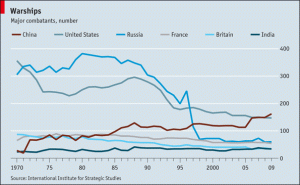
Changing Naval Balance

For background:

https://chuckhillscgblog.net/wp-content/uploads/2011/02/warships.gif?w=300

Numbers of course, are not the whole story. The US fleet is, by tonnage, far in excess of any competitor. The relatively strong allied fleets of Japan and South Korea are not included. The US still far outspends most of the rest of the world and most of the top ten navies of the world are our allies.

Still the decline of the Russian (Soviet) Navy and the continued growth of the Chinese Navy are clear. China’s rapidly improving quality including ships comparable to Aegis destroyers is not.

Source: Combat Fleets of the World here.

National Defense Industrial Association Special Operations/Low Intensity Conflict Achievement Medal Awarded to Lt. Aaron Renschler

WASHINGTON -- Adm. Mike Mullen, Chairman of the Joint Chiefs of Staff, congratulates Lt. Aaron Renschler after he received the National Defense Industrial Association Special Operations/Low Intensity Conflict Achievement Medal, Feb. 8, 2010. Renschler was recognized for his leadership while supporting Combined Taskforce 151's anti-piracy mission, including thwarting five separate pirate attacks and the at-sea apprehension of 50 Somali pirates. U.S. Coast Guard photo by Petty Officer 2nd Class Michael Anderson

NDIA SOLIC AWARD

“WASHINGTON — Adm. Mike Mullen, Chairman of the Joint Chiefs of Staff, congratulates Lt. Aaron Renschler after he received the National Defense Industrial Association Special Operations/Low Intensity Conflict Achievement Medal, Feb. 8, 2010. Renschler was recognized for his leadership while supporting Combined Taskforce 151’s anti-piracy mission, including thwarting five separate pirate attacks and the at-sea apprehension of 50 Somali pirates. U.S. Coast Guard photo by Petty Officer 2nd Class Michael Anderson

“Over a five-month deployment as officer-in-charge of a law enforcement detachment aboard USS San Jacinto and USS Farragut, Renschler played a central role in the detention of 50 suspected pirates, the seizure of a large weapons and explosives cache, and the liberation five Yemeni hostages.”

But there is also this interesting little tidbit:

“Additionally, he was cited for his leadership while heading a task force assigned to identify, track, and board the most advanced narco-terrorist means of transport in the history of the war on drugs – the self-propelled fully submersible drug sub.”

INDIAN OCEAN - Members of the U.S. Coast Guard Law Enforcement Detachment and Combined Task Force 151's visit board search and seizure team, on board the Arleigh Burke-class guided missile destroyer USS Farragut board a suspicious dhow March 31. USS Farragut is part of Combined Task Force 151, a multinational task force established to conduct anti-piracy operations in the Gulf of Aden. U.S. Navy photo by Petty Officer 1st Class Cassandra Thompson.

Coast Guard LEDET boards suspected pirate vessel

INDIAN OCEAN – Members of the U.S. Coast Guard Law Enforcement Detachment and Combined Task Force 151’s visit board search and seizure team, on board the Arleigh Burke-class guided missile destroyer USS Farragut board a suspicious dhow March 31. USS Farragut is part of Combined Task Force 151, a multinational task force established to conduct anti-piracy operations in the Gulf of Aden. U.S. Navy photo by Petty Officer 1st Class Cassandra Thompson.

(Source: Coast Guard news release)

The State of the Coast Guard–Summary and Impressions

I’m not going to regurgitate the Commandant’s speech or try to explain it all, but I thought I would give a few impressions. I’m sure there will be some truly important things I will miss, sorry.

The speech transcript is available here. And if you want an expanded explanation of what the Commandant said in his speech, I would suggest that you go here, go down to the foot of the page (now also near the top on the right side) and download the pdf, “U. S. Coast Guard Commandant’s Direction, 2011.” It’s a slick 24 page explanation that expands on the themes of the speech.

Continue reading