U.S. Coast Guard Cutter Seneca (WMEC 906) patrols off the coast of Haiti, April 13, 2024, during a deployment to the Windward Passage. The crew of Seneca completed a 58-day patrol in the Windward Passage and Florida Straits to deter illegal migration while supporting Homeland Security Task Force – Southeast (HSTF-SE) and Operation Vigilant Sentry (OVS). (U.S. Coast Guard photo)
Below is a District 7 news release. The unstated news here is that in spite of being almost two months in the area where migrants are expected to attempt to sail to the US, Seneca apparently made no intercepts. That is good news. The patrols, along with changes in immigration policy, are in fact discouraging attempts to migrate illegally by sea, at least in this area.
The ship also got to participate in Miami’s Fleet Week and was visited by the Secretary of the Navy. All good.
May 31, 2024
US Coast Guard Cutter Seneca returns home after a two-month patrol in the Windward Passage and Florida Straits
PORTSMOUTH, Va. — The crew of U.S. Coast Guard Cutter Seneca (WMEC 906) returned to their home port in Portsmouth, May 21, 2024, following a 58-day migrant interdiction patrol in the Windward Passage and Florida Straits.
Seneca’s crew deployed in support of Homeland Security Task Force – Southeast (HSTF-SE) and Operation Vigilant Sentry (OVS) while at sea in the Coast Guard Seventh District’s area of operations.
Patrolling off the coast of Haiti and southern Florida Straits, Seneca’s presence helped deter migrants from taking to the sea in unsafe vessels to ensure the safety of life at sea and protect the maritime borders of the United States.
While at sea, Seneca worked with a Coast Guard Air Station Miami HC-144 Ocean Sentry airplane crew and responded to an international search and rescue case involving an overboard passenger who fell from a cruise ship.
During the deployment, Seneca’s crew had the opportunity to attend the inaugural Fleet Week 2024 in Miami, Florida in early May. Crew members conducted nearly 1,000 public tours over a six-day period, showcasing the U.S. Coast Guard, cutter Seneca, and the service’s missions. Seneca hosted numerous VIPs aboard to include Secretary of the Navy Carlos Del Toro, local and state politicians.
“It’s been an honor leading Seneca and her crew, serving alongside the best and brightest women and men in the service,” said Capt. James F. McCormack, commanding officer of Seneca. “Seneca and her crew provided stability in the maritime environment of the South Florida Straits and represented the Coast Guard with distinction amongst the other U.S. maritime services at Fleet Week Miami. Seneca lived up to our motto, “Tradition of Honor, A Legacy of Action.””
While deployed, Seneca’s crew transited over 9,000 nautical miles.
Established in 2003, HSTF-SE is the Department of Homeland Security-led interagency task force charged with directing operational and tactical planning, command and control, and functions as a standing organization to deter, mitigate, and respond to maritime mass migration in the Caribbean Sea and Florida Straits.
OVS is the 2004 DHS plan that provides the structure for deploying joint air and surface assets and personnel to respond to irregular maritime migration in the Caribbean corridor of the United States. Its primary objectives are to protect life at sea while deterring and dissuading mass maritime migration alongside our federal, state, and local partners.
Seneca is a 270-foot, Famous-class medium endurance cutter. The cutter’s primary missions are counter drug operations, migrant interdiction, enforcement of laws and treaties, and search and rescue in support of U.S. Coast Guard operations throughout the Western Hemisphere.
For information on how to join the U.S. Coast Guard, visit www.GoCoastGuard.com to learn more about active duty and reserve, officer and enlisted opportunities. Information on how to apply to the U.S. Coast Guard Academy can be found here.
A convoy of Landing Craft Infantry (Large) sails across the English Channel toward the Normandy Invasion beaches on D-Day, 6 June 1944. Each of these landing craft is towing a barrage balloon for protection against low-flying German aircraft. Among the LCI(L)s present are: LCI(L)-56, at far left; LCI(L)-325; and LCI(L)-4. Photograph from the U.S. Coast Guard Collection in the U.S. National Archives.
The 80th anniversary of the Normandy D-Day invasion is just a few days way.
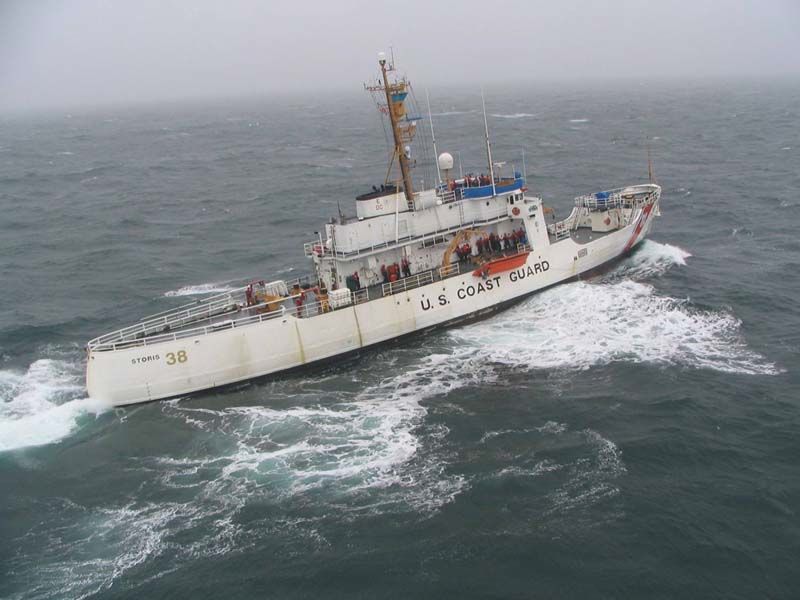
USCGC Storis, 2,030 ton Arctic Patrol Cutter (1942 to 2007).
A recent discussion in the comments of an earlier post, Canadian Coast Guard Multi-Purpose Vessel Recapitalization, led me to a sudden realization that every nation with a coastline in the Arctic, except the US, is building new ice strengthened patrol vessels.
Are we missing something?
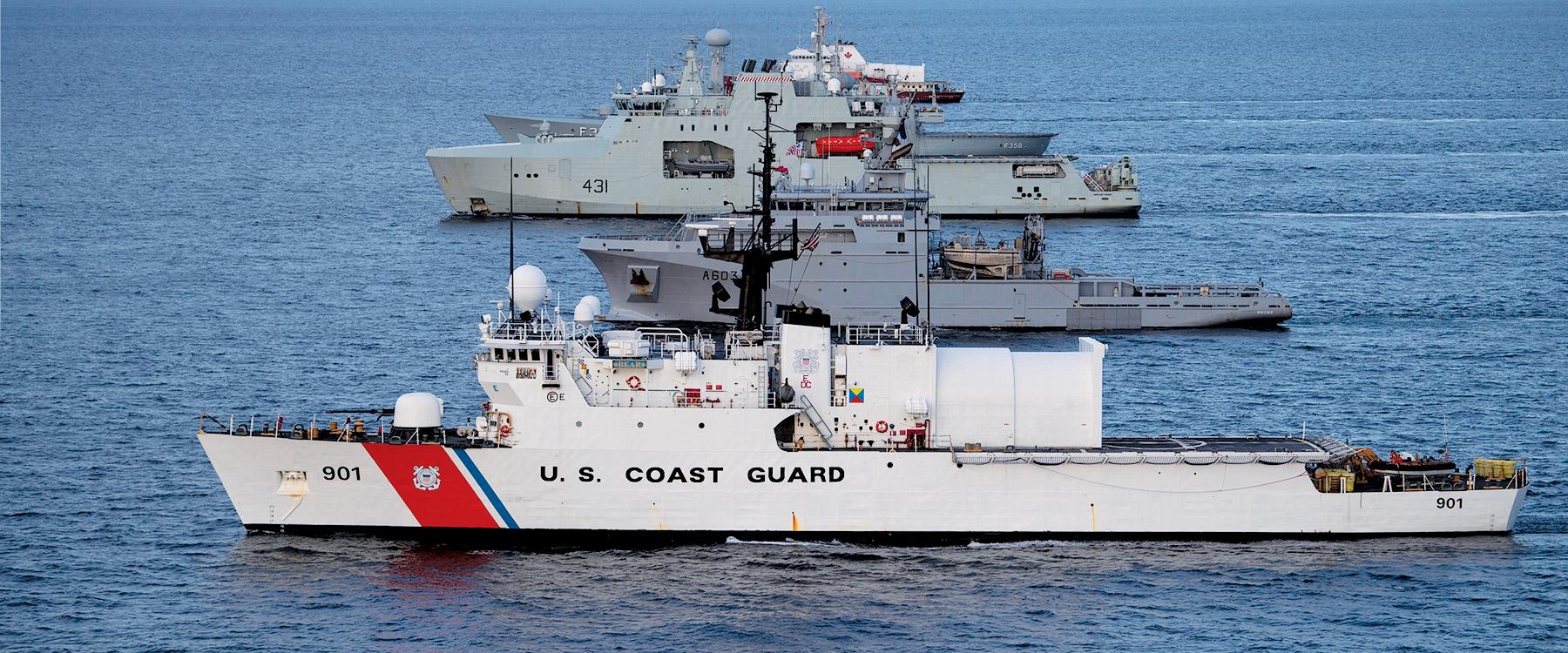
The USCGC Bear (WMEC-901) and allied ships from Canada, Norway, France, and Denmark steam in formation in the North Atlantic Ocean during Operation Nanook in August 2022.
These vessels may have some of the characteristics of icebreakers, but while intended to operate in an icy environment, they would be expected to spend a lot of time on solitary patrol rather than being used primarily to open ice covered waterways for other ships.
Now Canada, Denmark, Norway, and Russia–every nation with an Arctic Ocean coast except the US–are building ice-capable patrol vessels.
New programs, built, building or planned, are expected to produce five classes, a total of 25 ships (14 for Canada alone) that might be considered Arctic patrol vessels.
Canada:
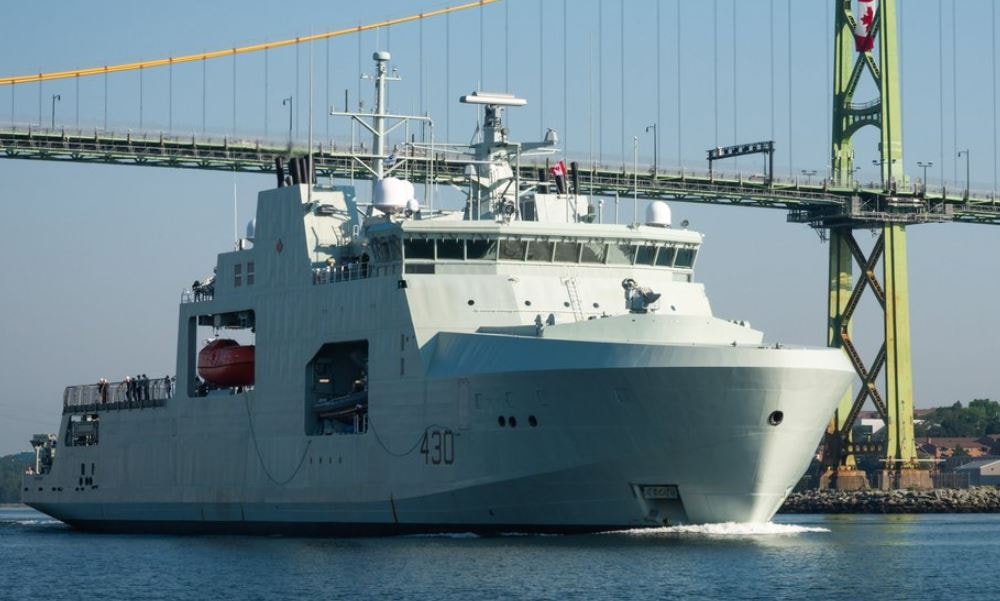
HMCS Harry DeWolf, leaving HMC Dockyard in Halifax and steaming under Angus L. Macdonald suspension bridge crossing Halifax Harbour in Nova Scotia, Canada
Canada is building a class of eight “Arctic Offshore Patrol Ships,” the Harry DeWolf class, six for their Navy and two for their Coast Guard. First of class was laid down in 2017. Four ships have been completed.
Displacement: 6,615 tons (full load)
Length: 103.6 m (339 ft 11 in)
Beam: 19 m (62 ft 4 in)
Draft: 5.7 m (18 ft 8 in)
Propulsion: Diesel electric, 4×3.6MW generators, two 2×4.5MW, twin shaft drive, total 12,000 HP.
Speed: 17 knots
They are Canadian Polar Class 4, meaning can maintain a speed of 3 knots through ice 4 feet thick.
—
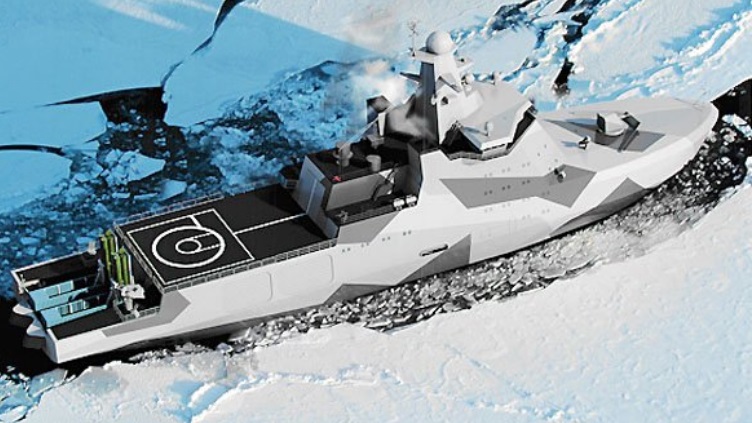
Canadian CG MPV. Credit Aker Arctic.
Canada is also building six “Multi-Purpose Vessels” for the Canadian Coast Guard, that the USCG would probably classify as light icebreakers. I have no information on their speed or horsepower. They are also Canadian Polar Class 4 (speed of 3 knots through ice 4 feet thick. (I will refer to these as CCG MPV.) It might be debated that these are not really patrol vessels since the Canadian Coast Guard is neither a military nor a law enforcement agency. Their primary missions are icebreaking, buoy tending, and cargo, but the Canadian Coast Guard does provide transportation for Canadian law enforcement agencies.
Displacement: about 8,500 tons
Length, overall: 99.9 meters (328′)
Beam: 20.3 meters (66.7′)
Draft: 6.2 meters (20’4″)
Propulsion: diesel-electric; two azimuthing propulsion units
Range 12,000 nautical miles
Russia:
Project 23550, Ivan Papanin class icebreaking patrol vessel with towing capability and containerized cruise missiles.
Russia is building a class of small armed icebreakers, Project 23550. Four ships are planned, two for the Navy and two for the Russian Coast Guard. The first ship was laid down in 2017. None of the class have been completed.
Displacement: 8,500 tons (full load)
Length: 114 m (374 ft 0 in)
Beam: 18 m (59 ft 1 in)
Draft: 6 m (19 ft 8 in)
Propulsion: two 6,300-kilowatt propulsion motors for 16,800 HP
Speed: 18 knots
They are diesel electric with conventional twin shaft drive. They are designed to break ice up to 1.7 meters (5 ft 7 in) thick.
These ships have gotten a lot of press because they have been associated with use of containerized cruise missile systems. Such systems were also associated with the Project 22160 patrol ships, but in spite of the fact that all Project 22160 ships are based in the Black Sea, I have seen nothing to indicate they have actually been used as missile launchers.
The patrol, rather than icebreaker, character of this class is reflected in its length to beam ratio (6.33:1) which is greater than that of any of the other ships looked at here, with the exception of the Thetis class (7.8:1). That is also substantially greater than the length to beam ratios of Glacier (4.18:1), Healy (5.12:1), the Polar class (4.79:1), or Polar Security Cutter (5.19:1).
Otherwise, the Project 23550 ships seem to be logical successors of the Ivan Susanin class of eight small military icebreakers that date back to the 1970s.
Norway:
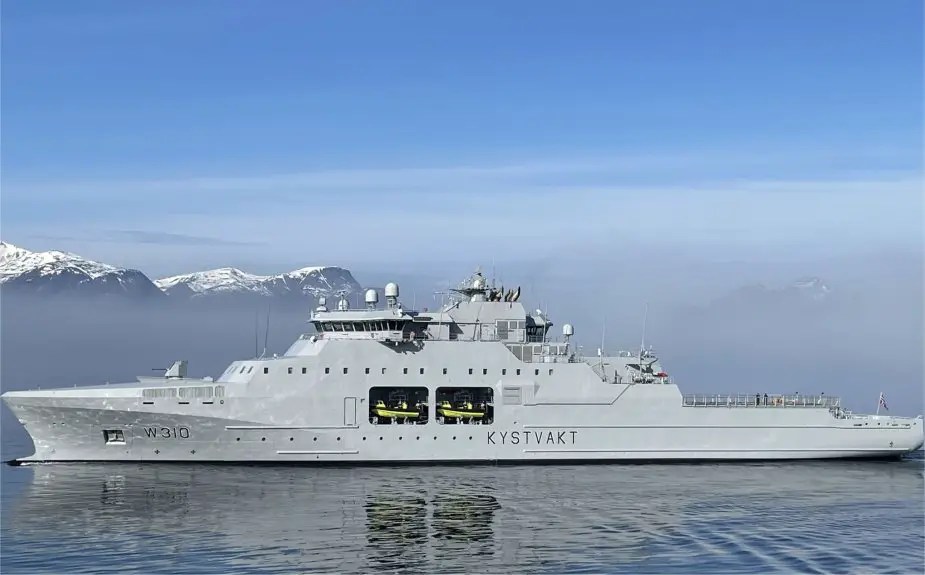
Jan Mayen class Offshore patrol vessel Jan Mayen. (Picture source: Vard)
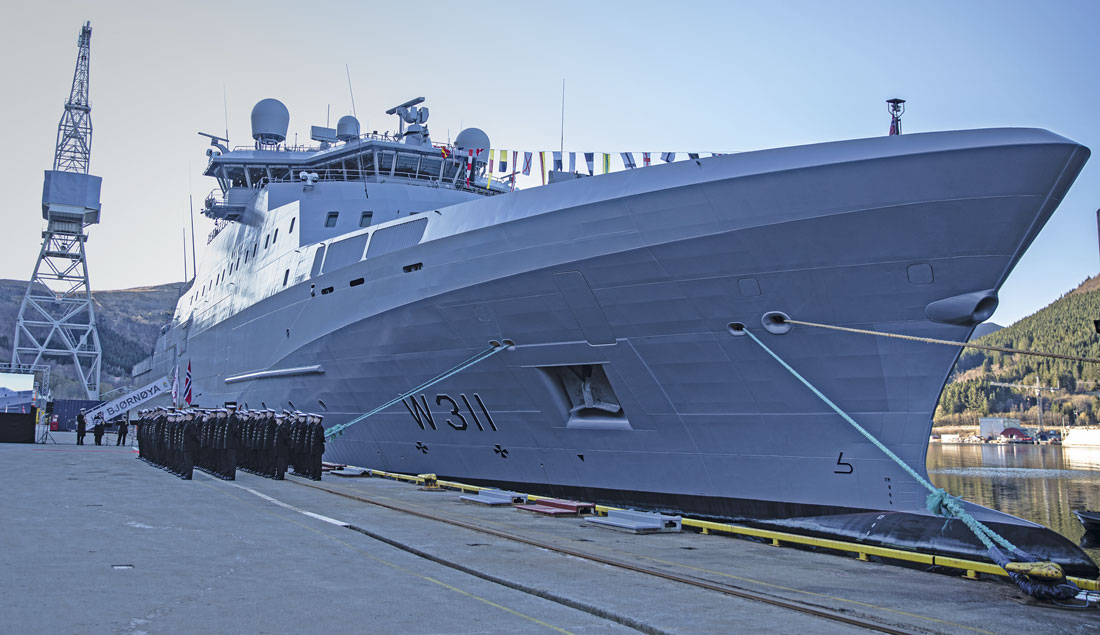
Norway is completing a three-ship class of ice capable Offshore Patrol Vessels, the Jan Mayen class. The first was laid down in 2020 and at least two are already commissioned, with the third expected this year.
Displacement: 9,800 tons (Standard, full load will be greater. These are big OPVs.)
Length: 136.4 meters (447.4 ft) loa
Beam: 22 meters (72.16 ft)
Draft: 6.2 meter (20.3 ft)
Speed: 22 knots.
They are expected to hangar two NH90 helicopters (10,600 kg/23,370 lb max take-off weight) with deck space to land an AW101 (14,600 kg/32,188 lb max TO weight). They are expected to have an endurance of eight weeks, accommodations for 100, collective CBRN protection, and space for containers on deck. (See late addition at the end of the post for more details.)
Denmark is in the preliminary stages of designing a replacement for their Thetis class ice capable frigates. Earlier reports had indicated a consortium has been selected to design and build vessels of a new class (pictured above) referred to as the MPV-80, a design intended to be “future proof” by the incorporation of modular systems. Later information seems to indicate no particular design has been chosen.
Trends:
I was curious to see if there were evolutionary changes over time in this type of ship. Chronologically, based on the “laid down” date of the first ship of class, from earliest to latest for which we have data, the order is:
First Group
Thetis (Denmark), 1988
Svalbard (Norway), 2000
Knud Rasmussen (Denmark), 2005
Protector class (New Zealand), 2005
Second Group
Harry DeWolf (Canada), 2016
Project 23550 (Russia), 2017
Jan Mayen (Norway), 2020
Canadian CG MPV, TBD
Thetis class replacement (Denmark), TBD
We have four new designs to look at. As with the earlier group, some seem more closely related to icebreakers (Svalbard, Harry DeWolf, Project 23550, and CCG MPV classes) while others are more conventional OPVs with adaptations for operating in ice.
Let’s look at how the new members of the two groups compare with their older counterparts.
Size
There has not been a lot of change in size between Svalbard (Norway), 6,375 tons, the only near icebreaker in the earlier group, and her newer Canadian and Russian counterparts. In fact, the Harry DeWolf class is, in some ways, a simplified version of the Svalbard design. The CCG MPV and Russian Project 23550 ships will be about 28.5% larger than the Svalbard. On the other hand, the Project 23550s and CCG MPV can be seen as 229% larger than the Ivan Susanin class of the late 70s, about 30% larger than the Wind class icebreakers of the 1940s, or almost exactly the same size as USS/USCGC Glacier, commissioned in 1955. They are only a little over half the size of USCGC Healy, and about 37% the size of the Polar Security Cutter.
Norway’s 9,800 ton Jan Mayen class, as the only new non-icebreaker example we have for an Arctic Patrol Cutter, represents a big jump in size from the earlier group, 2.8 times as large as the Thetis class, 5.2 times as large as the Protector class, and 5.7 times larger than the Knud Rasmussen class. Also, about 15% larger than the largest of the icebreaker style designs, the Project 23550s and CCG MPV. It should be noted that the Jan Mayen class will not replace the Svalbard, they are replacements for the Nordkapp class ice-strengthened patrol frigates, which were 3,200 tons full load. (See the late addition note at the end of the post. The Jan Mayen class bow does seem to have been designed to break ice.)
Speed
Here we see significant differences between the icebreaker group and the rest. All the icebreaker patrol ships have speeds between 17 and 18, with almost no difference between Svalbard (Norway, 2000) 17.5 knots, Harry DeWolf (Canada, 2016) 17 knots, and Project 23550 (Russia, 2017) 18 knots.
With the exception of the Knud Rasmussen class, (Denmark, 2005) 17 knots, which is a minimalist design, the non-icebreaker patrol ships show remarkable consistency, Thetis (Denmark, 1988), Protector class (New Zealand, 2005), and Jan Mayen (Norway, 2020) all have top speeds of 22 knots.
Propulsion
All the icebreaker designs are diesel electric, but while the Svalbard is powered by Azipods, the newer Harry DeWolf and Project 23550 designs use twin conventional shafts. The CCG MPV seem to replicate the Svalbard’s basic design.
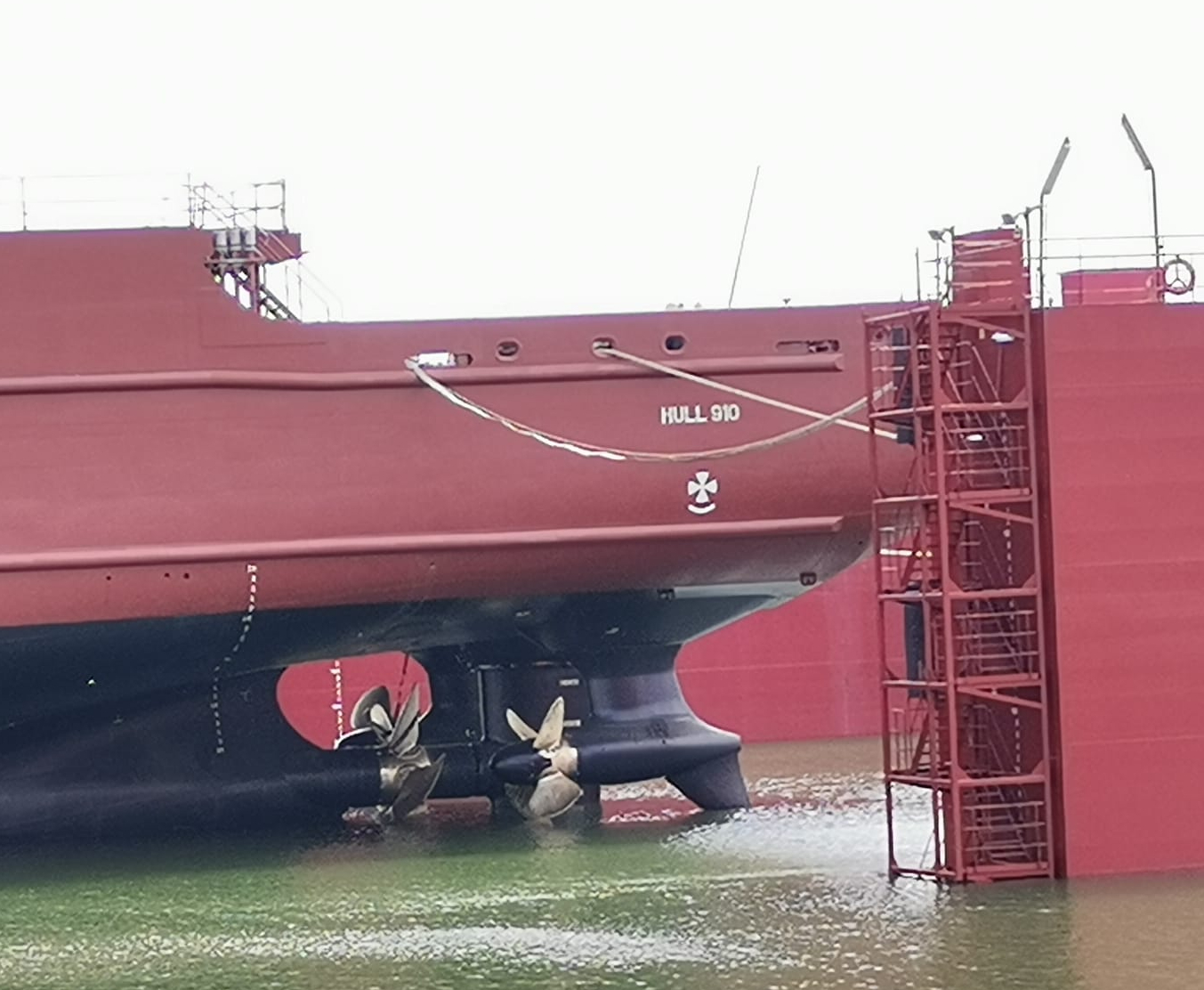
All the older non-icebreaking patrol ships use geared diesel propulsion. The Danish Thetis and Knud Rasmussen classes using single shaft propulsion; the Protector class has twin shafts. The newer, much larger Jan Mayen class have three screws including a center shaft and what appear to be Azipods providing the outer propellers.
Norwegian Jan Mayen class OPV under construction showing its three propellers, a conventionally shafted prop on the centerline and two rotating units. In addition, there is a rudder behind the centerline pro to allow directional control when the trainable units are idling.
Aviation
All eight of the classes of ships have flight decks and only the small Knud Rasmussen class lack a hangar. Only the newest and largest, the Jan Mayen class has provision for hangaring two helicopters (NH-90s). The Jan Mayen class also has a torpedo magazine for storage of helicopter weapons.
Weapons and Add-On Systems
There seems to be no particular trend in how they are armed as built. Three classes are equipped with 76mm guns, the Thetis and Knud Rasmussen classes from the earlier group and the Russian Project 23550 class from the newer group. Two classes are equipped with 57mm guns, the Norwegian Svalbard and Jan Mayen classes. Two classes are equipped with 25mm guns, the older New Zealand Protector class and the newer Canadian Navy Harry Dewolf class. The Canadian Coast Guard Harry DeWolf and CCG MPV classes, like all Canadian CG cutters is essentially unarmed.
Most of these ships include some provision for upgrades using modular or containerized systems. Even the oldest Danish ships incorporated the StanFlex system, that allowed addition of weapons including AAW and ASuW missiles and ASW torpedoes. The Russian Project 23550 has the reported ability to accept containerized cruise missiles. The Canadian Harry DeWolf class have tested use of a “Towed Reelable Active Passive Sonar” TRAPS. It appears that when Denmark does choose a design for their next class, it will incorporate even more flexibility using the SF Defense “Cube” system.
It should be noted that all of these designs, with the exception of the CCG MPV, were done before the Russian invasion of Ukraine set Europe on edge and before China became a “near Arctic power.” It appears, Denmark is determined that their Arctic Patrol Ship will be upgradable to a credible combatant.
Conclusions:
While the US plans to build medium icebreakers for Arctic patrol, the other four Arctic nations, that have been patrolling Arctic waters for decades are building different types of ship.
We still see both Arctic patrol vessels that include strong icebreaker characteristics and some that do not. (See the late addition note at the end of the post. All the new arctic patrol vessels have icebreaker characteristics.) Maximum speeds have not materially changed, ranging from 17 to 22 knots. Clearly, they value good aviation facilities with preferably at least two aircraft, at least one helicopter and a UAS or second helicopter.
I have to believe the Norwegian Jan Mayen and the Russian Project 23550 represent the latest thinking on an Arctic patrol ship. The Canadian Harry Dewolf class is not much of a departure from the Norwegian Svalbard, and patrol was not a primary driver in the design of the CCG MPV.
The Norwegians have had a decade and a half experience with the Svalbard and apparently decided one icebreaker was enough. They had almost four decades of experience with the Nordkapp class before designing the Jan Mayen.
The Jan Mayen will certainly be able to go anywhere fishing vessels or other non-icebreakers will be able to go in the Arctic. Still, I think they may regret not giving the ships an icebreaker bow. (A second look shows that the Jan Mayen does have a bow designed for icebreaking. See late addition note at the foot of the post.)
The Jan Mayen design might have been a bit different if it had been designed after the Russians attacked Ukraine.
The Project 23550 design is fairly conservative and probably relatively inexpensive. Compared to the preceding Ivan Susanin class, it is more than twice as large, 8,500 vice 3,710 tons; much longer, 374 vice 230 ft; faster, 18 vice 15.4 knots; but perhaps not as well armed if not equipped with containerized cruise missiles. While the project 23550 has a single 76mm gun, the older ships were armed with a twin 76mm and two 30mm Gatling guns. Notably the project 23550 has no credible defense against cruise missile or even UAS. Like all these ships, it was designed before the Russian Navy experienced combat in the Black Sea against Ukraine.
Reflection:
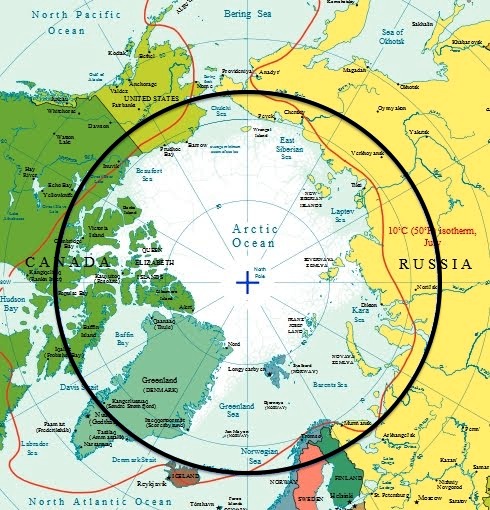
(In the comments below, when I say Arctic, I refer to the area North of the Arctic Circle. There are other definitions.)
The US icebreaker fleet is frequently compared to that of Russia, but the economic case for icebreakers for service in the Arctic for those two nations is completely different. The Russian economy is heavily dependent on mineral extraction from the Arctic. They have a relatively large population in the Arctic. They have several ports in the Arctic from which the minerals are shipped. They need icebreakers to keep those ports open and keep the minerals moving to export markets. Most of their icebreakers operate for commercial purposes. The Russian Navy and Coast Guard operate only a few light icebreakers.
If we compare our icebreaker fleet to that of other Arctic nations, we see an entirely different picture.
Canada has more interests in the Arctic than the US, though much less than Russia. They have a lot more area, and I believe a larger population in the Artic than the US. Their fleet of Polar icebreakers is nowhere near as large as large as that of the Russians. While they have a fairly large number of what the USCG would call light icebreakers, some of which operate in the Arctic during the summer, they have only a couple of what the USCG would call medium icebreakers. They do intend to build a couple of what the USCG would call heavy icebreakers, but currently they have none.
The Mainland of Norway extends about as far north as the Northern most parts of Alaska (71degrees 17′ 26″N). In addition, they administer the Arctic island archipelagoes of Jan Mayen (71 degrees N) and Svalbard (74-81 degrees N), but the Norwegian Navy and Coast Guard operate only one icebreaker, the Svalbard, which the USCG would consider a light icebreaker.
Denmark administers Greenland, most of which is in the Arctic. Cape Morris Jesup, the most northerly point in Greenland is only 383.4 nautical miles (710 km) from the North Pole, while the most northerly point in Alaska, Utgiagvik (formerly Pt. Barrow) is 1127 nautical miles from the Pole, but the Danish Navy has no icebreakers at all.
What does this mean for the US Coast Guard?
The US Coast Guard has not built nor operated any patrol vessels specifically for the Arctic since USCGC Storis was decommissioned in 2007 (commissioned 1942). Storis was one of the ships intended to be replaced by the Deepwater Program of Record.
The Coast Guard has recognized a growing need for presence in the Arctic for SAR, fisheries protection, and potentially pollution response. Currently it appears these missions will go to the planned new class of medium icebreakers, the “Arctic Security Cutters.”
The Arctic Security Cutters are likely to be large, complex, and expensive ships similar to Healy, but I have also seen reference to the need for shallow draft.
For fisheries protection and SAR, the Coast Guard needs the ability to go wherever fishing vessels are likely to go. On the other hand, significant frequent commercial traffic over the length of the Northwest Passage is unlikely, and if it develops, that would be primarily Canada’s responsibility.
It seems we could build two or three light icebreaking Arctic Patrol Cutters of less than 10,000 tons for the price of one medium icebreaker. It is true that they might not be able to go everywhere a medium icebreaker could go, but they could go where most of the missions require. Even light icebreakers can be remarkably capable. Svalbard has made it to the North Pole several times and took over recovery of research buoys for Healy when she had a major machinery casualty. Even little Storis, with only 1,800 HP, transited the Northwest Passage. A Harry DeWolf class also transited the Northwest Passage as part of a circumnavigation of North America.
Perhaps the Coast Guard should consider if perhaps one more Heavy Icebreaker and a number of Arctic Patrol Cutters with light icebreaking capability might be both cheaper and more effective than a new class of medium icebreakers. Given the difficulties we have had with the Polar Security Cutter program, it might also be quicker way to get more Arctic presence.
Late addition:
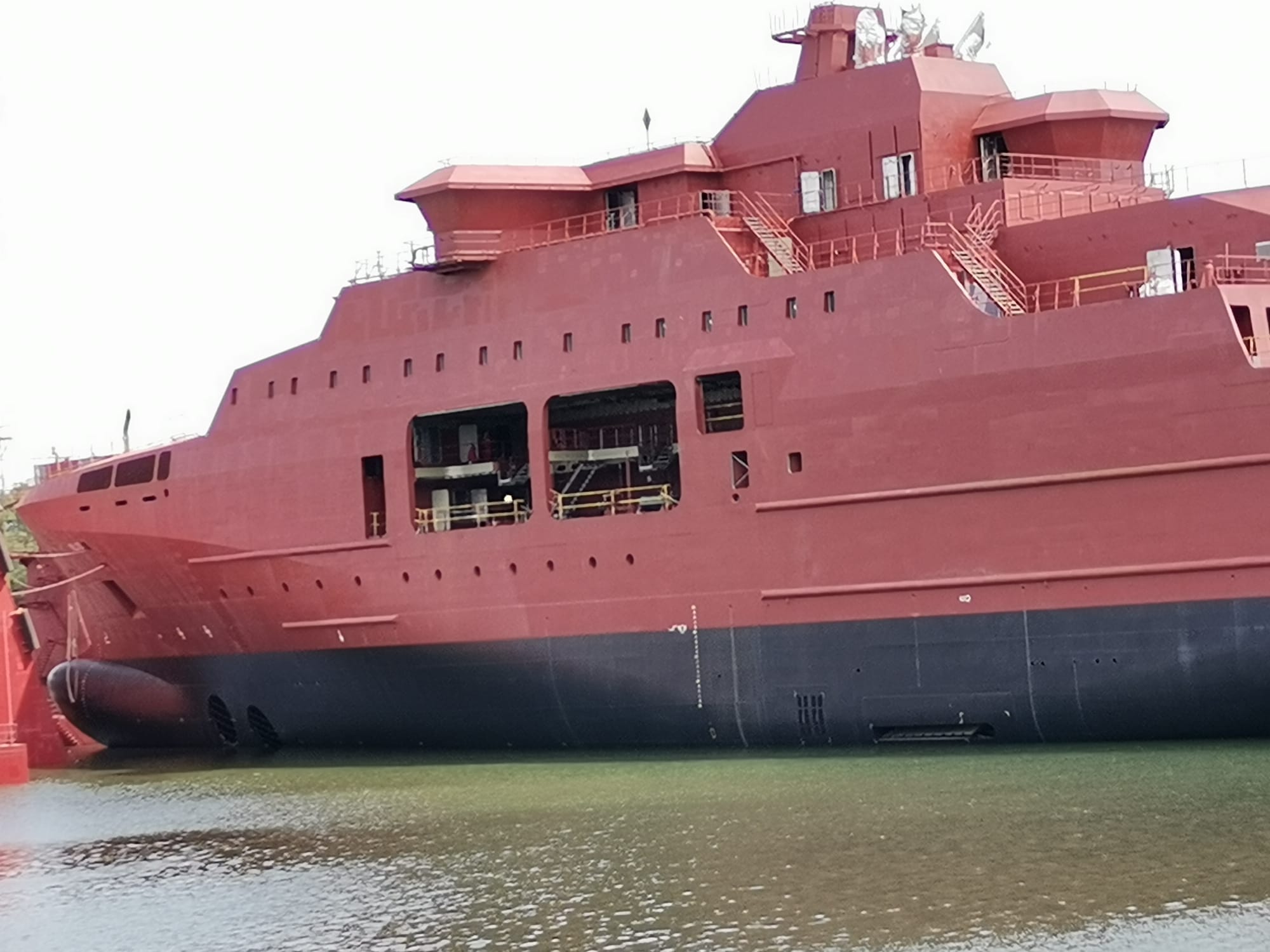
I ran across a diagram of the Knud Rasmussen class after writing the post above and found that the class has the cutaway bow typical of icebreakers. That made me wonder if perhaps I had misjudged the shape of the Jan Rasmussen class bow, so I took another look. If you click on the photo below and look closely at the bow below the waterline you will see that while it is a bulbous bow, the bottom of the bulb is the spoon shape typical of modern icebreakers.
The USCG might do well to buy and build the Jan Mayen design with minimal changes. They may actually have enough horsepower to be considered medium icebreaker, though they are probably much different from what the Coast Guard has been thinking of for their Arctic Security Cutter.
I would also hope that we would apply a sense urgency to the program and not wait until the Polar Security Cutter program is finished.
Jan Jayen forward.“Another photograph of Bjørnøya shows how there’s a sharp “ridge” on top of the bulbous bow. That should help splitting the floes before they come in contact with the stem.” –Tups
The Authorization is just a bill right now and even if enacted, it does not really provide any funds. I have a hard time understanding why Congress works this way, both and authorization and a budget. I think the authorization is supposed to come first as a sort of way to work toward consensus, establishing an upper limit on the budget, but for FY2024, the budget has already passed (long after the FY began) but the Authorization has only cleared the House and is in the Senate now. I don’t think it will take long in the Senate, but the FY is already two thirds over.
Even so, the Authorization has some interesting stuff regarding the out years. Historically the enacted budget has been larger than the Administrations budget request so this may happen. Just remember, while this suggests intention, it can not be taken for granted.
SEC. 103. AVAILABILITY OF AMOUNTS FOR ACQUISITION OF ADDITIONAL VESSELS AND AIRCRAFT.
(a) Fiscal Year 2025.—Of the amounts authorized to be appropriated under section 4902(2)(A) of title 14, United States Code, for fiscal year 2025—
(1) $138,500,000 is authorized for the acquisition or procurement of 1 missionized HC–130J Super Hercules aircraft;
(2) $36,000,000 is authorized for the service life extension program and any necessary upgrades of the 47-foot Motor Life Boat; and
(3) $216,000,000 is authorized for the acquisition of 2 Fast Response Cutters.
(b) Fiscal Year 2026.—Of the amounts authorized to be appropriated under section 4902(2)(A) of title 14, United States Code, for fiscal year 2026—
(1) $1,200,000,000 is authorized for the acquisition of a Polar Security Cutter;
(2) $1,100,000,000 is authorized for the acquisition of 2 Offshore Patrol Cutters;
(3) $138,500,000 is authorized for the acquisition or procurement of 1 missionized HC–130J Super Hercules aircraft; and
(4) $153,500,000 is authorized to outfit and assemble 5 MH–60T Jayhawk aircrafts.
SEC. 104. AUTHORIZATION FOR CERTAIN PROGRAMS AND SERVICES.
(a) Fiscal Year 2025.—Of the amounts authorized to be appropriated under section 4902(1)(A) of title 14, United States Code, for fiscal year 2025—
(1) $11,978,000 is authorized to fund additional recruiting personnel and offices for the Coast Guard Recruiting Command;
(2) $9,000,000 is authorized to enhance Coast Guard recruiting capabilities; and
(3) $25,000,000 is authorized for the implementation of each directed action outlined in enclosure 1 of the memorandum of the Commandant titled “Commandant’s Directed Actions-Accountability and Transparency”, dated November 27, 2023.
(b) Fiscal Year 2026.—Of the amounts authorized to be appropriated under section 4902(1)(A) of title 14, United States Code, $35,000,000 is authorized for the implementation of each directed action outlined in enclosure 1 of the memorandum of the Commandant titled “Commandant’s Directed Actions-Accountability and Transparency”, dated November 27, 2023.
If you are curious as I was about what “Commandant’s Directed Actions-Accountability and Transparency”, dated November 27, 2023 referred to, you can read it here.
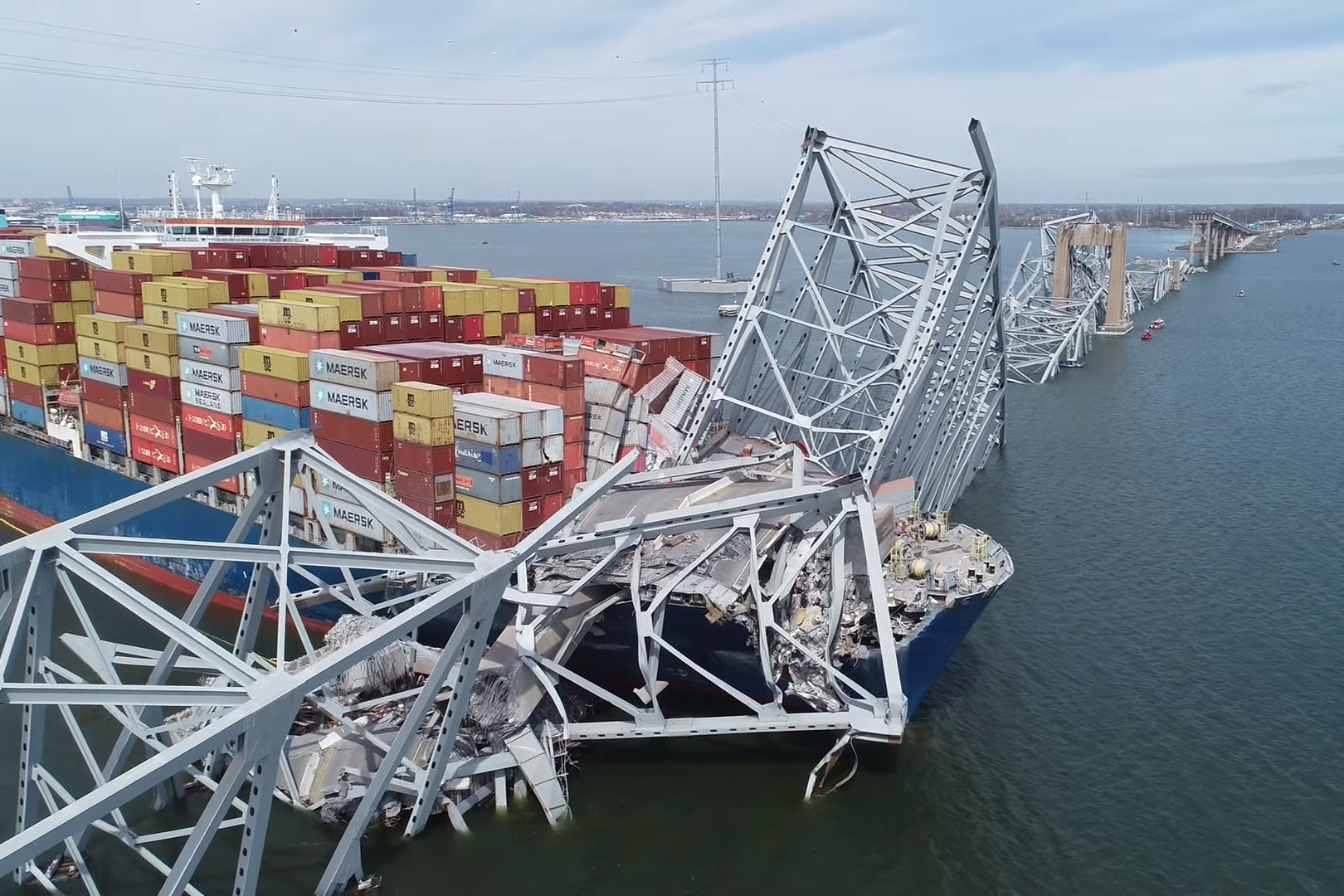
NTSB drone image of Francis Scott Key Bridge and Cargo Ship Dali, 26 March 2024
Defense News reports on the Coast Guard response to the allision that brought down the Key bridge in Baltimore and how it strained the service’s resources.
“…four Coast Guard cutters, at least 10 boats…27 Coast Guard civilians, 23 volunteers, 275 active duty service members and 82 reservists…These employees have been drawn from their home stations all over the country, including some as far as Alaska and California. That also means these stations are donating staff to the recovery effort in Maryland, and the Coast Guard’s operations lead said the service doesn’t have much to spare as it is.”
It is a story of an organization that, while under stress, responded successfully. It is also a cautionary tale that if we had two such emergency operations simultaneously, full response might not be possible.
It should also be seen as a testament to the Coast Guard’s agility, responsiveness, and resilience in spite of current personnel shortages.
There is also some encouraging news about steps being taken to close the Coast Guard’s current personnel shortages.
Congress has shown its intent to take action. The House cleared a bill on May 14 to authorize $12 million to fund recruiters and offices for the Coast Guard Recruiting Command and an additional $9 million for recruiting capability in fiscal 2025. That passed in a 376-16 vote.
The bill also aims to improve quality of life for Coast Guard service members, a factor that, like pay competitiveness and work-life balance, may give the private sector an edge.
With a particularly bad Hurricane season predicted, it’s good to remind the Administration and Congress that we have to be ready to do more than normal day to day operations. The Coast Guard is more than a first responder. The Coast Guard moves resources in anticipation of disaster.
Incidentally the bill linked in the quote above is H.R.7659 – Coast Guard Authorization Act of 2024. It is very interesting as evidence of Congress’s intentions. Take a look but be aware the Authorization is separate from the budget and even if signed into law, the authorization does not mean projects are actually funded.
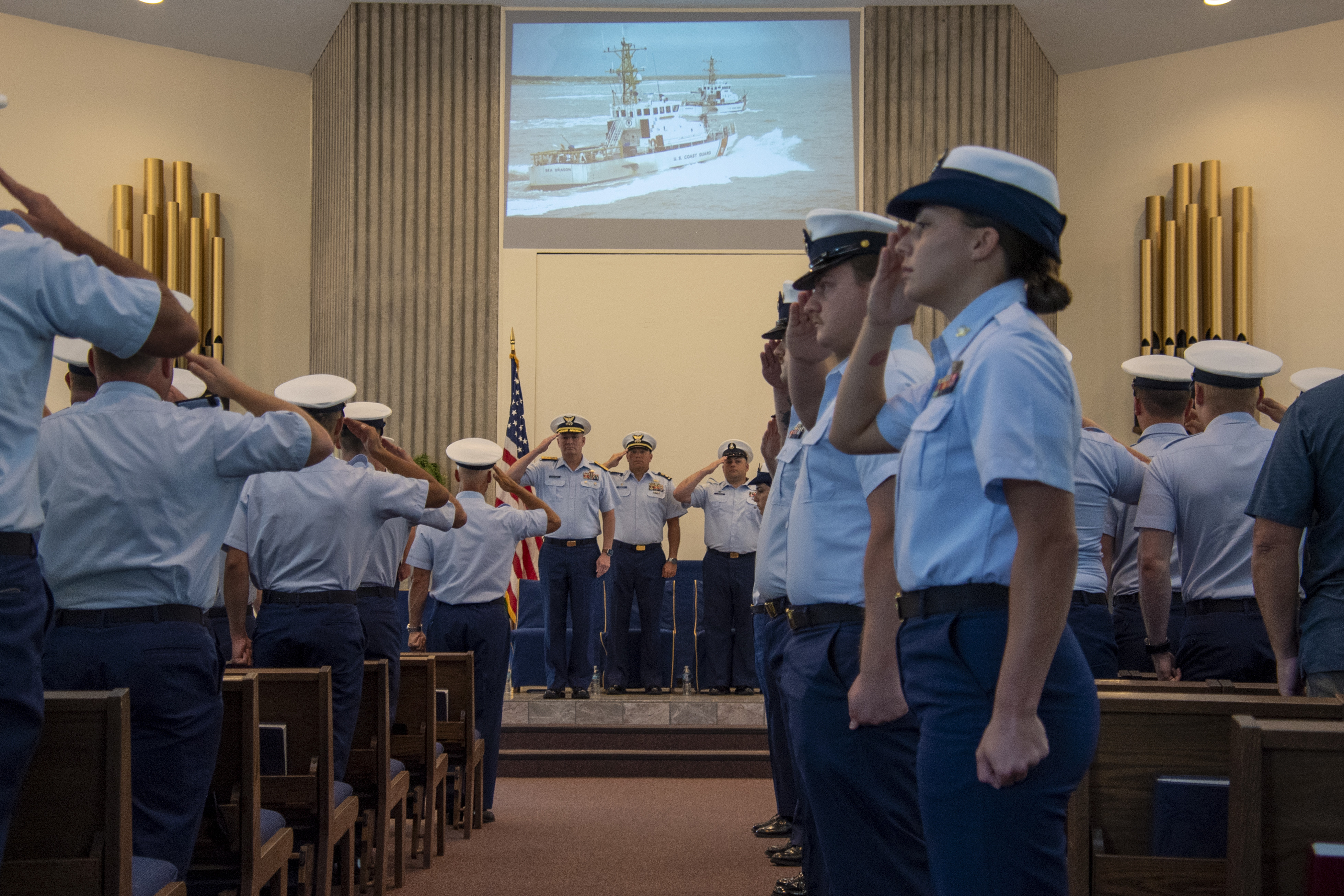
Coast Guard members salute during the playing of the national anthem during a decommissioning ceremony for the Coast Guard Cutters Sea Dog and Sea Dragon in St. Marys, Georgia, May 29, 2024. Rear Adm. Douglas M. Schofield, Coast Guard District Seven Commander, presided over the ceremony honoring the years of service the Sea Dog and Sea Dragon and their crews provided to the nation. (U.S. Coast Guard photo by Petty Officer 1st Class Ryan Dickinson)
Below is a press release. The two 87 foot patrol boats were assigned to a Force Protection unit for the Fleet Ballistic Missile Submarines (SSBNs) based at Kings Bay, GA.
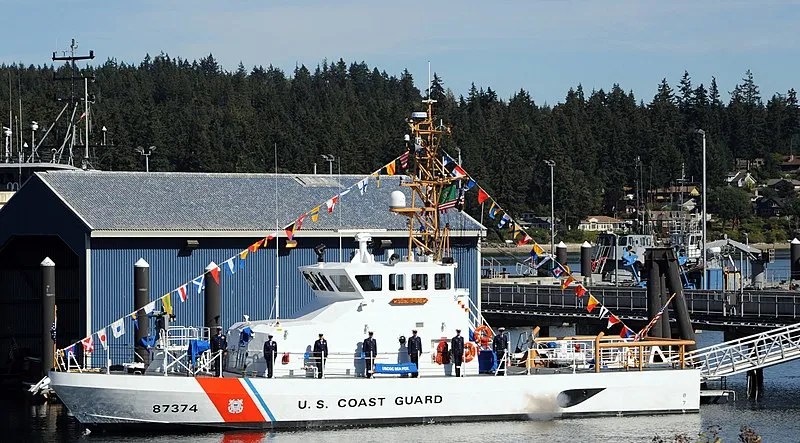
“The Coast Guard cutters Sea Devil (WPB 87368) and Sea Fox (WPB 87374) have relocated from Bangor, Washington, to replace the Sea Dog and Sea Dragon.”
Sea Devil and Sea Fox were assigned to the Force Protection Unit that escorts SSBNs from Bangor, WA. Is that unit being decommissioned, or are they being reequipped? The two WPBs at each unit were not the only boats used by these units.
As I recall these WPBs and their operating costs were paid for by the Navy Department. In any case these decommissionings do not affect normal Coast Guard operations.
These four WPBs were equipped a bit differently from standard Marine Protector class 87 footers, including having a .50 cal. mounted in a remote weapon station on a band stand on the bow.
KEYPORT, Wash. (Aug. 18, 2009) U. S. Coast Guardsmen man the rails as the U.S. Coast Guard Cutter Sea Fox (WPB 87374) is brought to life at Naval Base Kitsap. (U.S. Navy photo Ray Narimatsu/Released)
Thanks to Paul for bringing this to my attention.
May 29, 2024
PHOTO RELEASE: Coast Guard cutters Sea Dog, Sea Dragon decommissioned in St. Marys, Georgia
JACKSONVILLE, Fla. — The Coast Guard decommissioned the U.S. Coast Guard cutters Sea Dog (WPB 87373) and Sea Dragon (WPB 87367), Wednesday, during a ceremony in St. Marys, Georgia.
Rear Adm. Douglas M. Schofield, Coast Guard District Seven commander, presided over the ceremony honoring the years of service the Sea Dog and Sea Dragon provided to the nation.
The Sea Dog and Sea Dragon were 87-foot marine protector-class cutters assigned to Coast Guard Maritime Force Protection Unit Kings Bay in the Coast Guard’s Seventh District.
Maritime Force Protection Unit Kings Bay is designed to support the Navy’s efforts to provide anti-terrorism and force protection for its Ohio-class ballistic missile submarines and to assist in meeting its Presidential mandates for ballistic weapon security.
The Sea Dragon was commissioned in January 2008 and the Sea Dog was commissioned in July 2009.
“The men and women of the cutters Sea Dog and Sea Dragon, past and present, have exemplified unwavering professionalism and dedication, safeguarding our nation’s waters and supporting critical defense missions,” said Capt. David Vicks, commanding officer of Maritime Force Protection Unit Kings Bay. “I extend my profound gratitude to these courageous crews as we honor their steadfast service.”
Following the decommissioning ceremony, the cutters will be transferred to Marine Corps Air Station Cherry Point.
The Coast Guard cutters Sea Devil (WPB 87368) and Sea Fox (WPB 87374) have relocated from Bangor, Washington, to replace the Sea Dog and Sea Dragon.
For breaking news, follow us on X (formerly Twitter). For additional information, find us on Facebook and Instagram.
“In Ocean waves no poppies blow
No crosses stand in ordered row
Their young hearts sleep beneath the wave
The spirited, the good, and the brave,
But stars a …constant vigil keep,
For them who lie beneath the deep,
‘Tis true you cannot kneel in prayer,
On a certain spot and think he’s there
But you can to the ocean go
See whitecaps marching row on row;
Know one for him will always ride,
In and out with every tide,
And when your span of life is passed
He’ll meet you at the ‘Captain’s Mast’
And they who mourn on distant shore,
For sailors who will come home no more,
Can dry their tears and pray for these
Who rest beneath the heaving seas,
For stars that shine and winds that blow
And whitecaps marching row on row
And they can never lonely be,
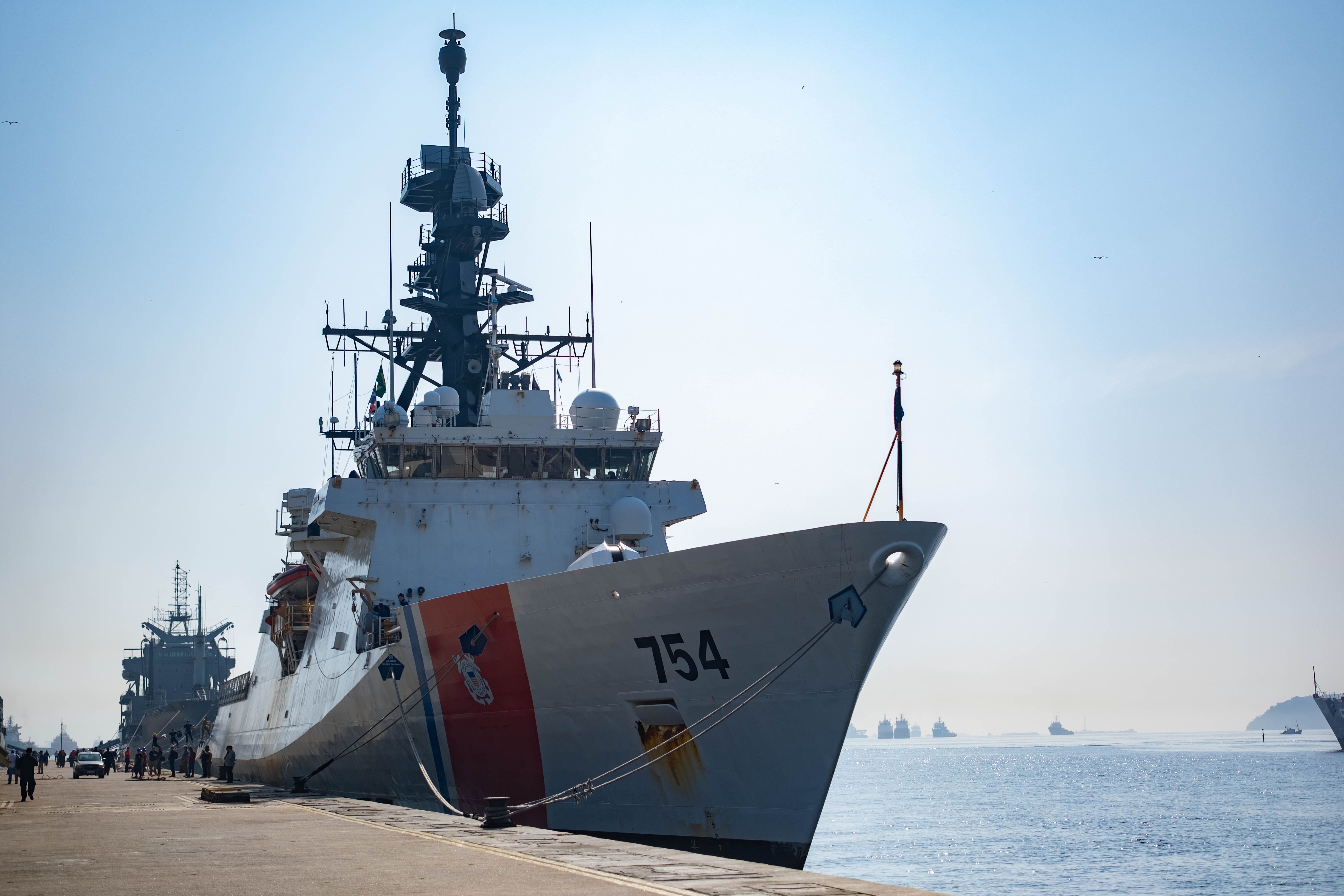
The U.S. Coast Guard Cutter James (WMSL 754) moors in Rio de Janeiro, Brazil, May 20, 2024. The James arrived in Rio de Janeiro for a scheduled port visit during Operation Southern Cross 2024. (U.S. Coast Guard photo by Petty Officer 3rd Class Logan Kaczmarek)
Brazil and the United States partner to combat illegal fishing as US Coast Guard Cutter arrives in Rio de Janeiro
RIO DE JANEIRO — U.S. Coast Guard Cutter James (WMSL 754) arrived in the port of Rio de Janeiro, Brazil for a scheduled visit, Monday.
This visit marks James’ third stop as the cutter continues its multi-mission deployment in the South Atlantic Ocean, exhibiting the U.S. Coast Guard’s partnership with Brazil and strengthening the interoperability of the two nations’ maritime forces to counter illicit maritime activity and promote maritime sovereignty throughout the region.
“Working with the Brazilian navy has been a successful demonstration of how our countries can work together,” said U.S. Coast Guard Capt. Donald Terkanian, James’ commanding officer. “James has had the opportunity to enhance relations between the U.S. and Brazil while also addressing the threats posed by illegal, unreported, and unregulated fishing, port security, and in facilitating safe and lawful maritime commerce and travel.”
James embarked Brazilian navy Lt. Cmdr. Fernando Schild in April of 2024. Brazil and the United States’ naval services both use unmanned aerial systems to provide increased maritime domain awareness across a variety of mission sets. The embarked Brazilian officer is part of Brazil’s first ship-based unmanned aerial systems squadron, and the embarkation of this officer aboard James highlights the robust partnership between the two nations and their shared commitment to upholding the rules-based international order at sea.
In recent years, the United States and Brazil have partnered to share and exchange maritime tactics, techniques, and procedures. Since 2009, the U.S. Coast Guard has provided 34 mobile training team deployments and three resident training courses to Brazil in the areas of crisis management, mobile command systems, port security, maritime law enforcement, search and rescue, and disaster response. Both countries are dedicated to the responsible management of marine resources, demonstrating their shared commitment through the continued integration of their naval forces.
James, staffed by 150 men and women and is one of the largest and most technologically advanced ships in the Coast Guard’s fleet. The crew is dedicated to missions including combatting drug trafficking and monitoring for illegal, unreported, and unregulated fishing activities in the Atlantic. Their work not only supports U.S. interests but also contributes to regional stability and security.
James is the fifth Legend-class national security cutter in the Coast Guard fleet and is currently homeported in Charleston, South Carolina. The national security cutters can execute the most challenging national security missions, including support to U.S. combatant commanders.
James is under the command of U.S. Coast Guard Atlantic Area. Based in Portsmouth, Virginia, U.S. Coast Guard Atlantic Area oversees all Coast Guard operations east of the Rocky Mountains to the Arabian Gulf. In addition to surge operations, they also allocate ships to work with partner commands and deploy to the Caribbean and Eastern Pacific to combat transnational organized crime and illicit maritime activity.
For information on how to join the U.S. Coast Guard, visit GoCoastGuard.com to learn about active duty and reserve, officer and enlisted opportunities. Information on how to apply to the U.S. Coast Guard Academy can be found here.
The accompanying article provides a brief overview, but I really recommend watching the entire interview. It is excellent. It even touches on Illegal, Unregulated, Unreported fishing.
There is an acknowledgement that resources made available for interdiction have declined even while seizures are up (as is the traffic in illegal drugs), but there is also good news in the successes of partner nations.
Again, there is no substitute for watching the interview.
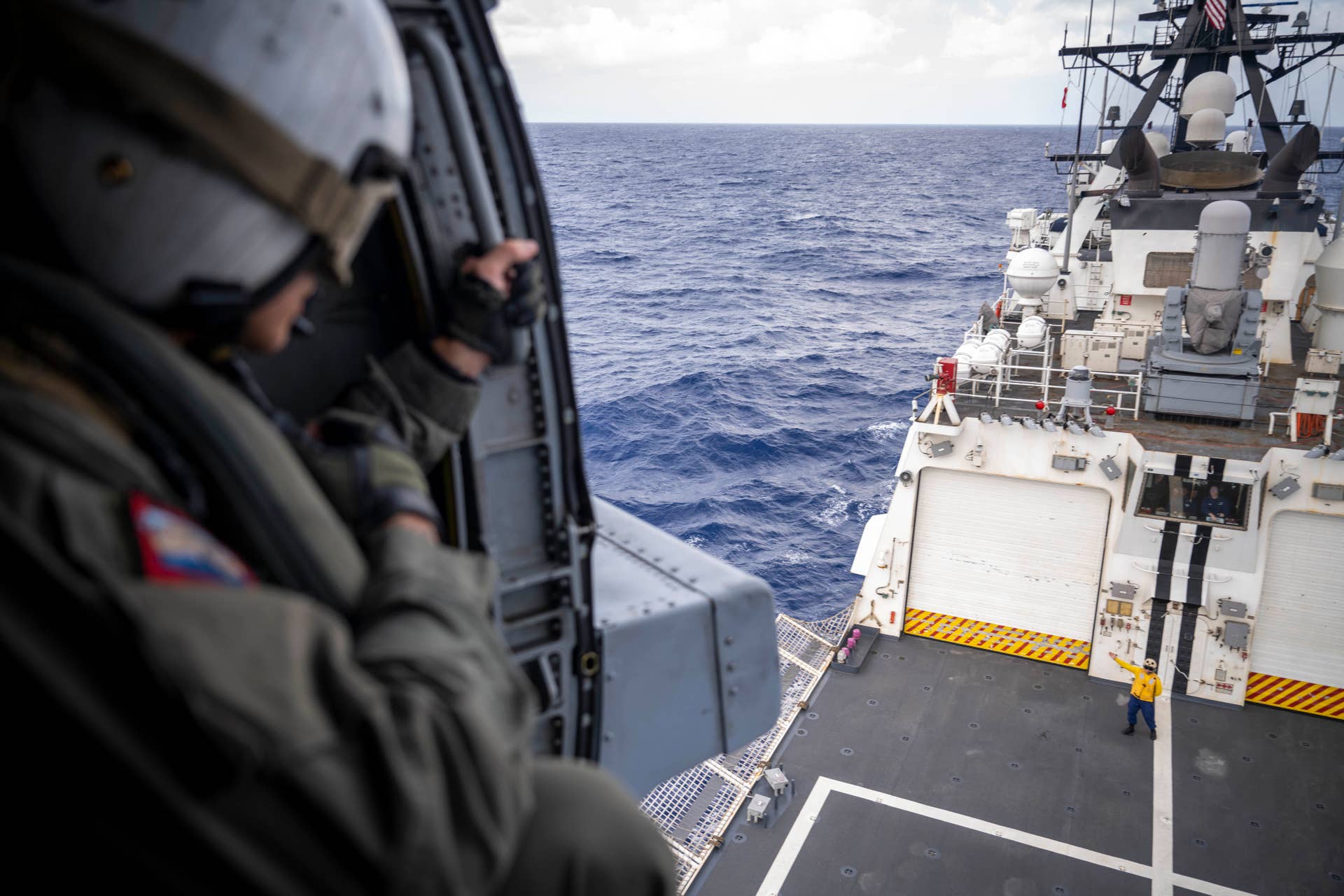
PACIFIC OCEAN (July 30, 2022) U.S. Navy Petty Officer 1st Class Humberto Alba, a naval aircrewman tactical-helicopter, attached to Helicopter Maritime Strike Squadron (HSM) 37, deployed on U.S. Coast Guard Legend-class cutter USCGC Midgett (WMSL 757), looks down at a USCGC crewmember after taking off during flight operations during Rim of the Pacific (RIMPAC) 2022. (U.S. Coast Guard photo by Petty Officer 3rd Class Taylor Bacon)
Below is a Third Fleet news release regarding the upcoming RIMPAC exercise. I am hoping we will see at least one story from each participating Coast Guard unit. There are likely to be several.
A National Security Cutter is almost certain to participate. I am particularly interested to see what the NSC will do. As I noted earlier, during the last two RIMPACs National Security Cutters did some interesting stuff. In 2020 Munro hosted a U.S. Navy Helicopter Sea Combat Squadron 21 MH-60S Helicopter. In 2022 Midget commanded a task force and hosted Navy MH-60R ASW helicopter.
Would be nice if they got to shoot their 57mm as part of the SINKEX. It’s not like they are going to prematurely sink the target. Maybe a dozen ALAMO rounds at 10,000 yards.
I would hope that, sometime in the future, we would conduct a Coast Guard SINKEX using one of our decommissioned ships. Would be good to get a practical demonstration of the effectiveness of our 57mm Mk110s.
May 21, 2024
U.S. Pacific Fleet Announces 29th RIMPAC Exercise
By Commander, U.S. Third Fleet Public Affairs
SAN DIEGO – Approximately 29 nations, 40 surface ships, 3 submarines, 14 national land forces, over 150 aircraft and more than 25,000 personnel will participate in the biennial Rim of the Pacific (RIMPAC) exercise scheduled June 26 to Aug. 2, in and around the Hawaiian Islands.
RIMPAC 2024 is the 29th exercise in the series that began in 1971. As the world’s largest international maritime exercise, RIMPAC combines force capabilities in a dynamic maritime environment to demonstrate enduring interoperability across the full spectrum of military operations.
The theme of RIMPAC 2024 is “Partners: Integrated and Prepared.” To promote a free and open Indo-Pacific, Exercise RIMPAC is the premier joint and combined maritime exercise, utilizing and preserving a world class maritime training environment. With inclusivity at its core, RIMPAC fosters multi-national cooperation and trust, leverages interoperability, and achieves respective national objectives to strengthen integrated, prepared, coalition partners.
This year’s exercise includes forces from Australia, Belgium, Brazil, Brunei, Canada, Chile, Colombia, Denmark, Ecuador, France, Germany, India, Indonesia, Israel, Italy, Japan, Malaysia, Mexico, Netherlands, New Zealand, Peru, the Republic of Korea, the Republic of the Philippines, Singapore, Sri Lanka, Thailand, Tonga, the United Kingdom and the United States.
Hosted by Commander, U.S. Pacific Fleet, RIMPAC 2024 will be led by Commander, U.S. 3rd Fleet, who will serve as the Combined Task Force (CTF) commander. For the first time in RIMPAC history, a member of the Chilean Navy, Commodore Alberto Guerrero, will serve as deputy commander of the CTF. Rear Adm. Kazushi Yokota of the Japan Maritime Self-Defense Force will serve as vice commander. Other key leaders of the multinational force will include Commodore Kristjan Monaghan of Canada, who will command the maritime component, and Air Commodore Louise Desjardins of Australia, who will command the air component.
During RIMPAC, integrated and prepared partners train and operate together in order to strengthen our collective forces and promote a free and open Indo-Pacific. RIMPAC 2024 contributes to the increased interoperability, resiliency and agility needed by the Joint and Combined Force to deter and defeat aggression by major powers across all domains and levels of conflict.
Details of RIMPAC activities and imagery are available at http://www.cpf.navy.mil/rimpac and https://www.dvidshub.net/feature/RIMPAC2024. Media coverage of RIMPAC 2024 is authorized and encouraged, but in all cases will be coordinated through the Combined Joint Information Bureau (CJIB). Media interested in covering the exercise should fill out the following form:
Any additional questions/queries should be sent to rimpac.media@gmail.com, or the C3F PA team (619-767-4383). Contact information for the RIMPAC CJIB will be made available prior to the beginning of the exercise.






 Chuck Hill's CG Blog