Chuck Hill's CG Blog

Chuck Hill's CG Blog

“Coast Guard Commandant challenges workforce to move the service forward” –MyCG

Just passing this along from MyCG (looks like access to the townhall video is limited). This seems to be a promising sign that the leadership does not expect all solutions to come from the top down.


Coast Guard Commandant challenges workforce to move the service forward

By Kathy Murray, MyCG Senior Writer

The U.S. Coast Guard Commandant Adm. Linda Fagan encouraged members to help her improve the service during a Workforce Town Hall on Wednesday.  Here’s the link: workforcetownhall.mov (sharepoint-mil.us)

“We’re all in different places in the team, but each and every one of us contributes to the well-being and organizational success of the Coast Guard,” Fagan said. “It’s OUR Coast Guard. It’s not mine, it’s not somebody else’s. There is no they or them. It’s us, ours, collectively. And so together we – WE – make the changes. Together we create the opportunity and together we create the culture that we aspire to.”

Adm. Fagan described her vision of a modern service, with a thriving, efficient, effective workforce.

According to Fagan, too many talented people with the Coast Guard are stuck trying to create success around inefficient processes. She challenged members to think in new and creative ways.  “Like if somebody comes to you and says, ‘We’ve always done it this way,’ that is a red flag, right? It may have served Joshua James well, but it doesn’t serve us well now. And so do not be burdened or encumbered by a legacy view when that [view is no longer] right.”

“The status quo is the risk position,” Fagan said.

Fagan took questions with Master Chief Petty Officer of the Coast Guard, Master Chief Heath Jones, during the hour-long event which was live-streamed from a packed auditorium at Coast Guard Headquarters. The pair answered questions submitted online in advance and from in-person attendees.

Sexual harassment remained a top concern. Two attendees shared their personal experiences with sexual assault, and concerns about access to resources for both military members and civilians.

Fagan thanked them and reiterated the steps the service has taken to address sexual assault, by creating a world-class Sexual Assault Prevention, Response and Recovery program available to both military members and civilians. But there’s more to do. “I want an environment where everyone always experiences a workplace that is free from harm,” she said, and noted the Service was engaged in a long-term effort to strengthen service culture.

“We have the devotion part down,” Fagan said, noting that more than 200 servicemembers are currently supporting the Baltimore bridge collapse. “When the Coast Guard is at its best,” she added, “we work together. We hold each other accountable. We hold each other up.”

Additional highlights:

  • On managing workforce shortages and decommissioning of vessels:   Although Jones noted improvements in recruiting, Fagan said she expects workforce shortages to persist and that more ships could be tied up in upcoming assignment years. “I see it as an opportunity to challenge some operating assumptions,” she said, mentioning ways we are working differently to conduct missions and avoid putting members at risk, but she reiterated that the Service, “cannot do the same with less.”
  • On the impact of budget-related stress on less senior employees:  Jones said he thinks members across every level of the workforce are impacted by the Coast Guard’s budget, as well as federal shutdowns and continuing resolutions. He said he is encouraged by a bill that currently seems to have bipartisan support that would continue to pay all military members in the event of a shutdown. Fagan added that since the 2019 shutdown, the Coast Guard has learned ways to mitigate some of the pay issues, if necessary.
  • On reducing civilian hiring delays: Fagan agreed that the process was not nimble enough. She said leaders are working to find ways to make it more efficient and advocating for budget increases to hire more human resources staff. But she asked for help in finding efficiencies and different ways to speed the process while generating, “the most robust talent pool we can find.”
  • What encouragement would MCPOCG offer to E-6 and below: “Don’t ever close the door to any opportunity in your career,” Jones said. He confessed that late in his career he almost missed a great opportunity that way.

Over 100 members of the workforce submitted questions before the Town Hall, and the Commandant and MCPOCG plan to respond to the remaining questions directly or on their social media platforms in the coming weeks.

“Maritime Nation S3 E3: The USCG: At the Intersection of Diplomacy, Law, and Security” –Navy League Video

Above is a great video interview of the Commandant conducted as part of a Navy League Series of video podcasts entitled Maritime Nation. I was frankly surprised by the depth of the interview, and impressed by the Commandant’s willingness to think outside the box.

Thanks to Lee for bringing this to my attention.

South Korea Seizes Chinese Fishing Vessels –Newsweek

A picture taken on November 16, 2011 from a South Korean helicopter shows Chinese fishermen wielding sticks to stop an attack by South Korean coastguard commandoes armed with clubs aboard rubber boats during a crackdown on alleged illegal fishing in South Korean waters in the Yellow Sea off the southwestern coast county of Buan. South Korea’s coastguard mobilized 12 ships, four helicopters and commandoes for a special three-day crackdown on illegal fishing by Chinese boats this week. REPUBLIC OF KOREA OUT AFP PHOTO / DONG-A ILBO (Photo credit should read DONG-A ILBO/AFP/Getty Images)

Newsweek reports,

“South Korea’s Coast Guard seized five Chinese vessels for allegedly fishing illegally in the country’s waters late last month, confiscating boats and deporting several crew members…The joint patrol’s 30 participating vessels and three aircraft waters were operating in the vicinity of Jeju Island from March 25-31, Korea JoongAng Daily reported.

“The country’s coast guard said that, on average, 300 Chinese vessels fish illegally in the country’s exclusive waters each day, with that figure dropping to an estimated 140 during periods of intensified crackdowns.”

As you can see from the photo above and below. This is not a new problem.

A picture taken on November 16, 2011 from a South Korean helicopter shows Chinese boats banded together with ropes, chased by a coastguard helicopter and rubber boats pacted with commandoes, after alleged illegal fishing in South Korean waters in the Yellow Sea.
Credit: Dong-A-Ilbo

In many cases these encounters have become violent. The South Koreans have not been afraid to seized Chinese fishing vessels, but on the other hand they have not been successful in stopping large scale illegal fishing.

“WORLD ICEBREAKERS OVERVIEW” –Aker Arctic

Coast Guard Cutter Healy (WAGB 20) and crew conduct formation steaming exercises with Candian Coast Guard Ship Sir Wilfrid Laurier and crew in the Beaufort Sea, July 28, 2023. The crew conducted a passenger exchange with the Sir Wilfrid Laurier off the coast of Utqiagvik, Alaska. (U.S. Coast Guard photo by Petty Officer 1st Class Michael Underwood)

Below is a publication of Aker Arctic. I assume they will not mind if I pass it along. It is after all something of an advertisement for their expertise. I was surprised to find the US has 16 icebreakers. I don’t know where they got that figure. There are of course Polar Star, Healy, and Mackinaw. They might also count Polar Sea. That leaves 12 or 13. The National Science Foundation has two or three depending on what you count and there is the Aiviq that the Coast Guard is likely to buy. That leaves eight or nine. Maybe they are counting the nine 140 foot Bay class icebreaking tugs. Clearly, they are not including the 16 Juniper class buoy tenders that do have an icebreaking capability, because there are too many of them. This highlights the wide range of capabilities that fall under the icebreaker label and the difficulty of classifying multi-mission ships.

Wikipedia also has a list of icebreakers, including past as well as present icebreakers.


ARTICLE / 13.03.2024

WORLD ICEBREAKERS OVERVIEW

For those who share our passion, we present a snapshot of the world icebreaking fleet as of 1st January 2024.

There is a multitude of ice-strengthened vessels designed for various purposes in the world. Some possess exceptional ice-going capabilities while others are suited only for light ice conditions. Only a select few can truly be classified as icebreakers.

Icebreakers pave the way

An icebreaker is a vessel designed for icebreaking duties. Its core features include a reinforced hull shaped to break the ice, a robust and powerful propulsion system, and appropriate winterization against low ambient temperatures. All characteristics are meticulously selected based on the intended area of operation and planned tasks. These typically include escort or ice management functions.

Major classification societies such as American Bureau of Shipping, Bureau Veritas, Det Norske Veritas, Lloyd’s Register, Russian Maritime Register of Shipping and — most recently — China Classification Society have established rigorous standards and guidelines for icebreakers to ensure safe navigation in ice-covered waters.

Hard to draw the line

The diversity of icebreaking ships makes compiling an exhaustive list of icebreakers challenging. It is difficult to draw a clear line between ships that should be included and ships that should be left out.

In addition to purpose-built icebreakers, many research ships, offshore vessels, and even one luxury cruise ship have been officially classified as icebreakers. However, their ability to operate independently in difficult ice conditions is merely a means to carry out other tasks.

Although smaller ice-strengthened tugboats are often used for icebreaking operations in harbours, they are not considered as icebreakers. Oil tankers, LNG carriers, and other cargo ships are also excluded even if they are fully capable of independent year-round operation in the most challenging Arctic ice conditions.

Market intelligence

At Aker Arctic, we keep a close track on all world icebreakers, including ship type, size, ice class, primary mission, icebreaking capability, and other technical characteristics in addition to expected lifespan.

“This is a cornerstone of our expertise, rooted in our keen interest in monitoring market evolution in our field,” notes Senior Naval Architect Tuomas Romu, who has compiled the overview of the world’s icebreaking fleet presented here.

“However, different countries’ fleet sizes should not be directly compared due to the diversity in the sizes, capabilities and characteristics of individual ships on the list,” Romu adds.

As of 1 January 2024, the complete list of icebreaking ships includes 243 ships: 179 in service worldwide, 29 under construction, and 35 in the shipyards’ orderbooks or included in various procurement programs. While the global fleet is gradually increasing in numbers, many of the new icebreakers are built as replacement to older ships.

World icebreaking fleet 1 January 2024.

Although an icebreaker is a very specific ship type, a review of the global icebreaking fleet must consider not only the diversity of the vessels themselves but also the different ways icebreaking ships are perceived and classified worldwide. For example, United States and Canada each use their own way of classifying icebreakers as “heavy”, “medium” or “light”. On the other hand, Russia’s vast icebreaking fleet can be split into a number of categories based on type, purpose and key technical characteristics.

Examples of two different classification systems: Canada.
Examples of two different classification systems: Russia.

Finland leads the world

Following World War II, Finnish companies made rapid advancements in icebreaking technology, pushing the state of the art in icebreaking design, construction, power supply, and propulsion systems. Today, Finland is a global leader in icebreaker design and construction, with most of the world’s icebreakers originating from Finnish expertise. Naturally, every single icebreaker in service in Finland has been designed and constructed locally.

The strong Finnish maritime cluster is composed of engineering offices, shipyards, equipment manufacturers, universities, model testing facilities, and other related entities. The cluster collectively fosters research, new ideas and innovations, continually inventing ways to improve operations in ice.

The task of how to break ice more efficiently and sustainably has intrigued naval architects and ship engineers for generations, constantly pushing the boundaries of the icebreaker design using new hull forms, alternative fuels, different propulsion systems, and new engine types.


Full-scale references

The Finnish maritime industry also maintains the most extensive full-scale reference database, ensuring that every new vessel meets its performance requirements set before construction.

“Anyone considering acquiring an icebreaker looks to Finland first. With over 80 years of experience, we consistently pioneer new market innovations,” says Romu. “Moreover, our vessels have received global acclaim for their performance and quality.”

Environmental stewardship

The global icebreaker market represents a diverse and dynamic sector, essential for supporting operations in challenging ice conditions worldwide. Finnish leadership in this field, marked by decades of innovation and excellence, sets a high standard for icebreaker design and construction. With increasing demand for efficient icebreaking vessels and sustainable maritime solutions, the Finnish maritime cluster remains at the forefront of technological innovation and environmental stewardship.

We at Aker Arctic are dedicated to monitoring developments, sharing our insights and fostering collaborations to further enhance our own capabilities. We believe this is vital for pushing the state of the art of icebreaking in order to ensure safety and optimal efficiency for maritime operations in icy waters in a constantly evolving world.

Text: Catarina Stewen

“India Rescues Iranian Fishing Vessel Hijacked By Pirates Off Somalia” –gCaptain

An Indian Navy carries out a rescue operation of an Iranian fishing vessel Al-Kambar 786 after it was seized by armed pirates off Somalia, in the Arabian Sea, according to a naval statement, in this handout photo released on March 30, 2024. SPOKESPERSONNAVY VIA X/Handout via REUTERS

gCaptain reports,

The Indian Navy said it had freed the 23-strong crew of an Iranian fishing vessel which was seized by armed pirates off Somalia….The vessel was intercepted by the navy’s INS Sumedha and INS Trishul, leading to “over 12 hours of intense coercive tactical measures” forcing the pirates to surrender…”

INS Sumedha (foreground in the photo above) is a Saryu-class 105 meter (344′) offshore patrol vessel, and was the first Indian vessel on scene.

Interestingly, the 23 member crew of this Iranian fishing vessel were all Pakistani nationals.

Peru to Build OPV(s) With Aid From S. Korea’s HHI

Artist impression of the Frigate, Offshore Patrol Vessel (OPV) and two Landing Craft Units (LCUs) for the Peruvian Navy. HD HHI image.

Naval News reports, that Peruvian shipyard Servicios Industriales de la Marina (SIMA) will be building the first of a new class of Offshore Patrol Vessels (OPV) for the Peruvian Navy, along with a frigate and two LCUs. Korean Shipbuilder Hyundai Heavy Industries (HHI) will provide the design, equipment & material package, and technical support.

“The OPV ordered is based on HD HHI’s HDP-2200 OPV solution, which is 95 meters long, 14.3 meters wide, with a maximum speed of 20 knots and a range of 6,000 nautical miles, capable of operating medium-sized maritime operation helicopters. She is designed with space for two containerized mission modules enabling versatile capabilities.”

Another four OPVs of the class are planned. These Offshore Patrol Vessels appear to be closely related to six similar ships being built by HHI in Korea for the Philippine Navy.

Note, it appears at least some versions of this design have a stern launch system. The other versions of the design also claim to have a top speed of 22 knots, so this may apply to the Peruvian ships as well.

This will not be the first time SIMA has teamed with a South Korean shipbuilder. SIMA also built BAP Pisco (AMP-156), an 11,394 ton full load Makassar-class landing platform dock, designed by Daesun Shipbuilding & Engineering Co., Ltd. commissioned in 2018. They have reportedly launched a second. In the 1980s SIMA completed two Italian designed Lupo class Frigates.

Former USCGC Acushnet in Another Life

War is Boring brings us a story about an effort to repurpose the former USCGC Acushnet (WMEC-167),

World War II Navy ship might be used to house homeless veterans in California.”

If you are just reading the title, you might think there was a mistake, but Acushnet was originally USS Shackle (ARS-9), a rescue and salvage ship.

I don’t have a lot of optimism about their long-term success, but wish the new owners luck.

Currently the ship is at the marina at Brown Point in Tacoma, Washington.

I also found it interesting that there are still remnants as the four concrete drydocks in Napa. Every time I see something like this, I think it would be a good idea to have a Coast Guard Yard, West.

Thanks to Paul for bringing this to my attention.

Canadian Coast Guard Multi-Purpose Vessel Recapitalization

Canadian CG MPV. Credit Aker Arctic.

Below is a press release from Seaspan Shipyards regarding a contract awarded for the Canadian Coast Guard’s Multi-Purpose Vessel program. We talked about these ships earlier. I am going to repeat some of that earlier post here. Much like USCG Juniper class buoy tenders or the Great Lakes Icebreaker Mackinaw, these Canadian ships are made to both tend buoys and break ice. But these ships will be a lot bigger than the Mackinaw and it appears they can also support a helicopter and probably UAS.

CHARACTERISTICS:

  • Displacement: about 8,500 tons
  • Length, overall: 99.9 meters (328′)
  • Beam: 20.3 meters (66.7′)
  • Draft: 6.2 meters (20’4″)
  • Propulsion: diesel-electric; two azimuthing propulsion units
  • Range 12,000 nautical miles

The relatively shallow draft was a design requirement. 

Canadian CG MPV. Credit Aker Arctic.

ICE CLASS: 

These ships will be Canadian Ice Class 4, meaning they will have the capability to maintain a speed of 3 knots through ice 4 feet thick. The Canadian Coast Guard will consider these heavy icebreakers. We don’t have any figures on horsepower, but they probably will have less than 20,000 HP which, in the USCG system, would classify them as light icebreakers.

Compared to the US Coast Guard’s “heavy” Great Lakes icebreaker, Mackinaw (3,500 tons and 73m), these will be more powerful and more than twice as large. These might be a good design for the planned second USCG Great Lakes icebreaker.

IMPLICATIONS FOR THE USCG:

Aside from possible use of the design for Great Lakes icebreaker, these might be pretty close to what the USCG needs for their planned medium icebreakers. Certainly, consultation with Canadian counterparts will sharpen the focus of the US design effort. We might also have reasons to limit beam and/or draft.

I might add that, ships like these could make good companions (tenders/mother ships) for support of distant FRC operations, carrying fuel, supplies, and air assets.


Seaspan Shipyards Progresses to Next Phase of Designing and Building Multi-Purpose Vessels for the Canadian Coast Guard

 March 26, 2024 – North Vancouver, BC – Seaspan Shipyards (Seaspan) has been awarded the Construction Engineering (CE) and Long Lead Items (LLI) contracts for the pre-construction work of the Canadian Coast Guard’s (CCG) first six Multi-Purpose Vessels (MPV).

Following the successful completion of the vessel’s Basic Design review in late 2023, Seaspan was awarded the CE and LLI contracts to complete the design and engineering work and to procure long lead-time material and equipment to ensure readiness to proceed with the construction of the first six ships of the up to 16 vessel fleet.

“This milestone demonstrates the tremendous capabilities in marine design and engineering that have been developed through the National Shipbuilding Strategy.  Our team, along with our partners from coast to coast, are excited to move to the next phase of this program, and ultimately provide the Canadian Coast Guard with the vessels they need to manage and safeguard Canada’s coastlines. A long run of ships like the MPV program enables Seaspan to continue to drive improvement and generate greater efficiencies, while ensuring we have stability for the next generation of shipbuilders, marine engineers and designers and supply chain in Canada,” said John McCarthy, Chief Executive Officer, Seaspan Shipyards.

“The designers and the ship builders of Seaspan Vancouver Shipyard – are playing key roles in taking the Canadian Coast Guard’s new multi-purpose vessels (MPVs) out of the drawing room and into the open ocean. The contracts announced today are an important milestone to getting these ships completed and represent an important investment in North Vancouver. This will secure good jobs while advancing the delivery of the MPVs to significantly expand the operational capacity of our Coast Guard for years to come.” – The Honourable Jonathan Wilkinson, Minister of Energy & Natural Resources and MP for North Vancouver.

The MPVs will be Polar Class 4 vessels, allowing them to carry out multiple missions including icebreaking in moderate ice conditions and assisting in shipping and flood control, search and rescue, environmental response, as well as maintaining Canada’s marine navigation system composed of approximately 17,000 aids to navigation. The new fleet of MPVs will replace the existing fleet of High Endurance Multi-Tasked Vessels and Medium Endurance Multi-Tasked Vessels.

“The Canadian Coast Guard saves lives at sea, maintains waterways open and safe for the movement of goods and services, protects the marine environment and supports Canadian sovereignty and security. The Multi-Purpose Vessels will be key assets for the Canadian Coast Guard’s future fleet, giving our personnel the modern, reliable tools they need to continue their vital work from coast to coast to coast,” said Mike Kelloway, Parliamentary Secretary to the Minister of Fisheries, Oceans and the Canadian Coast Guard.

Seaspan has already gained significant experience designing and building Polar Class vessels including three Offshore Fisheries Science Vessels which are now in service with the Canadian Coast Guard; an Offshore Oceanographic Science Vessel that is currently under construction; and a heavy Polar Icebreaker, the first of its kind to be designed and constructed in Canada in 60 years. Seaspan is preparing to cut steel on the Polar Icebreaker in late 2024 with the recent completion of a prototype block, ensuring that proper processes, procedures, and equipment are in place to build a vessel of this complexity.

QUICK FACTS ABOUT THE MULTI-PURPOSE VESSELS

  • With a displacement of 8,500 tonnes, the Multi-Purpose Vessels will be 99.9 metres long and 20.3 metres wide, and able to accommodate up to 50 personnel.
  • The area of operation for the MPV will include:
    • Year-round operations in Canada’s eastern and western seaboards, within Canada’s Exclusive Economic Zone (EEZ)
    • Year-round operations in the Gulf of St. Lawrence, the St. Lawrence River, and the Great Lakes
    • Seasonal (summer) operations in the western and lower Arctic
  • Under the NSS, Seaspan has become a major economic and job creation engine. According to an economic analysis conducted by Deloitte, Seaspan has contributed $5.7 billion to Canada’s GDP since 2012, while also creating or sustaining more than 7,000 jobs annually.

SOCIAL MEDIA

Twitter: @Seaspan
LinkedIn: Seaspan ULC
Instagram: @SeaspanULC
Facebook: Seaspan

ABOUT SEASPAN

Seaspan, a division of Seaspan ULC, is a leader in Canada’s ship design, engineering, building and ship repair industry. With modern facilities and a dedicated workforce of approximately 3,900 in North Vancouver and Victoria, the company has proven itself to be a trusted and strategic partner on a range of complex projects for both government and the private sector.

“Coast Guard Polar Security Cutter (Polar Icebreaker) Program: Background and Issues for Congress” Updated March 25, 2024 –CRS

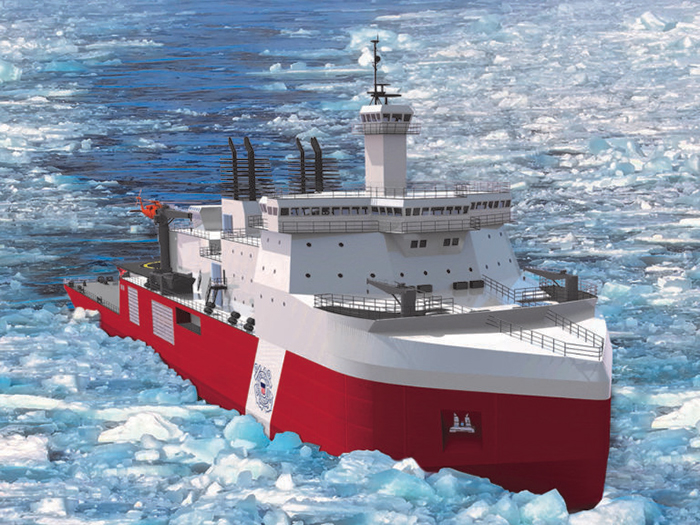
Polar Security Cutter. Image credit VT Halter Marine.

The Congressional Research Service has once again updated their look at the Polar Security Cutter (heavy icebreaker) program. (See the latest version here.)

I have reproduced the one page summary below.

As expected, the FY2024 budget includes $125M to purchase a US built commercially available icebreaker, presumably the Aiviq since it is the only one that meets the criteria.

The budget as enacted includes $20M for procurement of a Great Lakes Icebreaker (GLIB). The request for this item was $55M.

There was nothing in the enacted budget for the Polar Security Cutter program because the first two ship have already been funded but construction has yet to begin on the first ship, so there is no need to fund the third in FY2024.

There is a requirement to report on the possibility of reviving the Polar Sea,

In addition, within 120 days of the date of enactment of this Act, the Coast Guard is directed to provide a report that assesses the viability of reactivating Coast Guard Cutter Polar Sea. The report shall include an analysis of the material condition of the hull and cost and timeline estimates for a full overhaul of the vessel, including the renewal of the cutter’s propulsion, mechanical, electrical, communication, and support systems.


Summary

Required number of polar icebreakers. A 2023 Coast Guard fleet mix analysis concluded that the service will require a total of eight to nine polar icebreakers, including four to five heavy polar icebreakers and four to five medium polar icebreakers, to perform its polar (i.e., Arctic and Antarctic) missions in coming years.

Current operational polar icebreaker fleet. The operational U.S. polar icebreaking fleet currently consists of one heavy polar icebreaker, Polar Star, and one medium polar icebreaker, Healy. A second Coast Guard heavy polar icebreaker, Polar Sea. Polar Sea, suffered an engine casualty in June 2010 and has been nonoperational since then. Polar Star and Polar Sea entered service in 1976 and 1978, respectively, and are now well beyond their originally intended 30-year service lives. The Coast Guard plans to extend Polar Star’s service life until the delivery of at least the second Polar Security Cutter (PSC; see next paragraph).

Polar Security Cutter (PSC). The Coast Guard PSC program aims to acquire four or five new PSCs (i.e., heavy polar icebreakers), to be followed at some later point by the acquisition of new Arctic Security Cutters (ASCs) (i.e., medium polar icebreakers). The Navy and Coast Guard in 2020 estimated the combined total procurement cost of the first three PSCs in then-year dollars as $2,673 million (i.e., about $2.7 billion). The procurement of the first two PSCs is fully funded. The Coast Guard’s proposed FY2024 budget requested $170.0 million in continued procurement funding for the PSC program. The Coast Guard’s proposed FY2025 budget requests no procurement funding for the PSC program. The Coast Guard originally aimed to have the first PSC delivered in 2024, but the ship’s estimated delivery date has been delayed repeatedly and may now occur no earlier than 2028. Another potential issue concerns the accuracy of the PSC’s estimated procurement cost, given the PSC’s size and internal complexity as well as cost growth in other Navy and Coast Guard shipbuilding programs. The PSC’s estimated procurement cost per weight is roughly half that of the Navy’s LPD-17 Flight II and LHA amphibious ships. These amphibious ships are equipped with expensive combat system equipment that is not included in the PSC design, but whether this would account for all of the difference in cost per weight between the PSC design and the two amphibious ship designs is not clear. If substantial cost growth occurs in the PSC program, it could raise a question regarding whether to grant some form of contract relief to the PSC shipbuilder.

Commercially available polar icebreaker (CAPI). The Coast Guard’s proposed FY2024 budget requested $125.0 million in procurement funding for the purchase of an existing commercially available polar icebreaker (CAPI) that would be modified to become a Coast Guard polar icebreaker. The Coast Guard’s proposed FY2025 budget requests no procurement funding for CAPI, but the Coast Guard’s FY2025 Unfunded Priorities List (UPL) includes an item for $25.0 million in procurement funding for the ship.

Great Lakes icebreaker (GLIB). The Coast Guard’s proposed FY2024 budget proposed to initiate a new procurement program for procuring a new Great Lakes icebreaker (GLIB) that would have capabilities similar to those of Mackinaw, the Coast Guard’s existing heavy Great Lakes icebreaker. The Coast Guard’s proposed FY2024 budget requested $55.0 million in initial procurement funding for the ship, and the Coast Guard’s FY2024 UPL included an item for an additional $20.0 million in procurement funding for the ship. The Coast Guard’s proposed FY2025 budget requests no procurement funding for GLIB, but the Coast Guard’s FY2025 UPL includes an item for $25.0 million in procurement funding for the ship.