Singapore Builds “Cutter X”

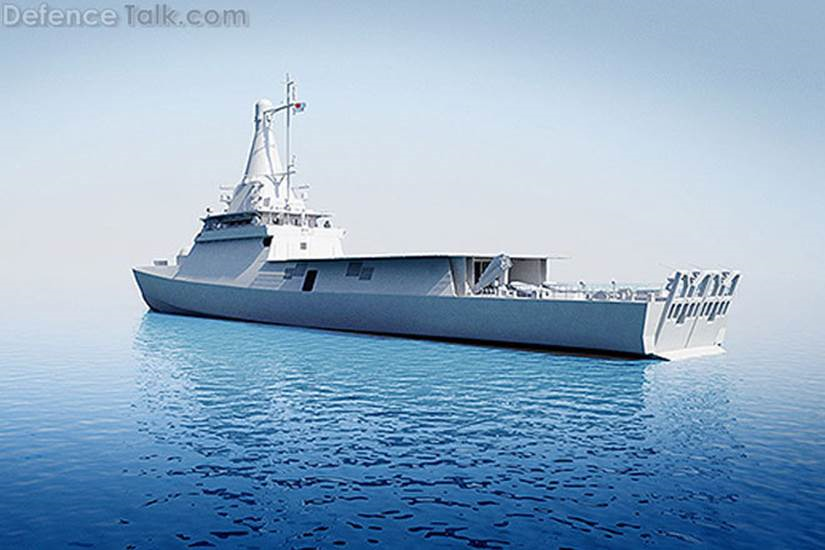
SingaporeLittoralMissionVesselPortBow

Singapore is building a new class of patrol vessels that look very much like my proposal for “Cutter X”, trading some Webber class and some larger ships for an intermediate design, costing about half what an OPC would cost, basically putting the equipment and crew (with some augmentation) of a Webber Class into a larger more seaworthy hull, to allow them to be used for extended operation in environments that do not require the ice strengthened hull and ability to launch and recover helicopters and boats in sea state five provided by the OPC.

Singapore is building eight of the ships under the project name “Littoral Missions Vessel” to replace eleven smaller, 500 ton, Fearless class patrol vessels that are approaching 20 years old. These ships are reportedly 80 meters in length (262.5 feet), displace 1200 tons (probably a light displacement), have a beam of 12 meters (39.4 feet), a range of 5,000 nautical miles at 15 knots, and a speed of 27 knots, all with a crew of only 30, though they do include additional accommodations for 30 more. (more here)

SingaporeLittoralMissionVesselPortQuarter

It appears these ships will use the same engines as the Webber Class. It is not clear how many of these engines they are using. Two would give them almost 12,000 HP which would almost certainly be good for at least 24 knots, but it might require three or four engines to make 27 knots.  (reports now indicate the class has two engines totallin about 12,000 HP)

In some respects these ships are more capable than the proposed cutter, in that they will have a 76mm gun and firecontrol system, in addition to smaller remotely operated weapons. It also appears to have space reserved for a small AAW missile system. On the other hand, while the flight deck can handle an H-60, the ship, unlike the French L’Adroit which was my model for “cutter X”, has no helicopter hangar, although it might be possible to add one using the same solution employed on L’Adroit (putting it under the bridge).

Soon, I expect to do an update of the “Cutter X” proposal, based on where we are now in the cutter recapitalization program.

More Info on the Eastern OPC Proposal

IMG_4134

All photos credit Navy Recognition

Recently found a brochure for Eastern’s OPC reportedly from last year’s Sea, Air, Space Conference. Credit FCNoVA from this discussion group. We have discussed this class before and here, the comments may still be of interest.

Relative to the question does the design meet the “objective” criteria or only the minimums it looks like relatively good news, meeting or exceeding the objectives in terms of endurance, speed, aviation facilities, and accommodations. I presume since this design meets most of the objective criteria, the other two designs will also similarly exceed the minimums. I will provide some of the information provided in the brochure and then provide my comments.

You can read the brochure here: http://www.mnvdet.com/Other/Eastern%20OPC%20Scan.pdf

DIMENSIONS:
Length overall: 328ft
Length between perpendiculars: 297ft
Beam overall: 52ft
Beam waterline: 48.67ft
Depth: 24.5ft
Draft: 16.1ft

Commentary: Compared to the Treasury Class (327 ft) cutters, this is, of course only one foot longer, but the beam and draft are both substantially greater, greater in fact than the beam and draft of the 378s, so we can expect the full load displacement to be considerably greater than the 327s’ approximately 2500 tons, and close to the over 3,000 ton full load displacement of the 378s. Unless the vertical weight distribution is messed up, these are likely to be good riding, very seaworthy ships, a notable improvement on the 270s and 210s.

Accommodations:
126 total
20 commissioned officers
12 CPOs
94 E-6 and below
Also included are a 466 sq ft physical fitness area, a 20 seat training room, and a 48 seat crew’s lounge.

Commentary: Note these are the accommodations, not the expected crew which will be 15 officers, 89 enlisted, and detachments totalling 12 for a total of 116. The Coast Guard is avoiding the mistake made on the Littoral Combat Ship of assuming a small crew, limiting accommodations, and then finding they need a larger crew than the ship was designed for.

Performance:
Range 9,500 nmi @ 14 knots
Sustained speed: 24 knots
Sprint speed: 26 knots.

Commentary: This is an area I was afraid we would see the design compromised. For similar speeds, this range is comparable to the that of the 378s. At speeds above 18 knots, its all diesel power plant will give it greater range than the 378s.

Main Propulsion/Auxiliary Prop and thruster/Electrical:

Main Prop: Two 12,204 HP MAN geared diesels
Ship Service Generators: 4,1044 kW
Auxiliary Prop/thruster: 750 kW, 1005 HP

Commentary: I interpret this to mean four generators of 1044 kW or 4,176kW total. That is a lot of power generation potential. By comparison a 378’s total capacity is 1500 kW, the 270s have 1425 kW. This suggest that the ship will have a hybrid power plant with the generators used for driving electric cruise motors. Running only three generators, one could probably supply routine electrical requirements and the other two could propel the ship. Two generators would supply the equivalent of approximately 2800 HP, this might be enough to drive the ship at 14 knots. Certainly three generators supplying 4200 HP would be more than enough. This will allow the ship to cruise with the Main Diesel Engines shut down.

The combined horsepower of the main diesels, 24,408 HP is more power than the diesel engines of the National Security Cutters which we know provide a high cruising speed, and it is about three and a half times the power of those on the 378s or the 270s.

The thruster is apparently of the drop down trainable type, allowing it to be used as an emergency or loiter propulsion system. The available power is relatively high meaning the ship could probably make seven or eight knots on the thruster alone.

I expect what we will see is two main engine spaces, each with one main diesel and one or two generators. Hopefully the main spaces will be separated by more than a single bulkhead, perhaps by the engineering control room, so that damage at a single point cannot effect both engine rooms. Hopefully also, at least one generator will be outside the two main machinery spaces. If so, these ships will have extraordinary main propulsion redundancy with at least three different spaces and five different systems capable of moving the ship–two MDE, two motors on the main shafts, and the bow thruster.

Construction: Steel Hull with an Aluminum Superstructure. Commentary: No surprise, although I would have liked to see steel superstructure, but it is a reasonable compromise.
IMG_4132

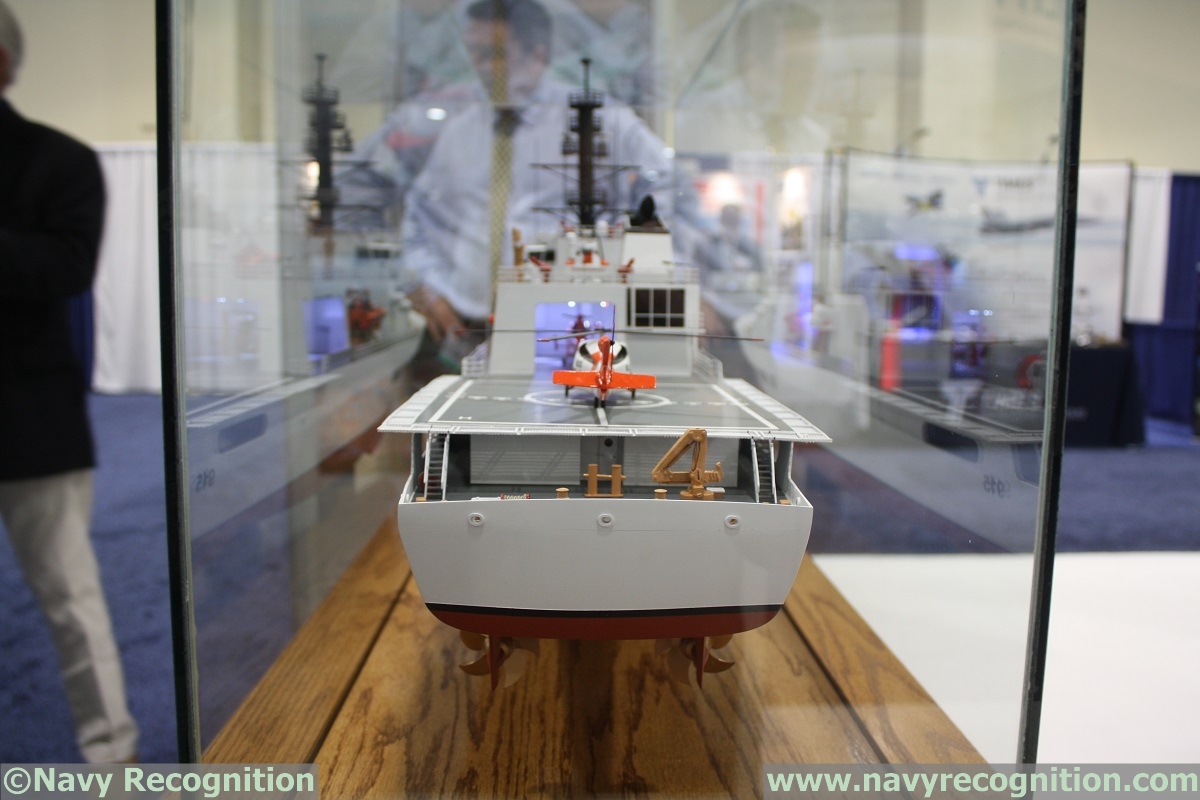
Aviation Facilities:

Hangar: H-65/H-60R+UAS/UAV
Flight Deck: 3725 square feet

Commentary: Good news that the hangar will be large enough to accommodate both a Navy MH-60R and a UAS although I am a bit concerned that since the Navy has moved to a larger airframe for their Firescout, there is a chance that the UAS may not include the latest version of what is likely to become a standard system.

Apparently the Flight Deck is at least as large and probably larger than that of the 378s.

IMG_4129

Weapons:

57mm Mk110 mod X
Electro-Optic Sensor System
25mm Mk38 mod2
two .50 cal. ROSAM (stabilized mount) plus two .50 cal. in soft mounts
ESM system
Mk53 mod X ASCM decoy system

Commentary: No surprise in what was mentioned. The radar fire control system that was included in previous specifications was not mentioned. This may have been simply an omission, but the Electro-Optic System might also serve as a firecontrol system, although it would be decidedly inferior to a radar system against surface targets in low visibility and against air targets in all situations. Consequently I am a bit concerned that this system has been compromised in the interest of simplifying the design.

The excess generator capacity may make these ships suitable for use of energy intensive weapons that may be developed in the future.

Let’s Give the OPC a Class Name–USCGC Newcomb (WMSM-915)

The procurement process for the Offshore Patrol Cutters is well underway. Three conceptual designs have been selected for further development. Challenges to the selection process have been rejected. There should be decision on the final design and contractor about the end of next year.

Perhaps the ships might feel closer to reality if there were a class name. I like the fact that we have been naming ships for notable figures in the history of the Coast Guard and its predecessor services as was done for the Bertholf and Webber Class cutters. Lets continue that with the Offshore Patrol Cutters.

Newcomb02

Frank H. Newcomb

Our friend Bill Wells tells the story of First Lieutenant, Frank H. Newcomb (Captain Commandant upon retirement), CO of the Hudson when it towed the Navy torpedo boat Winslow to safety from under Spanish guns in the port of Cardenas, Cuba during the Spanish American War.

uss_winslow_cardenas_text

Revenue Cutter Hudson towing USS Winslow while underfire from Spanish guns.

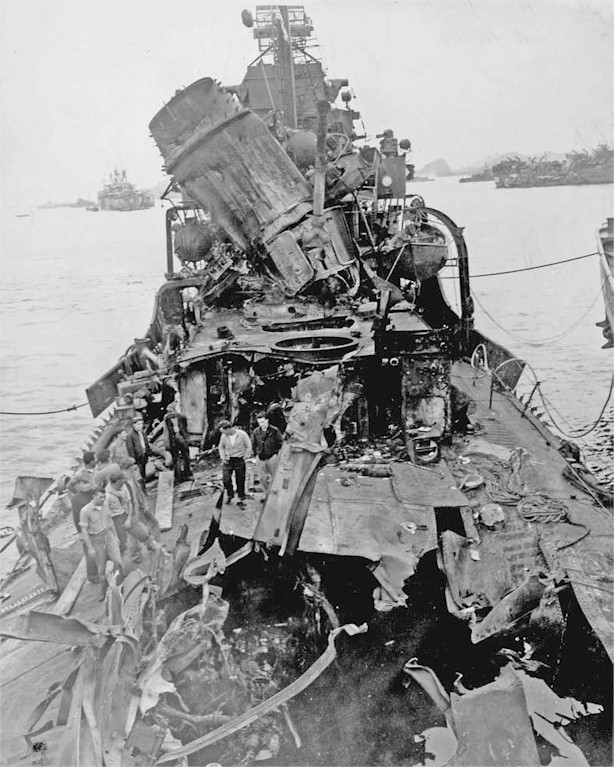
Newcomb was honored by the Navy as namesake for a Fletcher class destroyer, DD-586, USS Newcomb. She had a short but eventful history. In spite of not being commissioned until November 1943. She and another ship sank the Japanese submarine, I-185. She provided naval gun fire support at Saipan, Leyte, Iwo Jima, and Okinawa. As flagship of destroyer squadron 56, she lead a night torpedo attack on a Japanese Fleet during the Battle of Surigao Strait. She scored at least one torpedo hit on the Battleship Yamashiro, which was sunk in the battle, and like her namesake, while under fire, she towed a damaged ship, USS Albert W. Grant (DD-649), to safety. Off Okinawa she survived five (or six) Kamikaze hits.

USS_Newcomb_Damage_1945
USS Newcomb, DD-586, after taking at least four and possibly as many as six kamikaze strikes

Newcomb’s career was not limited to his time on the Hudson. This short biography (pdf) by Atlantic Area Historian William H. Thiesen also talks about his peacetime leadership, and how Admiral Waesche personal chose Newcomb as namesake for a destroyer as the best representative of the Coast Guard.

http://www.uscg.mil/lantarea/ExternalAffairs/humanstories/FrankNewcomb.pdf

“While Newcomb distinguished himself commanding a cutter in battle, he spent much of his career working as a field officer and inspector for the United States Life-Saving Service. Throughout his career, Newcomb championed the rights of those whose efforts merited recognition and promotion. For example, when he had received the medal for his wartime exploits, he insisted that Hudson’s crew receive specially struck medals as well, and the cook and stewards mate became the first African Americans to receive such recognition.

“Many in the Coast Guard as well as the general public have heard the story of the service’s only African American Live-Saving Service crew, which manned North Carolina’s Pea Island Life-Saving Station beginning in 1880. Few may realize that it was locally assigned U.S. Life-Saving Service inspector, Lieutenant Frank Newcomb, who worked diligently behind the scenes to institute an African American crew at that station. In fact, the local community opposed the establishment of an African American manned lifesaving station and arsonists burned down the original station. Newcomb had to camp out at the remote site of the burned out Pea Island station during construction of a new building to prevent sabotage a second time. While no one should diminish the accomplishments of the Pea Island Station’s courageous African American crew, it was Newcomb who risked his career and reputation to institute Pea Island’s African American crew in the racially-charged South following the Civil War.”

There has never been a Coast Guard vessel named for Newcomb. I think it is about time.

If you have any other suggestions for namesakes for the class, please add them in the comments section.

OPC and the LCS Replacement (SSC), Sister Ships?

I am not the only one seeing a possible opportunity for commonality between the Coast Guard’s Offshore Patrol Cutter (OPC) and the Navy’s projected Littoral Combat Ship (LCS) replacement. Here is a comment from Tim Colton’s Maritime Memos.

“The LCS program having proved unaffordable, largely thanks to the Navy’s idiotic passion for bells and whistles, they are now looking for suggestions for what they call a small surface combatant, or SSC. Read the announcement on FedBizOpps… The key words in the RFI are right up front: Small surface combatants enable the Navy to implement the Defense Strategic Guidance (DSG) imperative to develop innovative, low-cost, and small-footprint approaches to achieve our security objectives.

“It sounds as though we now have a potential overlap between the Navy’s SSC and the Coast Guard’s OPC, but that’s not necessarily a bad thing. In fact, it would be nice if, for a change, the Navy could manage to build some affordable ships. I know, shades of Gary Hart, but I think this is what we need, not more SSNs at $1.8 billion a pop. May Day, 2014.”

There is more information on the solicitation here.

Quoting from the solicitation, “This type of ship provides Combatant and Fleet Commanders a uniquely suitable asset for Theater Security Cooperation tasking and select sea control missions. These small surface combatants build and strengthen maritime relationships by operating with partners and allies in various theaters of operation.”

They are “asking for existing and mature design concepts.” The eight shipyards that bid on the OPC, and particularly the three that were selected, should be in a particularly good position to meet the demands of the solicitation.

We know they want more survivability and range, but they also want low cost and small footprint. To me that means a ship of similar size to the existing LCS but without the requirement for extreme speed that has made them high strung, crowded, and fragile. A slightly lengthened OPC can meet the requirements. Replace the 57mm with a larger gun and the Mk38 mod2 with CIWS/RAM/SeaRAM. Install CAPTAS (active/passive variable depth/towed array sonar) aft and use the extra length to add VLS and a second CIWS/RAM/SeaRAM, and you have a very viable, long ranged Small Surface Combatant.

If the Navy and Coast Guard could share a common Small Surface Combatant, they could probably be made in very economically.

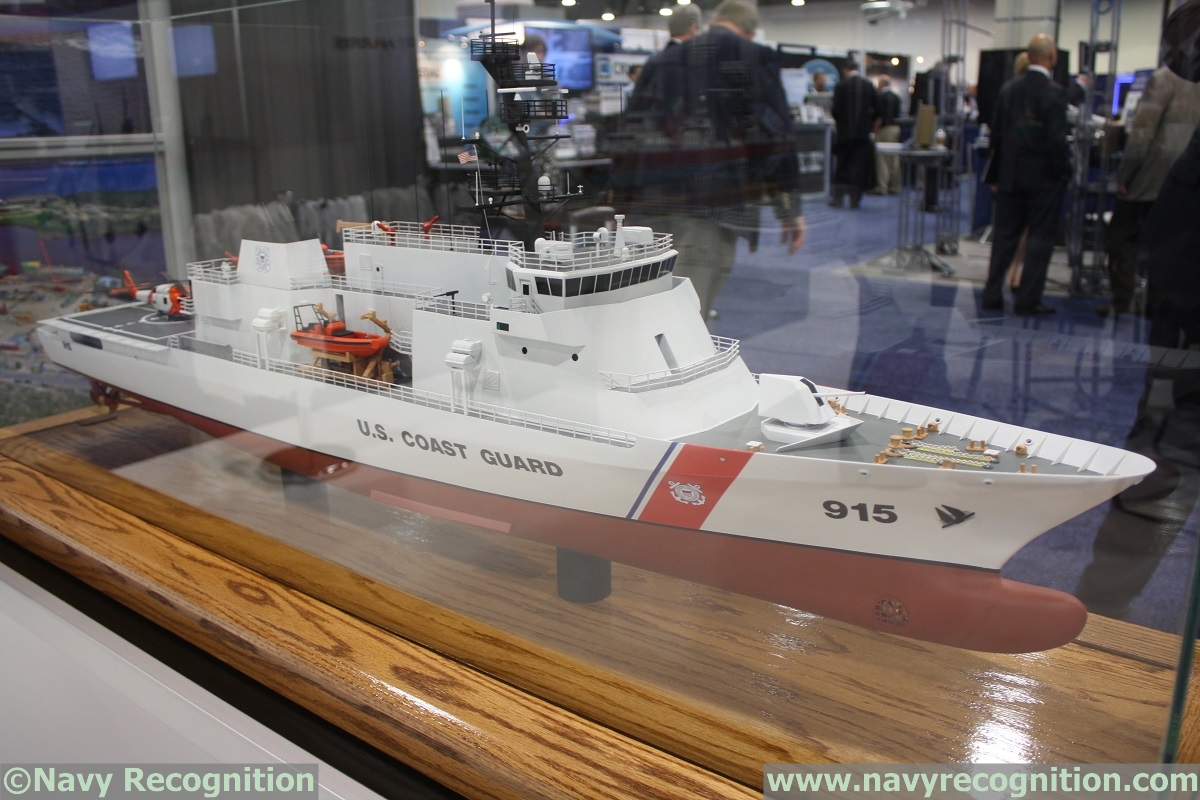
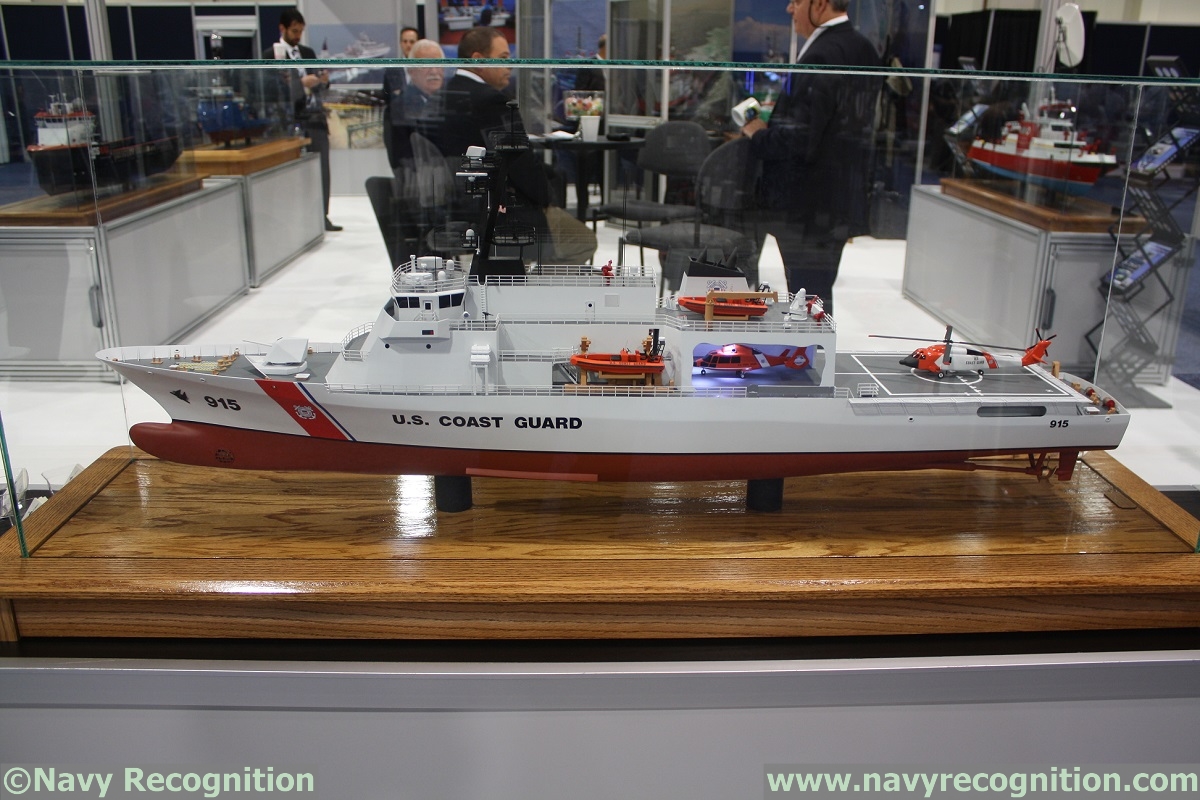
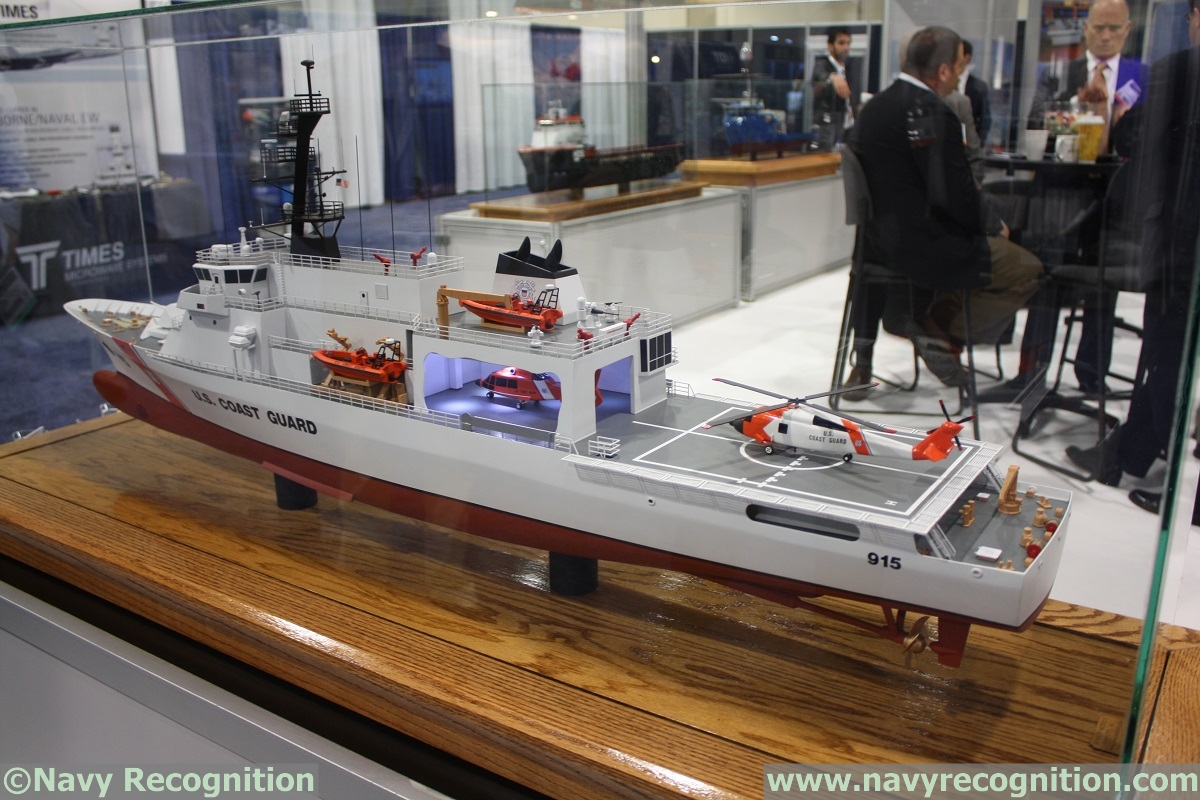
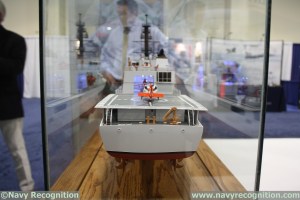
Eastern’s OPC Concept Model

Our friend at NavyRecognition has sent some photos of a model of the Eastern Offshore Patrol Cutter taken at Sea-Air-Space 2014. They have daily coverage of the event you can access here:
http://www.navyrecognition.com/index.php/news/naval-exhibitions/sea-air-space-2014.html

Click on the photo for a larger view.

IMG_4128

IMG_4129

IMG_4131

IMG_4132

IMG_4133

IMG_4134

IMG_4135

(Late addition, duplicating a comment)
One interesting feature I see on the model is that there appear to be four permanently mounted fire monitors, two on the hangar roof O-3 deck and two between the mast and stack on the O-4 deck.

Looks like the two ROSAM Mk49 remote controlled .50 cal. are just forward of the Mk38 mod2 and somewhat restrict its field of fire. I would rather see one or both of them forward, either on the roof of the bridge or on the O-2 deck forward of the bridge and above and behind the 57mm. Actually I would like to have a second Mk38 mod2 forward even if in lieu of the remote .50s. (There are crew served .50s on the bridge wings.)

It appears the SLQ-32 ESM antenna are inside the rails on top of the Bridge. I think they should be outside the rails but that is probably a simple change.

Three Nations Share German OPV Design

Toro_air_view

Toro_+_Dauphin
Photos: Chilean Navy photos of OPV Toro, 2012, note 40mm forward

We have a guest post today, Andres Tavolari, a 1st Lt in the Chilean Marine Corp Reserve talks about the recent christening of the third of a series of five ships that the US Coast Guard would consider Offshore Patrol Cutters. Not only have these ships supported SouthCom missions, Colombia and Argentina are also building ships of this class so cutters are likely to encounter and perhaps work with these or similar ships in their counter drug operations. Of the three countries Chile’s program is the most advance. Chuck

On last April 1st, was christened the third Fassmer-80 OPV for the Chilean navy. Named “Marinero Fuentealba” after a sailor who died trying to rescue the crew of a stranded ship on a storm in 1965, the new OPV will be delivered to the Navy in August 2014.   This is the third ship of a class of five for the Chilean navy, which are built in the ASMAR shipyard, Talcahuano, Chile, a German design selected among several bidders (Fincantieri, Vosper Thornycraft, Kvaerner Masa Marine, Damen and Fassmer). The detailed engineering was done by ASMAR which did 50,000 hours of modeling on the ships’ systems and components. The ships are classified as LRS +100 A1 LMC UMS.

The original design was modified in several aspects, most importantly, the addition of a hangar for a medium size helicopter.   With an overall length of 80,60 meters (264′), a waterline length of 74,40 (244′) and a moulded beam of 13,00 meters (42.6′), the Chilean Fassmer 80 OPV have a full load displacement of 1728 tons. With such a displacement, at 12 knots, their range is 8.000 nautical miles with accommodations for 60 persons including 20 passengers and the helicopter crew. The endurance is 30 days, carrying 298 m3 of fuel oil, 48 m3 of fresh water and 20 m3 of helicopter fuel. Two 12V26 Wärtsilä engines, delivering 4.080 KW (5,471 SHP each) @ 1.000 rpm, work on two 4 blades controllable pitch propelers. At 80% MCR the speed is 20 knots.   The first 2 ships are armed with a 40 mm gun taken second hand from German Type 148 missile boats, and with up to six .50 machine gun, although normally four are embarked. The third ship, the “Fuentealba” will be armed with a 76 mm Oto Melara gun also from a Type 148 missile boat. Some sources indicate its secondary armament will be up to 6 x 20 mm guns (probably old Oerlikon 20mm/70). This third ship has an ice strengthened hull and a different communications set, details have not been released yet. With these modifications “Fuentealba” will cost 43% more than the first two ships of the class, whose cost was less than $50M US each.   The flight deck and hangar are optimized for medium helicopters. Normally an AS-365 N2 Dauphin helicopter, similar to the MH-65, will be embarked. Typically it will be used for MIO and rescue operations.

There are two single points davits for two locally built 7,40 meters RIBs which can be launched and recovered while sailing at up to 12 knots. Under the flight deck is a working space with enough space for up to three 20 foot container sized units. There are four hatches in the flight deck permitting an easy access to the work deck. It is served by a Palfinger Marine PK 60000M crane installed on the flight deck. On the work deck and stern are the necessary fittings for towing other ships, towing being one of the main mission of this class of ships in Chilean service. Notably the second ship in the class (OPV 82 “Toro”) has, on the stern, 2 racks for depth charges!! Although an old weapon, several Chilean navy ships have been equipped with depth charges, as useful weapons for warning shots against submarines.

The Chilean Fassmer 80 OPVs have a Sperry Marine integrated Bridge System, an integrated communication system and an unmanned machinery space, remotely controlled. They are also equipped with the Mobile Maritime Command and Control System “SMC MM” and the ARIES fire control system for the 40 mm gun. Both systems are developed locally by SISDEF and DESA CHILE. It is most probable that the “Fuentealba” will be equipped with the SAETA fire control system, developed by DESA CHILE for the Chilean SA’AR missile boats armed with 76 mm guns.

The Chilean OPVs are operated by the Dirección General del Territorio Marítimo (DIRECTEMAR), a special branch within the Chilean Navy. The missions carried out by this ships are: coast guard, fishery protection, search and rescue, contamination control, training and support of isolated communities. Nevertheless, the first two ships have also deployed to international exercises and operations, such as UNITAS, PANAMAX and MARTILLO, the last one in combination with forces of the US Southern Command for fighting drugs smuggling in the Caribbean. The Colombian navy has received 2 slightly modified ships build locally by COTECMAR and has contracted a third ship, planning to build as many as 6, for operating 3 in the Pacific and 3 in the Caribbean (Argentina is also planning at least four-Chuck). Main modifications are a different mast, a different 40 mm gun, a telescopic hangar for a Bell 412 helicopter and a stern ramp. The stern ramp was considered less important for the Chilean Navy, which opted for improved towing capacity of towing ships and additional space for supporting isolated communities rather than the improved ability to deploy a boat quickly when chasing “go-fast” boats, since this is not a threat in Chilean waters. The OPV “Fuentealba” will be deployed to the Third Naval Zone, with homeport in Punta Arenas, on the Magellan Strait.

Thanks to Andres for his contribution. I noted this in the German Navy blog “Marine Forum” Daily News, 8 April, “CHILE – PERU Probably related to their ongoing dispute over Pacific Ocean sea areas, both the Chilean and Peruvian navy have (temporarily?) removed hull numbers and names from nearly all naval vessels, rendering identification difficult.” Hopefully this will be resolved amicably. Chuck

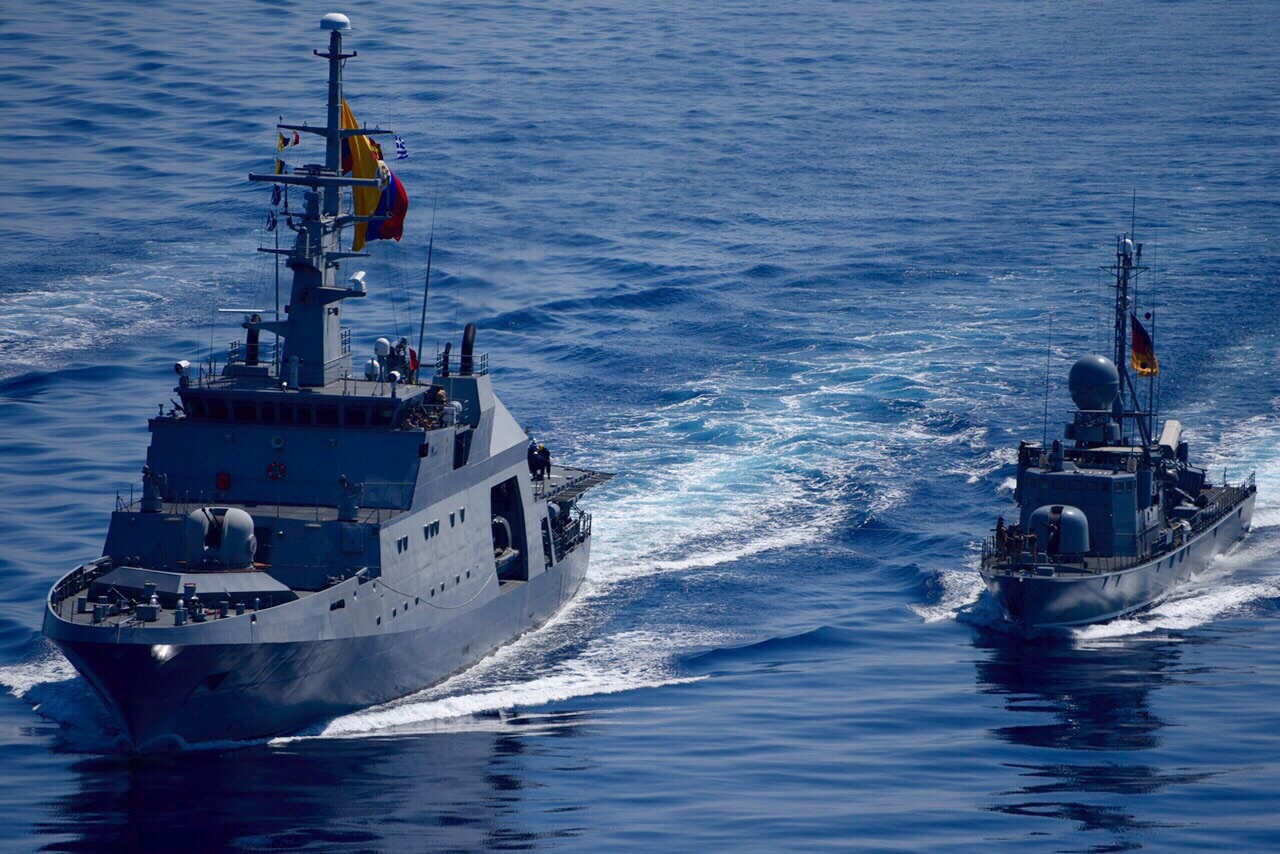
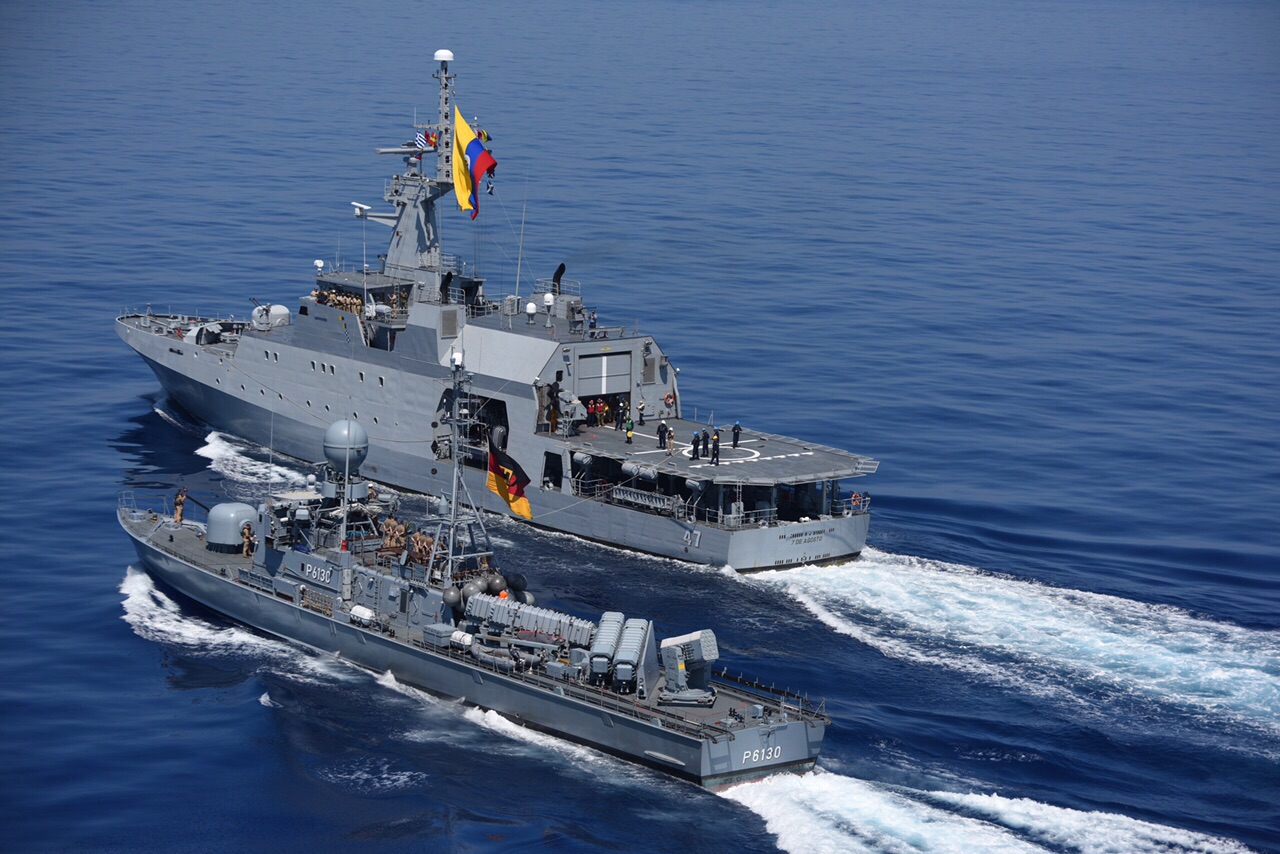
Addendum:

OPV Colombia 1

OPV Colombia 2

Photos provided Andres Tovalari. Colombian Navy OPV “7 de Agosto” sailing along a German Navy missile boat. Ship is currently part of Operation Atalanta countering piracy in the Indian Ocean.

As noted here,

“With 85 sailors on board, 7 de Agosto is armed with a 40 mm Oto Melara 40L70 twin gun, a 20 mm Oerlikon GAM-BO1 gun, and two Thor T-12 Remote Controlled Weapons Stations (RCWS). The T-12 RCWS includes a .50-calibre M2HB machine gun linked to a Controp SHAPO maritime day/night observation system.”

It is less obvious, but she also has a stern boat  ramp as well.

opv80

Could This be Bollinger’s OPC Candidate?

During Vietship 2014 Nava Exhibition in Vietnam, Dutch shipyard Damen unveiled for the first time the design of the Sigma 9814 Corvette ordered by Vietnam. It was announced in October 2011 that Damen shipyard in Vlissingen, Netherlands will build four Sigma corvettes for the Vietnamese Navy. The first two ships will be built in Vlissingen (Netherlands), and the last two (options) will be built in Vietnam, under Dutch supervision.

Navy Recognition is showing a photo of a model of a new corvette being built by Bollinger’s partner Damen for the Vietnamese Navy. The ships is the right size, 98 meters long and 14 meters of beam (321 ft x 46 ft).

We already discussed the fact that Damen had built an OPC sized ship for the Vietnamese counterpart of the USCG.

The photo even looks a little like the ships in this earlier illustration from Bollinger. The reported dimensions of the new Vietnamese vessel also correspond to the dimensions given for Damen’s 2600 ton OPV.

An interesting feature is how well armed this Vietnamese Corvette will apparently be. This bodes well for potential upgrades to the OPC. Quoting Navy Recognition:

the new SIGMA 9814 class will be fitted with:
8x MBDA Exocet MM40 Block 3
12x MBDA MICA VL surface-to-air missiles (in VLS)
1x Oto Melara 76mm main gun
2x Oto Melara MARLIN-WS 30mm gun mounts
The corvette will acomodate one anti-submarine helicopters Ka-28. The corvettes are set to receive the latest generation of electronics and sensors from Thales including TACTICOS combat management system,SMART-S Mk 2 radar and STING EO Mk 2 electro-optical fire control system.

OPC Multi-Year Procurement-a Clarification

I have been made aware that the earlier post on this topic might lead to some confusion. Lets look at it in more detail. This is what the bill actually says about this,

“SEC. 215. MULTIYEAR PROCUREMENT AUTHORITY FOR OFFSHORE PATROL CUTTERS.

” In fiscal year 2015 and each fiscal year thereafter, the Secretary of the department in which the Coast Guard is operating may enter into, in accordance with section 2306b of title 10, United States Code, multiyear contracts for the procurement of Offshore Patrol Cutters and  associated equipment.”

First, it should be apparent that this applies only to the Offshore Patrol Cutter (OPC). This will not help with the Fast Response Cutter (FRC) program.

Second it refers specifically to section 2306b of title 10, the section governing muti-year procurements (MYP), which brings with it some specific requirements, one of which is that to be eligible for consideration for a multi-year procurement, the program must be  “stable.” In the case of shipbuilding, this usually means that the first ship is at least complete. That will probably be in 2020, by which time, at least the first three ships should have already been contracted.

There is a form of contracting that would provide many of the advantages of multi-year procurement (MYP) that can include these first few ships, this is Block Buy Contracting (BBC) as was used at the start of the Navy’s current submarine program, but that was not what was authorized.

Clearly the House Transportation and Infrastructure Committee wants to allow the Coast Guard to exploit potentially more efficient forms of contracting, but the potential of multi-year procurement of OPCs is still years away. If they want to realize savings earlier, they will need to authorize Block Buy Contracting for the Offshore Patrol Cutters and/or Multi-Year Procurement for the Fast Response Cutters.

There is another issue here also. That is the disagreement between the Department and Administration (in the form of OMB) on one side and the Coast Guard and some members of Congress on the other about what elements of the project must be funded before it is considered fully funded and a contract can be awarded. This is a funding approach question. and it is actually not directly connected to the contracting mechanism. Authorizing MYP does not resolve this disagreement. The Department and Administration’s apparent reticence may be symptomatic of a desire to delay committing, which would work against the long term commitment required for a multi-year procurement, but it should be obvious to anyone that while the final number of OPCs may be open for debate, the Coast Guard does need at least the eleven that are currently planned to be included (one contracted and ten as options) in the initial construction contract.

Multi-Year Contract for the Offshore Patrol Cutter?

FierceHomelandSecurity is reporting a bill, H.R.  4005, out of the House Transportation and Infrastructure Committee (the Coast Guard’s traditional authorizers) that would set authorization levels for the Coast Guard in FY2015 and 2016. “No large spending increases under proposed Coast Guard reauthorization

Their write up contained an unexpected and pleasant surprise,

“Among its provisions would be one authorizing the service to enter into a multiyear contract for procurement of Offshore Patrol Cutter ships. The Coast Guard and its advocates have a long-standing argument with the Office of Management and Budget over whether it should have multiyear funding for ship procurement. The Coast Guard contends it keeps the per-unit cost of new ships down; OMB prefers to have ships fully funded before the service lets a new acquisition contract.”

Congressional Researcher Ronald O’Rourke has been pointing out the advantages of multi-year contracts for years, “Multiyear Procurement (MYP) and Block Buy Contracting in Defense Acquisition: Background and Issues for Congress” (pdf), Congressional Research Service, Ronald O’Rourke and Moshe Swartz, June 27, 2012.

Frankly, I had little hope it would be applied to the OPC, and only hoped it might be  applied to the Fast Response Cutters, “Six More FRCs and Approval of Full Rate Production, Time for a Multi-Year Contract.

It is hugely advantageous, in saving money for the American Tax Payer, and it eliminates uncertainty for both the contractor and for the Coast Guard. All the most successful Navy shipbuilding contracts are multiyear including those for both SSNs and Burke Class destroyers.

Now lets hope the bill becomes law and that a multiyear contract is awarded.

Bath Iron Works Offshore Patrol Cutter Concept

The U.S. Coast Guard has awarded General Dynamics Bath Iron Works a $21.4 million contract for the Offshore Patrol Cutter (OPC) program. Bath Iron Works is one of three shipyards chosen from a field of eight competitors to proceed to Phase I design work on this next-generation cutter program. The Bath Iron Works team includes L-3 Communications (New York, N.Y.) and Navantia, S.A. (Spain), a shipbuilder that Bath Iron Works has collaborated with for more than 30 years.

Our Friend at Navy Recognition was good enough to provide a copy of an artist’s concept of the BIW proposal he had found. We talked about the other two contenders for the OPC contract here.

The proposal is a variation of the the Navantia BAM (Buque de Acción Marítima) (more here).

The BAM has provision for carrying up to six containers. Hopefully this feature has been retained. It looks like all of the proposals may have this feature to some degree.

Presumably the ship will include the BAM’s hybrid propulsion system, with electric motors (two motors of approximately 1,000 HP) run off the ship’s service generators for slow to moderate cruising. The BAM’s main propulsion engines (12,240 HP total providing 21 knots) would probably need to be upgraded to meet the Coast Guard’s speed requirement (22 to 25 knots), but that should be fairly easy. Using the same diesels that are used in the Bertholf Class National Security Cutters (19,310 HP total) would supply the necessary power and simplify training and logistics. Alternately a four engine power plant similar to that used in the closely related Navantia built Venezuelan Guaiqueri class (approx 24,000 HP for 24 knots) would provide the necessary additional power and additional flexibility and redundancy.

In some respects the Bath proposal looks more like the Guaiqueri class with its larger central funnel, although the Bath proposal has a smaller funnel and a small additional stack presumably for the main generators to starboard.

The BAM’s length, beam, and draft are 93.9×14.2×4.2 meters (308×46.6×13.8 feet) their displacement is 2,900 tons, the Venezuelan Guaiqueri class are 98.9×13.6×3.75 (324.4×44.6×12.3 feet) and just over 2,400 tons.

It may only be that the conceptual drawing is slightly distorted, but I am a little concerned that it appears the hangar may not be long enough to take an H-60 sized helicopter. Even if we don’t need that now, we may in the future. The ship is as beamy as an FFG, so it could certainly accommodate a large double hangar.

Like the Eastern design, it looks like the Mk38mod2 on the top of the hangar is going to have a limited field of fire on one side. It does look like there is room for a second mount on top of the bridge. The 57mm, on the other hand, is up out of the green water that will inevitably washs over the bow, and has excellent fields of fire, including the ability to engage contacts close aboard, even when the ship rolls away from the target.

Both the BAM and Guaiqueri class have fewer accommodations than are expected to be provided in the OPC. So some changes were necessary there.

It appears the step-down from the flight deck to the fantail is less than a full deck. If so, then the ship is almost flush decked. e.g. the foc’sle is on the main deck. If that is the case, then the bridge would be on the O-3 deck just as it is on the 210s, 270s, 378s, and NSCs and the ship is really not as tall as it appears in the illustration. On the other hand if the step-down is a full deck (and it is on the BAM), the ship is going to feel unusually tall (but it will give a greater visible horizon).