
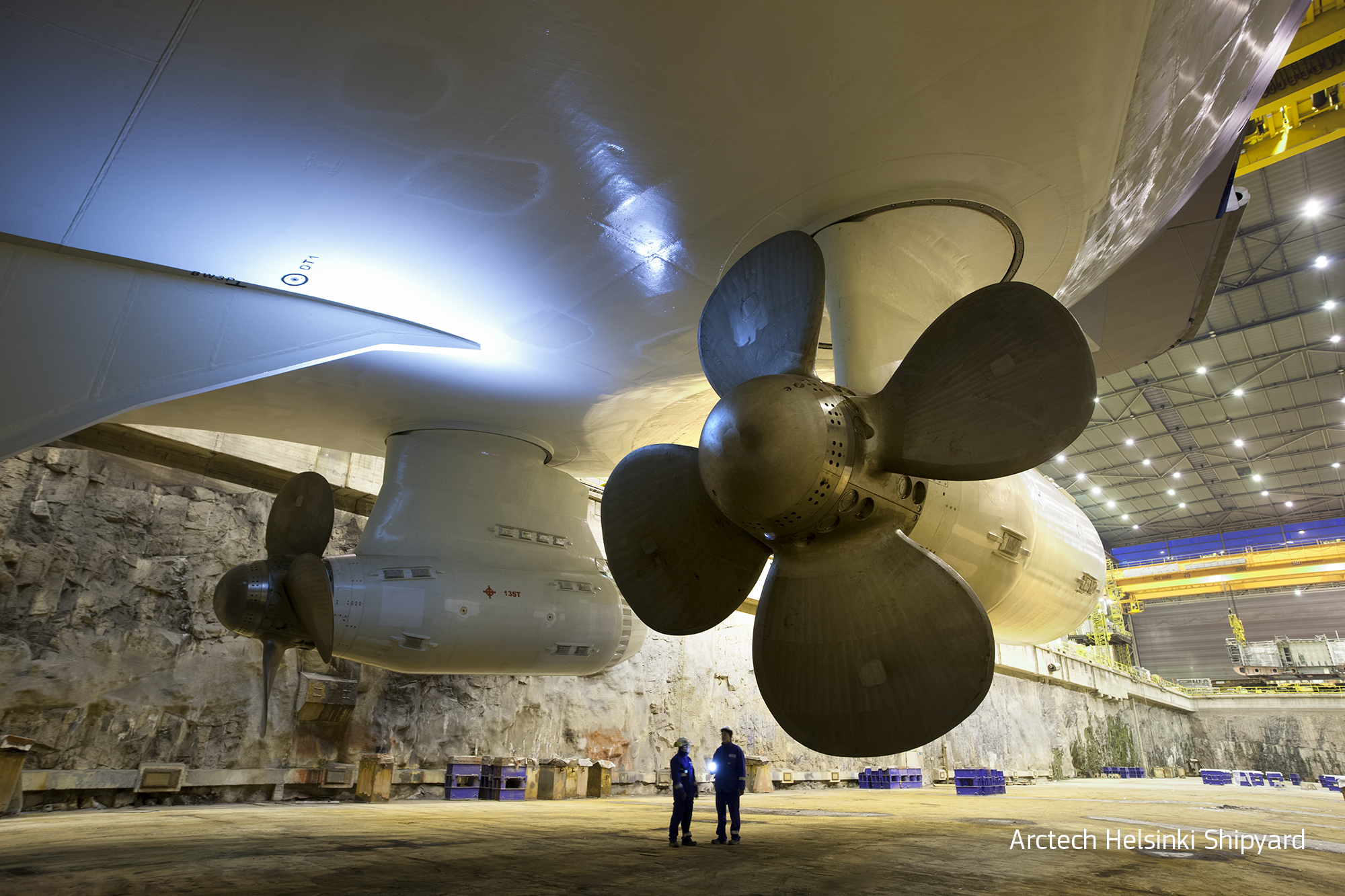
Azipods, state of the art propulsion technology for icebreakers.
The Senate Appropriations defense subcommittee has proposed that $1B be added to the Navy’s shipbuilding budget for the construction of an icebreaker for the Coast Guard.
This sounds like good news, and there is precedence for this, in the form of USCGC Healy. Still, there are reasons, this may not be the best approach for the project, for the Coast Guard, or for the Navy, particularly since this should not be a one time procurement, it should be the first of a series.
The Navy contracted for the Healy and it did not turn out so badly, but there were difficulties as discussed here.
There are really two issues.
- Who gets the money?
- Who should manage the project?
Who gets the money?
The Coast Guard has been trying to get the government to recognize that it needs an AC&I budget of $2-2.5B/year. It needs to be a new norm. Funding icebreakers is part of that. Putting the money in the Navy budget is deceptive, and it does nothing to address the true needs of the Coast Guard..
Because of sequestration it is easier to add money to a DOD budget than to the Coast Guard budget, but if they can make exceptions for one military service, you would think they could make an exception for the Coast Guard as well.
Who would be the best project manager?
The Coast Guard got a black eye for the Deepwater project, but that was largely the result of a misguided Reagan era directive that project management be outsourced to the private sector that was followed by a gutting of in-house expertise in DOD as well as the Coast Guard. NAVSEA also lost much of its in house expertise. Since then, the Coast Guard’s Acquisitions Directorate has been rebuilt into an award winning organization. In fact, while I don’t necessarily think it is true, the GAO has suggested that the Coast Guard’s procedures may be superior to those of the Navy.
The Coast Guard has been preparing for this acquisition for years. If the Navy is to manage it, the Coast Guard will have to spend time bringing them up to speed.
There is also the question of who will procure the follow-on icebreakers. We have been saying we need three heavy and three medium icebreakers. the Coast Guard needs to continue to increase its icebreaker procurement expertise to build these vessels as well.
If the project is given to NAVSEA, it may be low on their priority list. NAVSEA is currently building or planning:
- Ford class CVNs in series construction
- Flight III Burke class DDGs
- The America class LHA USS Tripoli under construction
- A new class LHA-8 planned which will cost more than $3B.
- A new class of up to 17 Oilers planned
- A new class of LPD planned
- The remaining LCS in series production and their frigate frigate follow-ons planned
If NAVSEA were to divert their personnel from these projects to the procurement of an icebreaker, it would hurt supervision of these projects.
All of these projects are far larger than construction of one icebreaker. So, if they are given the icebreaker project, will they put their best people on it? Do they have any icebreaker expertise? Will they have to hire new people who will need to go through a time consuming clearance process and take the time to be brought up to speed?
NAVSEA may want to do their own lengthy and costly study & review process. They may impose requirements that the Coast Guard would not. These would add to the cost and these costs would likely be added on to any future icebreakers that would probably be built to the same design.
A troubling “encouragement”:
There was a particularly troubling requirement quoted on page 31 of the Congressional Research Service’s report, “Coast Guard Polar Icebreaker Modernization: Background and Issues for Congress.” from the FY2017 DOD Appropriations Act (S. 3000) apparently from pages 98-99.
“While the effort to speed polar icebreaker acquisition by 2 years is commendable, the Committee believes more must be done now to expand our capabilities and to defend interests in the Polar Regions. In addition to concerns about our current fleet, the Committee notes that Russia has roughly 40 operational icebreakers and 11 icebreakers either planned or under construction. Therefore, to further accelerate production, the Committee recommends $1,000,000,000 in the “Shipbuilding and Conversion, Navy” account to construct domestically the first U.S. Coast Guard operated ship for the Polar Icebreaker Recapitalization Project. In order to achieve an earlier start on this project and to reduce cost and schedule risk, the Committee encourages the selection of an in-service U.S. hull design and the setting of limitations on overall ship specifications and requirements. The Committee directs the Secretary of Defense in coordination with the Secretary of Homeland Security to submit a report to the appropriate congressional committees not later than September 30, 2016 which provides polar icebreaker requirements, preferred design, overall acquisition strategy, and a breakout of funds necessary to support the acquisition.”
I find the direction to forego an opportunity to improve on the designs we have, in favor of decades old hull designs that no longer represent the best in current icebreaker design troubling, particularly since this may be the first of three heavy icebreakers, not just a single stop-gap design.

USCGC Polar Sea
There are of course only two large, in service, US hull designs.
- The Polar Class, an over 40 year old design, were built by Lockheed Shipbuilding and Construction Company, a company that no longer even exist.
- The Healy, designed over 20 years ago, was built by Avondale Shipyard, now closed, but once a part of what is now Huntington Ingalls Industries.

USCGC Healy (foreground)
Our most modern, but frequently forgotten Great Lakes Icebreaker, USCGC Mackinaw (WLBB-30), is a few years younger but still designed about two decades ago, was built by Marinette Marine, which is at least still an operational shipyard, producing Freedom Class LCS for the Navy.
Would it be enough to simply say we are going to scale up the Mackinaw hull (say double all the dimensions) so that we could have a ship that at least uses azipods like most modern icebreakers?

Launch of USCGC Mackinaw (WLBB-30) on April 2, 2005. Photo by Peter J. Markham.
Do we need the Navy?:
Perhaps NAVSEA could sub-contract the Coast Guard Acquisitions Directorate (CG-9) to procure the icebreaker.
Thanks to Tups for bringing the encouragement to select an in-service U.S. hull design to my attention.

 Chuck Hill's CG Blog