The US Naval Institute blog has a short article by Petty Officer First Class Philip Kiley, U.S. Coast Guard Reserve that discusses how reservists might deal with the current loss of paid training time. It also makes an suggestion as to how the Coast Guard might help reservists who may have lost their normal sources of income.
Monthly Archives: March 2020
Phone based Data Link?

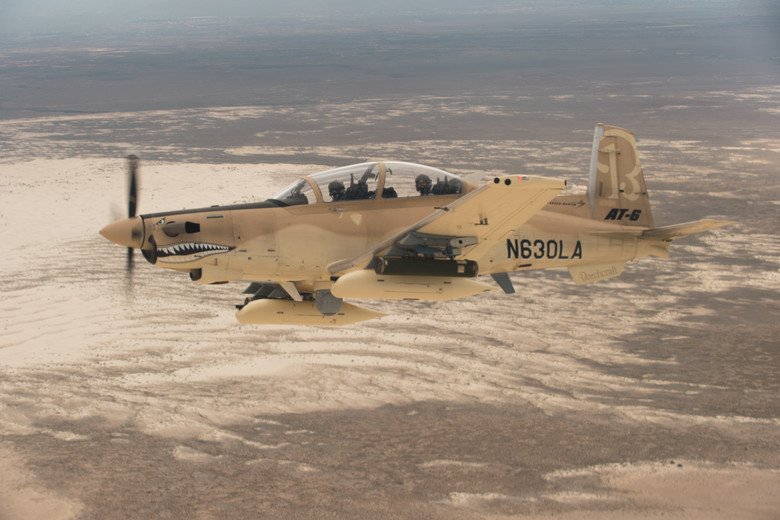
A Beechcraft AT-6B Wolverine experimental aircraft flies over White Sands Missile Range, N.M., July 31, 2017. Aircraft like the AT-6B and Embraer A-29 Super Tocano provide close-air support to U.S. allies and partners and can also be outfitted with commercial off-the-shelf command and control units like the Airborne Extensible Relay Over-Horizon Network, or AERONet, increasing their combat effectiveness. (U.S. Air Force photo by Ethan D. Wagner)
AirForceMag.com has an article about the purchase of four light attack aircraft that contains an intriguing little side note:
AEROnet is a fledgling air-to-air and air-to-ground radio system that would let the U.S. and foreign militaries share video, voice, and chat communications as well as command and control via tablets, smartphones, and mobile apps for less than $500,000.
Secure communications between Coast Guard units and other armed services, particularly in the case of a rapidly developing terrorist attack, has been one of my regular concerns. This goes back to an exercise I planned and supervised some time ago. We had two Air Force aircraft included in a counter terrorism exercise, but when they got on scene we could not effectively identify the target for them.
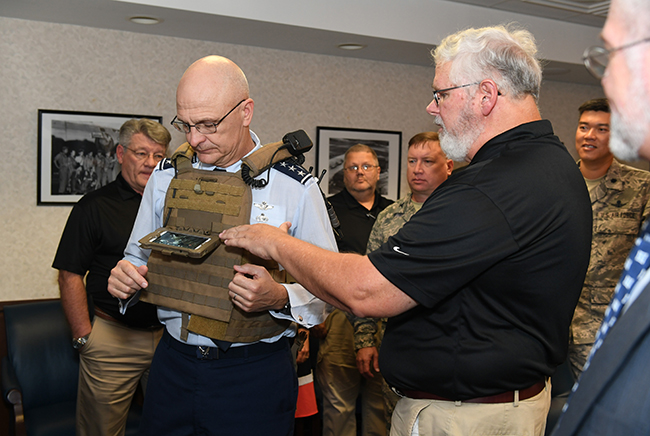
This system might be useful both within the Coast Guard and between the Coast Guard and other services. This lead me to look for more information “AERONet prototype could provide combat insight to allies.”
“The Airborne Extensible Relay Over-Horizon Network, or AERONet, digitally links friendly forces, providing them with their own location, the location of other friendly forces and real-time enemy movement updates. It will be showcased to partner nations at the Bold Quest exercise in Finland this month. AERONet is a version of systems already used by law enforcement to patrol borders and track and combat smugglers. First responders use similar systems while fighting wildfires in the mountain states.”
There is more here, “AEROnet Gets an Audience.”

Lt. Gen. Arnold W. Bunch, military deputy, Office of the Assistant Secretary of the Air Force for Acquisition, dons the Airborne Extensible Relay Over-the-Horizon Network concept combat tactical vest with the help of Steve Brown from the Tactical Data Network Laboratory at Hanscom Air Force Base, Mass., Sept. 26, during Bunch’s tour of the Command, Control, Communications, Intelligence and Networks division. The Air Force Life Cycle Management Center’s Aerial Network Division at Hanscom will bring AERONet to production, after the Air Force Research Laboratory prototyped the system. It is designed to support U.S. and partner nation operations as a tactical data network, as outlined by the Chief Staff of the Air Force Gen. David L. Goldfein. (U.S. Air Force photo by Todd Maki)
All Currently Commissioned NSC to Have Small Unmanned Air Systems by the End of the Year

A small unmanned aircraft system operator recovers an sUAS (Scan Eagle–Chuck) after a flight from Coast Guard Cutter Stratton in the South China Sea Sept. 16, 2019. The sUAS is capable of flying for more than 20 hours and has a maximum speed of about 60 mph. U.S. Coast Guard photo by Petty Officer 1st Class Nate Littlejohn.
The Acquisitions Directorate (CG-9) has announced that all eight currently commissioned National Security Cutters should have small unmanned aircraft systems but the end of the calender year (quoted below). Presumably these will be Scan Eagle systems. Intention is to have these on the Offshore Patrol Cutters as well.
“The Coast Guard’s small unmanned aircraft system (sUAS) for national security cutter (NSC) program reached a milestone March 4 when Rear Adm. Michael Johnston, assistant commandant for acquisition and chief acquisition officer, approved a move to full production, called ADE-3. This allows the program to move forward with outfitting the remainder of the Service’s operational NSCs with sUAS capability.
“The Coast Guard awarded a contract June 6, 2018, to Insitu for the procurement of sUAS capability on three NSCs and options to outfit the rest of the NSC fleet in future years. In 2019, the Commandant expressed the service’s intent to accelerate delivery of the capability. The sUAS program office, aided by Naval Information Warfare Center-Atlantic, developed an aggressive strategy to install and employ the sUAS capability onboard all operational NSCs by the end of calendar year 2020. The ADE-3 approval allows the newly implemented schedule to continue as set. The program is currently on track to meet guidance to double installation rates by the end of calendar year 2020.
“Coast Guard Cutters Stratton, James, Munro, Kimball and Waesche are fully outfitted with sUAS capability. Coast Guard Cutters Bertholf, Hamilton and Midgett are all currently being outfitted with the sUAS capability. Coast Guard Cutter Bertholf is scheduled to be fully mission capable in summer 2020 with Hamilton and Midgett on track to be completed before the end of the calendar year.
“A UAS consists of an unmanned aircraft, its mission payloads, launch and recovery equipment, ground support equipment, and data and control links. The Coast Guard requires a UAS that can remain on station for extended periods, expand maritime domain awareness and disseminate actionable intelligence on maritime hazards and threats.
“For more information: Unmanned Aircraft Systems program page”
“Coast Guard Struggling to Get Ships Repaired as Navy Expands Use of Smaller Yards” –USNI

Coast Guard Cutter Waesche prepares to refloat from drydock in Seattle, Wash., May 22, 2018. The Waesche is a 418-foot Legend-class National Security Cutter homeported in Alameda, California. US Coast Guard photo.
Reporting on remarks by Rear Adm. Nathan Moore, assistant commandant for engineering and logistics, at the WEST 2020 conference the US Naval Institute News Service reports that the Coast Guard is having difficulties getting its ships into commercial shipyards because of limited capacity in the industry and the increased use of smaller yards by the US Navy. The limited capacity also means that there may be no competition, so the cost of availabilities is going up.
He said the lack of competition is driving up the costs of the contracts they can award, and is leaving others without any interested bidders at all.
The Coast Guard is looking at increasing coordination with the Navy.
“Moore said the Coast Guard has been working with the Navy and industry to squeeze in Coast Guard ships as “filler work between Navy projects” with some success, but he’s hoping to see a more coordinated effort.”
The Navy sees there may be benefits for them in better coordination with the Coast Guard.
“During the same panel discussion, Naval Sea Systems Command (NAVSEA) Commander Vice Adm. Tom Moore said that coordination could help the Navy too – which has been struggling with its industrial base to achieve on-time and on-budget maintenance availabilities.”
Bottom line:
“’The old way that we’ve done it of being very restrictive on dates in and out of the shipyards is not working well for us in terms of not getting competition. So I think to get competition, we have to sort of change the way we do business.’”
“Navy League cancels Sea-Air-Space in response to coronavirus restrictions” –Navy Times
USNI News photo: A model of the BAE Systems Adaptable Deck Launcher, which is meant to be similar to the Mk41 Vertical Launch System but would be bolted to the top of the ship deck instead of installed underneath it. This model shows a four-cell launcher, with one cell holding four missile canisters.
Navy Times is reporting that the Navy League cancelled its Sea-Air-Space Expo after Maryland’s Governor banned gatherings of more than 250 people.
“The event will not be rescheduled this calendar year but will be back on next year from April 12 to April 14, 2021.”
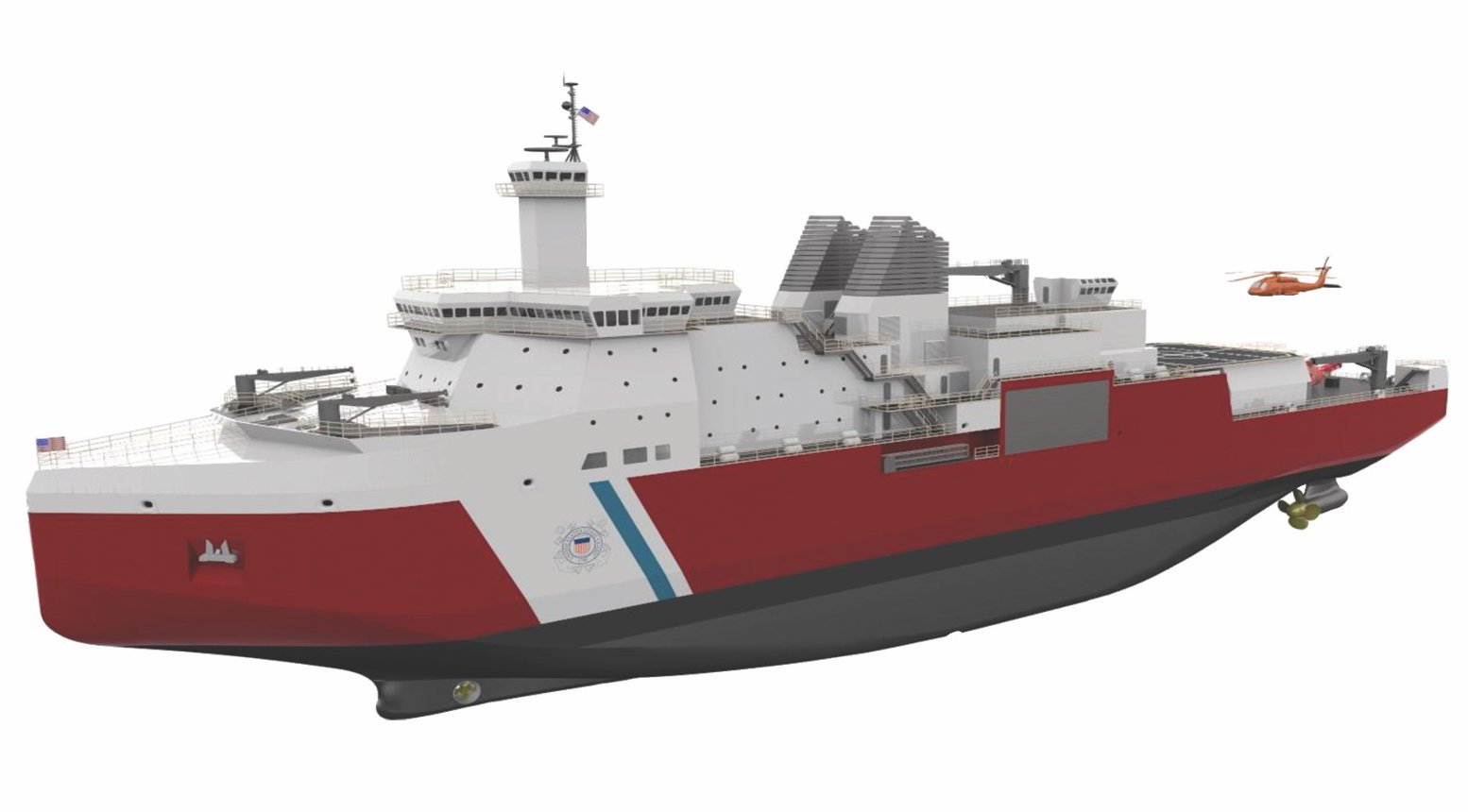
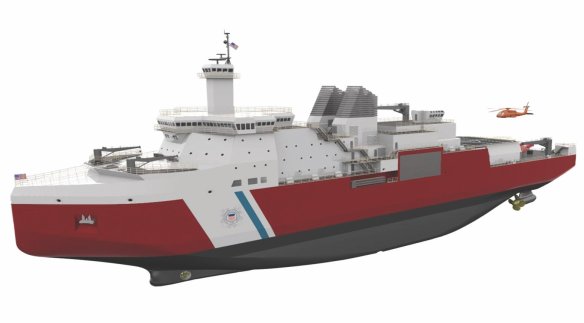
“Coast Guard Polar Security Cutter (Polar Icebreaker) Program: Background and Issues for Congress” Updated 12 March, 2020, CRS
The Congressional Research Service has once again updated their report on the Polar Security Cutter. You can see the whole report here. I have reproduced the one page summary below. The entire report is a 63 page pdf.
Summary
The Coast Guard Polar Security Cutter (PSC) program is a program to acquire three new PSCs (i.e., heavy polar icebreakers), to be followed years from now by the acquisition of up to three new medium polar icebreakers. The PSC program has received a total of $1,169.6 million (i.e., about $1.2 billion) in procurement funding through FY2020, including $135 million in FY2020, which was $100 million more than the $35 million that the Coast Guard had requested for FY2020. With the funding it has received through FY2020, the first PSC is now fully funded and the second PSC has received initial funding.
The Coast Guard’s proposed FY2021 budget requests $555 million in procurement funding for the PSC program. It also proposes a rescission of $70 million in FY2020 funding that Congress had provided for the procurement of long lead time materials (LLTM) for a 12th National Security Cutter (NSC), with the intent of reprogramming that funding to the PSC program. The Coast Guard states that its proposed FY2021 budget, if approved by Congress, would fully fund the second PSC.
The Coast Guard estimates the total procurement costs of the three PSCs as $1,039 million (i.e., about $1.0 billion) for the first ship, $792 million for the second ship, and $788 million for the third ship, for a combined estimated cost of $2,619 million (i.e., about $2.6 billion). Within those figures, the shipbuilder’s portion of the total procurement cost is $746 million for the first ship, $544 million for the second ship, and $535 million for the third ship, for a combined estimated shipbuilder’s cost of $1,825 million (i.e., about $1.8 billion).
On April 23, 2019, the Coast Guard-Navy Integrated Program Office for the PSC program awarded a $745.9 million fixed-price, incentive-firm contract for the detail design and construction (DD&C) of the first PSC to VT Halter Marine of Pascagoula, MS, a shipyard owned by Singapore Technologies (ST) Engineering. VT Halter was the leader of one of three industry teams that competed for the DD&C contract. The first PSC is scheduled to begin construction in 2021 and be delivered in 2024, though the DD&C contract includes financial incentives for earlier delivery.
The DD&C contract includes options for building the second and third PSCs. If these options are exercised, the total value of the contract would increase to $1,942.8 million (i.e., about $1.9 billion). The figures of $745.9 million and $1,942.8 million cover only the shipbuilder’s costs; they do not include the cost of government-furnished equipment (GFE), which is equipment for the ships that the government purchases and then provides to the shipbuilder for incorporation into the ship, or government program-management costs. When GFE and government programmanagement costs are included, the total estimated procurement cost of the first PSC is between $925 million and $940 million, and the total estimated procurement cost of the three-ship PSC program is about $2.95 billion.
The operational U.S. polar icebreaking fleet currently consists of one heavy polar icebreaker, Polar Star, and one medium polar icebreaker, Healy. In addition to Polar Star, the Coast Guard has a second heavy polar icebreaker, Polar Sea. Polar Sea, however, suffered an engine casualty in June 2010 and has been nonoperational since then. Polar Star and Polar Sea entered service in 1976 and 1978, respectively, and are now well beyond their originally intended 30-year service lives. The Coast Guard plans to extend the service life of Polar Star until the delivery of at least the second PSC. The Coast Guard is using Polar Sea as a source of spare parts for keeping Polar Star operational.
“More Navy Ships Headed to South, Central America to Stop Drug-Trafficking” –Military.com
Military.com is reporting that SOUTHCOM Commander, Adm. Craig Faller, claimed we would soon see additional assets rotating through his Area of Responsibility (AOR) including more ships and aircraft for drug interdiction.
“We’ve been working six to eight ships” to cover the Caribbean and Pacific approaches to the U.S. to counter the drug trade, he said, but the number needed “to cover that zone is much larger.”
“You’ll see additional forces in the air, on land, on sea, and some maneuver forces ashore” that could include a Security Force Assistance Brigade training unit to work with allies, Faller added.
We have been hearing that DOD is going to be providing more resources to SOUTHCOM for at least a couple of years. Perhaps this time they mean it. We have seen a couple of LCS deployments to the Area. One of those never got beyond the Caribbean, resulted in no seizures and ended early. Hopefully they will become more effective with more experience.
“Coast Guard to develop drone interception capability” –Defense Systems
Defense systems reports that,
“The U.S. Coast Guard is developing a counter-drone capability to both protect its own locations and to guard protected assets under special circumstances as provided for under a recent law.”
Ever since a quadcopter crash landed about two meters from German Prime Minister Angela Merkel in 2013 there has been a recognition that these systems might be used for sinister purposes.
Terrorist have started using drones as a cruise missile, lite.
The R&D Center has apparently already had a successful test.
“Spain seen joining Greece, France, Italy on European Patrol Corvette program” –DefenseNews
Defense News reports that it appears likely that four European countries and perhaps more will join forces to build a class of 3000 ton patrol vessels.
The two firms (Italy’s Fincantieri and France’s Naval Group–Chuck) are hoping to match Italian and French navy requirements with a jointly built, modular vessel that can handle patrol and surveillance missions as well as taking second-tier roles in anti-submarine and anti-surface missions.
The vessels these ships are to replace, perform their respective countries offshore coast guard missions.
The project is one of many being supported by an EU initiative called “Permanent Structured Cooperation” (PESCO) that is to be supported by the entire EU community. It sounds like this may be heading toward a shipbuilding version of Airbus.
According to this report, Bulgaria and Portugal are also joining the program.
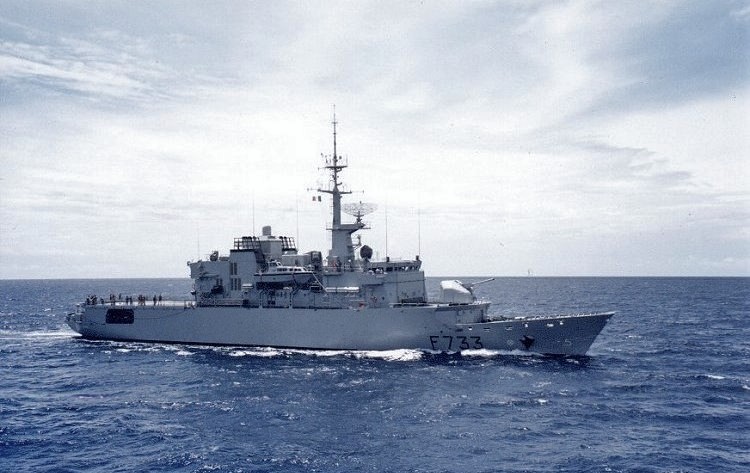
The French Navy intends to replace the six ships of the Floreal class. These “surveillance frigates” are scattered among France’s overseas territories. They have no ASW capability, but are equipped with a pair of Exocet anti-ship missiles (ASCM).
Italy expects to retire the ten ships of the Cassiopea, Sirio, and Commandanti classes 2022-2025. These ships are all about 1500 tons. They have neither ASW equipment or ASCMs.
The Greeks don’t seem to have any ships in this class, but may now see a need.
I was a bit surprised that Spain would join in this effort. They have their own OPV designs supplied by Navantia, and they have been doing pretty well. They have been produced a class of six referred to as BAM, and were expected to procure six more of the same class. In addition they have produced corvettes for Venezuela and have been contracted to produce five corvettes for Saudi Arabia. Navantia had teamed with Bath Iron Works to provide BIW’s proposal for the USCG OPC program, and they are on BIW’s FFG(X) team. It may be that they feel they have to join now or risk being excluded in the future.
If these ships come equipped as indicated in the diagram at the head of the article, they will be significantly better armed than the ships they replace. They will be a bit larger than the French ships being replaced and more than twice as large as the Italian ships being replaced.
It appears they will be very close in size to the Coast Guard’s Argus Class OPCs, being the same length (110 meters or 360 feet) and only slightly narrower.
“Navy, Marine Corps and Coast Guard working on ‘tri-service maritime strategy'” –Inside Defense

USS Sterett (DDG-104), front, participates in a photo exercise with Chilean Frigate Almirante Lynch (FF-07), second, Royal Canadian Navy Halifax-class frigate HMCS Ottawa (FFH-341), third, French Navy Floreal-class frigate FS Prairial (F-731), fourth, United States Coast Guard Cutter USCHC Bertholf (WMSL-750), fifth, the dry cargo and ammunition ship USNS Charles Drew (T-AKE 10), sixth, and Royal Canadian Navy commercial container ship Asterix. US Navy Photo
This is the only indication I have seen so far that an update to the existing plan is underway..
SAN DIEGO — The Navy is working with both the Marine Corps and Coast Guard on a joint maritime strategy the services expect to receive from staff this summer. Speaking to attendees at the West 2020 conference here, Chief of Naval Operations Adm. Michael Gilday disclosed work on the “tri-service maritime strategy” for the first time publicly. “We are trying to bring things together from a top-down perspective in a more integrated way,” Gilday said. Asked for details by Inside…
The rest is behind the paywall.
We of course already have a tri-service plan, “A Cooperative Strategy for 21st Century Seapower: Forward, Engaged, Ready“, published March 2015. The question is, will this be different? Will it have any effect on how the Coast Guard operates, how it trains or how it is equipped? This will be a document at a very high level, so we can’t expect much in the way of detail. It will be descriptive, rather than prescriptive. Plus there will presumably be a classified supplement.
The previous version seemed to be about how to manage a peaceful environment. The environment now looks much more challenging. The new strategy could and should lead to visible change.