Chuck Hill's CG Blog

Chuck Hill's CG Blog

Canadian Coast Guard Bay Class Motor Lifeboats–MLB and WPB Replacement?

Canadian Coast Guard vessel CCGS Garbarus Bay | Photo credit: Mel & Jer Creative

Recent reports of the delivery of CCGS Garbarus Bay prompted me to look again at the Canadian Coast Guard Bay class motor lifeboats. They are considerably larger than the USCG 47 foot MLBs. I was also reminded; we have not heard anything recently about replacements for the now retired 52 foot MLBs. The 87 foot WPBs are also nearing the end of their useful life. A large, reasonably fast MLB like the bay class could replace the 52 foot MLBs and some of the WPBs. (In other places we may need a different kind of WPB replacement.) With their smaller crew, be less expensive to operate than the WPBs. These could be the true “Fast Response Cutters” capable of responding in extreme weather when a Response boat medium or even an 87 footer could not. Might even call them Response Boat, Large.

The Canadians are procuring 20 of these large MLBs. The vessel’s particulars are as follows:

  • Displacement: 62.5 tons (47 foot MLBs are 18 tons; 87 footers are 91 tons)
  • Length overall: 19.0 meters (62′)
  • Length DWL: 17.5 meters (57.4′)
  • Beam: 6.3 meters (21′)
  • Depth at midship: 2.58 meters
  • Hull draft, nominal: 1.67 meters (5.5′)
  • Power: 2,400 kW (about 3,200 HP, more than the 2,950 HP of the 87 foot WPBs and more than three times the power of the 47 footers)
  • Speed: 23.5 kts

According to Wikipedia,

They are capable of operating in 12-metre (39 ft) waves, and in wind conditions at 12 on the Beaufort scale. The vessels’ hulls will be aluminum, not FRC (fibre reinforced composite), as with the original Severn design.

Canadian Coast Guard vessel CCGS Chedabucto Bay | Photo credit: Chantier Naval Forillon

“New office reduces the logistics burden for remote expeditions” –MyCG

ARABIAN GULF (Oct. 20, 2011) Logistics Specialist Seaman Krystal K. Weed inventories supplies in a storeroom aboard the aircraft carrier USS George H.W. Bush (CVN 77). George H.W. Bush was deployed to the U.S. 5th Fleet area of responsibility on its first operational deployment conducting maritime security operations and support missions as part of Operations Enduring Freedom and New Dawn. (U.S. Navy photo by Mass Communication Specialist Seaman Jessica Echerri/Released) 111020-N-JD217-003

Below is a story from MyCG.

This marks a significant change in Coast Guard operations. Not only are there now more distant operations. Operations “halfway around the world” are expected to continue and perhaps increase. Such operations are no longer one off or special. They are becoming routine.

Presumably this is based in Alameda because most of these new distant operations are expected to be in the Pacific, but it will also support Atlantic Area operations.


Aug. 30, 2023

New office reduces the logistics burden for remote expeditions

By Cmdr. Jeff Henderson, Deputy Office Chief, Office of Expeditionary Logistics (DOL-X)

Talk about logistics to any Coast Guard operator deployed to a remote region and they may share a common frustration – getting what they need, when they need it, and in the right location, can be difficult and all-consuming.

The Office of Expeditionary Logistics (DOL-X), the Coast Guard’s solution to relieve the remote logistics burden, celebrated reaching its full operational capability with a ribbon cutting ceremony Aug. 14 in Alameda, Calif.

“DOL-X represents our unwavering commitment to the development and execution of Coast Guard expeditionary logistics,” said Rear Adm. Carola List, Director of Operational Logistics (DOL), during the milestone ceremony.

Without question, expeditionary operations demand more from our existing mission support enterprise. The deputy commandant for Mission Support’s, Mission Support Action Plan, designed DOL-X to reduce logistical burdens for crews operating in remote environments and initial prototype tests have demonstrated real-time, measurable impacts. Expeditionary operations demand innovative solutions that extend operational reach while leveraging support from interagency and joint partners, coalition forces, and host nations. As DOL-X continues to mature, efforts will continue to ensure end-to-end synchronization and reliability and most importantly, lighten the load from the backs of our deployed shipmates.

Before becoming fully operational, DOL-X tested its capabilities with assigned DOL-X personnel providing dedicated logistical support for Coast Guard Cutter Mohawk’s deployment to U.S. Africa Command, two fast response cutters deployed to Patrol Forces Southwest Asia, and Coast Guard Cutter Midgett’s deployment to the Western Pacific. The downrange logisticians successfully integrated into the U.S. Navy’s Fifth, Sixth and Seventh fleets to act as in-theatre logistical integrators. In doing so, DOL-X created first-class partnerships at the fleet and task force level for logistics support.

These initial tests were so successful that DOL-X will now be supporting Coast Guard Cutter Stratton and Munro’s Western Pacific patrols. The former patrol included the completion of a historic Taiwan Strait transit and the first trilateral exercise between the Philippines, Japan, and the U.S. Both deployments were unique and dynamic opportunities to refine DOL-X’s in-theatre deployment support and further enhance interoperability with DoD and partner nations.

Resources:

“NPS Research on Coast Guard Icebreaker to Enhance Arctic Readiness” –Marine Link

During a seven-week Arctic transit aboard the U.S. Coast Guard icebreaker USCGC Healy (WAGB 20), Dr. Nita Shattuck from the Naval Postgraduate School (NPS) will study the impact of the extreme environment on crew performance and potential mitigations. Additional research includes assessment of an Amos01 3D printer installed by David Dausen from NPS’ Consortium for Advanced Manufacturing Research and Education (CAMRE), and specially instrumented to measure the impact of adverse Arctic sea conditions.

Marine Link reports the Naval Post Graduate School is doing some interesting studies on the working environment experienced by USCGC Healy’s crew.

To study the effects of these conditions on a ship’s crew at sea, Shattuck and her team will collect physiological data from the Healy’s crew members. Using innovative wearable technology, they will continuously monitor physiological processes such as sleep, heart rate, heart rate variability, respiration, oxygen saturation, and skin temperature. Study participants indicate that the rings are an improvement over wrist-worn wearables. The team will also use other sensors to monitor ambient light, noise levels, motion, and vibration aboard the ship.

The report also mentions that Healy will be going to Tromsø, Norway. How they get there will be interesting. Will they go the Northwest Passage through the Canadian EEZ or the Northern Sea Route through Russia’s EEZ?

“USNI News Fleet and Marine Tracker: Aug. 28, 2023”

The U.S. Coast Guard Cutter Forward (WMEC 911) steams near an iceberg in the Atlantic Ocean, Aug. 22, 2023. Forward deployed in support of Op Nanook, an annual Canadian-led exercise that offers an opportunity to work with partners to advance shared maritime objectives. (U.S. Coast Guard photo by Petty Officer 3rd Class Mikaela McGee)

The US Naval Institute’s Fleet and Marine Tracker again reports three Navy ships are operating under 4th Fleet. This has been the case since the end of the UNITAS exercise. We will have to wait to see if this higher level of activity becomes a new norm.

As for Coast Guard activity, they note PATFORSWA in the Mid East, USCGC Healy (WAGB-20) in the Beaufort Sea, USCGC Forward (WMEC-911) participation in Operation Nanook, and, “Legend-class National Security Cutter USCGC Munro (WMSL-755) is in the South China Sea and is conducting joint training with the Malaysian Maritime Enforcement Agency (MMEA).”

There is good coverage of Coast Guard out of area operations. USNI is publishing what information they get from the Coast Guard, but apparently the Coast Guard does not provide anything comparable to the statistical information the Navy provides (as in the example below), so there is no information about routine Coast Guard operational tempo.

Ships Underway

Total Battle Force Deployed Underway
297
(USS 238, USNS 59)
100
(USS 67, USNS 33)
67
(39 Deployed, 28 Local)

Unfortunately, the Coast Guard frequently lacks visibility (particularly the larger cutters and fixed wing aircraft) because despite being an important component of the “National Fleet,” it is not included in the “Total Battle Force.” It could be argued that the battle force number is not very instructive because it includes everything from aircraft carriers to fleet tugs and research ships, but people, including people in Congress take the number seriously. They talk about it a lot.

The investment in high quality platforms that make the Coast Guard so effective in its peacetime missions is only fully justified by the fact that the Coast Guard serves as a naval auxiliary in wartime.

We cannot allow people to forget that the Coast Guard has wartime roles that justify additional investment in capabilities that might not be otherwise justified.

A revision to the statistical presentation, like the example above, that included Coast Guard major units, would demonstrate that Coast Guard units are underway at a relatively high rate. It would show that the government is getting what it paid for.

“While Eastern Shipbuilding Thrives, New Coast Guard Cutter Lags Behind” –Forbes

Eastern Shipbuilding Group, Inc. photo

Forbes reports,

The U.S. Coast Guard’s “highest investment priority,” the $17.6 billion Offshore Patrol Cutter (OPC) program, faces additional delay. After blowing through a contractual delivery date of June 2023, governmental auditors are already suggesting that the new delivery estimate of late 2024, coming as Panama City-based OPC shipbuilder Eastern Shipbuilding Group inks an array of new commercial and governmental contracts, is optimistic.

The Coast Guard, in an emailed statement, now estimates that Eastern Shipbuilding Group will deliver the future Coast Guard Cutter Argus, the first of the Coast Guard’s much-needed OPCs, by September 30, 2024. The revised delivery target for the 360-foot vessel comes almost six years after the yard first cut steel for Argus back in January 2019.

There is a lot of additional analysis in the post.

As you may remember, Austal was awarded a contract in June 2022 that included options to build up to eleven OPCs, while Eastern’s contract for up to nine OPCs was truncated at four ships.

Thanks to Robert Cullison for bringing this to my attention.

“Commandant’s Letter to the Workforce”

This is from MyCG. It reflects what we were taught on the Eagle, “One hand for the ship, and one hand for yourself.” Or as we are told when on commercial air travel, put on your own oxygen mask before trying to assist others.

The original release includes a nice video I was not able to reproduce here.


Aug. 28, 2023

Commandant’s Letter to the Workforce

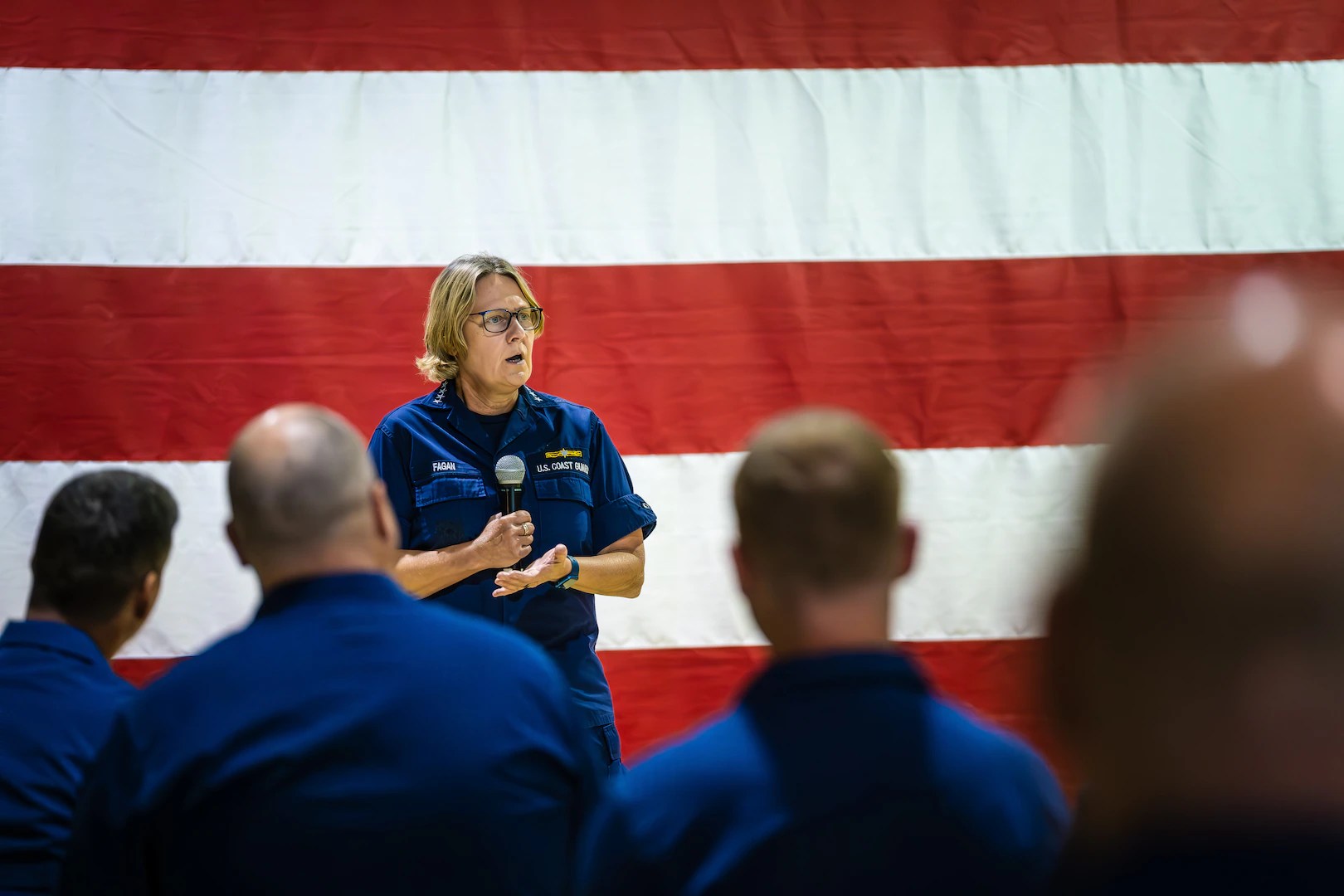
By ADM Linda Fagan, Commandant

For over 233 years the Coast Guard has served our Nation. Today we answer the call to protect our national security and promote our economic prosperity in a rapidly changing world. Earlier this summer we launched an unprecedented search and rescue effort to locate people aboard a missing deep-sea submersible. More recently, we rescued people who escaped the wildfire on Maui by sheltering in the water. Our marine inspectors continue to adapt to new technology in the maritime industry, such as alternative fuels and onboard automation. And our cutter crews face unprecedented challenges as they operate in the Caribbean, Strait of Hormuz, Arctic, and Western Pacific.

We complete these changing missions by applying principles of operations sharpened over centuries, including clear objective, unity of effort, and on-scene initiative. We align our actions to our core values of Honor, Respect, and Devotion to Duty. And our Ethos guides us to protect, defend, and save others. Our strong Service culture drives our operational success.

However, it is clear to me that we are not fully applying our core values, principles of operation, or Ethos to our own workplaces. In some places in our Coast Guard, there is an unacceptable disconnect between the workplace experience we talk about, and the experience our people are actually having.

The Operation Fouled Anchor investigation revealed clear evidence of that disconnect in the Coast Guard Academy’s past, which left victims to carry their pain in silent isolation.

Disconnection from our core values can occur anywhere in our Service. It is revealed by reports of sexual assault, harassment, hazing, bullying, retaliation, discrimination, and other harmful workplace behaviors. Today, there are victims of these betrayals grieving at our units. We must not let them suffer in silence.

Any disconnect between the core values we revere and the actual experience of each member of our workforce harms our people, erodes their trust in leaders, and undermines our ability to execute our missions.

In the past we may have thought about operational challenges and workforce climate as two distinct elements of our responsibility. There is no distinction. Our operational success depends on our people, and our people are sustained by a positive workplace experience.

The Coast Guard has a cultural norm of transparency and attention when things go wrong operationally. We investigate mishaps, determine root causes, and aggressively share what happened with others. Our command cadre courses share the lessons learned with each new generation of leaders. Today cutters operate safely after learning from the BLACKTHORN, as our boat crews remember Station Quillayute River, our marine inspectors the CAPE DIAMOND, the Deployable Specialized Forces community ME3 Lin, and our aircrews the CG 6505, to mention only a few examples. Our crews are comfortable speaking up when they see risky situations developing as they perform their missions.

Conversely, we do not have a cultural norm for transparency and attention around sexual assault or harassment, hazing and bullying, toxic leadership, discrimination, or other negative workplace experiences. We do not discuss incidents and do not encourage leaders throughout the Coast Guard to learn from them. Our people do not feel as confident speaking up about workplace behaviors as they do operational risks.

We must give our workplace climate the same transparency and attention as we do our operational missions. Leaders must be comfortable talking about workplace experiences with their crews, so that our crews feel comfortable reporting concerns. Leaders must then have the courage and discipline to act. As we demonstrate clear objective, unity of effort, and on-scene initiative in every operational mission, we must also apply those principles to care for our own workforce.

Trust and respect thrive in transparency but are shattered by silence. Through greater transparency, we will ensure every Coast Guard workplace has a climate that deters harmful behaviors and gives everyone the positive Coast Guard experience they expect and deserve.

This work will strengthen our readiness. We will live up to our Ethos to protect, defend, and save the American people by first protecting, defending, and saving each other.

In July I initiated a 90-day Accountability and Transparency Review to assess the Service’s authorities, policies, processes, practices, resources, and culture. The Review will plot a course for the way ahead. We will match our commitment to operations in our commitment to a culture of respect. I expect all Coast Guard leaders to provide all members of our workforce a positive experience reflective of our core values. Our mission success depends on it.

Editor’s Note: This letter is also published in the Coast Guard Academy Alumni Association Bulletin August/September issue.  

“U.S. Coast Guard Cutter Healy, National Science Foundation embark on Arctic Ocean mission”

News Release from Coast Guard News. There is a second video on the link showing the preparation and launching of an Unmanned Underwater Vehicle (UUV).


Aug. 26, 2023

U.S. Coast Guard Cutter Healy, National Science Foundation embark on Arctic Ocean mission

KODIAK, Alaska – U.S. Coast Guard Cutter Healy (WAGB 20) crew and embarked researchers departed Kodiak, Saturday, for the cutter’s second mission this year in the high latitudes of the Arctic Ocean.

Healy’s next mission takes the cutter west, where the crew and a new team of researchers will support work of the National Science Foundation and International Arctic Research Center by servicing the Nansen and Amundsen Basins Observational System (NABOS).  The month-long mission’s objective is to recover, service, and deploy nine long-term subsurface mooring arrays, stretching from the Eurasian Basin to the East Siberian Sea.

These moorings will give insight into the how water from the Atlantic Ocean is being introduced into the Arctic at the shelf water level, deep basin interior, and the upper ocean; as well as help develop an understanding of water circulation in the region. Another key capability Healy will provide is the ability to execute Conductivity, Temperature, and Depth (CTD) casts, sampling the water column in areas normally inaccessible due to pack ice.

“The Siberian Arctic, one of the regions of the Arctic where changes in sea ice and ocean are currently most noticeable, will be the area of this high-latitude mission onboard the Healy,” said Igor Polyakov, NABOS project lead. “However, this region is also one of the least observed, making this cruise crucial if we want to create a trustworthy observing and forecasting system.”

The NABOS project’s foundational goal since beginning in 2002 is to gain understanding of the circulation and the transformation of Atlantic waters into the Arctic Ocean. Missions from 2021 to 2025 are directed at quantifying the freshwater introductions and their impact on the transportation of heat from Atlantic waters into the region.

With these observations, NABOS looks to inform the scientific community and public on the potential impacts to Arctic sea-ice coverage and marine ecosystems, and the expanding effect on the mid-latitudes. The success of NABOS since its earliest days has always been reliant on international partnerships, researchers of diverse backgrounds, and assets like Healy achieving the results for which the project is known.

During July and August, the Healy’s mission supported and collaborated with the Office of Naval Research (ONR) experts from across a broad spectrum of disciplines, deploying and servicing instruments for ONR’s Arctic Mobile Observing System (AMOS) in the Beaufort Sea.

Under the leadership of U.S. Coast Guard Capt. Michele Schallip, Healy’s commanding officer and mission chief scientist, Dr. Craig Lee, Healy’s crew and research teams completed an array of science stations, including mooring very low frequency acoustic devices to the sea floor, deploying subsurface gliders, and conducting science equipment installations on ice floes.

The naturally hazardous environment of the Arctic required Healy to remain on-scene for lengthy periods to ensure proper function of instrumentation. In one instance, the ship was forced to send a repair part to the ice after a polar bear damaged equipment overnight. Healy’s unique capabilities are essential to the AMOS program, being the only U.S. platform able to provide researchers with access to the most remote reaches of the Arctic Ocean.

In addition to the NABOS and AMOS missions, the U.S. Coast Guard Research and Development Center is running and coordinating numerous scientific research efforts for the U.S. Coast Guard and partner research organizations. These projects will focus on several key areas pertaining to Arctic operations, including search and rescue, communications, crew performance, and atmospheric monitoring and characterization. The expanded knowledge base this research will provide will help the U.S. Coast Guard and partners improve Arctic operations and systems.

Healy is the Coast Guard’s only icebreaker specifically designed for Arctic research, as well as the nation’s sole surface presence routinely operating in the Arctic Ocean. The platform is ideally specialized for projects like NABOS; providing access to the most remote reaches of the Arctic Ocean; areas barricaded by pack ice and insurmountable by most research vessels.

The Healy deploys annually to the Arctic to support multiple science missions and Operation Arctic Shield, the service’s annual operation to execute U.S. Coast Guard missions, enhance maritime domain awareness, strengthen partnerships, and build preparedness, prevention, and response capabilities across the Arctic domain.

Commissioned in 1999, and homeported in Seattle, Healy is the largest ship in the U.S. Coast Guard at 420-feet with a displacement of over 16,000 tons. The crew compliment of 84 supports the ship’s primary mission of scientific support. It is one of two active polar icebreakers in the Coast Guard’s fleet. The Seattle-based Coast Guard Cutter Polar Star (WAGB 10) is a Polar icebreaker commissioned in 1976.

The Coast Guard is recapitalizing its Polar icebreaker fleet to ensure continued access to both Polar regions and support the country’s economic, commercial, maritime, and national security needs.

Force Protection Lesson from the Russo-Ukrainian War

Business Insider has a post reporting the successes of Ukraine’s kamikaze USV program as evaluated by Ukrainian intelligence chief Kyrylo Budanov. It included some information I had not seen in earlier reports.

“Budanov noted one occasion when a sea drone had been destroyed as it approached Russia’s Admiral Essen frigate in Sevastopol Bay…”It seemed unsuccessful. But the blast wave, because it was destroyed about 100 meters from the ship, and the charge was quite powerful, the wreckage completely damaged some of the ship’s electronic equipment, antennas, certain systems, and the hydroacoustic system. And it took 3-and-a-half months to repair,” Budanov said.”

This suggests to me that because kamikaze USVs with large explosive charges can do significant damage at 100 meters, then crew served machine guns on the target vessel are not sufficient protection.

These threats need to be destroyed well before they get within 100 meters (110 yards) of their target.

“Southern Command: Russia disperses ships in fear of Ukrainian strikes” –Kyiv Independent

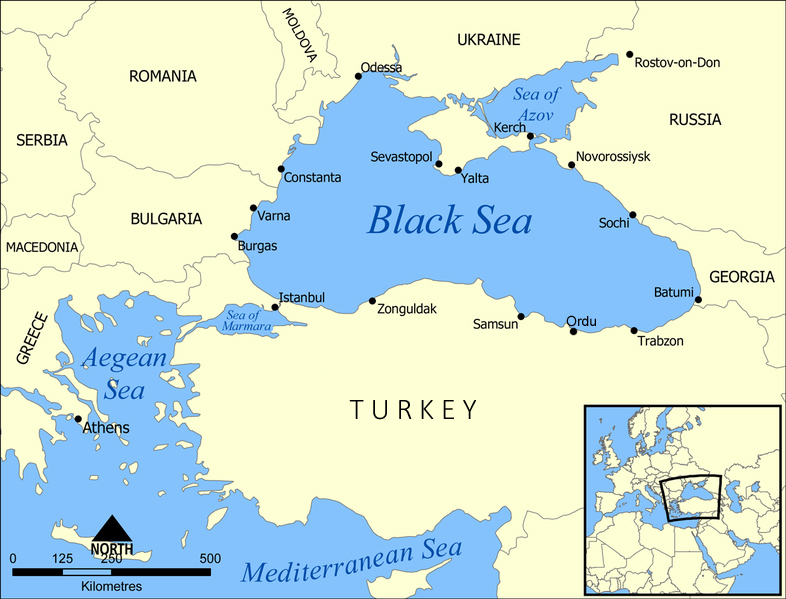
A map showing the location of the Black Sea and some of the large or prominent ports around it. The Sea of Azov and Sea of Marmara are also labelled. Created by User:NormanEinstein, Wikipedia

Kyiv Independent reports,

Russia has dispersed its naval forces in the Black Sea between the southeastern coast of Crimea and Novorossiysk in fear of Ukrainian surface drone strikes, Southern Command spokesperson Natalia Humeniuk said on Aug. 18.

Well, the US Navy is all a twitter about “Distributed Maritime Operations” (DMO) so is this a good idea for the Russian Black Sea Fleet? Like most such questions, it depends.

It depends on how good Ukrainian intelligence is. The supposed advantage for the Russian Fleet would be that their ships are harder to find, but is this case? Not only does Ukraine have access to some Western intelligence sources, but they seem to have good independent intelligence. All their successful USV attacks seem to have been against valid targets though there are many more potential targets that were not directly supporting the Russian military. When Russian ships are in port, the Ukrainians are going to know it.

Convoying has been a feature of Naval Warfare for over a thousand years because it is a defensive tactic that takes the choice of where and when to concentrate out of the hands of the offense. Spreading out the potential targets requires diluting the defense. That leaves the choice of where and when to concentrate effort in the hands of the Ukrainians.

To be successful, the defense has to detect all of the incoming USVs at a distance from their target and have sufficient numbers of countermeasures systems, in the right place, to engage all incoming USVs as they are detected.

The Ukrainian USVs don’t seem to be too hard to defeat once they are detected. Most of the successful countermeasures seem to have used machineguns, but you need one or more within effective range to engage every attacking USV.

The Ukrainians have told the world that no Russian Black Sea port is safe.

On August 4, Ukraine’s maritime authorities issued a “war risk area warning” to all international mariners headed for six Russian Black Sea ports, including Novorossiysk and the smaller oil-exporting terminals of Tuapse and Taman. The warning is scheduled to go into effect on August 23 and continue “until further notice” (Interfax-Ukraine, August 5). And on August 8, Zelenskyy’s economic adviser Oleh Ustenko told US media that “everything the Russians are moving back and forth on the Black Sea are our valid military targets,” including oil tankers or terminals.

When you multiply the number of points you have to defend, you divide your defensive force. USVs are cheap and readily produced. Ukraine will not have trouble finding targets. Ukraine will attempt to overwhelm the defenses by creating situations where even if the defense is taking out say four out of five or six out of seven attacking drones, the Russians still loose, even if it is only one ship at a time.

“CHINA’S MARITIME GRAY ZONE TACTICS AND SEALIGHT WITH RAY POWELL AND GAUTE FRIIS” –CIMSEC Podcast

CRASH AVERTED This photo taken on April 23, 2023 shows BRP Malapascua (right) maneuvering as a Chinese coast guard ship cuts its path at Second Thomas Shoal in the Spratly Islands. AFP PHOTO.

CIMSEC has a podcast discussing China’s “gray zone” tactics.

Perhaps more importantly they provide links to a series of short posts on specific gray zone tactics with examples.

There is also another post, “Gray Zone Tactics Playbook: Going Dark.” by Miao Shou, SeaLight, August 16, 2023.

Those bulbous bows probably make pretty good rams.