
Image Analysis of photo of Chinese shipyard showing multiple warships at various stages of … [+]H I Sutton, with permission from @Loongnaval
They are building a lot of these.

Image Analysis of photo of Chinese shipyard showing multiple warships at various stages of … [+]H I Sutton, with permission from @Loongnaval
They are building a lot of these.
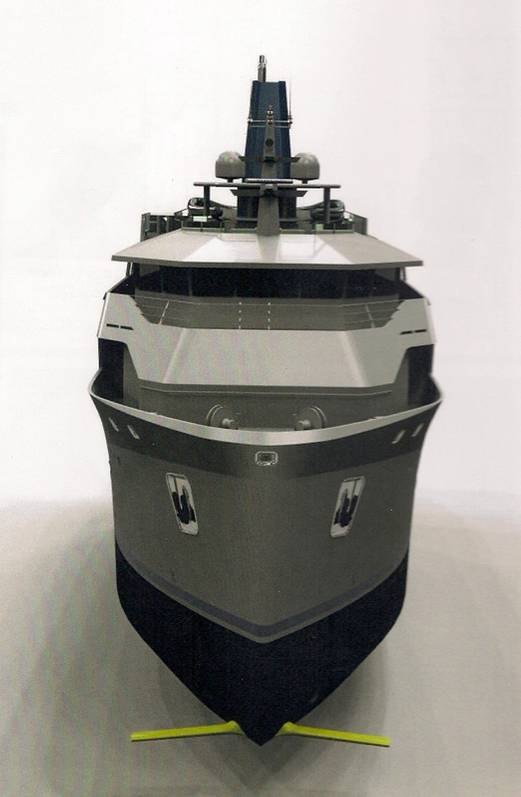
Coastal-steamer-sized, retractable Wavefoil installation. Credit Wavefoil
Marine Link reports on an innovation that promises a better ride, fuel savings, and lower emissions.
If it works nearly as well as reported, its worth a look.
The Acquisitions Directorate (CG-9) has issued a request for proposal for a Service Life Extension Program (SLEP) for the Coast Guard’s only heavy icebreaker, USCGC Polar Star. This is expected to be done over a five year period.
There is a good chance that the winning shipyard will not be in the Seattle area, where the ship is currently homeported. The last few years, Polar Star has undergone extended annual availabilities in a shipyard in Vallejo, California. This has to have been a hardship on the crew and their families. Once the contract is awarded, we will be fairly sure where the ships will have her availabilities for the next five years. If the winner is not in the Seattle area, I hope the Coast Guard will consider changing the Polar Star’s homeport so that the families can be near the shipyard where the renovation will take place.
I have duplicated the CG-9 announcement below.
—
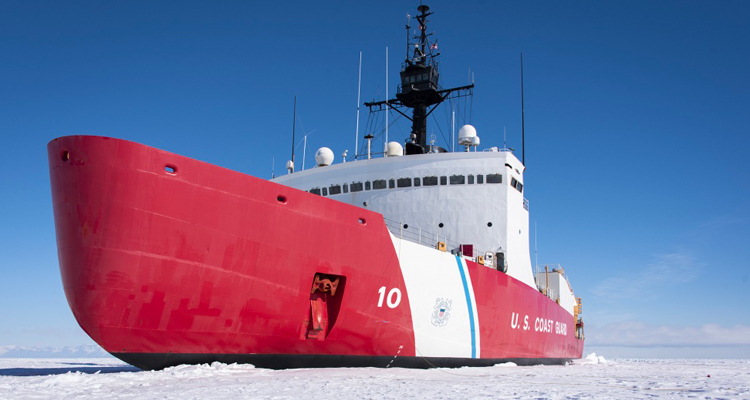
Coast Guard Cutter Polar Star travels through the ice Jan. 2, 2020, approximately 20 miles north of McMurdo Station, Antarctica. The 399-foot icebreaker is the only ship in U.S. service capable of clearing a path through the Antarctic ice to escort one tanker and two cargo vessels to McMurdo Station during Operation Deep Freeze. U.S. Coast Guard photo by Senior Chief Petty Officer NyxoLyno Cangemi.
The Coast Guard released a request for proposal (RFP) Jan. 31 to support the Coast Guard Cutter Polar Star service life extension program (SLEP) as part of the In-Service Vessel Sustainment program (ISVS). When completed, the SLEP effort will recapitalize a number of major systems and extend the service life of the cutter until the second Polar Security Cutter (PSC) is operational. This future contract will include SLEP work items and recurring maintenance in a five-year phased production schedule between 2021 and 2025. The future contract will also include an award fee with potential to be earned for making the ship available ahead of schedule.
The RFP is available here. The deadline to submit responses is March 18 at 2:00 p.m. EDT.
The 399-foot cutter – commissioned in 1976 – is the Coast Guard’s only active heavy icebreaker. It supports nine of the 11 Coast Guard statutory missions. Each winter, the cutter travels to McMurdo Station in Antarctica as part of Operation Deep Freeze, which supports the National Science Foundation-managed U.S. Antarctic Program.
When the cutter is eventually decommissioned, its duties will be assumed by the planned PSCs. The Coast Guard and the Navy are working together for the acquisition, through an integrated program office. Delivery of the first PSC is planned for 2024.
For more information: In-Service Vessel Sustainment program page

Launch of USCGC Mackinaw (WLBB-30) on April 2, 2005. Photo by Peter J. Markham.
US Senators from Great Lakes states are again pushing for second icebreaker on the Great Lakes at least as capable as USCGC Mackinaw. A letter jointly signed by U.S. Senators Tammy Baldwin (D-WI), Gary Peters (D-MI), Debbie Stabenow (D-MI), Rob Portman (R-OH) Chuck Schumer (D-NY), Amy Klobuchar (D-MN), Tina Smith (D-MN), Dick Durbin (D-IL), Kirsten Gillibrand (D-NY), Sherrod Brown (D-OH), and Todd Young (R-IN) has been mailed to the Commandant and the acting Secretary of Department of Homeland Security.
Full text of the letter can be found below:
Dear Director Mulvaney, Acting Secretary Wolf, and Admiral Schultz;
As the Administration works to finalize its FY 2021 budget request to Congress, we urge you to include adequate funding to support the Coast Guard’s acquisition of a Great Lakes icebreaker.
Icebreaking capacity supports the movement through the Great Lakes of more than 90 million tons of cargo annually. According to a study commissioned by the Lake Carriers’ Association, businesses that depend upon the Great Lakes maritime industry lost over $1 billion in revenues because of delays caused by inadequate icebreaking during the 2018-2019 ice-season. Vessel delays also resulted in the loss of 5,421 jobs dependent upon the efficient delivery of cargo throughout the Great Lakes Region.
The Coast Guard is required by law to maintain a heavy icebreaking capability on the Great Lakes to keep our region’s ports and harbors open and facilitate our nation’s free flow of commerce. However, the current maintenance condition of the existing icebreaking fleet has resulted in 182 lost operating days last winter primarily due to engine failures. To this end, Congress has authorized the Coast Guard to acquire a new Great Lakes icebreaker at least as capable as the heavy icebreaker the MACKINAW (WLBB-30), and has directed and provided funding for the Coast Guard to establish a major program acquisition office to support the design and procurement of a vessel.
We respectfully request adequate funding for the acquisition of a Great Lakes icebreaker in your FY 2021 budget request. Thank you, in advance, for your consideration of our views.
Their concern is easy to understand. There is no redundancy for the USCGC Mackinaw. If she has a catastrophic failure, it could be disastrous for the economics of the Lakes area. Even with her, shortfalls in capability have cost area a great deal.
We have discussed this before.
The Lake Carriers’ Association claims economic loses cost the Federal Government enough in taxes to pay for a new icebreaker in as little as two years.
Thanks to Fred for bringing this to my attention.
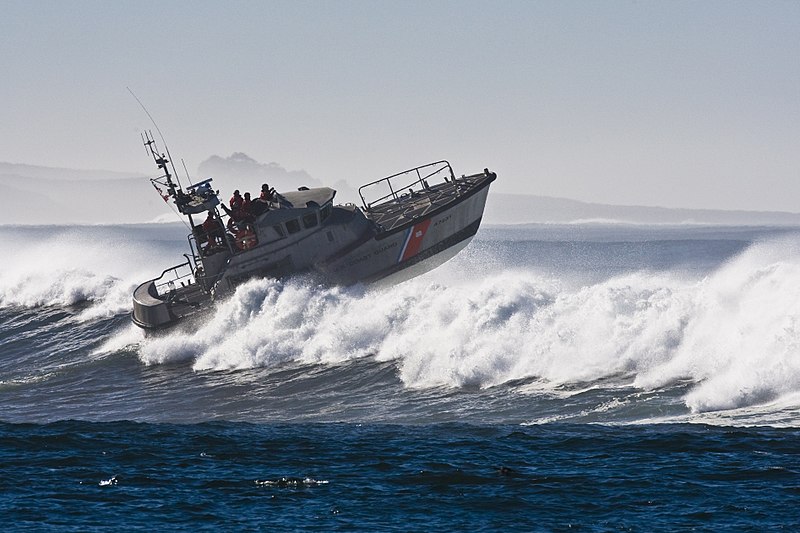
47-Foot Motor Life Boat (MLB) 47231 from Station Morrow Bay, 4 Dec 2007. Photo by Mike Baird
Marine Log reports that,
Birdon America, Inc. has named All American Marine, Inc. (AAM), Bellingham, Wash., as the West Coast shipyard for Phase I of the U.S. Coast Guard 47-foot motor lifeboat (MLB) Service Life Extension Program (SLEP).
Last August, Birdon America was awarded the prime contract to perform SLEO work on 107 of the 117 MLBs in the USCG fleet.
Regarding the scope of work.
Birdon America developed and proposed a solution to meet the Coast Guard’s SLEP requirements and included system replacements, performance enhancements in the areas of noise, seating, and reliability and addressed structural issues.
The main work will be on systems experiencing technical obsolescence: the main propulsion, electrical, steering, towing and navigation systems, as well as replacement of areas of the hull and structure that have demonstrated high failure rates. Additionally, efforts to enhance human system integration will be made where practical to do so.

The Congressional Research Service has again updated its look at cutter procurement. (Note, this link will take you to the latest version of the report and is subject to change with each update.) While I cannot be sure there are no other changes, I believe the significant changes are a reflection of the result of the House and Senate Conference Committee. From page 25.
Conference In final action, the FY2020 DHS Appropriations Act became Division D of H.R. 1158, the Consolidated Appropriations Act, 2020. The explanatory statement for Division D of H.R. 1158/P.L. 116-93 of December 20, 2019, provides the funding levels shown in the appropriation conference column of Table 2. The explanatory statement for Division D of H.R. 1158 states: The agreement [for the Coast Guard’s Procurement, Construction, and Improvements account] provides an increase of $537,850,000 above the request, including … $260,000,000 for a total of four FRCs…. The bill makes available $100,500,000 for long lead time material for a twelfth National Security Cutter, consistent with the direction in the House Report….
I have reproduced Table 2 from page 21 of the report below. The following explanatory note is quoted from the CRS report:
“Source: Table prepared by CRS based on Coast Guard’s FY2020 budget submission, HAC committee report, and SAC chairman’s mark and explanatory statement on FY2020 DHS Appropriations Act. HAC is House Appropriations Committee; SAC is Senate Appropriations Committee.”
Summary of Appropriations Action on FY2020 Acquisition Funding Request
Table 2 summarizes appropriations action on the Coast Guard’s request for FY2020 acquisition funding for the NSC, OPC, and FRC programs.
Table 2. Summary of Appropriations Action on FY2020 Acquisition Funding Request Figures in millions of dollars, rounded to nearest tenth
So again Congress is providing funding above that requested by the administration.
The increase from two to four Webber class is consistent with previous Congressional action, and should actually result in a savings over the life of the program, in that it is in line with the current contract options and will not require a renegotiation that might have raised the cost of individual cutters by up to $10M. That means a total of 62 Webber class will have been funded. Only two additional in FY2021 are planned, for a total of 64, 58 in the program of record plus six for PATFORSWA to support CENTCOM, but I would not be surprised to see four in the final FY2021 budget.
The addition of $100.5M for Long Lead Time items for a twelfth National Security Cutter looks like a strong commitment to fund another Bertholf class National Security Cutter.
Relative to the OPC program, from page 26:
OPC Program.- The contract awarded to construct the OPC was recently amended to address increased cost estimates after the Acting Secretary determined that relief permitted under Public Law 85-804 was appropriate and necessary to the national defense. An associated delay in delivery of the first two hulls reduced the fiscal year 2020 requirement for the OPC by $145,000,000. Funds included in the agreement continue necessary program requirements. The agreement maintains the commitment to ensuring the Coast Guard can continue the program of record for these critical vessels. As a condition of the granted relief, the vendor will be subject to increased oversight, including additional scrutiny of the costs borne by the Coast Guard. The Coast Guard shall brief the Committees quarterly on the metrics used to evaluate adherence to production timelines and costs, including those attributed to reestablishing the production line and maintaining the skilled workforce required to ensure contract performance.
So Congress is going to let the decision to allow extraordinary relief to Eastern Shipbuilding go ahead. The reduction of OPC funding that had been requested is only due to delays in the program and presumably the deletion of long lead time materials for OPC #5 from the payments that had been planned for Eastern.

French “POM” Offshore Patrol Vessel. Credit: Socarenam
Naval News reports that the French Navy has ordered six Offshore Patrol Vessels (Patrouilleur d’Outre-Mer – POM). with the intention of basing two each in New Caledonia (Nouméa) and French Polynesia (Papeete) in the Western Pacific and la Réunion (Port-des-Galets) in the Indian Ocean.
The POM will have an endurance of 30 days without refueling. Each ship will accommodate a crew of 30 sailors and 23 passengers and operate an unmanned aerial vehicle. Their armament will include a 20mm caliber remote-controlled turret (Narwhal by Nexter), as well as 12.7 mm and 7.62mm machine guns. The POM vessel will be 80 meters (262.4′) long and 11.8 meters (38.7′) wide, with a draft of 3.5 meters (11.5′). (I provided the conversion to feet–Chuck)
These ships will replace 180 foot long P400-class patrol boats.
We talked about these ships and also discussed the French Navy’s coast guard type missions and other French OPV projects here. Incidentally all the previous reporting indicated that these would be 70 meters (230′) in length. These really do not look like 80 meter ships. I would prefer a flight deck and hangar suitable for a medium sized helicopter like on L’Adroit, but in any case, it is bigger and, at 22 knots, faster than a 210 with a crew less than half as large.
These ships certainly could be considered as candidates for “cutter X,” taking the crew and equipment of the Webber class cutters and putting them in a larger, more seaworthy hull. Looking at these new CGI images, they look like a supersized Webber class, with the gun on the main foc’sle just forward of the super structure and four crew served .50 calibers sited almost exactly as they are on the Webber class; a very similar 360 degree view pilot house mounted well back where it will experience less vertical acceleration; and a boat launch ramp notched in the stern. Taking advantage of the larger hull it also incorporates a davit launched RHIB starboard, space for a 20 foot containerized mission module, a flight deck and hangar for a 700-kilogram-class rotor-blade drone more berthing, and a holding area for up to six prisoners.
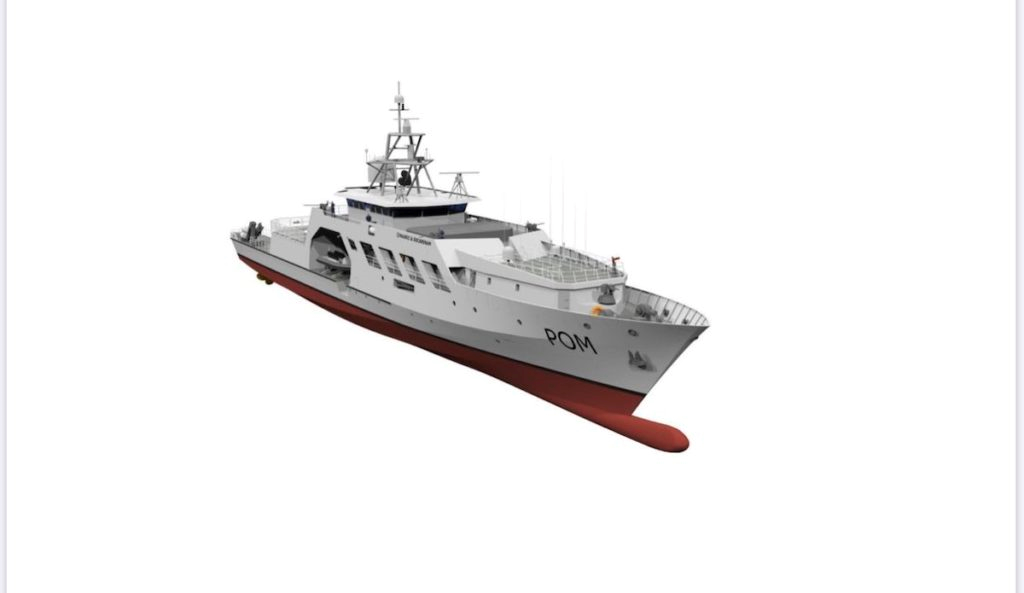
A CGI of the French Navy’s future POM OPVs (Credit : Socarenam)
It is now extremely unlikely the OPCs will be obtained at the low price initially bid by Eastern. They are now seen to be as large as the Bertholf class National Security Cutters. Perhaps if we look ahead to the time when Polar Security Cutter funding will have been completed, we should think about building a true “bridge” between the over 4,000 ton NSCs and OPCs and the under 400 ton Webber class. We might choose to continue building one OPC a year and build three Cutter X for about the same price as a second OPC. We could replace the WMECs that much quicker and perhaps build to a total of over 50 truly ocean going cutters. (11 NSCs, 14 OPC, and 30 Cutter X for about the same price as 11 NSCs, and 25 OPCs)
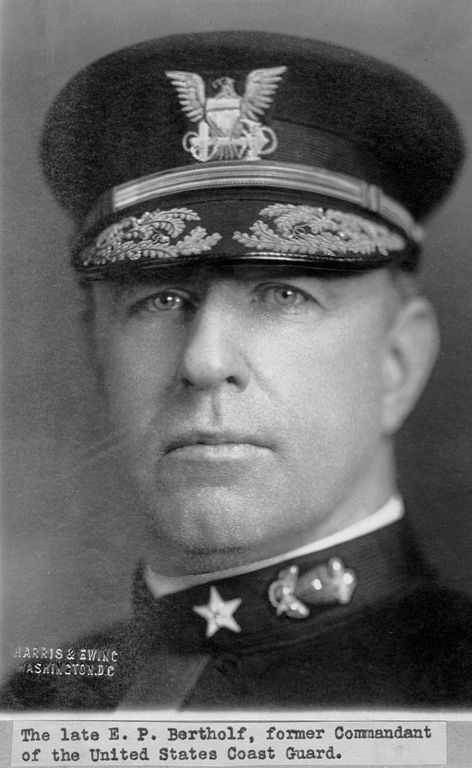
Photograph of Ellsworth P. Bertholf, Commandant of the U.S. Revenue Cutter Service from 1911 to 1915 and Commandant of the U.S. Coast Guard from 1915 to 1919. Coast Guard photo.
Today mark the 105th Anniversary of the formation of the US Coast Guard. “An Act to Create the Coast Guard” (Public Law 239) was signed into law on 28 January 1915.
Credit for this should go to Ellsworth Price Bertholf. First he saved the Revenue Cutter Service from being disassembled and then after WWI saved it from being absorbed by the Navy. He was one of three heroes of the Overland Relief Expedition. He died at age 55.
Did you know he was court marshalled and dismissed while a midshipman at the Naval Academy?
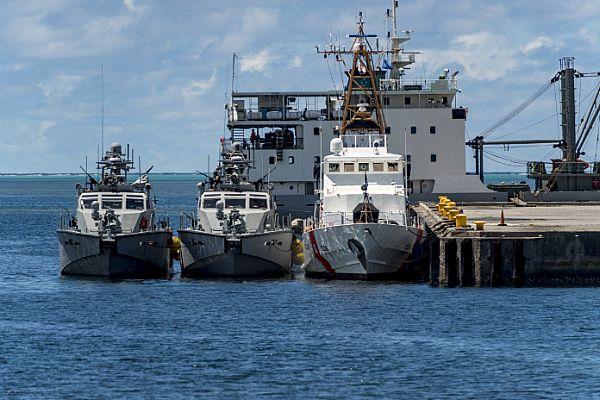
COLONIA, Yap (July 4, 2019) The U.S. Coast Guard Island-class patrol boat USCGC Kiska and Mark VI patrol boats assigned to Coastal Riverine Squadron (CRS) 2, Coastal Riverine Group 1, Detachment Guam, moored in the Micronesia port of Yap. CRG 1, Det. Guam’s visit to Yap, and engagement with the People of Federated States of Micronesia underscores the U.S. Navy’s commitment to partners in the region. The Mark VI patrol boat is an integral part of the expeditionary forces support to 7th Fleet, capability of supporting myriad of missions throughout the Indo-Pacific. (U.S. Navy photo by Mass Communication Specialist 2nd Class Jasen Moreno-Garcia/Released)
CIMSEC has issued a call for articles regarding the CNO’s recently issued “Design for Maintaining Maritime Superiority” the document does not mention the Coast Guard, but I think we have a part to play.
This is a good opportunity for some of those who follow this blog to try your hand at writing for a professional readership.

Graphical rendering of the new patrol craft for the Royal Thai Navy (Image from Marsun)
MarineLog reports that the Thai Navy has chosen MAN 16V175D-MM, IMO Tier II engines, each rated at 2,960 kWm at 1,900 rpm, to power a new class of two Patrol Craft. With two engines for each vessel that is just under 8,000 HP.
This new class is only the latest in a string of patrol craft, indigenously built by Marsun. This class appear to be closely related to the T995 and T996 patrol gun boats. if so it should have a speed of about 27 knots.
It appears to be equipped with a small RHIB, but the boat handling equipment does not appear as convenient as a dedicated davit or stern ramp.
Recently, the Thais seem to have been providing more powerful weapons for their patrol vessels than do most other countries. They recently equipped an Offshore Patrol Vessel with Harpoon Anti-Ship Cruise Missiles in addition to a 76mm gun. The choice of gun for this class appears to be a departure from the weapons that equipped previous patrol craft. The caliber, 30mm, is the same, but the rate of fire and the origin of the weapon are different.
The gun appears to be a Russian 30mm AK-306 barrel rotary cannon, a lighter version of the ubiquitous AK630. Maximum rate of fire is 1,000 rounds per minute. It should be quite effective as a short range anti-surface weapon.
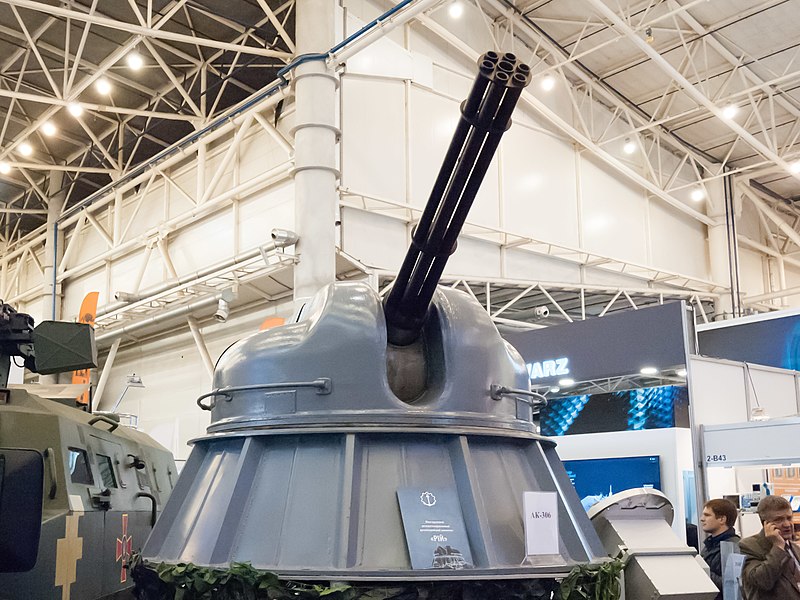
AK-306 rotary cannon, Zbroya ta Bezpeka military fair, Kyiv 2017, Photo from VoidWanderer via Wikipedia Commons
 Chuck Hill's CG Blog