Intelligence Upgrade for the OPC?

Allen Balough, a lead engineer for the C4ISR program (right), tests the new interior communications system with a Coast Guard Cutter Spencer crewmember after installation of leaky coax cable. The installation took place in Boston July 18-21. U.S. Coast Guard photo.

U.S. Coast Guard photo.

The Coast Guard has been enjoying the benefits of better intelligence available to (and from) the National Security Cutters (NSC).

The Acquisitions directorate (CG-9) recently issued a press release that suggests they hope to get more of the same from the Offshore Patrol Cutters (OPC).

Acquisition Update: Acquisition Directorate Looks To Continue Operational Successes With OPC C4ISR Design

Jan. 13, 2017

The Coast Guard shattered its record for drug interdictions in fiscal year 2016 due in large part to the enhanced capabilities of the national security cutters and their advanced command, control, communications, computers, intelligence, surveillance and reconnaissance (C4ISR) systems. The Acquisition Directorate’s C4ISR Program is working to bring similar success to the offshore patrol cutters.

The Coast Guard seized more than 400,000 pounds of cocaine in fiscal year 2016, worth around $5.6 billion, and much of that is thanks to the advanced intelligence-gathering capability of the NSC class.

“Since the post-9/11 reorganization of the intelligence community, the Coast Guard has a much greater responsibility for intelligence gathering,” said Wayne Jacobs, intelligence system acquisition manager. “Instead of simply acting on intelligence reports, NSC crews have an improved ability to gather information themselves and share it with the intelligence community.”

Part of the NSC’s success is thanks to its ability to access the most up-to-date intelligence reports from shore-based intelligence networks in addition to its own intelligence data collection systems. “Before the NSC, a cutter would use intelligence which could be eight to 12 hours old to find smugglers,” he said. “The NSC gives the Coast Guard the capability to guide their patrols with real-time intelligence to better locate drug traffickers.”

Once on patrol, the NSC’s advanced sensors and surveillance equipment help its crews identify, locate and interdict smugglers. For example, NSC crews can use infrared sensors to better locate smugglers at night.

However, perhaps the most important feature of the NSC is interoperability. “The Link 11 system is the best part,” Jacobs said. “It allows ships and aircraft in a group to share their tactical data so the NSC crew can better see the command and control picture around the cutter.” Link 11 allows tactical information sharing with other U.S. military branches and with allied militaries.

An advanced communications suite makes coordinating operations easier for NSC crews, improving interoperability further. The NSC uses both line-of-sight and satellite radios to provide voice communications, chat rooms and data transfers to better coordinate with partners.

Jacobs says that the NSC has led to a notable increase in the Coast Guard’s interdiction of semisubmersibles – vessels that operate partially underwater to avoid detection. “It’s a technique that we’ve seen more in recent years, and they’re very hard to find in the water,” he explained. “We’ve caught a lot of semisubmersibles thanks to operations guided by better intelligence data from these systems.”

Recognizing the success of the intelligence-gathering systems on the NSC, the C4ISR Program is working to bring similar systems to the OPC. “The OPC systems will provide similar capabilities to what the Coast Guard uses and needs on the NSC,” Jacobs said.

The OPC will feature the Link 11 system and similar intelligence-sharing equipment to the NSC. The C4ISR Program is also hoping to include a data collection system that will integrate and analyze information from the cutter’s sensors to provide the crew with better situational awareness. An advanced, Navy-provided electronic warfare system and gun system will also be included to help the cutter perform defense readiness missions. The Navy is also providing the latest multimode air search radar.

“Because they operate closer to shore, the OPCs are more focused on Coast Guard-specific missions like drug interdiction,” Jacobs explained. “We’re designing intelligence systems with that in mind.”

I am not sure what this means. The only likely change I see, to what was already planned for the OPC, is that perhaps the Ships Signals Exploitation Space (formerly referred to as a SCIF (Sensitive Compartmented Information Facility)) for which space was to be provided but with no immediate plans to equip and man it, will in fact be fully furnished. That would be a step in the right direction.

This might also be an attempt to head off any attempt to dumb down the OPC.

It might also be a “thank you and more, please” to the Navy for the “Navy Type/Navy Owned” equipment they have been providing.

It might be all three, but it is formal recognition that thermal imaging, Link 11, secure satellite radio, high level intel access, and sophisticated radars make our ships more effective.

OPC to Have Hybrid Propulsion

OPC "Placemat"

OPC “Placemat”

We have confirmation that the Offshore Patrol Cutter will have a hybrid propulsion system.

Shephard Media is reporting that, “DRS Technologies, a Leonardo Company, has been selected to provide the hybrid-electric drive propulsion system for the US Coast Guard Offshore Patrol Cutter.”

As to the exact configuration, we have this. Clive Wilgress-Pipe, director of business development and strategic programs at DRS Power Technology said,

“…that the new Offshore Patrol Cutter design solution uses the gearbox mount configuration.”

This suggests to me that the electric propulsion motors (EPM) will be physically close to the main diesel engines (MDE). Assuming the ship will retain redundant machinery spaces, I will speculate and say, this probably means the ship will have two machinery spaces each with a complete propulsion set (MDE, clutch, gearbox, and EPM) for one shaft, plus one or two generators. Previously I had expected one engine room with both main diesel engines, and a motor room with both electric motors.

We don’t have a speed capability for the ship on electric propulsion alone. I had assumed it would provide at least 14 knots to give the long endurance (10,400 n.mi.) claimed for that speed, which might have required only a pair of 1,500 HP motors, but Mr. Wilgress-Pipe’s remarks suggest it might be more.

“Typically you rate it up to about 17 or 18 knots.”

That would require something more like a total of 6,000 HP. As noted, in the linked post, some configurations (COmbined Diesel Electric And Diesel, CODLAD) allow the power of the electric motors to suppliment the main propulsion engines. If that is the case, and we could add something like 6,000 HP to the two 16V 28/33D diesel engines, each rated at 9,763 bhp, then the ship would almost certainly have a 25 knot max speed. (This is of course speculation, so we can only be sure of the 22.5 knots sustained previously reported.)

Giving these ships the option of cruising on electric power, provided only by the ship’s service generators, makes these ship potentially more useful as ASW ships. In this mode, they will be quieter and, in noisy littoral environments, more difficult for a submarine to distinguish from other traffic.

Thanks to Luke for bringing this to my attention. 

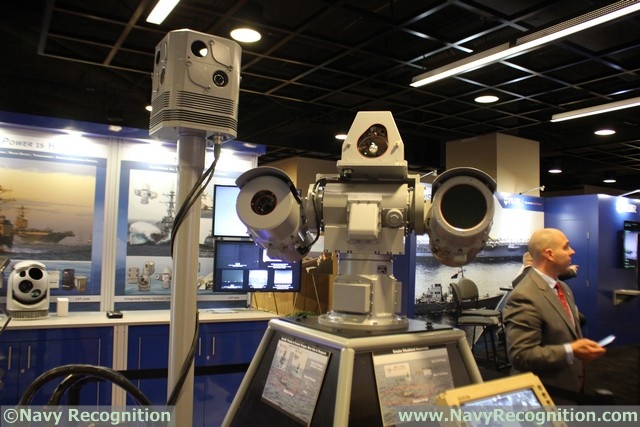
Mk20 mod1 Electro Optic Sensor System

Mk20 mod1 Electro Optic Sensor System (EOSS)

Mk20 Mod1 Electro Optic Sensor System (EOSS)

Two reports by NavyRecognition from the Surface Navy Symposium on the L3 Mk20 Mod1 Electro Optic Sensor System (EOSS). The video report above discusses the system from time 00:45 to 2:55, and there is this short written post reporting successful testing. Reportedly this EOSS will weigh half as much as the previous mk20 mod0 system, but have greater resolution and range. According to the report it is currently planned to be installed aboard U.S. Navy Cruisers/Destroyers and U.S. Coast Guard Cutters, presumably the Offshore Patrol Cutters (OPC).

The earlier Mk20 Mod0 is on the National Security Cutter.

The three parts visible are, I believe, a day light TV camera, a thermal imaging camera, and a laser range finder. I wonder if it could also function as a laser target designator?

Other than using it as a firecontrol for ASuW and AAW, this system can be used for:

– Spotting and kill assessment
– Target detection and identification
– Naval gunfire support
– Safety check-sight
– Location and track of man overboard
– Channel position and navigation


BAE at SNA 2017

Above is a short presentation by a BAE representative brought us by NavyRecognition from the 2017 Surface Navy Association Meeting.

  • 00:00–00:20 is intro.
  • 00:20–01:15 discusses the electromagnetic rail gun.
  • 01:15–02:30 covers the hypervelocity projectile that they expect to fire from the Mk45 5″ naval gun, the 155mm howitzer, and the electromagnetic railgun.
  • 02:30–03:35 is about the Mk45 mod4 5″ and an automated, unmanned magazine designed for an international customer (It is planned for the UK’s Type 26 frigate).
  • 03:35–04:42 is about the Mk110 57mm gun and a special purpose round they are developing, the ORKA (Ordnance for Rapid Kill of Attack Craft).

Below I have included a video with more detail on the ORKA round. Note this is a specialized guided round intended for use against small surface targets and inbound air targets. It should have a much higher probability of hit than the ballistic round, but is unlikely to have the full range (17,000 meters) or high altitude reach (PFHE: 24,930 feet) credited to the Mk110 because the round appears heavier than the ballistic round, control surfaces will add drag, and because of its larger size displaces some of the propellent that would have been in a more conventional round. The video claims an effective range of 10,000 meters (about 11,000 yards). That may also be its maximum range.

Coast Guard Commandant Will Stress Maritime Security to Trump Administration–USNI News

The US Naval Institute reports, “The Commandant of the Coast Guard will stress maritime security – particularly south of the border — in future discussions with the incoming Trump administration.” Read the rest.

This is one of the topics the Commandant has consistently hit. It should not not surprise anyone who has been reading or hearing his addresses.

Icebreakers and Motherships at SNA 2017

Defense & Aerospace Report Editor Vago Muradian interviews General Dynamics NASSCO’s Tom Wetherald regarding its US Coast Guard icebreaker and US Navy ship programs with during the 29th Surface Navy Association Symposium in Arlington, Virginia.

Interestingly NASSCO, like Eastern, teamed with VARD to develop their icebreaker concept.

Notably I see not weapons or positions for weapons on the icebreaker concept.

It may be good news for us that more Expeditionary Sea Bases (formerly “Afloat Forward Staging Bases”). It is likely one will go to to SOUTHCOM and may be available to support counter drug operations.

TRS-3D Baseline D Multi-Mode Radar for 9th NSC.

NavyRecognition reports, “Airbus Defense and Space, Inc., under contract with its affiliate Airbus DS Electronics and Border Security GmbH, will provide the TRS-3D Baseline D multi-mode radar (MMR) for the U.S. Coast Guard’s ninth National Security Cutter (NSC).”

The Bertholf Class have been equipped with the rotating Active Electronically Scanned Array (AESA) TRS-3D multi-mode (air search, surface search, helicopter control, and firecontrol) radars from the first. My understanding is that this is an improved version of the same radar that equips earlier National Security Cutters and the Freedom class LCS.

Airbus (formerly EADS) has an excellent multi-paged description of the system here.

It is not clear to me how this compares with the TRS-4D system, also from Airbus. The TRS-4D will equip Freedom Class LCS beginning with LCS-17, and I expected it to be used on the Offshore Patrol Cutter (OPC). (Late note: in fact the OPCs will have the SAAB Sea Giraffe multi-mode radar– Chuck) The TRS-4D appears to be very similar in many respects, but it looks at higher elevations and is lighter. Is it a replacement for the TRS-3D or is it a “junior” version of the same technology?

110 WPBs for Costa Rica

uscgcknight_island

US Coast Guard Cutter Knight Island (WPB-1348), photo by Rnendza

Some how I missed this when it came out, but the Tico Times reports the Coast Guard is planning on donating two of the 110 foot WPBs to Costa Rica this year.

That will bring to six the number escorted including two to the Republic of Georgia, two to Pakistan, and these two.

Thanks to Sanjay Badri-Maharaj for bringing this to my attention. 

Former Commandant, Adm. Papp Goes to Work for OPC Builder Eastern

papprobertadmuscg

gCaptain is reporting,

Florida-based Eastern Shipbuilding Group has appointed Admiral Robert Papp, former Commandant of the U. S. Coast Guard, as President of the company’s new Washington Operations division.

Significantly, Admiral Papp retired well before Eastern was selected as builder of the Offshore Patrol Cutter.

I regarded Admiral Papp as a friend of the Blog and a good man. I wish him all the best and success in his new endeavour.