NavyRecognition reports the commissioning of a new 4,860 ton medium icebreaker that is apparently intended for “domestic icebreaking” with the North Sea Fleet.
China’s New Icebreaker
5

NavyRecognition reports the commissioning of a new 4,860 ton medium icebreaker that is apparently intended for “domestic icebreaking” with the North Sea Fleet.
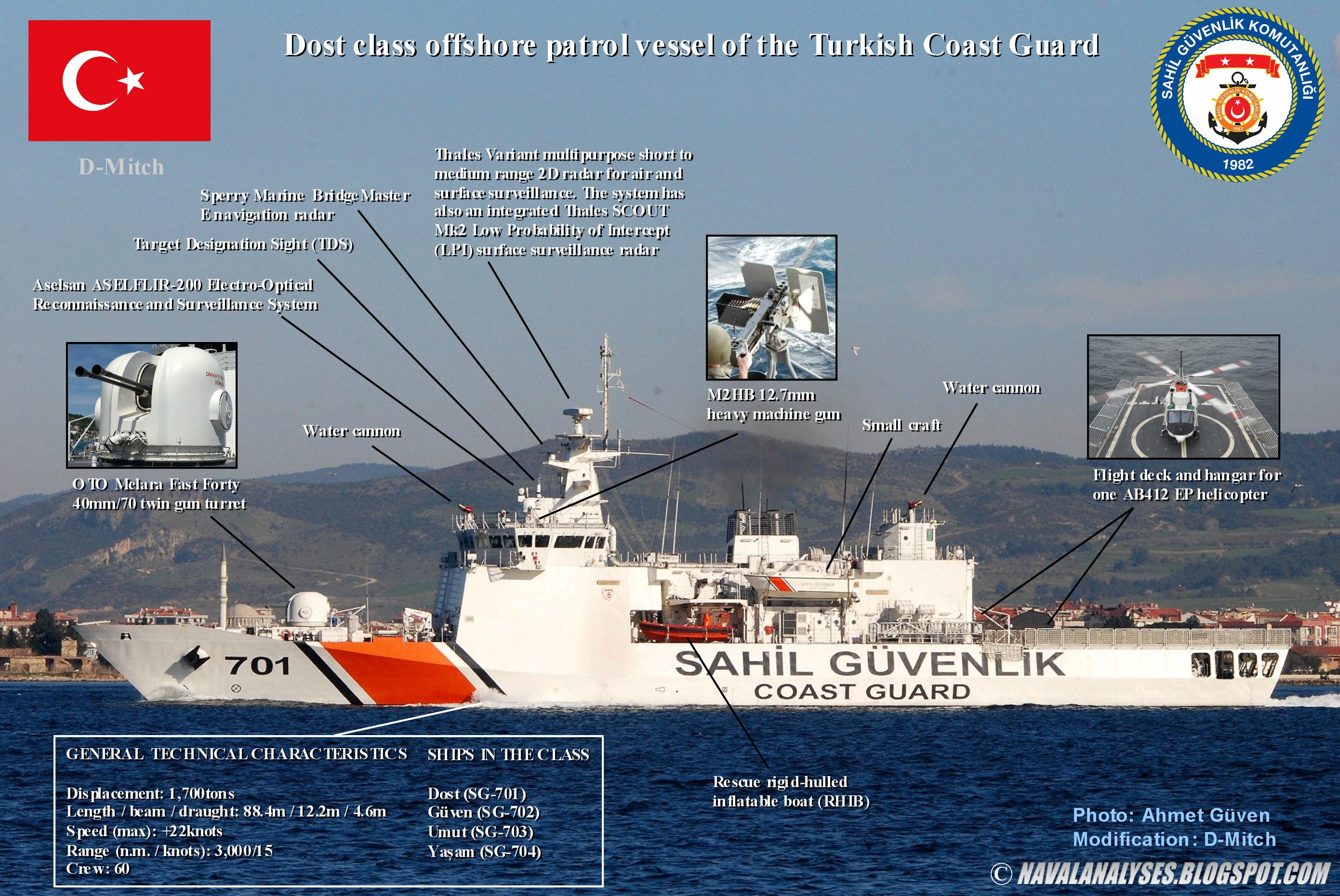
Photo: NavalAnalyses.Blogspot.Com. Click on the photo to enlarge
The German Navy Blog “Marine Forum,”
“5 January, Turkey, Acting on a tip-off / intelligence input, Turkish Coast Guard ships „Yasam“ and „Umut“ intercept Bolivian-flagged freighter „Joudi“ in international waters off Tobruk (Libya) … after receiving Bolivian government permission to board and search ship, boarding team finds 13 tonnes of cannabis.
“(rmks: first such action distant from Turkish waters; made feasible with induction of large DOST class patrol ships–emphasis applied–Chuck)”
So I looked up the class. The four ships of this class are the largest vessels in the Turkish Coast Guard. The next largest are only 210 tons. They are based on the Italian Sirio Class patrol vessels which operate under the Italian Navy but were paid for by the Transport and Navigation Ministry. I suspect the Sirio Class (appropriately modified) may have been the basis of the Marinette Marine’s OPC proposal.
Specs for the Turkish ships from my Combat Fleets of the World, 16th ed. with my translation to English units are:
The Gun: The Beda Bofors twin 40mm/70 gun is not a bad choice. It has been around for a while and it has improved over time. Current models are rated at 450 rounds per minute per barrel for 900 rounds per minute for the twin mount. That is faster than a .50 cal. M2 machine gun. The Italian Navy used this as a CIWS before switching to the improved 120 round per minute 76mm. It also has adequate range, 13,675 yards (12,500 m). This is less range than either a 57mm or 76mm, but adequate for most Coast Guard missions. There are at least four different projectiles available. The standard projectiles are about two pounds. There is also a high velocity solid tungsten alloy rod armour-piercing fin-stabilized discarding sabot (APFSDS) projectile that would probably be good for destroying fairly large diesel engines. .
If I read this correctly, the video is 380 rounds in 43 seconds.
Also from “Combat Fleets” this on the Turkish Coast Guard.
“Personnel: Approx. 2,200 total including 800 regulars and 1,400 conscripts, plus 1,050 on loan from the navy.
“Aviation: Coast Guard air assets include one Maule MX-7 light fixed-wing and three CASA CN-235 maritime patrol aircraft (the basic airframe for the HC-144, Chuck). Three Austa-Bell AB-206B Helicopters and thirteen search and rescue configured Agusta-Bell 412 helicopters. The aircraft are pained white with an orange diagonal stripe.”
http://issuu.com/faircountmedia/docs/uscg15#embed
DefenseMediaNetwork has published an online version of the new “Coast Guard Outlook.” I have not read it all, there is a lot there, 164 pages. Fortunately, it allowed me to embed it above.
It includes an interview with the Commandant, a story about the 100 year history of Coast Guard Aviation, one about the Coast Guard in Vietnam, and another about the Offshore Patrol Cutter, along with several others.
When I first brought it up, the print was too small to read comfortably on my laptop, but you have two ways to get a larger view. Clicking on the page twice enlarges it (maybe too large). There is also a slider at the lower left that changes the size of the page you are viewing. Unfortunately neither adjustment is carried over when you go to the next page.
Thanks to Lee for bringing this to my attention.
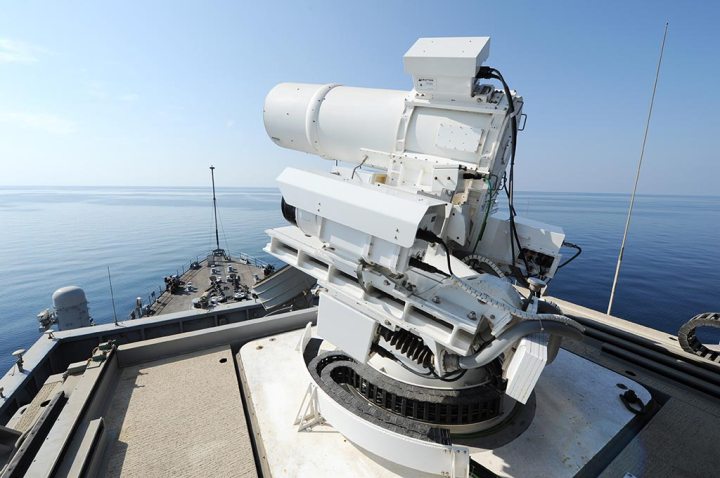
The Afloat Forward Staging Base (Interim) USS Ponce (ASB(I) 15) conducts an operational demonstration of the Office of Naval Research (ONR)-sponsored Laser Weapon System (LaWS) while deployed to the Arabian Gulf. U.S. Navy photo by John F. Williams
DefenseMediaNetwork has an interesting article about progress on weaponizing Lasers for use afloat. Some points that might be of particular interest to the Coast Guard were:
The Laser can be a less than lethal deterrent,.
“A laser offers scalable effects, from deter-and-dissuade to degrade or destroy. LaWS can address multiple threats using a range of escalating options, from non-lethal measures such as optical “dazzling” and disabling, up to lethal destruction of small attack boats and UAVs.”
The accompanying optics have other uses,
“The systems provide better high-resolution imagery than what existing shipboard EO/IR sensors provide now. With upgraded optics, a system like CLWS can bring targets as close as 1 kilometer or as far as 37 kilometers into clear focus. ‘The system enhances intelligence missions without engaging targets,’ …”
Now that it is over, looking back on 2015, I would like to thank the readers and contributors for making the effort very rewarding for me. This is a remarkably civil and knowledgeable group. Nice to see that all experience and knowledge levels are respected. Top five contributors by number of comments were x, Leesea, Tups, James WF, and Nicky. I got a number of suggestions by e-mail too.
The previous year, 2014, was a remarkably good year for the blog. The award of the preliminary Offshore Patrol Cutter contracts prompted a lot of interest, but still the blog enjoyed some growth. The blog had 213,556 views, 5.4% more last year.
In 2015, there were 277 new posts, growing the total archive of this blog to 1,452 posts. Top posts, by number of views were:
As you can see, nine out of ten of these were published in previous years. I hope this is not a reflection of declining quality, but it is gratifying to know that these posts are still of continuing interest.
I am told by WordPress that readers came from 169 different countries. I suspect some of these were just spammers. Still, 38 countries were reported to have at least 200 views. The top five, after the US, were the UK, Canada, the Philippines, Netherlands, and Australia.
I would also like to particularly thank Thinkdefence, the Center for International Maritime Security (CIMSEC) “Next War Blog”, Eaglespeak, for linking to this website and bringing more readers here.
Thanks for the interest.
Coast Guard Compass has once again held a competition for Coast Guard video of the year and the results are in. All ten are worth a look.
With New Years “Best of…” Lists are perhaps inevitable. This one, from NavyRecognition, while you might argue with the selection is at least interesting.
Perhaps most interesting for us are #6 BAE Systems Unveils the ORKA One Shot One Kill Round for 57mm Gun at Sea-Air-Space 20 and #3 Design of Future TKMS Built Saar 6 MEKO A100 Corvettes for Israeli Navy Unveiled.
#1 At NAVDEX 2015 Navantia unveiled its F-538 Frigate Design for the Peruvian Navy is interesting, as a cutter sized warship, but it is still only a proposal.

Photo: Chilean Navy photo of OPV Toro, 2012
A German blogger I worked with earlier on a project for CIMSEC, Sven Ortmann, has written a post contending that building dedicated Offshore Patrol Vessels (e.g. Coast Guard cutters) does not make sense, that it is more economical to have a navy’s warships, augmented as necessary by law enforcement officers, perform these peacetime functions. He is planning to publish the post, 24 December at 6:00PM Eastern, at his Defense and Freedom Blog here.
Sven asked if I would like to write a rebuttal, and this is the product of that query.
Terminology:
For the purposes of this post, I will lump fisheries, law enforcement, and SAR together as coast guard work, or for brevity CG work.
I would contend at least some OPVs are really warships, and on the other hand, that navy auxiliaries, not normally considered warships, might also be used also be used to perform CG work, as the British Royal Navy has done, but for the sake of avoiding repeated long explanations I will lump the ships that might do this work into two categories as Sven has done: “warships” and “OPVs.”
The Contentions: Sven’s argument is based on a number of questionable assumptions. I will try to address each of these.:
US Navy photo
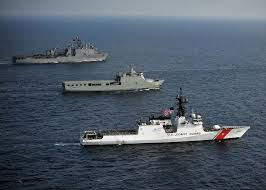
That OPVs are not warships and that they have no value in wartime. “What do you need in war (and for deterrence of war)? Combat capability. Warships are built for it, OPVs are mere targets in combat.”
I did an earlier post which examines what Coast Guard cutters, and by extention, what OPVs might do in wartime, “What Might Coast Guard Cutters do in Wartime? Part 2, Coast Guard Roles.” Their potential missions include Maritime Security, Blockade/Quarantine, Sea Control, Administrative Escort, Combat SAR, Deception, Special Warfare support, Naval Surface Fire Support. and with suitable modification, MCM and ASW. I would add that in the case of China’s very large OPVs, they might also be used as Attack Transports, being equipped, as they are, with extra accommodations, a number of boats, and facilities for large helicopters.

Image from FoxtrotAlpha, “Why China is Building the World’s Largest ‘Coast Guard’ Cutter”
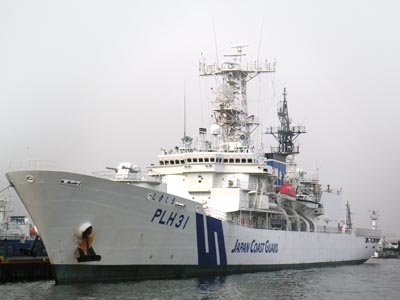
Photo: Japanese Coast Guard Cutter Shikishima, this class of two are currently the largest offshore patrol vessels in the world. China is building even larger OPVs. Photo from Japanese Wikipedia; ja:ファイル:JapanCoastGuard Shikishima.jpg
In many cases the only difference between what people see as OPVs and frigates or corvettes is how the ship is equipped. If an OPV is upgraded and people start to see it as a frigate, is it no longer an OPV? I don’t don’t think so. Offshore Patrol is a job to do, rather than a type of vessel, though a certain type of vessel is typically used as an OPV. World wide, the typical vessel built to perform OPV duties is 1500 to 2500 tons, has a medium caliber gun, some machine guns, and a helicopter deck. Some are better equipped than others. Some even include anti-ship cruise missiles Usually they don’t have some of the more sophisticated equipment found on warships, because of both initial cost and manning requirements, but given some time, frequently they can be upgraded.

Photo: Spanish BAM, Meteoro Class OPV
That if a nation builds a proper sized navy it will include enough warships to also do CG work. “Scenario A: A fleet with warships, no OPVs. Result: Enough warships for war’s needs, enough ships for policing and rescue.”
This is what I believe Sven suggests is the best choice, but it assumes there are enough warships for marine policing and rescue, but this is not necessarily the case.
We must ask how many ship-days we need to effectively perform the CG work. Then we must ask how many ship-days the navy will have remaining after maintenance, work-up, exercises, and out of area deployments.

EEZs in the Pacific (partial)
A nation’s wealth, its perception of threat, and the size of its EEZ are not necessarily proportionate.
Germany is a wealthy nation, with a potential great power adversary relatively close at hand. It has a substantial navy and a relatively small EEZ. Consequently using a small part of their navy a small part of the time may be sufficient to perform CG tasks.
Comparing the total number of cruisers, destroyers, frigates, corvettes LCS, and OPVs, Germany has about 20. The US has a lot more, about 140, or seven times the number, but the US EEZ is 197 times larger than that of Germany. Additionally, while the German Navy’s primary operating area is near or within their territorial sea and EEZ, the US Navy’s primary operating areas are far from US Waters. The circumstances are very different. The US could not be able to build a proportionately large number of pure warships to also patrol its EEZ.
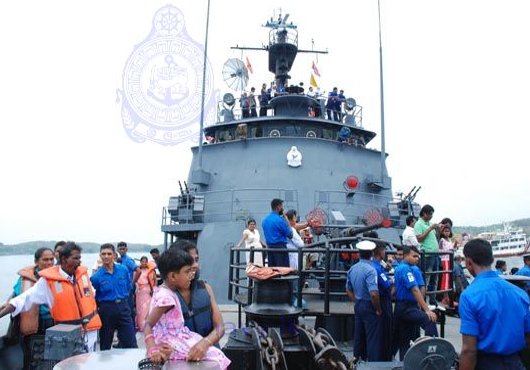
SLNS-Samudura, SriLanka
Photo: Former USCGC Courageous (WMEC-622)
There are other nations that feel relatively little threat and see little need for a navy, but have relatively large EEZs that are a major source of economic prosperity. They need to patrol their waters, they may very rationally build OPVs and they can mitigate any apprehension about their naval position by giving their OPVs more warlike capabilities.
That those warships will be in geographic positions that will allow them to do CG work. “Why the warships’ manning and fuel expenses are sunk costs? Simple; the warship would be out at sea for training anyway. Warship fuel and manning expenses may be (slightly or very much) greater in this case, but they’re sunk costs!” This assumes that policing and SAR does not interfere with the warship’s training and missions.
The US chooses to regularly deploys virtually all of its Navy ships far from the US EEZ as soon as they are fully worked up. If instead they hung around the US, they might be able to perform some CG missions, but it would require a change of national priorities. As it is, there are very few Navy vessels available to conduct counter-drug operations in the Forth Fleet Area (Latin America/Caribbean), and we very seldom see US Navy ships in Alaskan Waters
If we took the resources to maintain the Coast Guard’s offshore fleet and diverted it to additional Navy vessels,
I suspect Sven’s position is largely influenced by the frequent argument that OPVs should be used for counter piracy operations off Samalia. Actually we agree that using warships that are deployed to the area for other reasons, to do counter-piracy is perfectly reasonable.
On the other hand, if a nation wanted to keep its high cost navy units close to home where they can be used for defense, but it also felt an obligation to participate in counter-drug or counter-piracy operations far from any serious threat, OPVs are a relatively cheap way to fulfill the obligation without the diversion of more expensive assets.
I will note that OPVs also tend to become obsolete more slowly than more sophisticated warships. Currently the average age of USCG OPVs is over 40 years, while the average age of USN ships is about 14 years. This was not good policy, but it was possible because of the less sophisticated requirements of the OPV’s missions. In some cases frigates or corvettes are stripped of obsolete weapons and sensors and become OPVs as has been done by Spain, Portugal, and Italy.

Photo: Ship of the Spanish Navy Infanta Cristina, commissioned in 1980 as corvette with pennant F-34; in 2000 she was reclassified as oceanic patrol ship, pennant P-77, by José María Casanova Colorado, importé par Takashi kurita
That a Navy crew, supplemented as necessary by a law enforcement team, can do CG work as effective as a crew whose primary task is CG work. This will depend very much on the support provided by the command team on the ship, but I believe there is more of a tendency for those who view themselves first and foremost as warriors to view the CG missions as a distraction. They are less likely to view their career success as tied to the way they do these peacetime missions. The larger and more powerful the warship, the less likely they are to assign priorities to CG missions. This suggests a separate service, like the USCG, but at least navy officers assigned to smaller ships and OPVs that are dedicated to CG missions must feel greater pressure to succeed in these missions than those assigned to ships where these missions are well down the priority list.

There is another advantage to ships that are clearly intended for peacetime missions. The perception that the US Coast Guard cutters are law enforcement and search and rescue assets rather than military units, make them welcome in many places where Navy ships are not. This has opened doors for the Coast Guard that are closed to Navy ships.

Photo: German Police Coastguard ship Bad Bramstedt (BP24), by Hans Hillewaert
In conclusion. Sven’s prescription may be right for Germany, but for other nations different circumstances including EEZ size and threat perception may make OPVs a good choice. But even Germany has seen the need for at least three small OPVs (pictured above, as Sven pointed out to me).

Earlier I quoted the law that enacted the FY2016 budget. Now I’ll attempt to put it in context by comparing it to earlier budget allocations including the FY2014 budget, the FY2015 budget request, the FY2015 budget enacted, and the FY 2016 budget request. If you want to look back as far as FY2013 enacted and the 2014 request you can look here. There are some area where I do not have information, so I have left them blank. Hopefully I will be able to fill them later as more info becomes available.
…………….(Note all amounts in $000, unless indicated otherwise)
Acquisitions, Construction, and Improvement (AC&I):
Operations and Maintenance (O&M):
ENVIRONMENTAL COMPLIANCE AND RESTORATION:
RESERVE TRAINING:
RESEARCH, DEVELOPMENT, TEST, AND EVALUATION:
Mandatory (non-discretionary) appropriations (primarily retired pay):
Total budget:
Taking a closer look at AC&I particularly:
FY 2016 President’s Budget requests:
FY2016 Actual
Note the AC&I for vessels was increased $90.5M more than the $640M for the ninth NSC. Six Webber class WPCs were in the plan from the beginning so they do not account for the difference. Hopefully it restored the funding needed to keep the Offshore Patrol Cutter on track, and perhaps included a bit more for moving forward on the planned Icebreaker.
Capital Investment Plan, This is another document of interest. You can find the latest one, FY2016-2020 here. Hopefully we will see a revised one soon.

Photo: Hamina class missile boat Hanko (82) by kallerna, 2009
NavyRecognition reports, the Finnish Navy is looking for some small warships with unique characteristics.
Finnish Minister of Defence, Jussi Niinistö, has given the Defence Forces a mandate to start the Finnish Navy project, Squadron 2020. The aim of the Squadron 2020 project is to construct four new corvette-size fighting ships for year-round operation in the special weather and ice conditions at the Baltic Sea (emphasis applied–Chuck).
The Request for Information informs shipyards about the project and inquires know-how and price information from shipbuilders and suppliers to base the Request for Quote on. The RFI was sent out on 18 December 2015 and answers are requested by the end of March next year.
The expected cost for the four is 1.2B Euros or abut $1.31 B. Right now the Offshore Patrol Cutter is probably the closest thing to what they are looking for, but in all probability the final design will be both smaller and much better armed. The Finns have shown an ability to cram a lot of fight into very small packages, but then, they have no need for the long range that is a characteristic of most Coast Guard or US Navy ships.
Their Hamina class patrol craft (wikipedia here) which are smaller than our Webber class (268 tons vs 353 tons fl) are equipped with a 57 mm gun, both a radar and an optronic fire control system, an EADS-TRS-3D multi-mode radar just like the National Security Cutter, an eight cell vertical launch system for anti-aircraft missiles, four anti-ship cruise missiles, ESM, and sonar. They have an aluminum hull, a composite superstructure, and NBC protection. They also have an RHIB ramp in the stern.


