“Substandard” or Whistleblower

Samsung

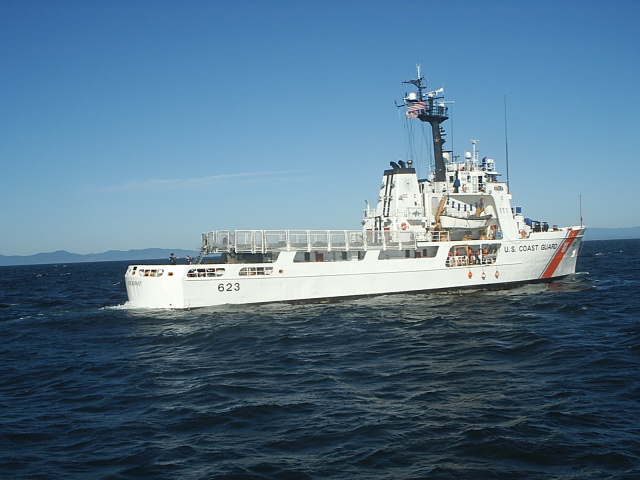
US Coast Guard photo

I don’t normally comment on CO reliefs. You can never know the full story looking in from the outside, and this is certainly the case here, but something is going on in the 13th district.

The Navy Times is reporting, Cdr. John Bitterman, commanding officer of the cutter Steadfast since July, “was fired for loss of confidence on Monday in the midst of an ongoing investigation…”

This seems to be a bit different, in that Cdr. Bitterman is claiming he is being fired not because of his performance, but because he reported the unsatisfactory condition of his ship, “… it was in such a state of disrepair — with moldy mattresses, lead contamination, bad decking —— that he asked his leadership for money to fix things up…His requests were denied…and the mix of the ship’s condition, the high operational tempo and the crew’s already rock-bottom morale led to his temporary relief.”

I have to wonder, is this going to be a trend? Steadfast is a 47 year old ship, and actually one of the newer 210s. Currently planned production of the Offshore Patrol Cutter suggest the last 210 will not be replaced until 2028 at which time it will be at least 59 years old.

Perhaps the Coast Guard will have to acknowledge, at some point, that they will have to retire ships without replacement.
Mini-Aegis Possible for Corvette (or Cutter) Sized Ships

NavyRecognition reports on the presentation of the Raytheon’s AN/SPY6(V) Air and Missile Defense Radar at the recently completed SEA-AIR-SPACE trade show.

This is the radar that has been selected to go on the Flight III version of the Burke class DDG. Most of the emphasis has been on larger installations, but the good news for the Coast Guard is that these systems are modular, based on two foot square elements than each constitute a separate radar, so that it can be scaled down as well as up. These fixed arrays would normally be arranged with four arrays positioned to each cover a 90 degree sector. Raytheon claims arrays consisting of nine elements arranged in a 3×3 square (6 ft x 6 ft) provides performance similar to the 12 foot octagonal AN/SPY-1D on existing Burke class DDGs. It appears the intention is that the Flight III ships will have roughly octagonal arrays consisting of 37 elements, 14 foot across. There is also an option for an even larger array of 69 elements in an octagonal 18 foot diameter array.

These radars are reportedly capable of performing virtually every type of radar function including air and surface search and firecontrol. Reportedly the radar will be “qualified” in 2017 and the initial operational capability will be attained in 2023, presumably with the first flight III DDG.

When might we consider using these?

The Bertholf was commissioned in 2008 so the class will start needing mid-life renovations some time after 2023.

The Offshore Patrol Cutter construction program is expected to be stretched out with funding over 15 years and deliveries will probably extend from FY2021 to FY2035. Over so long a period it would not be unreasonable to expect that there will be a “B class” with updated systems. By that time, these systems may be so common it may be reasonable to replace the planned radar suite with these fixed systems.

At the very least, at some point it might be advisable to convert at least one of each class to accept this or a similar system as a prototype for war emergency conversion. This might be something DOD would pay for.

Russia’s Oblique Icebreaker

baltica_icebreaking

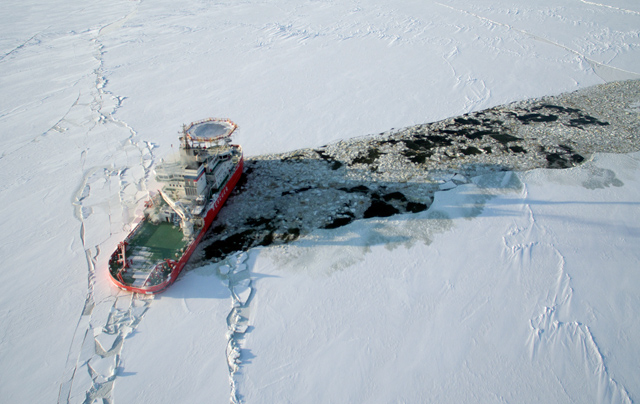
Photo: Acker Arctic, Russian Icebreaker Baltika

gCaptain reports successful completion of trials of Russia new concept icebreaker Baltika. The unique design allows the relatively small icebreaker, similar in size and power to USCGC Mackinaw, to open a channel wider than its own beam. The ship has a beam of 20.5 meters but has demonstrated the ability to open a 50 meter wide channel.

According to Project Manager Mika Hovilainen who was on board the vessel during the ice trials, “Baltika’s voyage to the Gulf of Ob proves the exceptional operational capability of the oblique icebreaker concept in very difficult ice conditions. The vessel could operate in ice conditions that exceeded the design criteria used as the basis of the vessel concept. Baltika could carry out the same operations as conventional icebreakers with just half of the propulsion power as well as perform maneuvers which are not possible for any other vessel currently in service.”

WPB Replacement?

Incat_Veecraft_350

Inevitably the CG will want to replace its Marine Protector class WPBs. MarineLog reports construction of a class that look like something that might be considered. Yes, they are bigger than the existing WPBs, but at 35 meters (115′) vice 47 meters (154′), they are significantly smaller than the Webber class. Even so they can make 29 knots and have provision for an 8 meter RHIB.

Canadian Naval Review

One of our regular contributors, Lee Walher, has brought to my attention a publication I had not been familiar with, the Canadian Naval Review.

It seems to be a publication that addresses many issues that are common among coast guards and medium to small sized navies.

The publication is supported by subscription and sponsors. The full current edition is available only to subscribers, but in fact, it looks like virtually all the content is readily available. In addition, it appears that after a couple of months, full access is available to a pdf edition, via the Achieves and Index page.

This is the table of contents for the current edition.

Editorial: Always the Bridesmaid, Never the Bride, Ann Griffiths

The Case for a More Combat-Capable Arctic Offshore Patrol Ship, Rob Huebert

 NOPEC: A Game Worth Playing?, Andrew Bergel

 Interoperability and the Future of the Royal Canadian Navy, Andrew Touesnard

 A Clash of Naval Strategies in the Asia-Pacific Region, Brian Wentzell

 Most Capable Design or Most Qualified Team?, Janet Thorsteinson

 Making Waves AOPS and the NSPS: Wishful Sinking?, Danford W. Middlemiss

 Collaborative Naval Procurement: Lessons from the ANZAC Frigate Build, Jeffrey Collins

 A View From the West: Reefs of Discontent in the South China Sea, Brett Witthoeft

 Dollars and Sense: Can DND Afford New Submarines?, Dave Perry

 Warship Developments: Flexible Examples from Offshore, Doug Thomas

 Human Capital and the National Shipbuilding Procurement Strategy, Commander Ian Wood

Book Reviews

“Air Force looking at using Ospreys for search and rescue”–Air Force Times

USAF_CV-22_Osprey_flies_over_the_Emerald_Coast_DOD_Photo

USAF CV-22, DOD photo

The Air Force Times is reporting the Air Force is considering using the V-22 Osprey for SAR, at least Combat SAR. They see these platforms as having an advantage where speed is critical. They also recognize that in other circumstances, agility may be more important, so they are not considering wholesale replacement of helicopters with these relatively large aircraft. The planned purchase of 112 HH-60W next-generation Black Hawk helicopters is still expected to go ahead.

It may be worth noting the Marines are already using their MV-22 for combat SAR.

In the not to distant future, we may have aircraft that combine the agility of the H-60 with the speed of the V-22.

OBANGAME EXPRESS 2015: Two steps forward. One step back.–CIMSEC

Very interesting and balanced assessment of an exercise in the Gulf of Guinea from a German observer describing the successes and failures in attempting coordination between nations with long held suspicions and distrust.

Former USCG 378 figures prominently in an accompanying photo.

This is an important, but difficult area to work in. Fractured politically, the exercise included 23 nations. This was a US sponsored exercise, but it had substantial European participation.

Nice to see an honest exercise report, that is more than all sweetness and light.