
Found this on Facebook, thought you might find it interesting. Click on it to enlarge.
- Blue–US
- Green–Allied
- Red–Iranian and Chinese
Thanks to Tom W.

Found this on Facebook, thought you might find it interesting. Click on it to enlarge.
Thanks to Tom W.
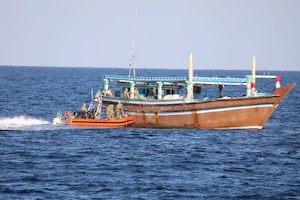
GULF OF OMAN (Dec. 12, 2023) Coast Guardsmen from the U.S. Coast Guard Sentinel-class fast response cutter USCGC Glen Harris (WPC 1144) seize illegal narcotics thrown over the side of the fishing vessel in the Gulf of Oman, Dec. 12. Glen Harris operates in the U.S. 5th Fleet area of operations to help ensure maritime security and stability in the Middle East region. (Photo by U.S. Coast Guard )
Below is a news release from U.S. Naval Forces Central Command Public Affairs. While apparently drugs were seized, there is no indication they seized the smuggling vessel nor arrested its crew. That seems surprising.
Crewmembers from the Sentinel-class fast response cutter USCGC Glen Harris (WPC 1144) observed individuals on a fishing vessel throw seven bales of material over the side. The material was discovered to be 174 kilograms of heroin.
Glen Harris arrived in the Middle East region last year and operates from Naval Support Activity Bahrain.
The fast response cutter is part of a contingent of U.S. Coast Guard ships forward-deployed to the region under Patrol Forces Southwest Asia (PATFORSWA). PATFORSWA deploys Coast Guard personnel and ships alongside U.S. and regional naval forces throughout the Middle East.
Thought I would share this video. Found it on a SeaWaves post, Patrolling Greenland on Denmark’s HDMS Triton. HMDS Triton a Thetis class patrol frigate. These ships do Coast Guard type work in or near the Arctic. It is a type of ship that you will not find in the Coast Guard fleet, but one that we may want to add in the future. It is ice strengthened. As a ship that operates in an area where icing is common. its ground tackle (anchor handling equipment) is below the foc’sle deck, and its boats and boat handling gear can be enclosed. The crew is relatively small (I think they are double crewed to get more underway time), but additional berthing is available, and weapons can be added using the Stanflex system.
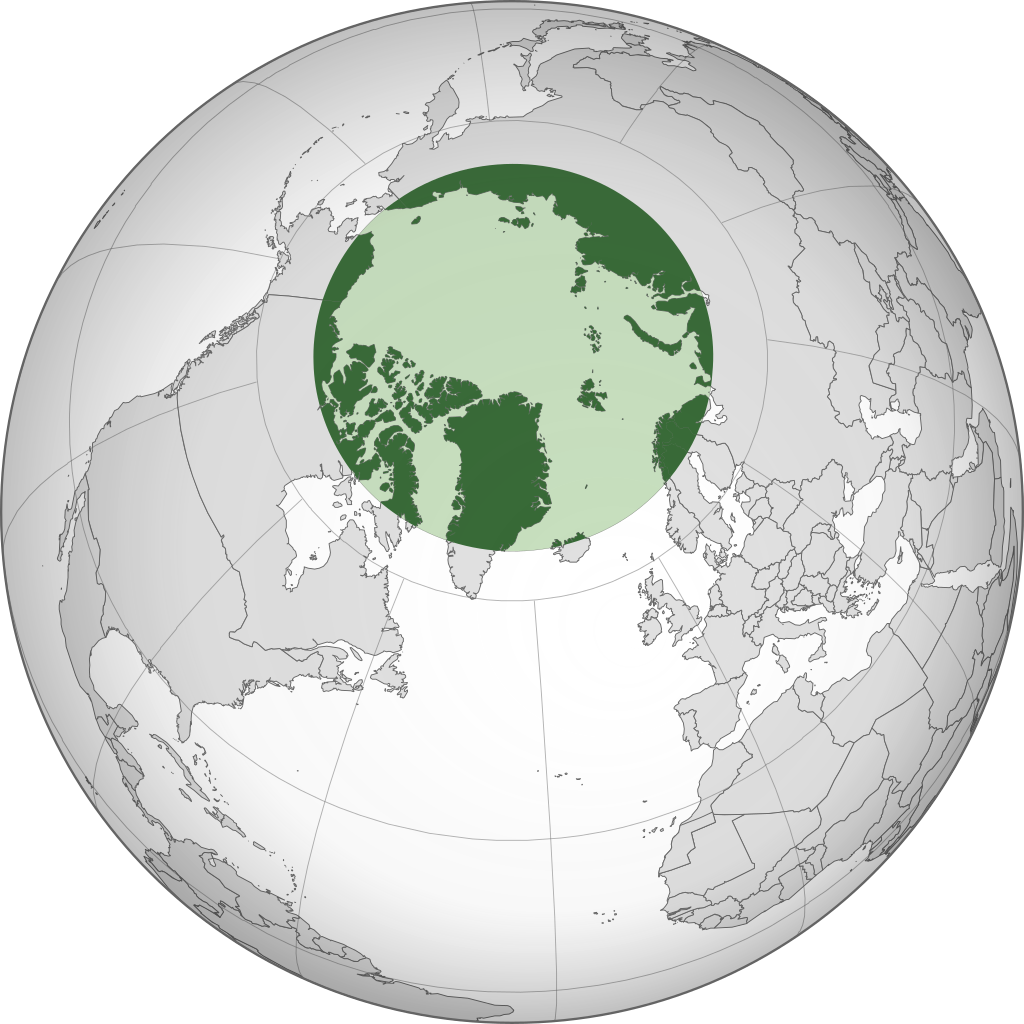
Arctic (orthographic projection) with national borders and land highlighted. Credit Heraldry, Isochrone, via Wikipedia, 23 July 2023.
The Thetis class ships are now over 30 years old. They are to be replaced by a new class, currently referred to as MPV-80 (multi-purpose vessel, 80 meter).

OMT MPV-80 technical specifications
Below is the narrative that accompanied the YouTube video.
The Arctic region is the gateway to the North Atlantic. For NATO and its Allies, maintaining a strong presence here is vital to protect trade, transport and communication links between North America and Europe.
As climate change causes the polar ice caps to melt and the sea levels to rise, new sea routes are beginning to emerge, which could present a threat to Euro-Atlantic security. Greenland is considered by scientists to be ground zero for climate change. Along with the Faroe Islands, it forms part of the Kingdom of Denmark and is therefore under Danish military protection. That protection falls to the Joint Arctic Command, or JACO, a Danish-led operational command with a central headquarters in Nuuk, Greenland’s capital.
Join the Danish Armed Forces in Greenland, at sea, in the air and on land, to discover more about how security might be affected in this region and learn about the capabilities and experience NATO Ally Denmark has in the North Atlantic area.

In an undated photo released by Zodiac Maritime, the tanker Central Park is seen. Attackers seized the tanker linked to Israel off the coast of Aden, Yemen, on Sunday, Nov. 26, 2023, authorities said. While no group immediately claimed responsibility, it comes as at least two other maritime attacks in recent days have been linked to the Israel-Hamas war. (Zodiac Maritime via AP)
“Armed assailants seized and later let go of a tanker linked to Israel off the coast of Yemen on Sunday before being apprehended by the United States Navy, officials said. Two ballistic missiles fired from Houthi-controlled Yemen then landed near a U.S. warship aiding the tanker in the Gulf of Aden, raising the stakes amid a series of ship attacks linked to the Israel-Hamas war.”

GULF OF OMAN (Nov. 14, 2023) Illegal narcotics seized from a stateless vessel are stacked on the deck of the U.S. Coast Guard Sentinel-class fast response cutter USCGC Emlen Tunnell (WPC 1145) in the Gulf of Oman, Nov. 14. Emlen Tunnell was operating under Combined Task Force 150, one of five task forces under Combined Maritime Forces, the largest multinational naval partnership in the world. CTF 150 focuses on maritime security operations in the Gulf of Oman, Arabian Sea and Indian Ocean. (Photo by U.S. Coast Guard courtesy photo)
Below is a NAVCENT news release.
By U.S. Naval Forces Central Command Public Affairs | November 20, 2023
MANAMA, Bahrain —
A U.S. Coast Guard cutter crew seized about $21 million worth of illegal drugs from a stateless vessel while operating in the international waters of the Gulf of Oman, Nov. 14.
Coast Guardsmen from the Sentinel-class fast response cutter USCGC Emlen Tunnell (WPC 1145), working under the command of Combined Maritime Forces’ Combined Task Force (CTF) 150, seized 2,000 kilograms of hashish and 384 kilograms of methamphetamine from the vessel during an interdiction operation.
“This new seizure shows once again the operational effectiveness of Combined Maritime Forces assets and nations,” said French navy Capt. Yannick Bossu, CTF 150 commander. “It illustrates that nations from all around the world are committed to regional maritime security in the Indian Ocean alongside their regional partners.”
This event marks the fifth time in recent months the French-led CTF 150 has interdicted illicit narcotics at sea. In those previous operations, CTF ships seized more than 4,522 kilograms of methamphetamine, heroin, and hashish from stateless vessels during interdiction operations, with a street value of more than $94 million.
CTF 150 is one of five task forces under Combined Maritime Forces, the largest multinational naval partnership in the world. CTF 150 focuses on maritime security operations in the Gulf of Oman, Arabian Sea and Indian Ocean.
Since 2021, Combined Maritime Forces has seized more than $1 billion in illegal drugs while patrolling waters across the Middle East.
The 38-nation naval partnership upholds the international rules-based order by promoting security and stability across 3.2 million square miles of water encompassing some of the world’s most important shipping lanes.

Photo credit: German Federal Police
Singapore’s Ministry of Defence (MINDEF) has signed a contract with German company Fassmer to acquire four new offshore patrol vessels (OPVs)…The ships are based on an OPV design operated by the German Bundespolizei (Federal Police). Furthermore, they are designed with high maneuverability to operate in Singapore’s congested waters.
In a comment, a reader, Katoult, who I see provided the photo above, pointed me to an even better article on the topic at Naval News, thanks.
I have a lot of respect for Singapore’s decision makers. They are very tech savvy and, like the US, cannot depend on cheap labor in large numbers. I am a bit surprised they did not use a version of their Littoral Missions Vessel design for this mission. This is the fourth nation to choose a Fassmer OPV design. It does appear to be a bit more seaworthy and incorporates a hangar that the Littoral Missions Vessel does not include. I think we will see unmanned systems operating from these ships.
At about $30,000 each APKWS is a low-cost way to provide a precision counter to a number of threats.
We have already seen reports of the 70mm APKWS guided rocket being used against relatively small Class 2 unmanned aerial systems.
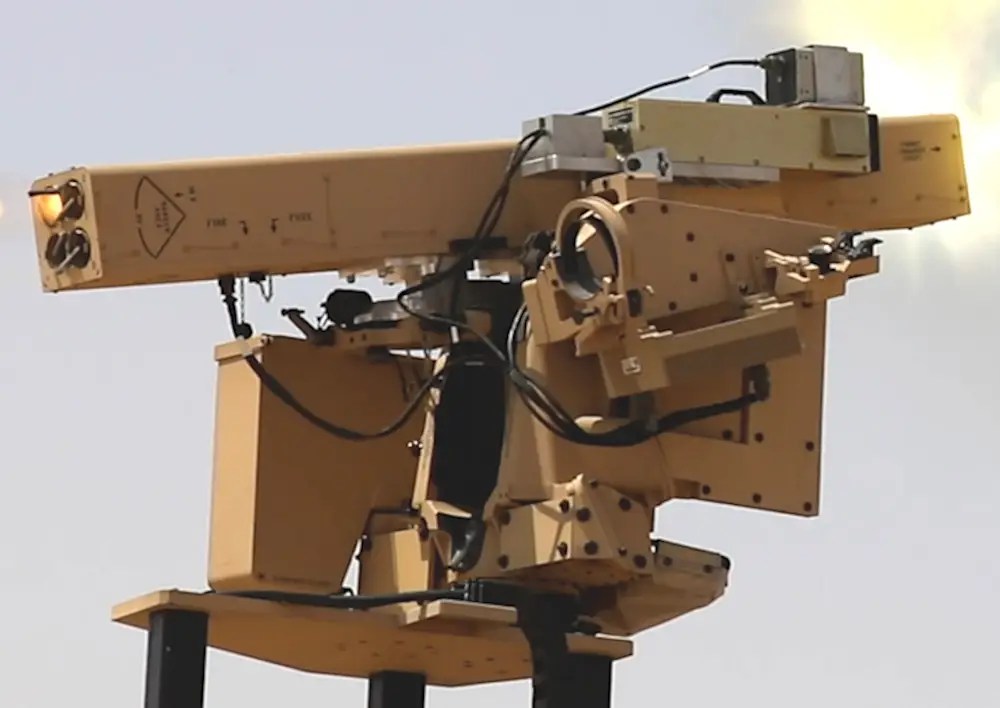
A close-up of the modified CROWS II, a small remote weapons system mount, fitted with the LAND-LGR4 launcher and the added sensor or other system (silver/gray rather than tan). US Army
Here we have a better picture of how the system might be deployed on the PATFORSWA Webber class patrol craft.
The PATFORSWA cutters already have the air search/detection or “hunter” part of a C-UAS system. Reportedly their Mk38 systems have been upgraded to 30mm capable of firing airburst munitions that can provide close in UAS kill capability. Adding a CROWS II RWS with LAND-LGR4 launcher and a laser designator mounted on the O-1 deck, above and behind the Mk38, would allow them to begin engaging UAS and other threats at triple the effective range of the 30mm.

The Tactical Notebook has a short post, “What I Got Wrong About the War in Gaza,” that includes a look at what Israel is doing with their Navy to support the ground war in Gaza. It is a quick lesson in the value of small, shallow draft combatants armed with guns and small, short-range missiles, a type the US Navy does not have, but the Coast Guard has or could have with relatively small changes.
A report of Israeli warships firing upon anti-tank guided missile teams leads me to think that the degree of cooperation between Israeli ships at sea and Israeli columns ashore may be very close indeed. That is, while Israeli warships are probably firing upon places likely to harbor Hamas kornetisti well ahead of the arrival of Merkavot and Namerim, it is also possible that sailors have been shooting in response to particular requests made by their compatriots on land.
Israel Navy strikes terror targets in Gaza, including smuggling boats and terror fortifications on the coast. Includes footage from a missile-mounted camera. 29 Dec. 2008
Below is a US Naval Forces Central Command news release that included the video above.
While the Unmanned Surface Vessel was identified as a MARTAC T38 Devil Ray USV, the weapon was not identified. I think we can be pretty the “Lethal Miniature Aerial Missile System” was the AeroVironment Switchblade 300 launched from their Multipack Launcher (MPL).
The Drive has a more extensive report, “Switchblade Kamikaze Drone-Armed Uncrewed Fast Boat Tested.”
I have suggested this weapon would be almost ideal for the Coast Guard, should they need to stop a terrorist attack using a small, fast, highly maneuverable boat.
As a counter such an attack, this weapon is far better than a 7.62mm or .50 caliber machine gun.
MANAMA, Bahrain –November 02, 2023
U.S. Naval Forces Central Command (NAVCENT) is advancing lethality and the combat capabilities of unmanned surface vehicles (USVs) during live weapons firing exercises in the international waters surrounding the Arabian Peninsula, Oct. 23.
The firing exercises were conducted as part of Exercise Digital Talon and constituted the first use of lethal munitions from USVs in the Middle East region.
During the exercise, NAVCENT’s Task Force 59, the Navy’s first Unmanned and Artificial Intelligence Task Force, demonstrated the ability of unmanned platforms to pair with traditionally crewed ships in “manned-unmanned teaming” to identify and target simulated hostile forces at sea. The hostile forces were represented through the use of a target boat. Then, using live munitions launched from another unmanned platform, NAVCENT forces engaged and destroyed the targets.
During multiple firing events, a MARTAC T38 Devil Ray USV, equipped with a Lethal Miniature Aerial Missile System, successfully scored direct hits each time. A human operator ashore at Task Force 59’s Robotics Operations Center made the engagement decisions.
Digital Talon was coordinated with and supported by Commander, Special Operations Forces Central Command.
This exercise is the second time in as many months the U.S. Navy has successfully demonstrated advanced unmanned capabilities in the region, according to Vice Adm. Brad Cooper, NAVCENT commander. In September, unmanned underwater surface and aerial vehicles were able to track Iranian Navy and Islamic Revolutionary Guard Corps Navy ships and small boats over several days during routine patrols in and around the Strait of Hormuz.
“We are focused on the operational application of new, cutting-edge unmanned systems and artificial intelligence technologies. Last month, we integrated 12 different unmanned platforms with manned ships for ‘manned-unmanned teaming’ operations to conduct enhanced maritime security operations in the waters surrounding the Arabian Peninsula,” he said. “During Digital Talon, we took a significant step forward and advanced our capability to the ‘next level’ beyond just maritime domain awareness, which has been a traditional focus with Task Force 59. We have proven these unmanned platforms can enhance fleet lethality. In doing so, we are strengthening regional maritime security and enhancing deterrence against malign activity.”
Looking ahead, Cooper said, he expects to see the progress expand in scale and impact, including future exercises expanding the arsenal of combat-capable unmanned systems.
“I’m excited about the direction we’re headed,” he said.
U.S. Naval Forces Central Command/U.S. 5th Fleet’s area of operations encompasses about 2.5 million square miles of water area and includes the Arabian Gulf, Red Sea, Gulf of Oman, Gulf of Aden, Arabian Sea and parts of the Indian Ocean. This expanse, comprising 21 nations, includes three critical choke points at the Strait of Hormuz, the Suez Canal and the Strait of Bab al Mandeb.

Click to enlarge. Hamas has revealed a new torpedo-like weapon which it claims has been used against Israel.
Naval News reports on a new naval weapon reportedly used by Hamas against Israel. It is a type of weapon that might be used in a terrorist attack on a port, so perhaps the Coast Guard should be interested. It is not particularly sophisticated, but as we have seen in Ukraine, unsophisticated weapons can work in some circumstances.
I will take a wag (wild ass guess) at its size and weight. Looks about six feet long and about twelve inches in diameter. The way it is being carried, I would say it is probably less than 300 pounds, probably closer to 200. That makes it about half the weight of a light weight ASW torpedo like the Mk46 which weighs 508 pounds and has 96.8 lb (43.9 kg) warhead. This probably means the weapon is buoyant while torpedoes are typically negatively buoyant. The proportion of the weapon’s weight devoted to warhead may be more than the case of the Mk46, so warhead weight might be more than 50 pounds, but almost certainly less than 100 pounds. That is far less powerful than typical WWII torpedoes, but even 50 pounds exploded against the hull would probably mission kill or sink any small vessel. The Mk27 torpedo, a small passive acoustic homing torpedo with a 95 pound warhead, used by US submarines against Japanese escort vessels in the latter part of WWII, scored 33 hits and 24 of those resulted in a sinking.
 Chuck Hill's CG Blog