
In case you missed it, I’ll point to a new post by a serving CG officer, suggesting the US Coast Guard might be the best instrument to counter increasing Chinese aggressiveness at sea.

In case you missed it, I’ll point to a new post by a serving CG officer, suggesting the US Coast Guard might be the best instrument to counter increasing Chinese aggressiveness at sea.
Maritime Executive brings us the video above and more information and background regarding the December 19 confrontation between the South Korean Coast Guard and 44 Chinese fishing vessels.
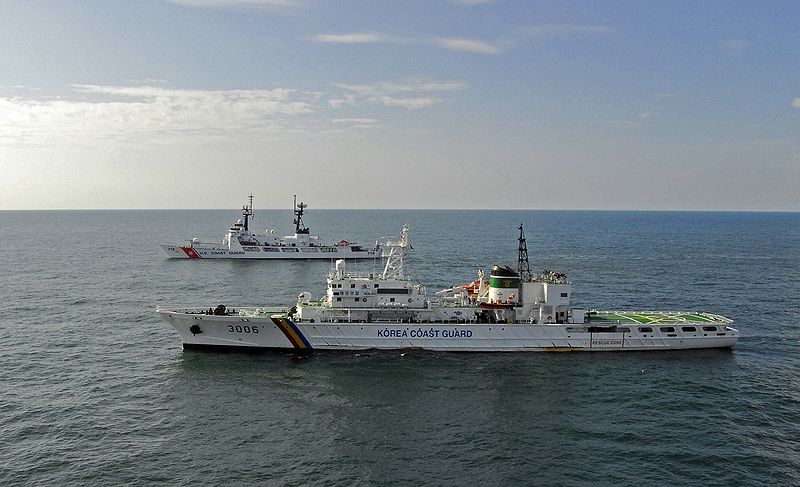
Republic of Korea Coast Guard vessel #3006 in company with U.S. Coast Guard cutter USCGC Boutwell (WHEC-719) during the North Pacific Coast Guard Forum in August 2007. This forum was created to increase international maritime safety and security in the Northern Pacific Ocean and its borders. The Boutwell worked with the Korean coast guard while on their way to Yokosuka, Japan. The Japanese coast guard is one of the six nations involved in the forum.
The Independent reports a South Korean Coast Guard vessel fired 249 warning shots when it was reportedly swarmed by 44 Chinese fishing vessels fortified with iron bars and steel mesh.
Military.com reports a conversation with the Commandant that touched on possible Coast Guard participation if there should be a restart of the Korean War (it has never officially ended). There really isn’t a lot here.
“We are written into the campaign plans for North Korea,” Adm. Paul Zukunft said this week in an interview with Military.com at the Coast Guard’s Washington, D.C. headquarters. “So I’ve got a force identified; if called upon, it must be ready to carry out that mission as well.”
…
“Most plans are written to ask for everything and we’ve got a lot more going on in the world than just the [Democratic People’s Republic of Korea] right now,” he said. “…But we’ve got ships, planes, port security units that are written into these campaign plans.”
Not much detail, but good to know they are thinking about us.
The Commandant reminds us,
“They’re already doing current-day missions,” he said, of the elements identified for action. “I have no force in garrison. We will have to stop doing something else if we have a much bigger away game in support of a military campaign.”
That is of course true of our active duty assets, but we do have reserves which have been called on repeatedly to support the “Global War on Terror.” Beefing up the reserves is something we have not talked about much.
My earlier post concerning how the Coast Guard might be employed if the US attempted to blockade North Korea is here.


The Former USCGC Morgenthau, now in Vvietnamese service
The Philippines has a continuing interest in the 378 foot WHECs, after all they already have three, and it appears they may want another. Certainly they and other operators (Nigeria, Bangladesh, and Vietnam) will want to cooperate in finding ways to keep them operational.
An online discussion group called “Defense of the Republic of the Philippines” has a page entitled “Where in the World are the WHECs?” devoted to the topic. It includes both the old and new names and hull numbers. It also looks at the future disposition of 378s still in US Coast Guard service (Sherman, Midgett, Mellon, and Douglas Munro). (Yes we currently have both a USCGC Douglas Munro (WHEC-724) and a USCGC Munro (WMSL-755).
Sherman is expected to be decommissioned in 2018, Midgett in 2019, Mellon in 2020. Douglas Munro’s decommissioning is not currently scheduled but will probably happen in 2021.
The decommissioning information is based on Annex J of a MARAD report, “OFFICE OF SHIP DISPOSAL PROGRAMS ANNUAL REPORT FOR FISCAL YEAR 2016.”
CIMSEC has a brief discussion of the possibility of deploying a Coast Guard presence in the South Chia Sea.
First let me say, I don’t think using cutters for Freedom of Navigation demonstrations would be an improvement. Our warships have every right to be there. Substituting Coast Guard Cutters to be less offensive to the Chinese might be seen as a sign of weakened resolve, and it would be a whole lot easier for them to make a move against a cutter than a DDG.
The presumption in these discussions seems to be, that if we do put a presence in the South China Sea, it will be a large cutter. There is another alternative. If we want a Coast Guard presence in the area, perhaps we should start small. We could move three 110 foot WPBs to a port in the South China Sea. When enough Webber class become available, we could replace the WPBs with the newer WPCs and donate the 110s to a navy or coast guard in the area. (It would not hurt if some of the members of the WPB crews were of Asian descent.)
They could do the same kind of capacity building our cutters in South West Asia do. They could help with local fisheries enforcement, particularly the increasingly aggressive members of Chinese maritime militia units. If our cutters occasionally provide force protection or operate with a DDG conducting a Freedom of Navigation Exercise, that’s good too.

Photo: Yellow Sea from DeepSeaWaters
I have seen several references lately to the possibility of blockading North Korea. A good explanation of why this is apparently being considered is in a Bloomberg article by Retired Admiral James Stavridis, who previously served as Commander, U.S. Southern Command; Commander, U.S. European Command; and NATO Supreme Allied Commander Europe. Quoting Wikipedia,
James George Stavridis (born February 15, 1955) is a retired United States Navy admiral and the current dean of the Fletcher School of Law and Diplomacy at Tufts University, a graduate school for international affairs. Stravidis serves as the chief international diplomacy and national security analyst for NBC News in New York. He is also chairman of the board of the U.S. Naval Institute and a Senior Fellow at the Johns Hopkins University Applied Physics Laboratory.
So perhaps we should consider this as a serious possibility. If it happens, would the Coast Guard have a role?
Certainly Coast Guard boarding teams would be high demand.
North Korea shares borders with South Korea to the South, a long border with China to the North, and a short Border with Russia to the Northeast. If the US attempts to blockade North Korean waters in the Yellow Sea and the Sea of Japan, it will bring US naval units into close proximity to both China and Russia including major Chinese and Russian Navy bases. We have to consider how they might react.
Both China and Russia might be more comfortable if the blockading units operating closest to them were Coast Guard rather than Navy. This applies equally to both ships and aircraft.
Certainly to protect Coast Guard units they would have to have Navy and Air Force backup.

The Indian Navy has announced the launching of the first two of a new class of five Offshore Patrol Vessels (OPVs). Three more of the class are expected by the end of the year.
Within the Indian Navy, these are unique in that they are being built by a private, rather than a government, shipyard.
Wikipedia reports that these vessels are 110 meters in length (Same as the Offshore Patrol Cutter) with a displacement of 2000 tons (this appears to be light displacement). They are armed with an OTO Melara 76mm super rapid gun mount (SRGM) and two 30mm AK-630M six barrel Gatling guns. It is powered by twin diesels 18,200 kW (24,400 HP) for a maximum speed of 25 knots.
India has both a Coast Guard and a Navy, and both operated Offshore Patrol Vessels. The Coast Guard was established in 1978 and operates under the Ministry of Defense. Indian CG OPVs tend to be more lightly armed than their Navy counterparts.
The Indian Navy currently operates ten Offshore Patrol Vessels.
The Indian Coast Guard currently operates 16 Offshore Patrol Vessels and three larger “Pollution Control Vessels” which also function as OPVs.
The oldest of the Indian Coast Guard OPV was commissioned in 1983. The oldest Indian Navy OPV was commissioned in 1989.

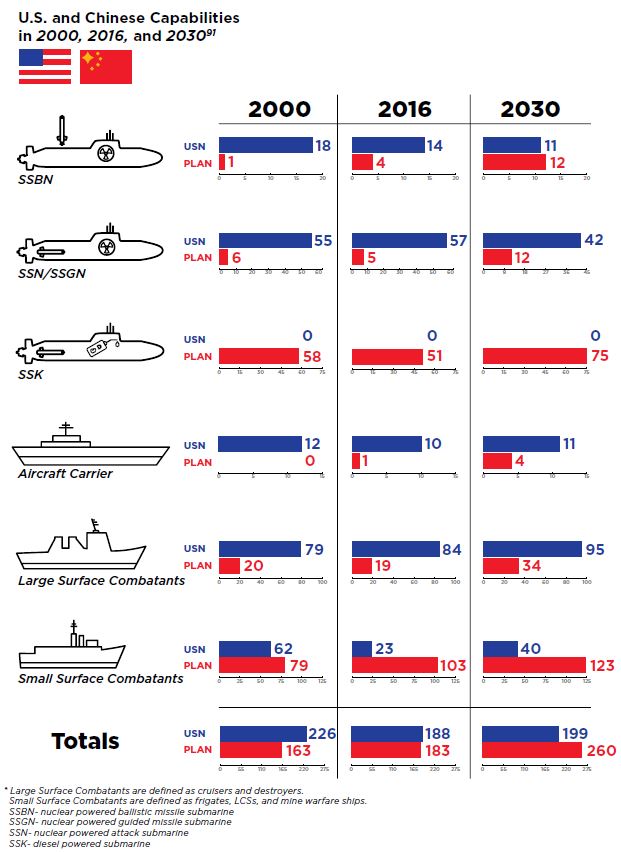
Found this graphic on the US Naval Institute Blog.
Considering that the US Navy is spread all over the globe, with responsibilities in the Atlantic as well the Pacific, while the Chinese Navy will be concentrated in the Western Pacific, far from American Naval bases with the exception of a small number of units in Guam, Japan, and possibly Singapore, the Chinese Navy is likely to enjoy a considerable local advantage, particularly early in any conflict.
In peacetime, it takes three CONUS based ships to maintain one in the Western Pacific. That would improve in wartime, but the Chinese would always have an advantage. Not to mention Chinese land based air and missiles.
Is there anything the Coast Guard can do to mitigate the coming imbalance in the Western Pacific?
It could be worse if US vs both China and Russia.
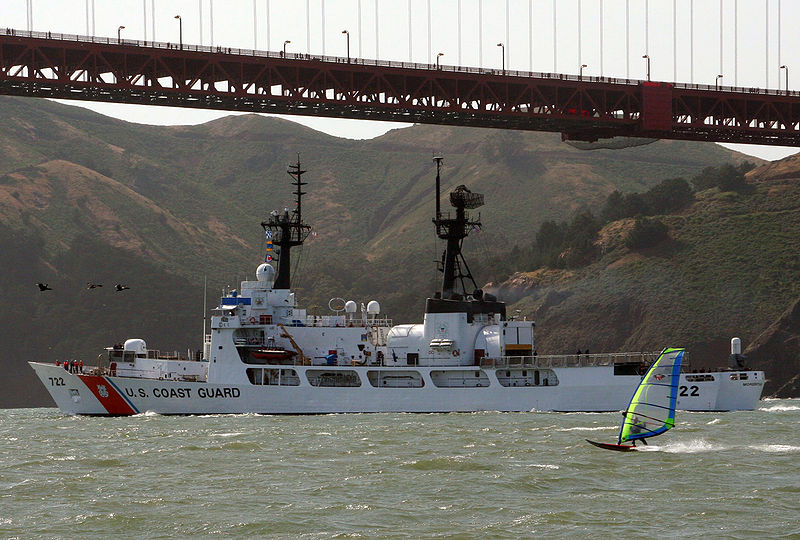
We have a report from Naval Today that Morgenthau, being decommissioned today, will be going to back Vietnam.
Ironically Morgenthau served in Vietnamese warters earlier. This from Wikipedia:
Soon after its commissioning in 1970 the Morgenthau sailed to Vietnam for service in the US Navy’s Operation Market Time. (Operation Market Time was the United State’s successful operation to stop North Vietnamese ships and boats from infiltrating South Vietnam to supply weapons and munitions to North Vietnamese military, including the People’s Army of Vietnam (aka “NVA” – North Vietnamese Army) and Viet Cong.)
Morgenthau was extremely active in the Vietnam War: its duties included boarding/inspection of ships and boats suspected of running guns, ammunition and supplies, naval gunfire support missions, providing medical care to Vietnamese villagers (MEDCAPS – civic action program), ferrying special forces soldiers on missions, and 24/7 patrol duties.[10]
From records compiled by then-Lieutenant Eugene N. Tulich, Commander, US Coast Guard (Ret), Morgenthau‘s Vietnam numbers included: Miles cruised – 38,029 nautical miles (70,430 km; 43,763 mi); Percentage time underway – 72.8%; Junks/sampans detected/inspected/boarded – 2383/627/63; Enemy confirmed killed in action (KIA) 14; Structures destroyed/damaged – 32/37; Bunkers destroyed/damaged – 12/3; Waterborne craft destroyed/damaged – 7/3; Naval Gunfire Support Missions (NGFS) – 19; MEDCAPS (Medical Civic Action Program) – 25; Patients treated – 2676.
For exceptionally valorous action in combat, Morgenthau received a number of awards and commendations, including a Navy Unit Commendation when Morgenthau distinguished itself with outstanding heroism in action against the enemy. Morgenthau’s actions included its multi-day undetected tracking and surveillance of a 160′ North Vietnamese SL-8 trawler that attempted to resupply waiting North Vietnamese Army and Viet Cong, and the April 11, 1971, destruction of that enemy ship when Morgenthau and other forces engaged in a two-hour battle against the ship, at the end of which the North Vietnamese SL-8 trawler suffered a massive explosion and disappeared from radar screens. For this and its other Vietnam service, the ship and Morgenthau‘s crew were additionally awarded the Navy Combat Action Ribbon; Navy Unit Commendation; Navy Meritorious Unit Commendation; Vietnam Service Medal; Vietnam Gallantry Cross Unit Citation; Vietnam Civil Actions Unit Citation; Vietnam Campaign Medal; and other awards.
Morgenthau served in Vietnam until July 19, 1971.
I am curious, will it be repainted Vietnamese Navy gray or remain white and wear the stripes of Vietnam’s recently formed Coast Guard?
 Chuck Hill's CG Blog