
Image Analysis of photo of Chinese shipyard showing multiple warships at various stages of … [+]H I Sutton, with permission from @Loongnaval, (This is not a naval base just one of several shipyards-Chuck)
of the rate at which the Chinese Navy is overtaking the US Navy.
We did discuss this earlier, “Comparison, the Chinese Navy of 2030 and USN.”
The Chinese have begun building large surface combatants (destroyers and/or cruisers) at rate faster than that of the US (The US generally commissions two per year). The number the Chinese are expected to have commissioned in 2019 and 2020, as many as twelve, is staggering. Their first very large aircraft carrier equipped with catapults and arresting gear is expected to be commissioned in 2022, only three years after their first (smaller) domestically built aircraft carrier (The US builds one every five years). They seem to have begun building large amphibious warfare landing ships at about the same rate as the US. In addition they have built types with no counterpart in the US Navy including 60 Type 022 missile armed fast attack craft and Type 056 corvettes, 64 ordered to date, with about 8 built per year. They also have about 60 conventionally powered submarines and about 54 frigates while the US has neither type currently.
If you would like to look into this in more detail. I would suggest the following Congressional Research Service Report.
“Table I, Numbers of Certain Types of Ships Since 2005,” on page 20 is particularly illustrative. You can see the trend with total number of Chinese vessels growing while the number of USN ships has remained relatively stable. It notes that the number of Chinese ships does not include auxiliary and support ships while the USN figure does not include patrol craft (the number given for 2015 actually does include the 13 Cyclone class patrol craft). If we counted the USN ships in the same way the Chinese ships are counted, by subtracting auxiliaries and support ships, and adding in the 13 Cyclone class Patrol Craft, the numbers for 2019 would be China 335, USN approximately 239. It is also worth noting that the Chinese fleet is younger than the US Navy fleet.
The US Navy is still larger in terms of both personnel and tonnage and has an overwhelming advantage in aircraft. The USN still has far more carriers (11 of which 5 are more than 30 years old), nuclear submarines, and destroyers and cruisers. But here, as elsewhere, the trend is against the US. (The number of USN nuclear submarines is actually expected to decline, but should exceed those of the Chinese Navy for the foreseeable future.)
Thus far the Chinese have succeeded in creating a situation where the USN operating inside the “First Island Chain” during hostilities would be exceedingly difficult. They clearly intend to have a local superiority. It the imbalance in ship construction continues they may achieve an absolute superiority.
They have now begun creating a Blue Water Navy with the capability to intervene virtually anywhere, following the USN model. This will give them the option of insuring that all those preditory loans they have been making are repaid or the collateral handed over.
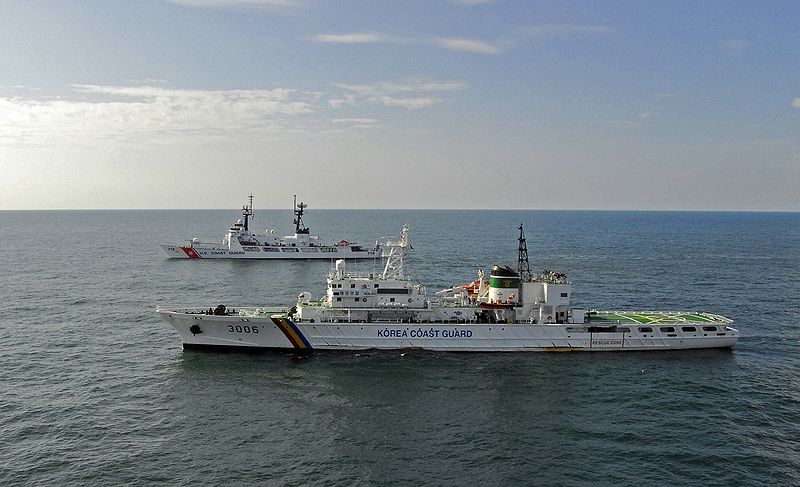
China ultimately plans to bring Taiwan back into the fold, by force if necessary, but ferrying the necessary number of troops would be a herculean task, not unlike the Normandy invasion. The force of 38 large amphibious warfare ships that has, for many years, been the US Marine Corps stated objective, would have lifted only two brigades, not the multiple divisions that would likely be required to take Taiwan. Their large Coast Guard (248 ships according to the CRS report and growing) and maritime militia is as likely to be as instrumental in any invasion as the large amphibs they are currently building.





 Chuck Hill's CG Blog