“Ukraine Sinks Russian Navy Missile Corvette In Drone Boat Attack” –The War Zone

The War Zone reports,

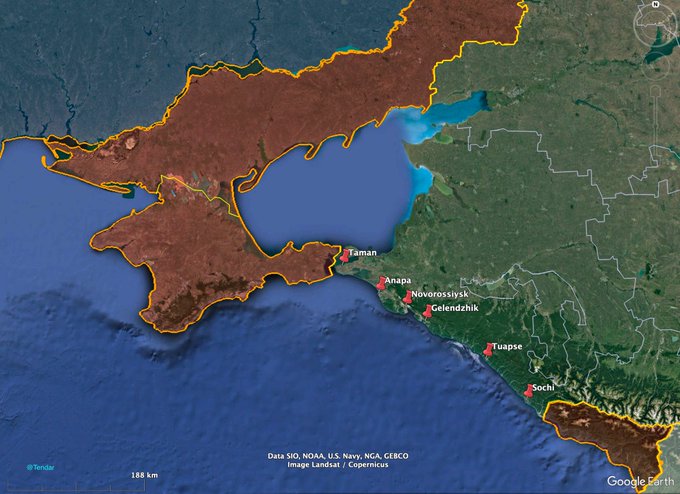
“A dramatic new view released by the Ukrainian Defense Intelligence Directorate (GUR) shows several of its uncrewed surface vessels (USVs) strike and sink the Russian Tarantul-III class missile corvette Ivanovets. The attack took place Wednesday night local time on the Black Sea near Lake Donuzlav in western Crimea, the GUR said on its Telegram channel.

“A 128-second video posted on Twitter shows what appears to be a complex attack on the Ivanovets by what Lt. Gen. Kyrylo Budanov, commander of GUR, told us were Maritime Autonomous Guard Unmanned Robotic Apparatus (MAGURA V5) USVs operated by the GUR’s Group 13 drone unit.”

Tarantul-class corvette

The vessel in the video is a Tarantul class missile corvette. These vessels are powered by four engines totaling 32,000 HP making them very fast (42 knots). The hot gas turbine exhausts on either side of the transom glow brightly early in the video.

They have a pair of 30mm gatling guns on the aft superstructure with a clear field of fire aft.

This ship appears well equipped to defeat an unmanned surface vessel (USV) attack.

The Drive post analyses the attack, but I would point out that I don’t see as many splashes as I would have expected, if the 30mm guns were functioning. I don’t see muzzle flashes. What I did see appeared to be from heavy machine guns (12.7 or 14.5mm) rather than 30mm.

Many USVs were involved in this attack. The Ukrainians claimed six USVs hit the little corvette. Still other USVs filmed the ultimate explosion and sinking.

Perhaps the 30mm guns had run out of ammunition engaging other USVs by the time the drone in the first video recorded attack gets as close as seen in the video.

The report included this statement,

““The Ivanovets MRK sank while repelling a night attack by the Ukrainian Armed Forces on Sevastopol,” the Russian VoenkorKotenok Telegram channel wrote.”

The Russians have historically stationed a “guard ship” off their ports to prevent surprise attack. Ivanovets may have been stationed off Sevastopol specifically as a counter to a drone attack.

Guns for Ukrainian Island Class Patrol Boats.

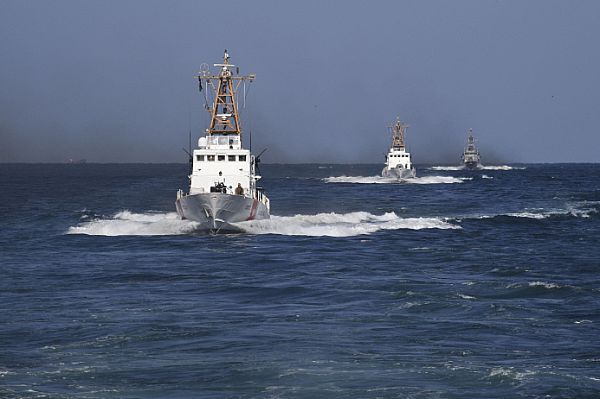
Ukrainian Navy Island-class patrol boats, formerly of the U.S. Coast Guard, conduct maritime security operations in the Black Sea off the coast of Odesa, Ukraine.
UKRAINIAN NAVY

This was on the U.S. Department of Defense Daily Digest Bulletin for Aug. 7, 2023.

Safe Boats International LLC,* Bremerton, Washington, is awarded a $22,271,829 firm-fixed-price modification to previously-awarded contract N00024-21-C-2201 for the exercise of options for procurement and installation of six Gun Weapon Systems onto the Island Class patrol boats with spares. Work will be performed in Tacoma, Washington, and is expected to be completed by October 2024. Foreign Military Financing (Ukraine) funds in the amount of $22,271,829 will be obligated at time of award and will not expire at the end of the current fiscal year. The Naval Sea Systems Command, Washington, D.C., is the contracting activity. (Awarded Aug. 3, 2023)

Five Island class 110 foot patrol boats were transferred to Ukraine.  One of them has been sunk.

Previously vessels of this class were armed with crew served Soviet era 25 mm guns.

This is reported as modification of an existing contract, so I presume at least one vessel has already been rearmed. Thinking two guns per vessel, then six gun systems will go on three additional vessels. So, at least four ships with two guns each. Presumably, they would be 25 or 30 mm guns, hopefully the new 30mm Mk38 Mod4.

The announcement does say, “Work will be performed in Tacoma, Washington, and is expected to be completed by October 2024.” If this is true, these are additional boats. The Coast Guard still has many available for transfer. It is also possible there might be only one gun per vessel. All we know for sure is in the quote above.

In Dec. 2019 there was a suggestion that these vessels might be fitted with anti-ship cruise missiles, but there has been nothing further to indicate it has or will happened.

“Ukraine Situation Report: Photos Show Damage To Russian Tanker After Drone Boat Strike” –The Drive

The Drive has an excellent report on the sea drone attack on Russian Tanker Sig, including photos of the damage.

Looking at the video above, it is apparent that it starts with the unmanned surface vessel alongside ship or structure which might have been a point of reference. It makes a sharp high-speed turn until about time 0:19, when the target came clearly into view at a relatively short distance. This is a 37 second video, assuming 40 knots the UAS could go 4,000 yards in three minutes or only about 822 yards in the 37 seconds. The last 18 seconds when the UAS is pointed at the target would be a distance of about 400 yards.

The post also notes that Ukraine has declared six Russian Black Sea ports subject to “War-Risk.”

“Northern Fleet ship seriously damaged in drone attack” –The Barents Observer

The Barents Observer provides the most complete report I have seen on a recent attack on a Russian Landing ship (LST). It identifies the ship as the Olenegorsky Gornyak, a Ropucha-class landing ship. It was in serious danger of sinking because a vehicle deck stretches the length of the hull.

I think this type of threat may be something the Coast Guard may want to seriously consider since the Coast Guard is the likely agency to defend against it.

A few comments on the conduct of the attack. It was a night attack. It would be interesting to know if the moon was down when the attack was made. It appears there was a lot of light coming from the bridge of the target ship that may have adversely effected night vision. The UAS appears to have used a slow approach, which would have been less likely to attract attention than a high-speed approach, which would have left a phosphorous wake. The target vessel appears to have been unaware of the approach. I see no defensive fire from the target vessel. The target vessel appears to be stopped or moving very slowly because, when the USV steadies up, there is little or no bearing drift.

“Ukraine to receive 3 more Island-class patrol boats from the U.S.” –Naval Post

180201-N-TB177-0211
U.S. 5TH FLEET AREA OF OPERATIONS (Feb. 1, 2018) Island-class patrol boats USCGC Wrangell (WPB 1332), left, USCGC Aquidneck (WPB 1309), middle, and coastal patrol ship USS Firebolt (PC 10) patrol the open seas. Wrangell, Aquidneck and Firebolt are forward deployed to the U.S. 5th Fleet area of operations in support of maritime security operations to reassure allies and partners and preserve the freedom of navigation and the free flow of commerce in the region. (U.S. Navy photo by Mass Communication Specialist 2nd Class Kevin J. Steinberg/Released)

Naval Post reports,

According to Ukraine’s Washington Ambassador’s statements on Friday, the U.S. will hand over three Island-class patrol boats to Ukraine in November.

Thanks to Nicky for bringing this to my attention. 

Bulgaria Selects Lürssen to Provide OPV with ASW and ASuW Capability

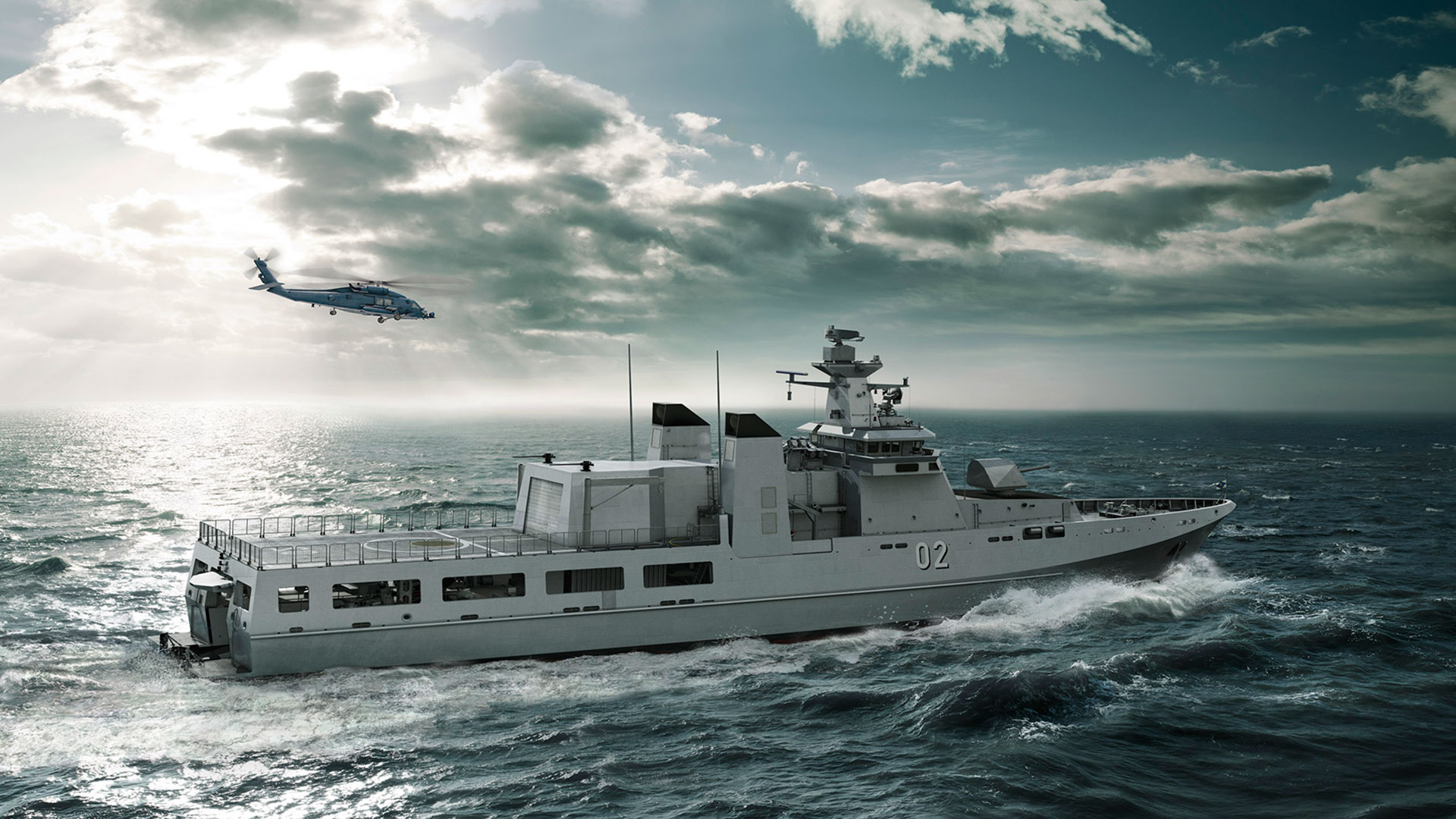
Lürssen 90 meter OPV

NavyRecognition reports that Bulgaria has approved the purchase of two Offshore Patrol Vessels (OPV) from the German firm Lürssen. This is the same company that designed OPVs for Australia and Brunei, but these will be different from the earlier ships.

“…the Bulgarian Navy has a requirement for two modular, multi-role patrol vessels, which would be capable of performing various types of tasks, such as anti-submarine and anti-surface warfare.”

“According to local media, the Bulgarian Ministry of Defense (MoD) has requested a ship that will be armed with one 76mm naval gun, anti-ship and surface-to-air missiles, lightweight torpedos and close-in weapon systems for self-defence. The ship will also have a flight deck to accommodate a medium-sized helicopter.”

Lürssen’s descriptions of their OPV offerings make no mention of an ASW capability, but they do have space for containerized systems that might include some type of towed array sonar. Because of the capabilities required, along with the larger crew required to support them, I would assume that the chosen design is based on the larger 85 or 90 meter offerings. According to the company web site the 90 meter OPV is typically equipped with:

  • 1 X 76/62 COMPACT OR 1 X BOFORS 57 MK3
  • 4 X MM40 EXOCET OR 4 X RBS 15 MK3 OR 4 X NSM
  • 1 VLS MK56 OR RIM-116 RAM
  • 2 X DECOY (E.G. MASS OR SWKS)
  • 2 X 20MM REMOTE CONTROLLED
  • 2 X .50 M2HB MACHINE GUNS
  • 1 X 3D SEARCH RADAR
  • 1 X FIRE CONTROL RADAR
  • 2 X NAV RADAR
  • EO/IR SENSORS
  • 1X HELICOPTER
  • GUIDANCE RADAR
  • ESM / ESM
  • IFF
  • LINK 11/16
  • HELICOPTER HANGAR
  • HELICOPTER LANDING DECK (11T)
  • 2 X 9 M RIB
  • 2 X 5,5 M RIB
  • STERN RAMP
  • 2 CONTAINER SPACES

(Bulgaria does already have Exocet and Sea Sparrow missiles in their inventory.)

Physical Characteristics are:

  • DISPLACEMENT: 2,100 T
  • LENGTH: 90 M (295 ‘)
  • BEAM: 14 M (46′)
  • DRAUGHT: 3.5 M (11.5′)
  • CREW: 86 (+4 EMBARKED)
  • TWO DIESEL ENGINES
  • 6,300 KW  (8448 HP) (That should result in 21-22 knots–Chuck)

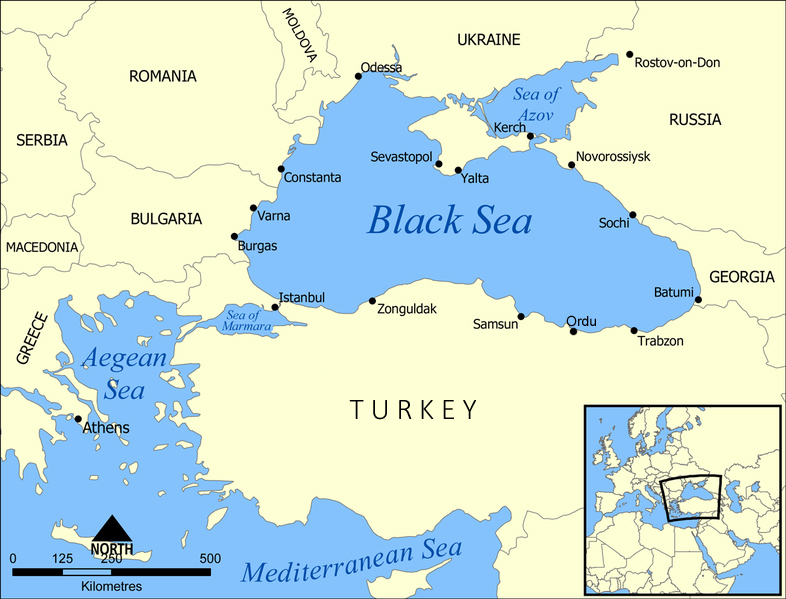
Bulgaria’s Navy is small but growing. They still have a lot of Soviet/Eastern Block equipment. Bulgaria’s coast is on the Black Sea. Other nations bordering the Black sea are Georgia, Romania, Russia, Turkey, and Ukraine. Of these Russia has the strongest naval presence.

No indication yet where the ships will actually be built.

A map showing the location of the Black Sea and some of the large or prominent ports around it. The Sea of Azov and Sea of Marmara are also labelled. Created by User:NormanEinstein, Wikipedia

Russian CG and Ukrainian Navy Go to Blows.

A couple of reports of a nasty incident that culminated in the seizure of three Ukrainian naval vessels. This may be worth watching. It is another assault on Freedom of Navigation.

“Tension escalates after Russia seizes Ukraine naval ships”

“Russia blocks passage in Kerch Strait Near Crimea, Deploys Su-25 Jets And Ka-52 Attack Helicopters.”


Project 22160 patrol ships, Russia’s Cutter X

The Zelenodolsk Shipyard in the Volga area will lay down the third Project 22160 patrol ship Pavel Derzhavin on February 18, shipyard spokesman Andrei Spiridonov told TASS on Monday. "The shipyard will hold a solemn ceremony of laying down the Project 22160 patrol ship Pavel Derzhavin developed by the Severnoye Design Bureau in St. Petersburg [in northwest Russia]," the spokesman said.

Recently, NavyRecognition reported Russia was laying down a third Project 22160 patrol ship. The first of this class should enter service next year. In size they fall between the Offshore Patrol Cutter and the Webber class WPCs, in the range I have called “Cutter X.” The size (1200-1800 tons full load) seems to be favored by many navies and coast guards.These ships are a bit unusual among small Russian ships in having a substantial range.

Reportedly the Russians are building six of these. Specs are as follows:

  • Length: 94 meters (308 ft)
  • Beam: 14 meters (46 ft)
  • Draught: 3.4 meters (11.2 ft)
  • Speed: 30 knots
  • Range: 6,000 nmi
  • Endurance:  60 days
  • Crew: 80

At one point there was a public statement that these had been designed to counter piracy off the Horne of Africa. But it has been more recently reported that they will be quipped with Kalibr (Tomahawkski) land attack missiles, the type recently used by ships in the Caspian Sea to attack targets in Syria. The ship is “modular” and has a reconfigurable space under the rear of the flight deck. The missile will be mounted in containers under the flight deck. Adding anti-submarine or additional anti-ship capabilities would require trading off the Kalibr missiles.

Russian Project 22160

The ship has a new naval gun mount incorporating a 57mm gun. The gun is reportedly capable of 300 rounds per minute and a range of 12 km. Effective range is about 4 km. This is a development of gun with a long history in Soviet and Russian Service in both anti-air and anti-armor roles, and as is frequently the case with Russian weapons, the ammunition is shared in common with the Russian Army.

In addition they will carry short range Anti-Air missiles. It appears they will be vertical launched from canisters between the gun and superstructure.

While these ships do not have a strong self defense capability, the mounting of cruise missiles similar to the Tomahawk on small vessels, particularly on one like this, that has a relatively long range, gives them a sort of miniature maritime strike capability, far less capable, but also far cheaper than a Carrier Strike Group. While the ships are small and the weapons unobtrusive, the potential to accurately strike up to eight separate targets would have required an attack by dozens of aircraft not too many years ago.

Apparently all six ships are to be assigned to the Black Sea Fleet and will be home ported in Novorossiysk.

Interestingly, it appears the Russians may also be building a similar size anti-submarine warfare ship. Again NavyRecognition has the report.