“A Cooperative Strategy for 21st Century Seapower: Forward, Engaged, Ready” Kickoff, 13 March

There is an upcoming event some of you might be interested in. It is the introduction of the new Navy/USCG/USMC strategy, “A Cooperative Strategy for 21st Century Seapower: Forward, Engaged, Ready”, slated for roll-out on March 13. Speakers include the Commandant, the Chief of Naval Operations, and the Commandant of the Marine Corps.

It will likely fill up quickly, so sign up soon if you want to go.

When: 3/13/2015 11:30 AM – 12:30 PM
Where: 1616 Rhode Island Avenue, N.W. Washington, DC 20036
Registration: http://my.csis.org/csis/CSIS1700/CSISEventRegistration.aspx?eventcode=2015_065
Cost: Free

Anyone want to be my on-scene reporter?

FY2016 Budget–First Look

We now have access to the proposed Coast Guard Budget for FY2016 in several levels of detail in the form of pdfs. These range from a one page “fact sheet” to over 500 pages of Congressional justification.

FierceHomelandSecurity, also gives us a quick overview including how it fits in the larger Department budget. The Department’s budget is up 7.3% while the Coast Guard budget is up by only 1.6%.

The good news is that the budget has increased, the bad news is that all the increase can be accounted for by the increase in retired pay. In real terms, it is another cut, though not a big one.

In support of the DHS’s strategic objectives, the FY 2016 Budget provides for the acquisition of six Fast Response Cutters, continues to invest in pre-acquisition activities for an affordable Offshore Patrol Cutter and funds vessel sustainment projects for two 140’ WTGB Icebreaking Tugs and a 225’ Seagoing Buoy Tender.  The budget also continues sustainment and conversion work on legacy fixed and rotary wing aircraft, missionization of the C-27J aircraft received from the Air Force, and investment in Command, Control, Communications, Computers, Intelligence, Surveillance, and Reconnaissance (C4ISR) systems.

It is a bit surprising that the cut in the AC&I account is not larger than it is, considering the Coast Guard is not ready to fund any new large ships in 2016. The NSC program is just finishing up and there is a small amount for that and some money to prep the OPC program, but no new starts for major cutters.

The six Webber class “Fast Response Cutters” puts the program back on track to continue delivering four per year since only two were included in 2015. This program will be with us until far into the future, with the last delivered in 2026 at the current rate.

Major Renovations for the 140 icebreaking tugs have already begun. The Acquisition Directorate, CG-9, is reporting work on the second vessel, Penobscot Bay has begun. Looks like C-27J integration is getting a boost.

I still wonder when we will start doing something about the inland fleet.

Coast Guard Budget and Charlie Hebdo

Defensenews reports,

“When the Hill passed its spending bill in December, it excluded DHS, instead putting the agency under a three-month continuing resolution while the Republican-controlled Congress sought to challenge President Barack Obama’s executive order on immigration.

“Asked about the DHS funds days after the Paris attacks, newly re-elected House Speaker John Boehner, R- Ohio, said “I don’t believe that the funding of the department is in fact at risk.” Meanwhile, Senate Appropriations Committee member Sen. John Hoeven, R-N.D, indicated “more has to be done” to prevent such attacks, which could include an increase of funds.” (Emphasis applied–Chuck)

Should the Coast Guard play the terrorism card in a push for increased funding?
I hate to push fear as a justification for funding but keep a couple of things in mind.

  • If the electorate and their representatives are afraid, maybe they are right, maybe there is a threat.
  • Funding for Coast Guard counter-terrorism capabilities is a lot more relevant to the threat than funding for Navy high end warships, Air Force F-35s, or Army theater ballistic missile defense systems.
  • Improvements that help the Coast Guard deal with terrorism, including better comms, better Maritime Domain Awareness, and better sensors can also help the Coast Guard do a better job on their other missions.

The Department of Homeland Security seems to have a fixation on terrorism that the Coast Guard seems to have viewed with some skepticism. As a result while Departmental funding has continued to increase, Coast Guard funding has actually declined. We have been out of step with Department priorities.

Perhaps it is time to embrace the Department’s priorities.

It does seem the world is becoming a more dangerous place.

The house is pushing a bill that would have DHS strengthen the southern border including more aircraft.

Are they really worried about the right threats? Really, we should be talking about what we should be afraid of, and that should include the introduction of a nuclear device which most likely to come by sea.

The Pentagon wants $350B to modernize Nuclear deterrents, new SSBNs, new ICBMs, and new nuclear bombers, none of which will have any deterrent effect on terrorists. And after all will $350B for deterrence be any more effective than $320B?

Perhaps it would make sense to spend $1B more a year on the Service that is most likely to be on the line if terrorists attempt to bring a weapon of mass destruction into the US, when most of that money is expected to be spent over the long term anyway.

If the Coast Guard is going to embrace counter terrorism as a priority, the service needs to act like it believes a terrorist attack is a possibility and ask to be armed appropriately to deal with terrorist threats, a 7.62 mm machine gun on a 25 foot boat will not cut it.

It the Coast Guard is to have a creditable capability, it will need small highly accurate missiles like Griffin, Hellfire, or Brimstone to deal with relatively small, fast, highly maneuverable threats and light weight torpedoes to deal with larger, hard to stop threats. We also need to get modern reliable patrol vessels or aircraft armed with these weapons spread out geographically to cover all our ports.

CG-83527

No caption.  No date listed; probably June 1944.  No photo number.  Photographer unknown.

No caption.
No date listed; probably June 1944.
No photo number.
Photographer unknown.

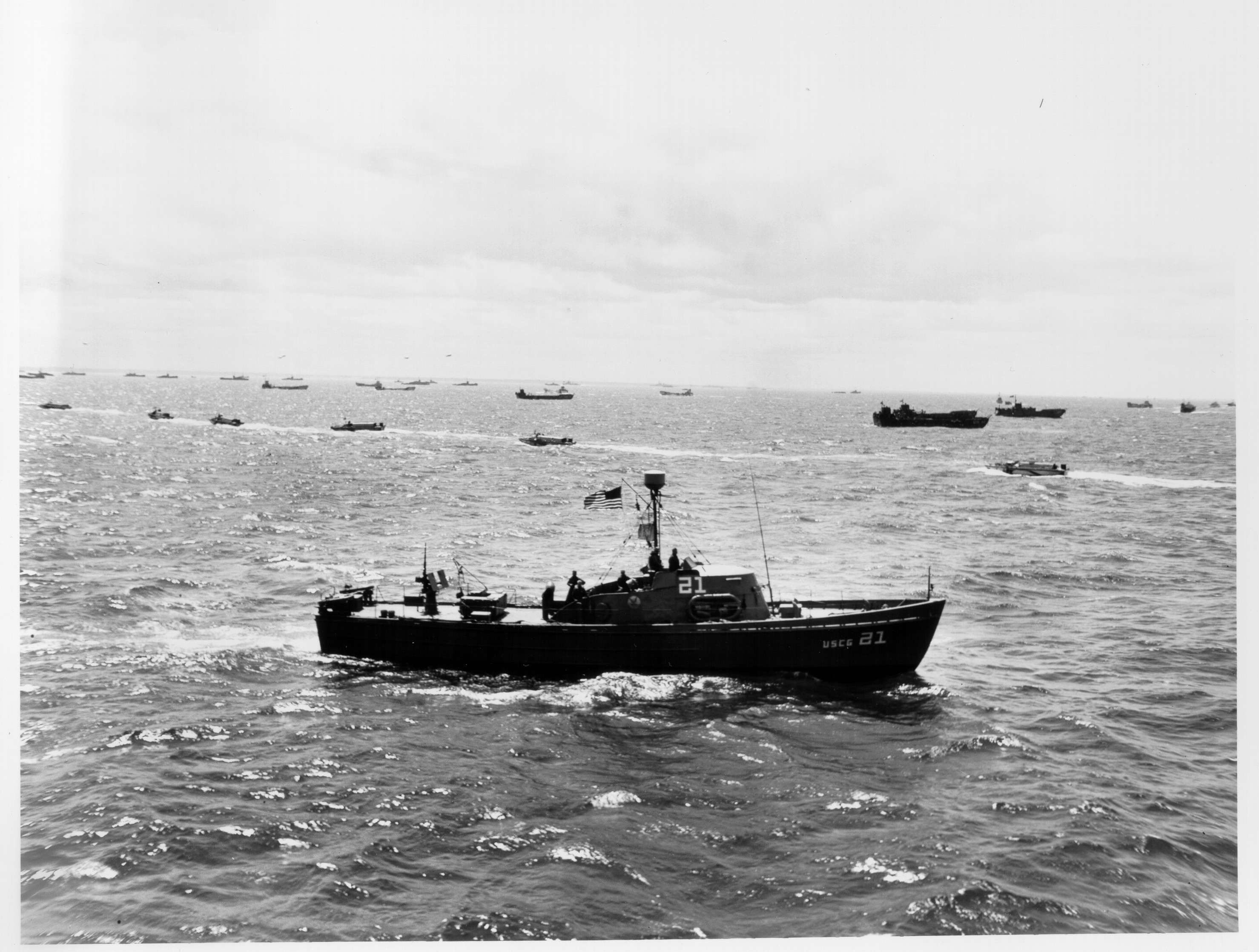
One of the proudest achievements in Coast Guard history was the performance of the sixty 83 foot gasoline powered, wooden hull patrol boats of Rescue Flotilla One, that saved 1,438 American and Allied lives during the Normandy landings in June 1944. An average of approximately 24 rescued for each boat.

"Crew of CG-16 pointing to the tally board of 126 rescued soldiers."  Photo courtesy of Terry Hannigan. (NOT AN OFFICIAL USCG PHOTOGRAPH)

“Crew of CG-16 pointing to the tally board of 126 rescued soldiers.”
Photo courtesy of Terry Hannigan.
(NOT AN OFFICIAL USCG PHOTOGRAPH)

There is at least one vessel of this class, CG83527, still in near original condition.

She’s in Everett, WA. Unfortunately the boat is not currently open to the public. The caretaker organization is having a hard time keeping the boat up. They need some help. Dan Withers, Cell: 206-947-2303, danwithers@q.com, is heading the organization.

At some point, I hope we will have this vessel, or another of its class, at the new Coast Guard museum being built at New London.

The 83-foot Coast Guard cutter USCG 1 off Omaha Beach on the morning of D-Day, tied up to an LCT and the Samuel Chase

The 83-foot Coast Guard cutter USCG 1 off Omaha Beach on the morning of D-Day, tied up to an LCT and the Samuel Chase

Commandant Remarks and Q&A–USNI/CSIS on CSPAN

Earlier we talked briefly about the Commandant’s address to the USNI and CSIS Maritime Security Dialog. This is the entire address.

It is about 53 minutes, of which the first half is prepared remarks and the second half Q&A.

I think you will find it worth the time.

Thanks again to James WF for pointing me to this.

Commandant Addresses Surface Navy Association Symposium

Thursday the Commandant addressed the annual Surface Navy Association symposium in Arlington, Virginia. Navy Times has a short description of his address. It is certainly worth the read. Reading it, I get the impression, perhaps this Commandant is thinking outside the box, and recognizes that business as usual is not cutting it.

The summary includes comments on Drug Enforcement, Migrant Interdiction, and Polar Operations.

Thanks to James WF for bringing this to my attention.

The 2015 Budget is Coming, Really it is, Maybe, Sometime

While the rest of the Federal Government has a 2015 budget, Homeland Security still does not. The DefenseDaily reported the bill out of committee in the House, describing the provisions, including this regarding the Coast Guard:

“The bill would give the Coast Guard $439.5 million above the president’s request, primarily by rejecting proposed cuts “that would have gutted vital Coast Guard operations,” according to the news release. The House committee increased Coast Guard funding to allow more cutter and aviation operating hours, training and maintenance; and to purchase the eighth National Security Cutter, two Fast Response Cutter patrol boats, an additional C-130J aircraft and one H-60 remanufactured helicopter.”

At this point the bill has been approved by the House and sent on to the Senate. DefenseNews talks about why Homeland Security is tied up in Immigration Policy.

It is good to see some additional operational funds, but I am frankly disappointed that there are only two Webber class WPCs included. This was the administration request, but I had hoped to see more added as has been done in the past. It could still happen, so we will have to wait and see.

This does raise the question of what CG-9, the Acquisitions Directorate, is doing about the contract for follow-on WPCs? All options on Bollinger’s original winning bid have expired. The Coast Guard paid for and now owns the design. A new bidding process was expected for the remaining ships, but last year’s buy was apparently negotiated without competition. As the number of ships remaining to be built gets smaller the ability and incentive for other yards to compete against Bollinger’s already established assembly line will decrease.

We also seem to have missed the opportunity for making a Multi-Year Procurement (See also).

Budget According to American Society of Naval Engineers

An interesting Power Point (pdf)https://www.navalengineers.org/…/Documen…/Carnevale_2014.pdf about how the Federal Budget and Geopolitics influence Naval Shipbuilding from the American Society of Naval Engineers. Of course most of it is about Navy shipbuilding, but they do touch on Coast Guard programs and there are a couple of items worthy of note.

First on page 8, “Total Federal Spending, Who’s Spending the Money” one entry notes that over the three years between 2010 and 2013 the Dept. of Homeland Security spending has gone up 36%. While I seem to recall, Coast Guard spending has actually declined.

On page 33 is “FY15 USCG Vessels Appropriations Status.” It show the differences between the Administration request, and the House and Senate mark-ups. Most significantly, while the Administration asked for only two Webber class WPCs ($110M), the House included four ($205M), and the Senate six ($318M). In-service Vessel Sustainment was also bumped up. The Administration requested $24.5M, the House included $34.5M and the Senate $49M. There was another bump, Senate added $8M for Polar Icebreaker Preservation, which I presume was for the Polar Sea. The House cut the OPC program $10M and zeroed the Icebreaker program (-$6M).

The last thing of interest to me on this page was that while the Administration asked for $803M for Coast Guard vessels, the House requested a bit over $83M more ($884.347M), and the Senate $240.5M more ($1,043.5M). The FY2014 continuing resolution was $999M

Lobbying Congress and the Administration

Would like to call attention to something retired Navy and Marine Corp flag officers are doing to lobby for better funding for the Navy. It is a letter signed by 95 retired flag officers. Perhaps it would not be unreasonable to expect the Coast Guard’s retired flag officers to do something similar.

While the Navy may be in trouble, the Coast Guard is in a far worse situation. While some of these officers may have be to an extent muzzled by the Department, there is nothing to stop their speaking out now, and if anything the situation has gotten progressively worse since they left the service.

Frankly I find it hard to understand why there is not more outcry about the Coast Guard’s budget. All I seem to see is happy talk about the wonderful new assets, while the Fleet continues to age. We really need a sense of urgency.