Are We Going to do the Same Thing to the Crew of Healy that was done to the Crew of Polar Star?

The spouse of a Coast Guard Cutter Healy (WAGB 20) crewmember waves goodbye as the cutter departs Base Seattle for a multi-month deployment to the Arctic, June 12, 2024. (U.S. Coast Guard photo by Petty Officer 3rd Class Annika Hirschler)

Having recently reread the Acquisition Directorate’s In-Service Vessel Sustainment web page, I found this.

Service life extension program for Coast Guard Cutter Healy will occur in a five-year phased production between 2026 and 2030. Healy is a 420-foot cutter, the service’s only active medium polar icebreaker, which was commissioned in 1999. When completed, the SLEP effort will recapitalize a number of major systems and extend the service life of the cutter until the polar security cutters are operational.

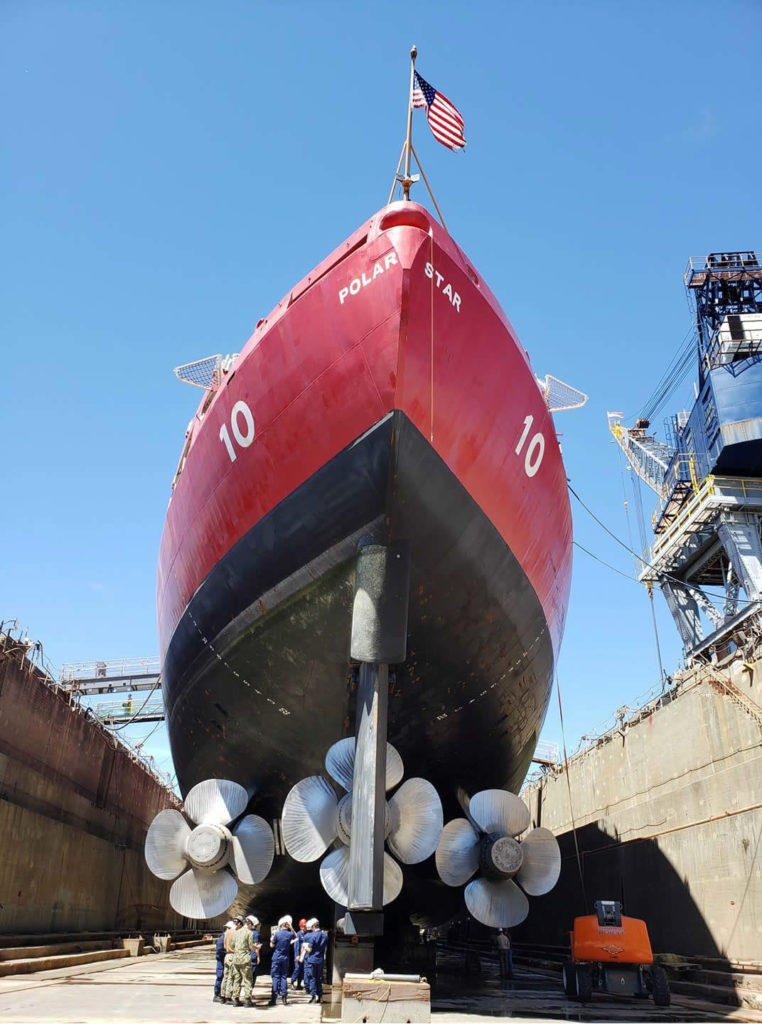
This sounds an awful lot like what was done to Polar Star over a five year period. Healy, like Polar Star, is based in Seattle, but Polar Star’s five year rolling Service Life Extension Program was not done in Seattle, it was done in Vallejo, CA. Vallejo is 776 miles from Seattle. These five phased Yard periods were extremely long, so the ship spent about half its down time far from home. I know they tried to mitigate the effect on the crew, but it had to be bad for crewmembers whose families were in Seattle.

I can’t help but think it would have been a good idea to change Polar Star’s homeport to Vallejo or Alameda (water depth at the Support Center permitting). Vallejo is a lower priced area than Seattle and there is property there from the old Navy shipyard that the city is still trying to develop. Pretty sure the city would be happy to have Healy homeported there.

If Vallejo was not possible, it is 31 miles from Vallejo to Alameda. That is not a particularly long commute in the Bay area, for the relatively short time the ship would be in Alameda, and there are relatively affordable places to live in between.

Is it going to be different for Healy?

I also notice this, that the SLEP is intended to “extend the service life of the cutter until the polar security cutters are operational.” Since Healy is nominally a medium icebreaker, I would have thought the Coast Guard would keep her in service until replaced by an Artic Security Cutter (medium icebreaker). Healy was commissioned in 1999, so I would have thought she would remain in service 40 years, until 2039. A SLEP ending in 2030/31 also suggests another ten years of life. Are we going to have to wait until 2039 for the Polar Security Cutters to be completed?

“Coast Guard Cutter Alert returns home to Astoria for the last time” / Change of Homeport –News Release

02.02.2024, Crewmembers of the Coast Guard Cutter Alert (WMEC 630) stand behind cocaine bales seized from a drug smuggling vessel in Eastern Pacific waters during the cutter’s last patrol out of its current homeport of Astoria, Oregon, Feb. 7, 2024. The 4,950 kg of cocaine seized is estimated to be valued at more than $143 million. (U.S. Coast Guard photo)

Note, I made an error in my original commentary. USCGC Active is still in commission and homeported in Port Angeles, Washington. I have made corrections to the text. 

Below is a U.S. Coast Guard Pacific Area news release. The news release is significant because it demonstrates that 210s are still doing useful work, despite being almost 55 years old in this particular case.

But the news release also notes that, “… the cutter will shift homeport in June to be stationed in Cape Canaveral, Florida.” After the transfer, Pacific Area will have only three WMECs, USCGC Alex Haley in Kodiak, the newly arrived 270 USCGC Harriet Lane in Hawaii, and USCGC Active in Port Angeles, WA.

When I retired in 1991 PACAREA had ten WHECs and I believe seven WMECs. With Alert’s departure, they will be down to 9 large patrol cutters, 6 NSCs and three MECs.

The first four Offshore Patrol Cutters are expected to be assigned to the Pacific Area, but they have been substantially delayed.

The next two Fast Response Cutters USCGC David Duren (WPC-1156) and USCGC Florence Finch (WPC-1157) will be homeported in Alert’s old homeport of Astoria. I would expect that the first will arrive in Astoria about the same time Alert departs.


Feb. 26, 2024

Coast Guard Cutter Alert returns home to Astoria for the last time

ASTORIA, Ore. – The U.S. Coast Guard Cutter Alert (WMEC 630) and its crew returned to their homeport, Monday, after a 59-day counter-narcotics patrol in the Eastern Pacific Ocean.

This patrol is scheduled to be the cutter’s last patrol out of its current homeport of Astoria, Oregon.

During the patrol, the Alert’s embarked helicopter crew from, the Helicopter Interdiction Tactical Squadron (HITRON), based out of Jacksonville, Florida, sighted a suspected “go-fast” vessel driving on a northerly course and alerted the cutters crew. The crew responded and launched both of its small-boat pursuit teams. Due to the vessel’s refusal to stop when ordered, the HITRON helicopter disabled the engines of the “go-fast” and monitored until the pursuit crew gained control of the vessel. Simultaneously, the second small boat team recovered dozens of bales of cocaine jettisoned into the ocean by the suspected smugglers. The crew then worked tirelessly through the night to haul in and account for all 4,950 kg of cocaine, valued at more than $143 million.

The interdiction is among the Coast Guard’s largest single interdictions in the Eastern Pacific and represents a major blow to the criminal organizations attempting to smuggle illicit narcotics through the maritime domain. Additionally, it serves as the capstone in Alert’s time in Coast Guard Pacific Area, as the cutter will shift homeport in June to be stationed in Cape Canaveral, Florida as part of the larger Coast Guard Force Alignment Initiative.

“The crew worked in the margins, and we won big in the margins,” said Cmdr. Lee Crusius, commanding officer Coast Guard Cutter Alert. “The return on investment from the Coast Guard to the American people continues to be demonstrated by our ability to project capabilities and rule of law within the maritime domain. Day in and day out, the women and men of our service are doing important business, protecting vital international interests from those who wish to subvert order.”

The smuggling of cocaine represents a large threat to not only the health of nations and rule of law, but destruction of fragile ecosystems in its manufacturing and movement.

The cutter Alert was commissioned in 1969 and is the newest of three 210-foot Reliance-class Medium Endurance cutters stationed on the West Coast. It performs a variety of missions to protect Americans and American interests in the Northern and Eastern Pacific Ocean.

For information on how to join the U.S. Coast Guard, visit GoCoastGuard.com to learn about active duty and reserve, officer, and enlisted opportunities. Information on how to apply to the U.S. Coast Guard Academy can be found at USCGA.edu.

“Fast Response Cutter Laydown, Report to Congress, November 15, 2023” –USCG

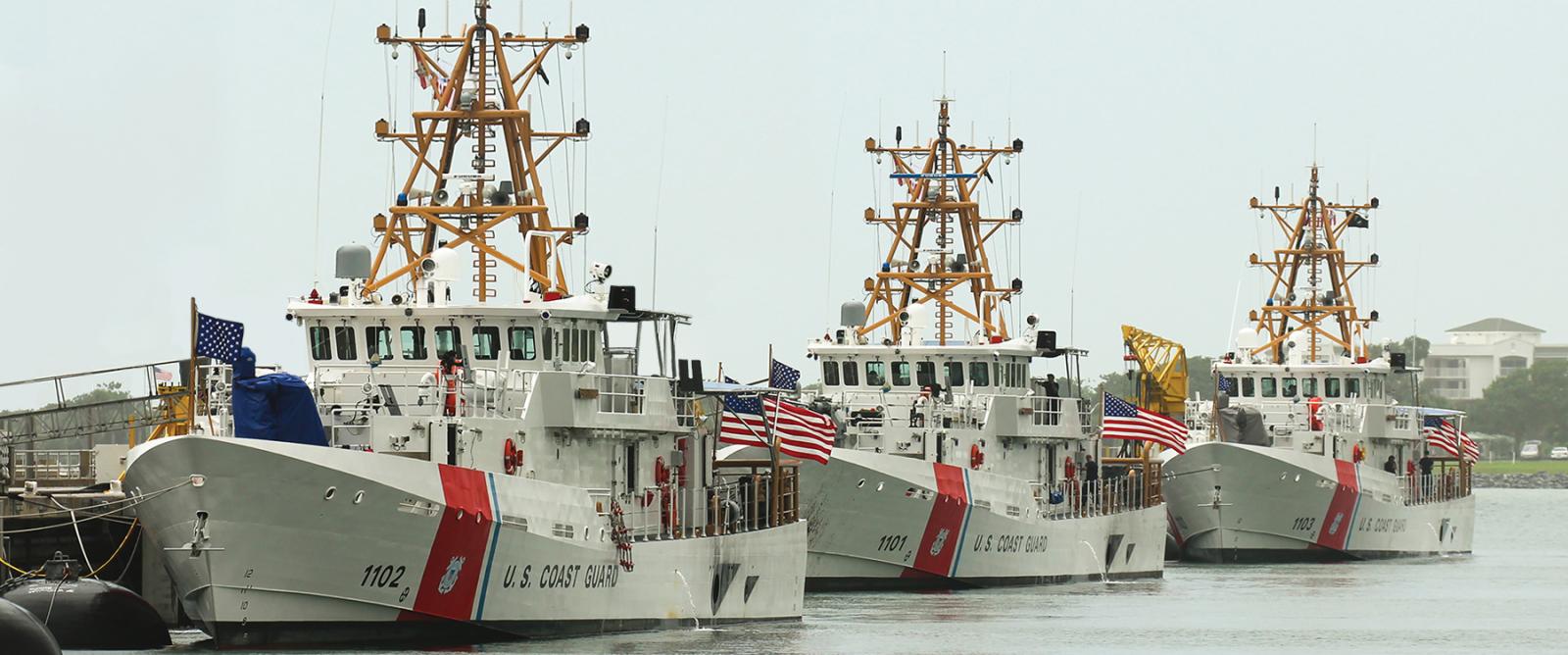
The first three fast response cutters—the USCGC Richard Etheridge (WPC-1102), Bernard C. Webber (WPC-1101), and William Flores (WPC-1103).
U.S. COAST GUARD

Just wanted to alert anyone interested to the existence of this document.

Don’t think there are any real surprises here, but homeports are a bit more complete than the Wikipedia information.

It does further clarify the fate of USCGC Benjamin Dailey (WPC-1123) that suffered a fire while in dry dock. The ship was found beyond economical repair, decommissioned, and is stored awaiting ultimate disposition. That means that the current plan is for 64 operational FRCs with a request outstanding for four more. It may mean at least one of the future FRCs will be based in Pascagoula, as a replacement.

“Coast Guard Cutter Calhoun arrives to new homeport in Charleston” –News Release CG News

USCGC Calhoun 759 arrives Charleston.

Below is a news release from Coast Guard News. Once again, a new cutter is put to work even before commissioning.

Dec. 3, 2023

Coast Guard Cutter Calhoun arrives to new homeport in Charleston

NORTH CHARLESTON, S.C. — The crew of the U.S. Coast Guard Cutter Calhoun (WMSL 759) arrived at their homeport in North Charleston, Sunday, after delivery from Ingalls Shipbuilding and supporting missions throughout the Coast Guard’s Seventh and Eighth districts.

The Coast Guard accepted the delivery of the 10th national security cutter (NSC) on Oct. 13, 2023, after the initial christening ceremony in Pascagoula, Mississippi, June 4, 2022.

Calhoun is the fourth Legend-class NSC to be homeported in North Charleston, joining Coast Guard Cutters Hamilton (WMSL 753), James (WMSL 754), and Stone (WMSL 758).

Calhoun’s crew began deploying to Pascagoula in March 2023. Following an intense 37-day post-delivery period, Calhoun supported the Coast Guard’s Eighth District in response to an oil discharge approximately 20 miles northeast of the mouth of the Mississippi River in the Gulf of Mexico. Calhoun remained on scene for 48 hours, providing key offshore command and control capability to the multi-agency response.

“Our crew members have more than earned their time back home,” said Capt. Timothy Sommella, commanding officer of Calhoun. “Most of our crew has surged the past 18 months in support of other Coast Guard units to meet global commitments. The most recent deployment of over 120 days to the Gulf Coast for the cutter’s delivery and acceptance was particularly challenging but tremendously satisfying. We finally sailed away as a crew for the first time with the same commitment to excellence and determination that the ship’s namesake, the first Master Chief Petty Officer of the Coast Guard, Charles L. Calhoun, displayed during his distinguished Coast Guard career. We are incredibly thankful this time of year for the personal and professional support from our friends and loved ones who stood with us, and we will continue to forge those bonds, whether at sea or ashore.”

During the remainder of Calhoun’s first patrol, Calhoun provided a forward presence in support of Homeland Security Task Force-Southeast and Operation Vigilant Sentry within the Coast Guard Seventh District’s area of responsibility to deter irregular migration and save lives in the South Florida Straits while testing its vital equipment, systems, and completing required training.

“It is a privilege to be a part of such an amazing team of professionals,” said Senior Chief Petty Officer Aaron Deluca, Calhoun’s command senior enlisted leader. “Having completed the challenges of acceptance, training, and sailing one of the most technologically advanced assets in the Coast Guard, I am excited to bring cutter Calhoun to its homeport and the community of Charleston.”

Calhoun is named to honor the first Master Chief Petty Officer of the Coast Guard, Charles L. Calhoun, who was from Ocean City, Maryland. During Calhoun’s tenure, he was responsible for improving and developing many of the Coast Guard’s administrative and people-focused programs, resulting in better communications and retention efforts within the enlisted community.

Calhoun is the newest 418-foot, Legend-class cutter to join the Coast Guard fleet. The Legend-class cutter program leads the Coast Guard’s ongoing surface fleet recapitalization and, when combined with the future offshore patrol cutters, will comprise the Coast Guard’s offshore response capability for decades to come. The cutter’s primary missions are counterdrug operations, migrant interdiction, living marine resources, defense readiness, and command and control in support of U.S. Coast Guard operations worldwide and here at home.

For information on how to join the U.S. Coast Guard, visit GoCoastGuard.com to learn about active duty, reserve, officer, and enlisted opportunities. Information on how to apply to the U.S. Coast Guard Academy can be found here.

WMEC 210 Makes Three Drug Busts, Seizing 11,550 Pounds of Cocaine–Additional Observations on Eastern Pacific Drug Interdiction

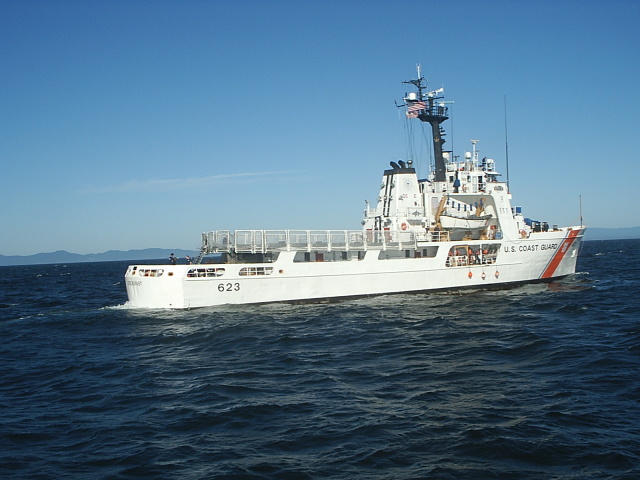
USCGC Steadfast (WMEC-623)

Below is a Coast Guard News Release. It is in fact a pretty typical news release. There are lots of these, and I usually don’t bother to publish them, but this one has prompted me to make some observations.

USCGC Steadfast had a very successful patrol. In fact, she did as well as any National Security cutter might have done despite the fact, she is less than a quarter the size of an NSC. Despite her age, size, and relatively slow speed, she has the critical assets necessary for success–good boats, an airborne use of force helicopter, and a crew that knew how to use them. Conclusion: It is a numbers game. Not every cutter needs to be 4500 tons, because we need numbers and smaller cutters can do the job. (I do like the fact that the newer cutters are faster.)

Looking back on six months’ worth of Coast Guard News reports (60 pages) it looks like a disproportionate part of the Eastern Pacific drug interdiction patrols are being done by PACAREA cutters. It is counter intuitive, but LANTAREA ships are actually much closer to the patrol areas and LANTAREA has many more large patrol cutters (NSCs and MECs: LANT 25 / PAC 9).

PACIFIC AREA CUTTERS: 

ATLANTIC AREA CUTTERS:

LANT Cutters do all the drug interdiction in the Caribbean and Migrant interdiction as well but, in addition to the 25 large ships, LANTAREA also has something like 35 Webber class cutters (in addition to the six in PATFORSWA), with 19 or 20 in the 7th District alone. By comparison, PAC AREA, with 84% of the entire US EEZ, has only 13 Webber class, four in the 11th District, six in the geographically huge 14th District that must also assist the nations of the Compacts of Free Association, and three in the 17th District (Alaska). The 13th District, where PACAREA’s three 210s, that are apparently doing most of the Eastern Pacific drug interdiction work are based, has not a single Webber class. Conclusion: PACAREA needs more ships than currently assigned or planned. The Webber class have probably made it possible to move more MECs to the Pacific. In the meantime, LANTAREA should be sending more ships to the Eastern Pacific drug transit zone.


July 23, 2023

U.S. Coast Guard Cutter Steadfast returns home after 70-day counternarcotics patrol in Eastern Pacific

ASTORIA, Ore. – The U.S. Coast Guard Cutter Steadfast (WMEC 623) and crew returned to homeport, Friday, after a 70-day counternarcotics patrol in the Eastern Pacific.

Steadfast’s crew disrupted the flow of illegal narcotics on three separate occasions during their patrol, preventing a combined total of more than 11,550 pounds of cocaine from reaching the U.S.

The crew steamed more than 16,000 nautical miles conducting training, law enforcement missions, providing search-and-rescue coverage, and conducting helicopter operations while patrolling the waters between their Astoria homeport and the international waters off the coasts of Central and South America.

While patrolling in the Eastern Pacific, June 9, Steadfast’s cutter boat crew detected a suspected narcotics-smuggling panga-style vessel. Coast Guard personnel conducted a boarding on the vessel, resulting in the interdiction of 2,200 pounds of cocaine.

On June 18, Steadfast was notified by a Customs and Border Protection Maritime Patrol Aircraft and crew (MPA) of another suspected narcotics-smuggling vessel. Steadfast personnel launched the helicopter, which was able to visually detect the target. Steadfast’s boarding team interdicted the 50-foot low profile vessel (LPV), a type of vessel specifically designed for avoiding radar detection, which make them difficult to detect. Steadfast personnel were able to interdict and seize 6,864 pounds of cocaine from the vessel.

During routine operations on July 9, Steadfast personnel were notified by MPA crew of a suspected narcotics-smuggling vessel transiting international waters. Steadfast launched a cutter boat with a boarding team and HITRON helicopter and aircrew to interdict the vessel. The target vessel attempted to evade the pursuit crew and began jettisoning suspected packaged narcotics overboard. The gunner aboard the HITRON helicopter used disabling fire to stop the engines of the smuggling vessel, ending the pursuit. Steadfast personnel recovered the jettisoned contraband, resulting in the seizure of another 2,464 pounds of cocaine.

The seized contraband was offloaded in San Diego during Steadfast’s transit home.

The ongoing battle against drug cartels in the Eastern Pacific theater demands united efforts on all fronts. Between initial detection, gathering intelligence, interdiction, and case prosecution, the Coast Guard works closely with partner nations and other U.S. agencies to interrupt the flow of illegal narcotics and chip away at the influence of cartels.

“This patrol marked another epic adventure for the crew of Steadfast,” said Cmdr. Brock Eckel, Steadfast’s commanding officer. “The crew’s teamwork and dedication were key to our operational success and their camaraderie made memories of a lifetime at sea and in exotic foreign ports. In keeping with the traditions of the sea services, I am also proud to have inducted 55 pollywogs into the glorious realm of Neptunus Rex’s Kingdom as Honorable Shellbacks.”

Notably, Steadfast became the second known U.S. military vessel to cross the equator on the 4th of July, earning 55 crew members the title of “Star-Spangled Shellbacks.” Steadfast’s crew was able to participate in a line crossing ceremony that solidified crew camaraderie and upheld the long-practiced traditions of seagoing services.

In addition to the ship’s successes in the counternarcotics arena, Steadfast and crew enjoyed several new and exciting experiences in other areas. During their port call in Panama City, Steadfast crew members spent time bolstering relationships with the Panamanian Navy, participating in a volleyball tournament and a barbeque. One of the ship’s small boat crews also rescued a sea turtle that had been entangled in fishing gear, cutting it free and releasing it back to the sea.

Commissioned in 1968, Steadfast is a 210-foot Reliance-class medium endurance cutter homeported on the Oregon coast. The cutter and crew deploy along the western seaboard from North America to South America conducting missions such as living marine resource law enforcement, counter-narcotics and migrant smuggling, and search-and-rescue operations.

“Media Advisory: First New England-based Fast Response Cutter to arrive in Boston” –D1/Six FRCs Coming to Boston

The 50th fast response cutter, William Chadwick, was delivered to the Coast Guard Aug. 4 2022, in Key West, Florida. It will be homeported in Boston. U.S. Coast Guard photo.

A news release from First District. The big news here is that there will be six FRCs assigned to Boston. Wikipedia had already identified five as going to Boston. (Incidentally the photo in the news release is not of USCGC William Chadwick, it is USCGC Oliver Henry (WPC 1140) arriving in Port Moresby.)

News Release

U.S. Coast Guard 1st District Northeast

Media Advisory: First New England-based Fast Response Cutter to arrive in Boston

U.S Coast Guard conducts port visit in Port Moresby, Papua New Guinea

Editors note: Media interested in attending the ship’s arrival are requested to RSVP with d1publicaffairs@uscg.mil no later than 4 p.m. Wednesday.

BOSTON — Coast Guard Cutter William Chadwick (WPC-1150) is scheduled to arrive Thursday following a transit from Key West, Fla. The newly-built William Chadwick was accepted by the Coast Guard on August 4, and will be the first of six Fast Response Cutters homeported in Boston.

The cutter’s arrival will include a water salute from the Boston Fire Department and air escort by an Air Station Cape Cod, Mass., MH-60 Jayhawk crew. Crew families, and Coast Guard personnel will be providing a pier side welcoming party for their arrival.

WHO: Lt. Cmdr. Tyler Kelley, commanding officer of the William Chadwick, along with the ship’s crew.

WHAT: Arrival of USCGC William Chadwick to Boston

WHEN: Thursday September 29, 2022, at 1:00 p.m. Media are requested to arrive by 12:30 p.m. to clear security and be escorted to the pier

WHERE: Coast Guard Base Boston, 427 Commercial St., Boston, MA 02109

The Sentinel-class fast response cutter (FRC) is designed for multiple missions, including drug and migrant interdiction; ports, waterways and coastal security; fishery patrols; search and rescue; and national defense. The Coast Guard has ordered 65 FRCs to replace the 1980s-era Island-class 110-foot patrol boats. The FRCs feature advanced command, control, communications, computers, intelligence, surveillance and reconnaissance equipment; over the horizon cutter boat deployment to reach vessels of interest; and improved habitability and seakeeping.

The ship’s commissioning ceremony will be held November 10, 2022 at Base Boston.

Born in Dover, New Jersey, the cutter’s namesake was a keeper of the Green Island Lifeboat Station in New Jersey and recipient of the Congressional Gold Lifesaving Medal for his rescue of the crew of the schooner George Taulane on Feb. 3, 1880. Chadwick remained keeper of Green Island Station until his retirement in August 1886.

“Polar Star arrives at homeport after completion of dock work and sea trials during second phase of service life extension project” –CG-9

Photo: Official USCG Polar Star Facebook

The Acquisitons Directorate (CG-9) reports that USCGC Polar Star has returned to Seattle, after at least 146 days away from homeport (April 8 to Sept. 1) following the second phase of a five phase Service Life Extension program at Mare Island Dry Dock, Vallejo, California.

Now that is a long time. I know steps have been taken to mitigate the hardship this time away from homeport has caused, but knowing the ship will be spending months every year in Vallejo, wouldn’t it be worthwhile to change the ships homeport? It might also have allowed the ship to make an Arctic Summer cruise.

After all that is going into remaking this ship, I wonder if perhaps we will keep it around, even after the second Polar Security Cutter is delivered?


Polar Star arrives at homeport after completion of dock work and sea trials during second phase of service life extension project

Sept. 1, 2022 —

Polar Star

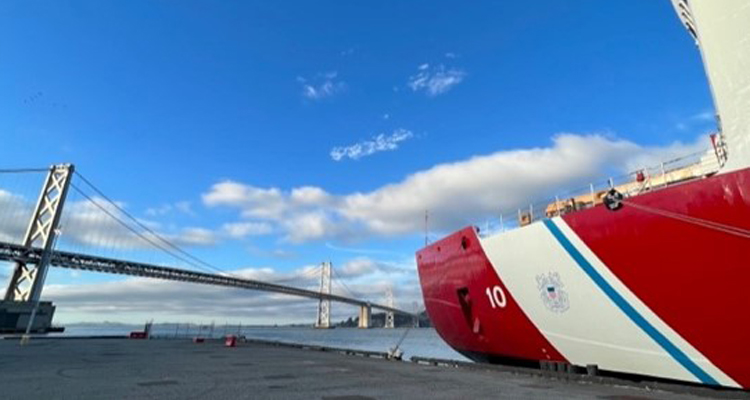
Coast Guard Cutter Polar Star sits moored in San Francisco following completion of dock trials on Aug. 12, 2022, for the second phase of its service life extension project completed by Mare Island Dry Dock. U.S Coast Guard photo.


Coast Guard Cutter Polar Star has completed sea trials for the second phase of its service life extension project (SLEP), as part of the In-Service Vessel Sustainment Program, and returned to its homeport of Seattle. The remaining contracted production work will be completed by Sept. 30 at the homeport, as well as final testing of the newly installed machinery control systems.

Polar Star commenced the second phase of SLEP work items and recurring maintenance on April 8. Service life extension program work is taking place over a five-year, annually phased production schedule that runs through 2025, and each phase is coordinated to support operational commitments, such as the annual Operation Deep Freeze deployment to Antarctica, and to take advantage of planned maintenance availabilities. During the second phase, all of the galley equipment was recapitalized, reflecting the modern upgrades of commissary equipment available on extended voyage seagoing ships.

In addition, Naval Surface Warfare Center Philadelphia Division and Coast Guard Yard installed two machinery control systems. The Coast Guard Machinery Control System (CGMCS) recapitalizes the Main Propulsion Control and Monitoring System that was installed during Polar Star’s reactivation in 2013. The CGMCS increases system reliability and operator familiarity, as this newly installed propulsion control system is standard across much of the service’s surface fleet. The new Propulsion Power Distribution System replaced the analog diesel electric propulsion suite that was installed when Polar Star entered service in 1976. The new system features improved reliability as compared to the legacy system and reduces maintenance requirements that previously took approximately 45 days and 1,600 maintenance-hours to complete.

The Polar Star crew will conduct integrated operational testing of both new systems prior to departing for Operation Deep Freeze in 2023. The cutter regularly completes Operation Deep Freeze deployments to resupply McMurdo Station in Antarctica.

Polar Star is the Coast Guard’s only active heavy icebreaker. The 399-foot cutter supports nine of the 11 Coast Guard statutory missions. The Coast Guard is investing in a new fleet of polar security cutters (PSC) that will sustain the service’s capabilities to meet mission needs in both the Arctic and Antarctic regions. The first PSC is on contract for delivery in 2025.

For more information: In-Service Vessel Sustainment Program page and Polar Security Cutter Program page

Keyword

“Coast Guard cutter leaves Petersburg after 32 years” –KFSK

The cutter Anacapa tied up at the Coast Guard’s mooring in Petersburg (Joe Viechnicki/KFSK)

There is a very nice story by local media about the departure of USCGC Anacapa from Petersburg, AK. The 110 is not being decommissioned. She is changing homeport to Port Angeles, WA, where there will be a crew turn-over.

The Anacapa’s replacement in Petersburg is an 87-foot San Francisco-based Marine Protector class cutter called the Pike, built in 2005.

Anacapa’s engines and generators are being replaced, so looks like she will be retained a few more years.

There was an earlier post that featured Anacapa, “What Does It Take to Sink a Ship, Illustrated,” when she was tasked with sinking a derelict Japanese fishing vessel, back in 2012.

Major Cutter Homeports

“Coast Guard Cutter Forward and Coast Guard Cutter Bear, homeported in Portsmouth, Virginia, finish an at-sea transfer while underway on a two-month patrol. Coast Guard Cutter Forward returned to homeport on April 10, 2021.” (U.S. Coast Guard photo)

Recently I had to look up homeports of WMECs. I found that there did not seem to be a single comprehensive up to date list. Seemed it might be useful to share the list. I have added the Bertholf class and what we know about the basing of the Offshore Patrol Cutters as well. These are not district assets, but I found it convenient to group them by homeport district. The numbers in parenthesis are the hull numbers. First some observations.

OBSERVATIONS:

The intent is to split the Bertholf class, almost evenly between the Atlantic and Pacific Areas: five (45%) to LANTAREA and six (55%) to PACAREA.

The vast majority of medium endurance cutters are assigned to LANTAREA. All 100% of the 270s and 24 (86%) of 28 total.

Despite the fact that the vast majority of the US EEZ and territorial sea (84%) falls under the Pacific Area Commander, the vast majority of large patrol cutters are based in the Atlantic Area. This is, at least in part, due to the Alien Migrant and Drug interdiction missions. It is counter intuitive, but Charleston, SC is closer to the Eastern Pacific Drug transit zones than San Diego, CA.

Once the first four OPCs reach their bases in San Pedro and Kodiak, the Pacific Area will once again have ten “high endurance cutters,” as they did before recapitalization began.

WHO BUILT THEM?:

The entire Bertholf class has been built by Huntington Ingalls of Pascagoula, MS. The lead ship was laid down in 2005 and commssioned in August 2008. The tenth is expected to be delivered 2023. The eleventh, maybe 2024.

The Bear class WMEC270s were built by two different builders. The first four ships (901-904) were built by Tacoma Boatbuilding, Tacoma, WA, with Bear laid down in August, 1979 and the last of the four commissioned in December, 1984. The remaining nine were built by Derecktor Shipbuilding, Middleton, RI. The first of these laid down June, 1982, and the last of the nine completed in March 1990.

The 16 Reliance class WMEC210s were built by four different builders, with the first laid down in May 1963 and the last commissioned August 1969, less than six years and three months later.

  • The first three, 615-617, were built by Todd Shipyards, Houston, TX.
  • The fourth, 618, by Christy Corp., Sturgeon Bay, Wis.
  • Five, 619, 620, and 628-630, were built at the Coast Guard Yard, Curtis Bay, MD.
  • Seven, 621-627, were built by American Shipbuilding, Lorain, OH.

WMEC 622 and 628 have since been transferred to Sri Lanka and Colombia respectively. All underwent a major maintenance availability at the Coast Guard Yard between 1984 and 1998.

THE FORCE LAYDOWN:

FIRST DISTRICT: 2 WMEC270s

  • US Naval Shipyard Portsmouth, Kittery, ME: two WMEC270s: Tahoma (908), Campbell (909)

FIFTH DISTRICT: 9 WMEC270s, 2 WMEC210s

  • Portsmouth, VA: 9 WMEC270s: Bear (901), Escanaba (907), Forward (911), Harriet Lane (903, currently in SLEP at CG Yard), Legare (912), Northland (904), Seneca (906) , Spencer (905), Tampa (902)
  • Virginia Beach, VA: WMEC210s: Dependable (626), Vigorous (627)

SEVENTH DISTRICT: 3 National Security Cutters (2 more under construction), 2 WMEC270s, 5 WMEC210s

  • Charleston, SC: 3 NSCs: Hamilton (753), James (754), Stone (758), (two more NSCs building: Calhoun (759), Friedman (760))
  • Naval Station Mayport: 1 WMEC210: Valiant (621)
  • Cape Canaveral: 2 WMEC210s: Confidence (619), Vigilant (617)
  • Key West: 2 WMEC270s: Mohawk (913), Thetis (910)
  • St. Petersburg: 2 WMEC210s: Resolute (620), Venturous (625)

EIGHTH DISTRICT: 4 WMEC210s

  • Pensacola: WMEC210s: Dauntless (624), Decisive (629), Diligence (616), Reliance (615)

ELEVENTH DISTRICT: 4 National Security Cutters

  • Alameda, CA: 4 NSCs: Bertholf (750), Waesche (751), Stratton (752), Munro (755)

THIRTEENTH DISTRICT: 3 WMEC210s

  • Astoria, OR: 2 WMEC210s: Alert (630), Steadfast (623)
  • Port Angeles, WA: 1 WMEC210: Active (618)

FOURTEENTH DISTRICT: 2 National Security Cutters

  • Honolulu, HI: 2 NSCs: Kimball (756), Midgett (757)

SEVENTEENTH DISTRICT

  • Kodiak, AK: 1 WMEC283: Alex Haley (WMEC-39)

OFFSHORE PATROL CUTTER HOMEPORTS

We have heard where the first six OPCs are expected to be homeported.

  • Argus (915) and Chase (916) will go to San Pedro, CA
  • Ingham (917) and Rush (918) will go to Kodiak, AK
  • Pickering (919) and Icarus (920) will go to Newport, RI


“Coast Guard to host groundbreaking ceremony at Base Boston for Fast Response Cutter pier construction” –News Release

Below is a First District news release. This is good news for those hoping to see some new cutters in New England. We have known for a while that Webber class FRCs were going to Boston, but the surprise I see here is, “…$35 million recapitalization of current Coast Guard facilities at Base Boston and acquisition of six new Fast Response Cutters (emphasis applied–Chuck) at a cost of $380 million.”

This follows the pattern we have seen lately of these vessels being clustered, rather than being widely distributed in ones and two.

Base Boston (photo above) must certainly have much to recommend it, but as a high-cost area, it seems likely it will host no large patrol cutters in the future. It was once homeport to several High Endurance Cutters. Until recently, it hosted three WMEC270s, Escanaba, Seneca, and Spencer. All three have since moved to Portsmouth, VA. We already know the Coast Guard plans to base OPCs #5 and #6 in nearby Newport R.I. at the former US Navy base, where there had been no large cutters.

Wikipedia has a good list of Webber class WPCs and their homeports. It does not reflect the addition of two more ship to the program of record, FRCs #65 and #66, in the FY2022 budget, but it does list 64 named vessels and homeports for 50 cutters including two expected to be homeported in Boston, USCGC William Chadwick (WPC-1150) and USCGC Warren Deyampert (WPC-1151), expected to arrive in the second half of 2022. Homeports are not yet identified for 16 ships. Four of those are presumably going to Boston so where are the remaining 12 going? One is each is expected to go to Seward and Sitka. Two will go to Kodiak. That leaves eight. Some may be added to already identified homeports. One of the 50 identified includes the first ship going to St. Petersburg, FL. St. Pete will likely get at least two more. Assuming that is the case that leaves six. We also know that two will go to Astoria, Oregon. That leaves four. The recent addition of two was probably with the intention of stationing them in America Samoa. Two there would only leave two which might go to previously identified homeports, so we may not see any additional homeports added.

News Release

U.S. Coast Guard 1st District Northeast

Media Advisory: Coast Guard to host groundbreaking ceremony at Base Boston for Fast Response Cutter pier construction

Editors’ Note: Media interested in attending are requested to RSVP at 617-717-9609 by 4 p.m., April 13, and should arrive no later than 9:45 a.m., Thursday.

FRC

BOSTON —The Coast Guard is scheduled to hold a media event for the Coast Guard Fast Response Cutter Homeport Groundbreaking Ceremony at Base Boston, Thursday.

WHO: Rear Adm. Thomas Allan, commander, Coast Guard First District, Massachusetts Governor Charlie Baker, Congressman Stephen Lynch, and Mayor of Boston, Michelle Wu.

WHAT: Coast Guard Fast Response Cutter Homeport Groundbreaking Ceremony

WHEN: Thursday, April 14, 2022, at 10 a.m.

WHERE: Coast Guard Base Boston, 427 Commercial Street, Boston, MA 02109

This ceremony marks the starts of a large Coast Guard investment in the Northeast with a $35 million recapitalization of current Coast Guard facilities at Base Boston and acquisition of six new Fast Response Cutters at a cost of $380 million. The FRCs are the Coast Guard’s newest cutter class replacing the Legacy Island Class Patrol Boats and will operate throughout the Coast Guard’s First District from New York, to the Canadian border. 

These cutters are designed for missions including:

  • search and rescue
  • fisheries law enforcement
  • drug and migrant interdiction
  • port, waterways, and coastal security
  • national defense

In addition, the Coast Guard will increase personnel presence in the area with 222 new Coast Guard members to crew and maintain the cutters. These new crews are expected to have an annual economic impact of $45 million on the local economy.