Coast Guard Personnel as Ship Riders in the South China Sea?

Informationdissemination.net has a surprising proposal for dealing with the Chinese non-military aggressiveness in the South China Sea. He proposes putting US personnel (he specifically mentions US Coast Guard personnel among other possibilities) on the vessels of friendly nations, specifically mentioning the Philippines, but this might be extended to other nations facing similar attempted intimidation.

The intended effect of emplacing U.S. personnel aboard allied vessels ideally should be twofold. First, help our allies by lowering their risk of operations (such as resupplying isolated garrisons) and assuring them that the U.S. is a stalwart friend. Second, negate Chinese escalation dominance by forcing them to confront Americans in order to achieve their ends. This would force them into a choice between moving to higher level rungs on the escalation ladder and therefore incurring a greater risk of conflict with the U.S., or backing off. Whatever course they chose, their incremental approach would be dealt a setback.

The comments also note that having a US rep on board would also insure that incidents are accurately reported keeping allies as well as the Chinese honest and lending the reports greater credibility.

Narco-Submarines

New Type Narco Sub--a "Snot Boat?"

There is a new publication that appears to be the definitive source on Narco subs and related craft including semi-submersibles and un-manned, towed narco “torpedoes.” It certainly has the best selection of photographs I have ever seen on the subject.

Narco-Submarines Specially Fabricated Vessels Used For Drug Smuggling Purposes
In cooperation with InSight Crime & Small Wars Journal— El Centro
Byron Ramirez and Robert J. Bunker, Editors

And of course these could be used for smuggling in things other than drugs.

You can access the report in pdf form here.

Commandant Remarks and Q&A–USNI/CSIS on CSPAN

Earlier we talked briefly about the Commandant’s address to the USNI and CSIS Maritime Security Dialog. This is the entire address.

It is about 53 minutes, of which the first half is prepared remarks and the second half Q&A.

I think you will find it worth the time.

Thanks again to James WF for pointing me to this.

Extend Counter Piracy Efforts in the Indian Ocean to Include Other Maritime Governance Missions

With Piracy effectively suppressed in the Indian Ocean and the Gulf of Aden, the Australian Strategic Policy Institute is recommending that steps be taken to allow these forces to counter other international crimes beginning with drug smuggling.

There are a number of impediments to effective enforcement, but the study authors suggest there are also mechanisms in place that may make this effort mort effective.

Good maritime governance has been lacking in this region. If they could create, what would amount to an international Coast Guard with a supporting judicial system, it might also serve as a model for other areas such as West Africa, the Straits of Malacca, and the Caribbean.

Largest Ship

You have to see this. Makes aircraftcarriers look small.

gCaptain reports the arrival of the largest ship in the world at Rotterdam. There are different ways to measure ships, but this is 382 meters (1,253 feet) in length and 124 meters wide (407 feet) of beam, anyway you look at it, this thing is big. It is made for picking up and moving offshore drilling rigs.

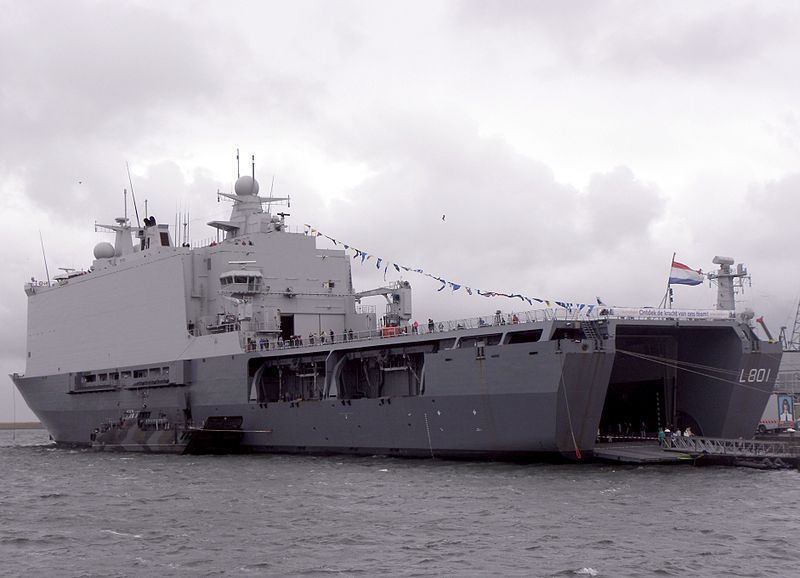
Dutch Mothership?

L 801 Johan de Witt Uploaded by Oxyman

L 801 Johan de Witt Uploaded by Oxyman

The following was reported by the German Navy blog Marine forum, “8 January, PIRACY–Anti-Piracy Forces: Sweden is preparing for another mission (M-04) in support of EU operation “Atalanta”, this time working jointly with the Netherlands navy … COMBAT BOAT 90 fast interceptor craft, helicopters and 70 personnel to embark on Netherlands Navy dock landing ship JOHAN DE WITT.”

As you may recall, I have advocated using WPCs supported by a mother ship to supplement the larger cutters for distant drug interdiction operations.

We have done cooperative counter drug operations with the Netherlands Navy in the past. Early last year, the Netherlands OPV Zeeland embarked both a CG LEDET and a CG helo det.

Perhaps we could run a test using the Johan de Witt or her sistership Rotterdam to try out the mothership concept. Their crew size is similar to that of the National Security Cutters (less than that of the Hamilton class), but they have berthing for hundreds more. They have aviation facilities for up to six helicopters. They can handle boats from both davits and a well deck. They have excellent Command and Control facilities.

“The ships have a complete Class II hospital, including an operating theater and intensive care facilities. A surgical team can be stationed on board.” That could make them welcome in a lot of ports.

Would the Dutch be interested? The Dutch Navy has already demonstrated its commitment to counter drug trafficing. They have used these ships several times for counter-piracy. Counter drug operations are not that much different, and piracy seems to be in decline. When it was being finished, there were reports that the Dutch wanted to sell the Johan de Witt. Operating off Latin America might be seen as an opportunity to demonstrate both this class and the Netherlands’ ship building expertise in an international market.

What might the experimental effort include. In addition to the mothership, perhaps three MH-65s, add a mix of Webber class WPCs, WPBs, Response Boat Mediums (RB-M), and Navy Riverine Command Boats (the US Navy version of the Combatboat 90).

In addition to its counter drug objectives, the deployment might be seen as a partnership station effort, training as well as working with the locals, and if there should be a natural disaster while they are in the area, it will be a ready made Coast Guard response.

Germany to Build Four OPVs for Israel

Photo Credit: jimmyweee, Malaysian OPV Pahang, IMDEX2007

Photo Credit: jimmyweee, Malaysian OPV Pahang, IMDEX2007

DefenseNews is reporting that Germany will be building four Offshore Patrol Vessels for the Israeli Navy. Israel has seen a need for OPVs to protect its growing offshore energy industry.

Israel had previously considered the Lockheed “international” LCS design, but it was deemed too expensive. The design selected is a version of the MEKO A100. Two versions of this design are already in service, The Kedah class (pictured above) with the Malaysian Navy and the K-130 class corvettes of the German Navy.

It will be interesting to see how these ships turn out. They will be similar in size, perhaps a bit smaller than the Offshore Patrol Cutters.

A late addition:

Israel_Navy_Saar_6_MEKO_TKMS_1

Added Nov. 16, 2020.


Operation Mare Nostrum Influences Frigate Design

DefenseNews is reporting Adm. Giuseppe De Giorgi, chief of the Italian Navy says their experience with their massive migrant interdiction operation “Mare Nostrum,” that saved over 150,000, is influencing the design of future frigates.

“The experience of Mare Nostrum has helped shape the design of Italy’s new frigates, which are dual use and can engage in large-scale rescues. Openings on the sides of the vessels allow people to disembark from fishing boats as they would on a dock.

“These ships will have a large space under the flight deck which is wired and plumbed so containers with bathrooms or hospital facilities can be installed, not to mention sleeping quarters. We will also be able to store large inflatable boats for special forces, which can be used, alongside landing craft, to evacuate Italian nationals from conflicts where helicopters are vulnerable to man-portable air-defense systems.

“I think this is the future. Increasingly, I don’t think countries will be able to deploy separate naval forces for policing, civil use and military use. I believe a navy must be designed from the start to be as flexible as possible.

“There are other innovations on the new ships. We are aiming to use electric propulsion up to 10 knots and to use bio-fuel and liquid gas fuel. The fuel tanks are being designed to use regular fuel as well as liquid gas. I think we are the first to do this.

“Additionally, the frigates will be able to provide electricity and drinking water for a community of 6,000 hit by a natural disaster.

“We will also be able to carry sea-skimming robots to clear up pollution on the surface, with the polluted water then stored in the tanks of a new refueling ship we are also designing.”

Italy has both a Coast Guard and a maritime Customs Service, but neither has large patrol vessels (over 1,000 tons) like the USCG, so the Italian Navy performs some coast guard functions.

The next class of US Coast Guard cutter, the Offshore Patrol Cutter, includes a design requirement to hold, shelter, and feed up to 500 illegal immigrants on deck. There are still a number of unknowns, but there is reason to believe that the winning design may also include provision for support of containerized modules and a hybrid propulsion system even though neither were included in the specification.

Aside from the ability to provide electricity to communities ashore, the excess generator capacity of a hybrid propulsion system may also allow the vessels to support electrically powered weapons like lasers and rail-guns.

Monster Offshore Facility

The New York Times calls it, “The Biggest Ship in the World (Though It Isn’t Exactly a Ship)”

“It’s called Prelude, and it’s bigger than big. More than 530 yards long and 80 yards wide, it was constructed with 260,000 metric tons of steel, more than was used in the entire original World Trade Center complex, and it’s expected to displace 600,000 metric tons of water, or as much as six aircraft carriers.”

This one is to be anchored in North West of Australia, but if one comes to the US EEZ, it is going to be an incredible Marine Inspection task.

Egyptian Patrol Boat was Hijacked by ISIS–Unconfirmed

The German Navy Blog MarineForum reports without attribution:

1 Dec., EGYPT
Update: 12 Nov incident (with one navy vessel set ablaze and 8 people killed) alleged to have not been battle with smugglers nor fishermen … instead, ISIL terrorists / Sinai militants said to have hijacked the Egyptian navy vessel for an attack on Israeli Mediterranean installations (offshore platforms?) … when Egyptian navy realized the situation, the boat was pursued and finally intercepted.
(rmks: unconfirmed local media reports)