“U.S., Canada Coast Guards, Royal Canadian Air Force conduct search and rescue exercise near Herschel Island, Yukon” –D17

Herschel Island in the arctic, location circled. Basic map is NASA Blue Marble image, with the circle drawn in Inkscape. via NASA World Wind

Below is a press release from District 17 (Alaska). Except for the mention of the Arctic, this sounds like a pretty routine SAR exercise but look at the map above. This was more than 150 miles north of the Arctic Circle, on the Northwest Passage, North of the Canadian mainland. The helicopter would have deployed from Kodiak on the South side of Alaska more than 800 miles South. Click on the link above to see the video.

Oct. 3, 2023

(VIDEO AVAILABLE) U.S., Canada Coast Guards, Royal Canadian Air Force conduct search and rescue exercise near Herschel Island, Yukon

ANCHORAGE, Alaska – The U.S. Coast Guard and Canada Coast Guard conducted a cooperative search and rescue training exercise near Herschel Island, Yukon, Canada, on Saturday.

The exercise centered around the French cruise ship Le Commandant Charcot, whose crew simulated an onboard fire with severe personal injuries and a complete evacuation of the vessel.

The crew of a U.S. Coast Guard HC-130 aircraft from Air Station Kodiak were first to respond to the simulated distress call and acted as the on-scene commander for the exercise, coordinating response efforts and relaying communications.

Later a Royal Canadian Air Force HC-130 crew responded to drop medical supplies and response personnel onto Herschel Island where exercise participants that were acting as injury victims awaited treatment.

A U.S. Coast Guard MH-60 Jayhawk helicopter crew from Air Station Kodiak also responded by lowering a rescue swimmer onto the deck of the cruise ship to hoist mannequins acting as injured crew members.

“The increase in human activity in the arctic means there may be a potential for increased Search & Rescue response there as well,” said Captain Brian McLaughlin, Chief of Incident Management at U.S. Coast Guard District Seventeen. “Exercising the Coast Guard’s capabilities to operate in one of the most demanding and remote regions in the world, while simultaneously identifying the associated challenges, highlights the critical importance of these joint exercises and their influence on future operational success along our shared maritime border with Canada.”

The exercise, which took more than a year to plan, is part of the Coast Guard’s ongoing commitment to a safe and secure arctic.

Correction: The title of this press release was changed to reflect all entities involved.


“NPS Research on Coast Guard Icebreaker to Enhance Arctic Readiness” –Marine Link

During a seven-week Arctic transit aboard the U.S. Coast Guard icebreaker USCGC Healy (WAGB 20), Dr. Nita Shattuck from the Naval Postgraduate School (NPS) will study the impact of the extreme environment on crew performance and potential mitigations. Additional research includes assessment of an Amos01 3D printer installed by David Dausen from NPS’ Consortium for Advanced Manufacturing Research and Education (CAMRE), and specially instrumented to measure the impact of adverse Arctic sea conditions.

Marine Link reports the Naval Post Graduate School is doing some interesting studies on the working environment experienced by USCGC Healy’s crew.

To study the effects of these conditions on a ship’s crew at sea, Shattuck and her team will collect physiological data from the Healy’s crew members. Using innovative wearable technology, they will continuously monitor physiological processes such as sleep, heart rate, heart rate variability, respiration, oxygen saturation, and skin temperature. Study participants indicate that the rings are an improvement over wrist-worn wearables. The team will also use other sensors to monitor ambient light, noise levels, motion, and vibration aboard the ship.

The report also mentions that Healy will be going to Tromsø, Norway. How they get there will be interesting. Will they go the Northwest Passage through the Canadian EEZ or the Northern Sea Route through Russia’s EEZ?

“An Arctic presence grows more important for U.S. and its partners” –The Watch

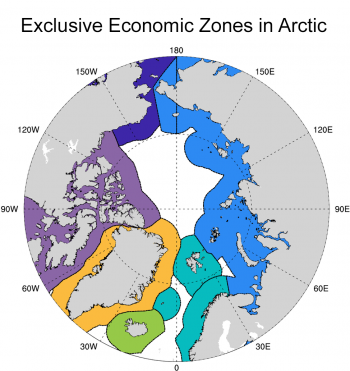
This map show the exclusive economic zones (EEZs) within the Arctic: Canada (purple), Greenland (orange), Iceland (green), Norway (turquoise), Russia (light blue), and USA (dark blue). As sea ice reduces there will be more opportunity for ice to drift from one EEZ to another, which has implications for the potential spread of pollutants.
Credit: DeRepentigny et al., 2020

NORTHCOM’s on-line magazine, The Watch, has a short post about the Arctic.

I would note that most of the discussion centers on the Atlantic side of the Arctic, whereas the Coast Guard concentration has primarily been on the Pacific side. We have seen some indications there may be Coast Guard Arctic capable assets on the Atlantic side in the future. Not too early to think about that.

The Coast Guard has had good relations with the Russians in the Arctic because of a common interest in fisheries, SAR, and environmental protection. That is all to the good. At some future date, the Coast Guard will probably do a Freedom of Navigation Exercise through the at least parts of the Northern Sea Route. Hopefully we can find ways to, perhaps, disagree amicably as we have with the Canadians in regard to the Northwest Passage.

“Military Planners Should Map Out Operations in Warming Arctic Waters, Expert Says” –USNI

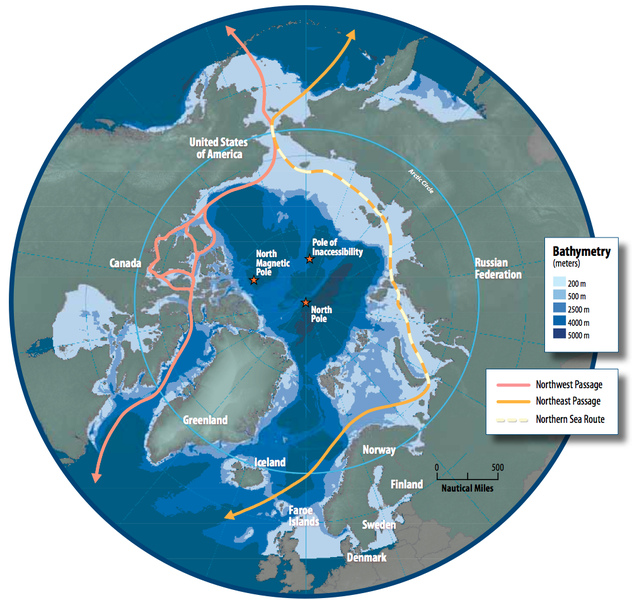
Map of the Arctic region showing shipping routes Northeast Passage, Northern Sea Route, and Northwest Passage, and bathymetry, Arctic Council, by Susie Harder

A reminder from the US Naval Institute of an issue that Russia and Canada share in opposition to the US–passage through Arctic Straits.

Let’s not forget that, when the US Navy wants to do “Freedom of Navigation” Exercises through the Northern Sea Route, there will be a Coast Guard icebreaker leading them.

“Royal Canadian Navy HMCS Harry DeWolf Departs On Her Maiden Operational Deployment” –Naval News

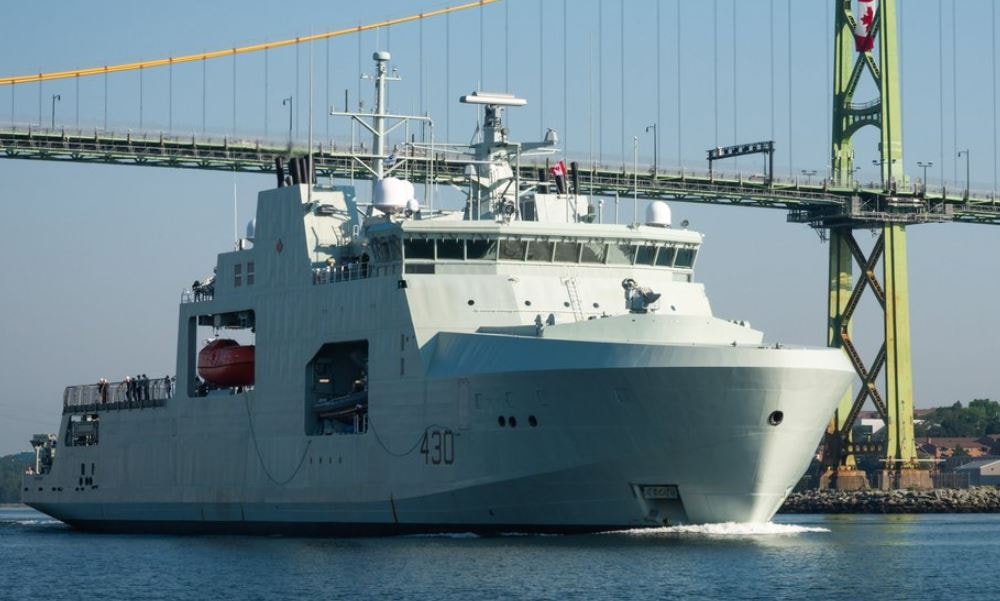
HMCS Harry DeWolf, leaving HMC Dockyard in Halifax and steaming under Angus L. Macdonald
suspension bridge crossing Halifax Harbour in Nova Scotia, Canada

Naval News reports the first of Canada’s planned eight Arctic Offshore Patrol Ships (AOPS) (six for their Navy and two for their Coast Guard) departed on its first operational deployment on August 3. The deployment is expected to take four months and will include participation in the annual Nanook Exercise with partners including the USCG, transit of the North West Passage, counter clockwise circumnavigation of North America, and drug operations in the Eastern Pacific transit zone and the Caribbean again in cooperation with the USCG.

USCGC Healy departed for a clockwise circumnavigation of North America on July 10. Presumably these two will arrange to say hello as they pass. Hopefully both crews will be home by Christmas.

“Rushing Navy Ships into the Arctic for a FONOP is Dangerous” –USNI

Map of the Arctic region showing shipping routes Northeast Passage, Northern Sea Route, and Northwest Passage, and bathymetry, Arctic Council, by Susie Harder

An interesting discussion of the Navy’s proposed Freedom of Navigation Operation (FONOP) in the Arctic which would presumably require Coast Guard assistance.

Within these stories are three different ideas: first, that the Navy is interested in expanding its physical presence in Alaska, through returning to Adak and/or a port on the Bering Strait ( Nome has been discussed for years); second, that Navy personnel need to regain operational familiarity with the Arctic environment; and third, that the Navy appears to be considering a freedom of navigation operation (FONOP) in the Arctic for summer 2019.

The first two ideas are unremarkable. Given the dearth of infrastructure and the challenging environment, both improved facilities and practical learning opportunities are required to ensure Navy vessels and aircraft operate safely and effectively.

The third idea—conducting a FONOP in the Arctic in just a few months—is a bombshell.

I seem to remember hearing that this had been discussed, and the Commandant had taken the position that the Coast Guard could not support the idea of a Freedom of Navigation Operation given the state of our icebreaker “fleet,” but apparently the idea is still alive, at least as of mid January.