USCGC Stratton in the Philippines

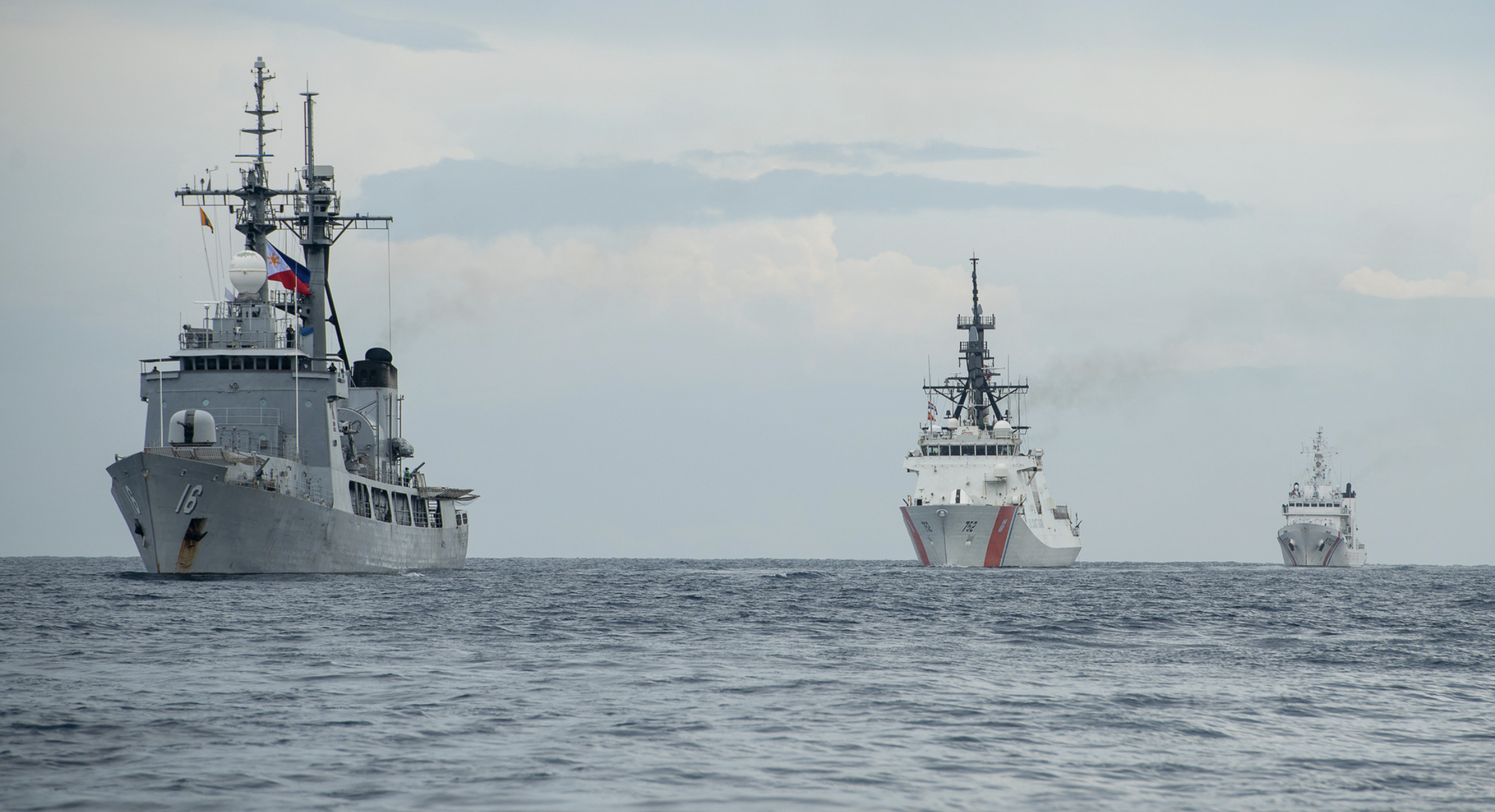
The Legend-class USCGC Stratton (WMSL 752) sails with Philippine Navy’s Gregorio del Pilar-class patrol ship BRP Ramon Alcaraz (PS-16) (former USCGC Dallas) and Philippine Coast Guard Vessel BRP Melchora Aquino (MRRV-9702) as part of a division tactics exercise in the Sulu Sea, May 20, 2025. Stratton is deployed and assigned to Destroyer Squadron (DESRON) 15, the Navy’s largest DESRON and the U.S. 7th Fleet’s principal surface force. The U.S. Coast Guard has operated in the Indo-Pacific for more than 150 years, and the service is increasing efforts through targeted bilateral patrols with our national security cutters, fast response cutters, and other activities conducted in support of maritime missions to enhance our regional partnerships. (U.S. Coast Guard photo by Petty Officer 3rd class William Kirk)

Below the line is a report of Alameda based USCGC Stratton’s visit to the Philippines at the start of a Western Pacific deployment. The report mentions exercising “with the Armed Forces of the Philippines and the PCG.”

“Following their departure, Stratton’s crew conducted a bilateral Maritime Cooperative Activity (MCA) …The MCA included exercises in maritime domain awareness, division tactics, maneuvering, and visit, board, search and seizure procedures.”

Following the link above we learn,

Participating units included the Legend-class cutter USCGC Stratton (WMSL-752) and a P-8A Poseidon maritime patrol and reconnaissance aircraft from the U.S. Navy, as well as the Philippine Navy’s Gregorio del Pilar-class patrol ship BRP Ramon Alcaraz (PS16); Acero-class patrol gunboats BRP Gener Tinangag (PG903) and BRP Domingo Deluana (PG905); an AW109 naval helicopter; the Philippine Air Force’s Super Tucano and Sokol helicopters; and the Philippine Coast Guard’s Teresa Magbanua-class patrol vessel BRP Melchora Aquino (MRRV 9702).

That is a pretty substantial exercise, US Navy, Philippine Navy, and Philippine Air Force in addition to US and Philippine Coast Guards.

While the Philippine Coast Guard has many of the trappings of a military service, they are not nearly as well armed as their Chinese, US, and Japanese counterparts. Their most powerful weapon seems to be .50 caliber machine guns. If they get into an armed confrontation with the Chinese, they cannot go it alone. Notably this was not a SAR exercise. Perhaps the idea was to practice coordination of support for the Philippine Coast Guard in their interactions with the Chinese, making sure the Philippine CG can communicate with the Philippine Navy and Air Force and with US assets in the area.

Army Recognition’s Naval News also has a report on the exercise which mentioned that Japanese built Philipine WPC BRP Malapascua (MRRV 4403) also participated in the exercise. “Philippine and US Naval Forces Conduct First Joint Maritime Exercise to Strengthen Indo-Pacific Maritime Security


May 24, 2025

U.S. Coast Guard Cutter Stratton departs Philippines, commences months-long Indo-Pacific patrol

PUERTO PRINCESA, Philippines — The U.S. Coast Guard Cutter Stratton (WMSL 752) and its crew departed Puerto Princesa, Philippines, Monday, after in-port engagements and visits with the Philippine Coast Guard (PCG), the U.S. Ambassador to the Republic of the Philippines MaryKay Carlson, U.S. embassy staff, and PCG District Palawan senior leadership.

Stratton’s visit to Puerto Princesa marked the first international port call of their months-long deployment to the Indo-Pacific region.

Following their departure, Stratton’s crew conducted a bilateral Maritime Cooperative Activity (MCA) with the Armed Forces of the Philippines and the PCG within the Philippines’ exclusive economic zone. The MCA included exercises in maritime domain awareness, division tactics, maneuvering, and visit, board, search and seizure procedures.

These engagements demonstrate the U.S. commitment to maritime governance that supports security, freedom and prosperity in the region.

The U.S. Coast Guard serves as a unique instrument of national power, bridging defense, diplomacy and law enforcement to further national objectives and mutual interests with allies and partners like the Philippine Coast Guard.

During the visit, Stratton’s commanding officer, Capt. Brian Krautler, welcomed Amb. Carlson, PCG Commandant Adm. Ronnie Gil Gavan, and senior PCG leaders aboard Stratton, highlighting U.S. Coast Guard interoperability with allies.

“Our alliance with the Philippine Coast Guard has cultivated a close, collaborative maritime partnership—this is Stratton’s second deployment to the Philippines during my two years aboard as commanding officer,” Krautler said. “Our enduring partnership enables combined effects and cooperation across a broad spectrum of engagements and operations. Stratton’s deployment to the Indo-Pacific will further strengthen our relationships with allied coast guards and services throughout the region.”

The U.S. Coast Guard works closely with regional allies to deliver a broad range of capabilities in support of a prosperous and secure Indo-Pacific. Multilateral operations like the at-sea MCA and in-port engagements enhance cooperation, improve interoperability and strengthen readiness.

While moored, Krautler and Stratton’s leaders also met with the WESTCOM Commander PCG District Palawan for a pre-sail planning meeting to discuss bilateral search and rescue exercises (SAREX) to enhance cooperation. At-sea operations and exercises with the Philippine Coast Guard will strengthen the ability to execute coordinated maritime operations and enhance overall mission readiness.|

The U.S. Coast Guard’s commitment to a prosperous and secure Indo-Pacific requires working closely with regional allies, allowing the service to improve its logistics flexibility to better deliver a broad range of capabilities.

During the patrol, Stratton is scheduled to engage with regional partners and participate in joint operations aimed at enhancing maritime safety and security. Throughout its Indo-Pacific deployment, Stratton is assigned to Destroyer Squadron (DESRON) 15, the Navy’s largest DESRON and the U.S. 7th Fleet’s principal surface force. DESRON 15 regularly assumes tactical control of surface units operating in the area.

Stratton’s port call to the Philippines marks the cutter’s third visit following stops in 2019 and 2023. Consistent U.S. Coast Guard national security cutter deployments to the region demonstrate the U.S. commitment to strong maritime governance that supports security, freedom and prosperity in the Western Pacific.

Commissioned in 2012, Stratton is one of ten Legend-class national security cutters and one of four homeported in Alameda, California. National security cutters are 418 feet long, 54 feet wide and have a 4,600 long-ton displacement with a top speed of 28 knots, a range of 12,000 nautical miles and can hold a crew of up to 170. National security cutters routinely conduct operations throughout the Pacific, where their combination of range, speed and ability to operate in extreme weather provides mission flexibility.

The namesake of U.S. Coast Guard Cutter Stratton is Capt. Dorothy Stratton, who led the service’s all-female reserve force during World War II. Dorothy Stratton was the first female commissioned officer in the Coast Guard and commanded more than 10,000 personnel. The ship’s motto is “We can’t afford not to.”

“Coast Guard Cutter Kimball returns home following Bering Sea deployment” –CG News

U.S. Coast Guard Cutter Kimball (WMSL 756) conducts a passing exercise with the Royal Canadian Navy ship HMCS Regina while Kimball patrols the Bering Sea, July 18, 2024. During Kimball’s 122-day patrol, the crew also interacted with strategic partners in Victoria, Canada, strengthening relationships by focusing on shared interests in the Bering Sea and the expanding Artic region. U.S. Coast Guard photo by Ensign James Bongard.

Below is a Coast Guard News release. It wasn’t like the ALPATs I remember. For one thing it was four months long. There was the interaction with the Canadian Navy, shadowing Chinese warships, engagement and community outreach during a port visit in Nome, but this caught my attention.

Kimball’s crew was instrumental in conducting a proof of concept fueling at sea with the Coast Guard Cutter Bailey Barco (WPC-1122), a fast response cutter (FRC) homeported in Ketchikan, Alaska. This successful evolution extended the endurance of the Bailey Barco and resulted in Bailey Barco’s crew conducting over 10 vessel boardings in Bristol Bay, Alaska, an area not routinely accessed by FRCs due to logistical constraints.

Pacific Area has been pushing the envelope on employing the Fast Response Cutters, doing things never expected. A second set of eyes on patrol.


Aug. 7, 2024

Coast Guard Cutter Kimball returns home following Bering Sea deployment

HONOLULU — The crew of the Coast Guard Cutter Kimball (WMSL 756) returned to their home port at Base Honolulu, Thursday, after completing a 122-day patrol in the Northern Pacific, Bering Sea, and American Arctic.

Kimball’s crew patrolled in support of Operation Alaskan Groundfish Enforcer, Alaskan Sentinel and Bering Shield, promoting maritime governance by enforcing domestic fishery regulations while countering illicit maritime activity from foreign fleets along the maritime boundary line.

Kimball’s crew detected four Chinese surface combatants operating in vicinity of the Amchitka and Amukta Passage within the U.S. exclusive economic zone in early July. Under Operation Frontier Sentinel, Kimball monitored the Chinese vessels, meeting presence with presence to ensure there were no disruptions to U.S. interests in the maritime environment around Alaska.

Kimball’s crew interacted with strategic partners in Victoria, Canada, strengthening relationships by focusing on shared interests in the Bering Sea and the expanding Artic region. Kimball’s command cadre met with senior leadership from the Royal Canadian Navy at the Canadian Maritime Forces Pacific and Joint Task Force Pacific headquarters, participating in geopolitical analysis briefs and roundtable discussions on enhancing joint maritime domain awareness in the Arctic. The visit included tours of the HMCS Ottawa, HMCS Corner Brook and culminated later in the patrol with a passing exercise with HMCS Regina, promoting interoperability with the Royal Canadian Navy and simultaneously advancing the Tri-Service Maritime Strategy through U.S. sea-service engagements.

Showcasing law enforcement expertise, Kimball’s crew ensured fishing vessels in the Bering Sea were within compliance of all federal fishery conservation laws and safety requirements through the completion of twenty living marine resources boardings. Kimball’s boarding team identified one vessel operating in violation of U.S. fisheries regulations, resulting in a $4,500 violation from National Oceanic and Atmospheric Administration’s (NOAA) office of law enforcement.

Kimball’s crew protected U.S. economic interests monitoring foreign fishing vessels along the maritime boundary line, preventing U.S. economic exclusion zone incursions. Kimball’s law enforcement teams conducted a joint boarding with Customs and Border Protection and NOAA of a foreign flagged reefer vessel to inspect fish bait being imported into the United States strengthening federal partnerships in the region.

While operating in the Bering Sea, the crew demonstrated the multi-mission agility of the national security cutter’s advanced command-and-control capabilities by coordinating Alaskan based Coast Guard air and surface assets, forming dynamic force packages that dramatically enhanced the nation’s offshore search and rescue (SAR) abilities. Kimball operated with a forward deployed MH-60 Jayhawk helicopter and aircrew in Cold Bay, Alaska, and the District Seventeen command center to execute complex SAR exercises for improving, coordination, response times, and range of rotary Coast Guard assets to assist mariners in distress.

Additionally, Kimball’s crew was instrumental in conducting a proof of concept fueling at sea with the Coast Guard Cutter Bailey Barco (WPC-1122), a fast response cutter (FRC) homeported in Ketchikan, Alaska. This successful evolution extended the endurance of the Bailey Barco and resulted in Bailey Barco’s crew conducting over 10 vessel boardings in Bristol Bay, Alaska, an area not routinely accessed by FRCs due to logistical constraints.

During port visits in Alaska, Kimball’s crew engaged with local communities. In Nome, crewmembers engaged with the tribal leadership and conducted two community outreach events, including public training and engagements for “Kids Don’t Float,” a statewide initiative to prevent youth drowning incidents. Kimball crewmembers demonstrated the importance of proper life jacket use and cold immersion survival. While in Dutch Harbor, crewmembers volunteered for community events including staging tents and site facilities for summer cultural camps.

“This crew excelled at operating in one of the harshest maritime environments, rising to the challenge of meeting presence with presence when encountering strategic competitors, ensuring the safety and security of U.S. fishermen, engaging with local communities, and providing overarching SAR coverage throughout the Bering Sea” said Capt. Robert Kinsey, Kimball’s commanding officer. “The Coast Guard is a key domestic and international Arctic security leader, shaping the region to promote rule of law and prevent foreign malign influence. I couldn’t be more proud of the crew’s professionalism, dedication, and ability to work together with our partners, foreign and federal, to deliver mission excellence for the American people.”

Commissioned in 2019, Kimball is one of ten commissioned Coast Guard legend-class national security cutters and one of two homeported in Honolulu. National security cutters are 418-feet long, 54-feet wide, and have a 4,600 long-ton displacement. They have a top speed more than 28 knots, a range of 12,000 nautical miles, and can hold a crew of up to 170. National security cutters routinely conduct operations throughout the Pacific and Atlantic, where their combination of range, speed, and ability to operate in extreme weather provides the mission flexibility necessary to conduct vital strategic missions.

The namesake of U.S. Coast Guard Cutter Kimball is Sumner Increase Kimball, who was organizer of the United States Life-Saving Service and the General Superintendent of the Life-Saving Service from 1878–1915. The ship’s motto is “Wield the Paddles Together: Work Together.”

“MQ-9B SeaGuardian Showcased at RIMPAC 2024” –News Release

An MQ-9 Sea Guardian unmanned maritime surveillance aircraft system flies over the Pacific Ocean during U.S. Pacific Fleet’s Unmanned Systems Integrated Battle Problem (UxS IBP) 21, April 21. UxS IBP 21 integrates manned and unmanned capabilities into challenging operational scenarios to generate warfighting advantages. US Navy Photo

The Coast Guard has an unfilled requirement for a shore based Uncrewed Air System (UAS) to provide Maritime Domain Awareness.

Below is a news release from General Atomics Aeronautical Systems, Inc.

Reading the news release, I see the system incorporated an “integrated Minotaur Mission System.” Minotaur is a system currently being installed on all Coast Guard fixed wing search aircraft as well as US Navy and Marine Corps platforms. It went on to say “For RIMPAC, the MQ-9B effectively passed ISR&T (Intelligence, surveillance, reconnaissance, and targeting–Chuck) information to various surface and air units, such as the Nimitz-class carrier USS Carl Vinson, Guided Missile Destroyers (DDGs), Littoral Combat Ships (LCS), frigates, patrol boats, P-8s, P-3s, and numerous other U.S. and foreign units that took part in the exercise.” Could that have included Midgett and her task force? The use of the MQ-9B to drop sonobuoys for the task force and their embarked ASW helicopters would have been an interesting experiment.


GA-ASI’s MQ-9B SeaGuardian® Showcased at RIMPAC 2024

Sonobuoy Dispensing System and LRASM Among the New Capabilities Featured

SAN DIEGO – 14 August 2024 – With the completion of the U.S. Navy’s Rim of the Pacific (RIMPAC) flight operations on July 28, 2024, the MQ-9B SeaGuardian® Unmanned Aircraft System (UAS) supplied by General Atomics Aeronautical Systems, Inc., self-deployed back to its home base in El Mirage, Calif., but only after introducing an array of new capabilities. The flight home followed close to 100 flight hours supporting RIMPAC 2024 over the four-week exercise in and around the Hawaiian Islands.

RIMPAC is the world’s largest international maritime exercise. RIMPAC 2024 featured 29 nations, 40 surface ships, three submarines, 14 national land forces, more than 150 aircraft, and 25,000 personnel.

SeaGuardian provided real-time Intelligence, Surveillance, and Reconnaissance (ISR) data feeds to the U.S. Pacific Fleet Command Center using Signals Intelligence (SIGINT) parametrics and full-motion video to the watch floor and intelligence centers for real-time dynamic tasking — just as it did for the RIMPAC 2022 exercise. This year, SeaGuardian delivered some new features and capabilities, including Long Range Anti-Ship Missile (LRASM) targeting and a new Sonobuoy Dispensing System (SDS) to support its Anti-Submarine Warfare capability. SeaGuardian was configured with a prototype SDS pod capable of deploying 10 A-size sonobuoys per pod (SeaGuardian can carry up to four SDS pods or up to 40 sonobuoys) and the SeaVue Multi-role radar from Raytheon, an RTX business. Upon dispensing, the sonobuoys were successfully monitored and controlled by the SeaGuardian’s onboard Sonobuoy Monitoring and Control System (SMCS).

SeaGuardian is a maritime derivative of the MQ-9B SkyGuardian® and remains the first UAS that offers multi-domain Intelligence, Surveillance, Reconnaissance, and Targeting (ISR&T) as an internal payload that can search the ocean’s surface and depths in support of Fleet Operations. At RIMPAC 2024, SeaGuardian showcased all operational payloads, which includes the SeaVue, SNC’s Electronic Support Measures (ESM) solution, an Automatic Identification System (AIS), and a self-contained Anti-Submarine Warfare (ASW) system.

SeaGuardian’s multi-domain capabilities allow it to flex from mission to mission and pass real-time sensor data directly to the Fleet. For RIMPAC 2024, SeaGuardian added Link 16 Joint Range Extension Application Protocol (JREAP) “C” (internet protocol) and an integrated Minotaur Mission System to provide real-time sensor data for the various Maritime Operations Centers, ships, and aircraft with Minotaur nodes.

“For RIMPAC, the MQ-9B effectively passed ISR&T information to various surface and air units, such as the Nimitz-class carrier USS Carl Vinson, Guided Missile Destroyers (DDGs), Littoral Combat Ships (LCS), frigates, patrol boats, P-8s, P-3s, and numerous other U.S. and foreign units that took part in the exercise,” said GA-ASI President David R. Alexander.

On July 31, 2024, SeaGuardian self-deployed back to GA-ASI’s Desert Horizon Flight Operations Facility in El Mirage, Calif.

About GA-ASI

General Atomics Aeronautical Systems, Inc. (GA-ASI), an affiliate of General Atomics, is a leading designer and manufacturer of proven, reliable RPA systems, radars, and electro-optic and related mission systems, including the Predator® RPA series and the Lynx® Multi-mode Radar. With more than eight million flight hours, GA-ASI provides long-endurance, mission-capable aircraft with integrated sensor and data link systems required to deliver persistent situational awareness. The company also produces a variety of sensor control/image analysis software, offers pilot training and support services, and develops meta-material antennas.

For more information, visit www.ga-asi.com     

Avenger, Lynx, Predator, SeaGuardian, and SkyGuardian are registered trademarks of General Atomics Aeronautical Systems, Inc.


U.S. Coast Guard Cutter Waesche returns home following a 120-day Indo-Pacific patrol

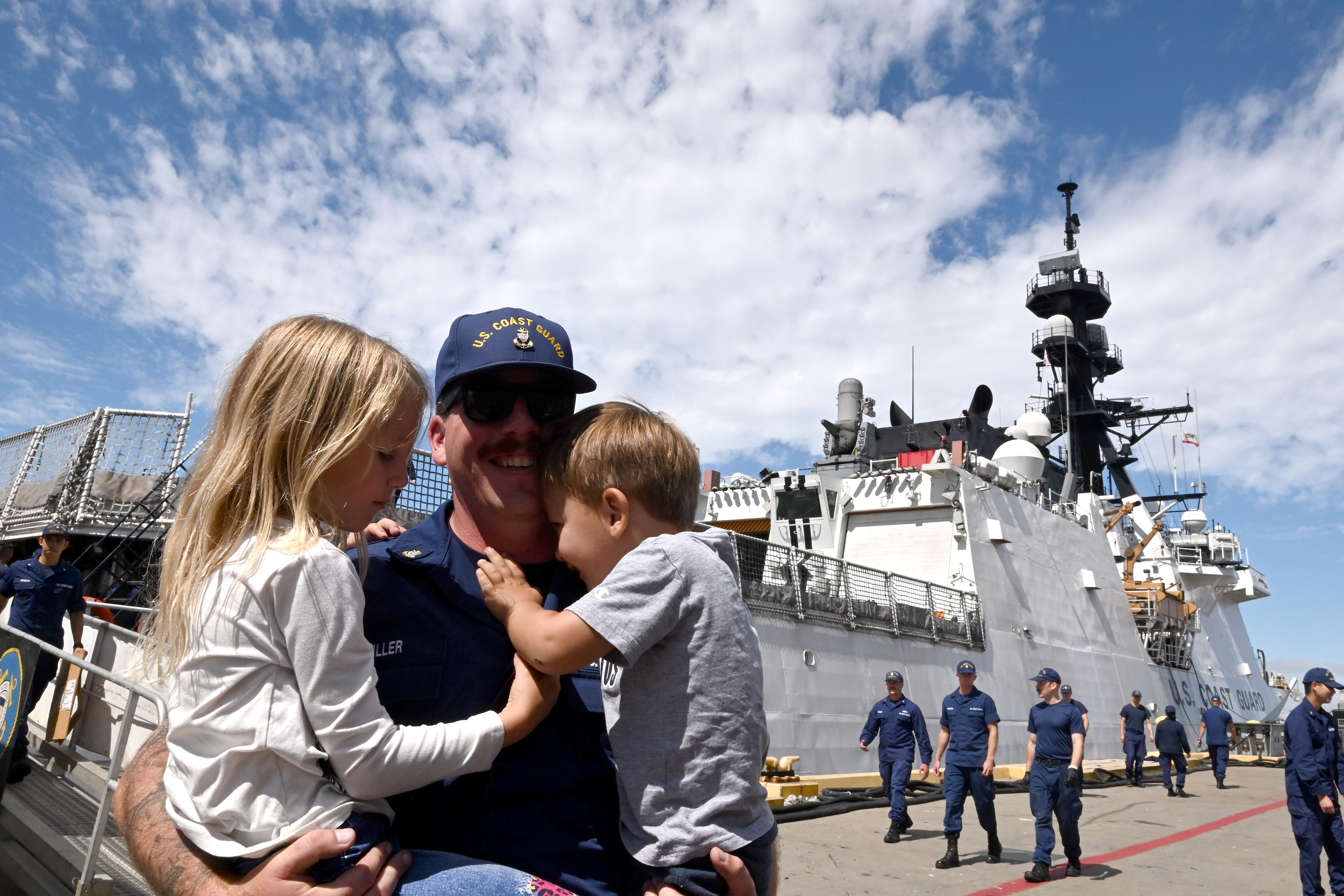
The U.S. Coast Guard Cutter Waesche (WSML 751) crew members reunite with family, friends and loved ones after returning to their Base Alameda, California, home port, Aug. 11, 2024, following a 120-day Indo-Pacific patrol. The Waesche participated in various engagements, exercises, and events throughout their deployment. U.S. Coast Guard photo by Chief Petty Officer Matthew Masaschi.

Below is a news release from Coast Guard News (more photos and a video there). Looks like the Coast Guard is aiming to keep at least one cutter in the Western Pacific at all times.

Those of my generation can’t help but see the irony of the friendly relations with the Socialist Republic of Vietnam as Waesche accompanied the 7th Fleet Flagship to Cam Ranh Bay.

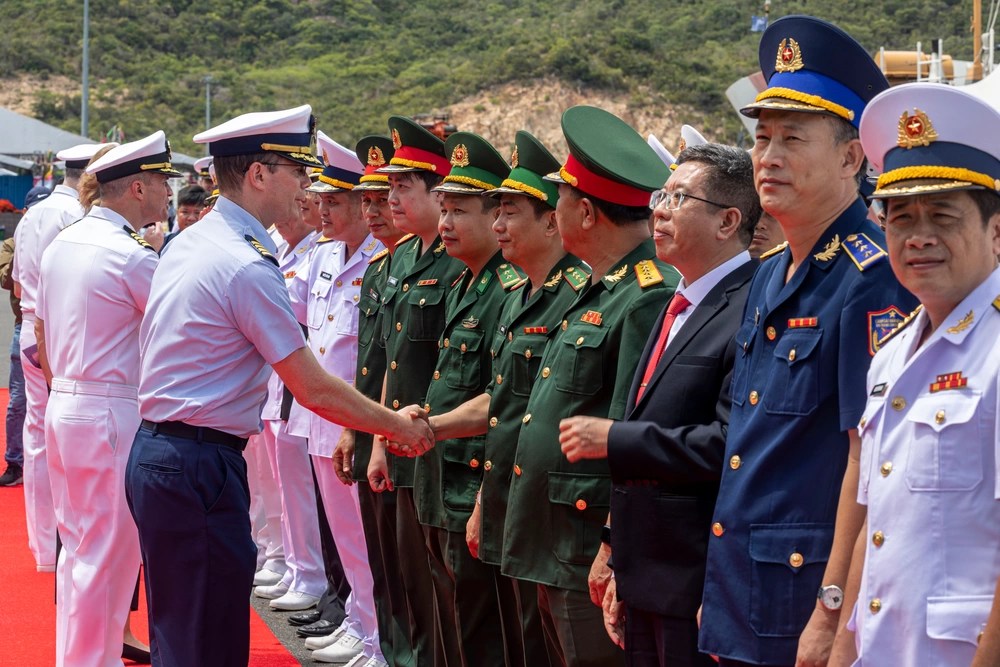
U.S. Coast Guard Capt. Tyson Scofield, commanding officer of the U.S. Coast Guard Cutter Waesche (WMSL 751), shakes hands with leadership from the Vietnamese People’s Army during a reception at the Cam Ranh International Port in Vietnam, July 8, 2024. Leadership from the Vietnam Coast Guard and Vietnam Peoples Navy welcomed U.S. Sailors and Coast Guardsmen upon their arrival. Waesche is deployed to the Indo-Pacific to advance relationships with ally and partner nations to build a more stable, free, open and resilient region with unrestricted, lawful access to the maritime commons. (U.S. Marine Corps photo by Cpl. Elijah Murphy)

Aug. 12, 2024

U.S. Coast Guard Cutter Waesche returns home following a 120-day Indo-Pacific patrol

ALAMEDA, Calif. — The U.S. Coast Guard Cutter Waesche (WSML 751) and crew returned to their Base Alameda home port Sunday, following a 120-day patrol throughout the Indo-Pacific.

Waesche participated in various engagements, exercises, and events throughout their deployment.

The cutter’s leadership and crew met with officials and military personnel during port calls in Japan, Republic of Korea, Singapore, and Vietnam.

Following Waesche’s visit to Maizuru, Japan, Waesche joined crews from the Japan Coast Guard vessel Wakasa (PL 93) and the Republic of Korea Coast Guard patrol vessel Taepyongyang (KCG 3016) for a joint search-and-rescue exercise at sea.

Waesche’s crew also conducted a bilateral U.S.-Philippine search-and-rescue exercise with the Philippine Coast Guard in the South China Sea.

“We are thankful to have traveled safely home to our loved ones and to have completed a successful and meaningful patrol,” said Capt. Tyson Scofield, Waesche’s command officer. “Waesche’s patrol strengthened U.S. relationships with our partner nations to foster a free and open Indo-Pacific. The opportunity to work alongside our allies and partners in the Indo-Pacific through impactful engagements was an honor and a rewarding experience that the crew will remember for the rest of their lives.”

Tyson assumed command of the Waesche during a change of command ceremony held in Honolulu as the cutter transited to the Indo-Pacific.

Waesche deployed with a San Francisco-based MH-65E Dolphin helicopter and an aircrew from Air Station Barbers Point, Hawaii.

Waesche was assigned to Destroyer Squadron (DESRON) 15, the Navy’s largest DESRON and the U.S. 7th Fleet’s principal surface force. DESRON 15 regularly assumes tactical control of surface units operating in the area.

Commissioned in 2010, Waesche is one of four Legend-class national security cutters homeported in Alameda. National security cutters are 418-feet long, 54-feet wide, has a top speed of over 28 knots, a range of 12,000 nautical miles, endurance of up to 90 days, and can hold a crew of up to 170. The advanced technologies of the national security cutter class ships are designed to support the operations and missions in the Indo-Pacific region.

“Inside the U.S. Coast Guard’s Aleutian encounter with China’s military — and what it means” –Alaska Beacon

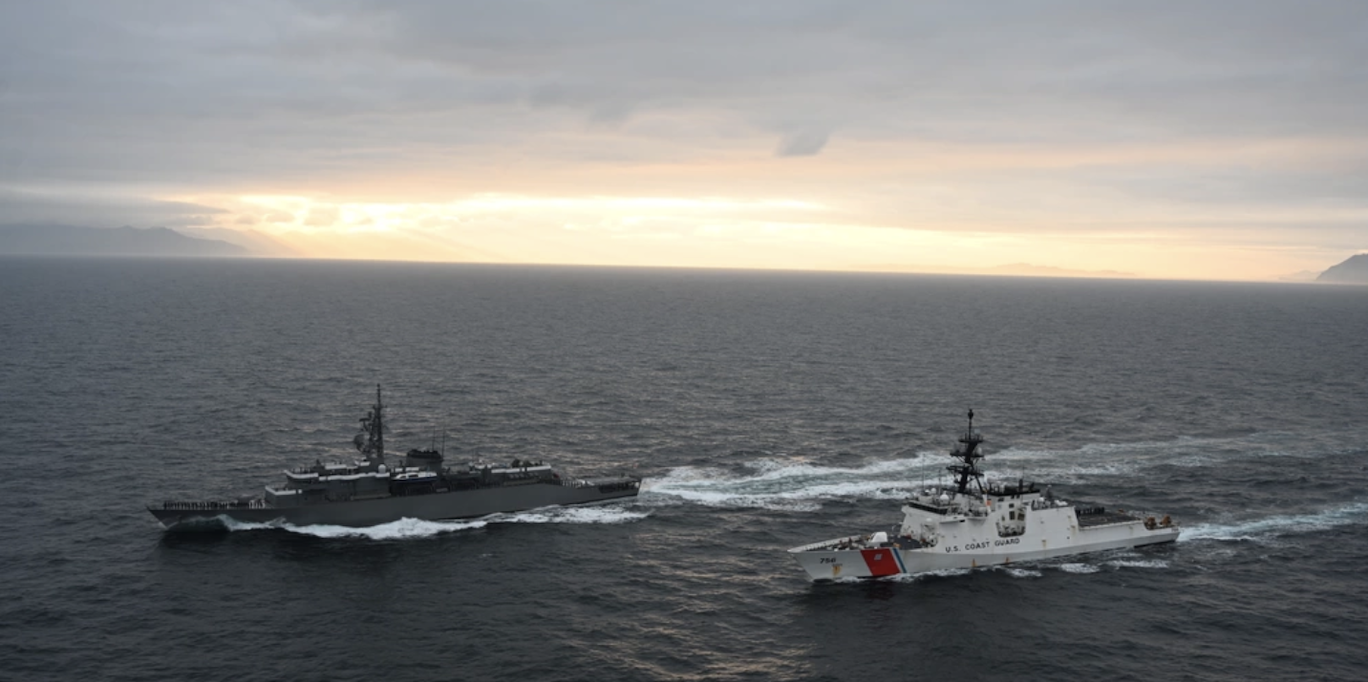
The U.S. Coast Guard Cutter Kimball, right, and a Japanese naval training vessel travel near the island of Unalaska in 2021. (U.S. Coast Guard photo)

The Alaska Beacon reports on the local reaction to the presence of Chinese ships in the Bering Sea, July 6 and 7.

The reaction clearly favored a more powerful and more visible response than a Coast Guard cutter and C-130.

So why use a cutter? Wouldn’t a destroyer or frigate be more appropriate?

A destroyer would have been faster, but the cutter is actually faster than the frigates the Navy is currently building.

The immediate answer is that there probably were no US Navy surface combatants in the vicinity, but would that have even been desirable?

What if they had suddenly become hostile?

Well, the cutter would probably have been sunk. That is a fact, but that is probably equally true of a destroyer outnumbered and taken by surprise at close range. Losing a cutter would be less of a loss and a prompt response from the Air Force would follow, probably quickly sinking the Chinese warships that have no fighter protection. That’s assuming they had not already been sunk by a US Navy submarine that may or may not have also been following them.

The US Navy just does not routinely keep surface vessels in the area of the Aleutians. Apparently, the Chinese were only there for two days. It would probably take longer than that for a USN combatant to make a transit, putting it out of position for its normal duties.

They were probably only doing this because the US does Freedom of Navigation Exercises in their backyard. But their response just plays into our narrative that we have every right to transit the Taiwan Straits–Look, they are transiting a narrow passage between US islands, and we didn’t object.

Would I like to see the cutters better equipped to defend themselves, sure, but it probably would not make any difference if they came to blows. Meanwhile the cutter makes a pretty good AGI. 

The Chinese are unlikely to start a war in the Aleutians unless they simultaneously also start it somewhere else, like Taiwan, but we still want to keep an eye on them, to discourage mischief.

Thanks to David for bringing this to my attention.

NSC and FRC Participate in Navy COMTUEX

USCGC Stone completes an Underway Replenishment.

The Navy League’s online magazine, Seapower, has a report on a recent Navy/Marine Composite Training Unit Exercise (COMPTUEX), “WASP ARG AND 24TH MEU COMPLETE JOINT FORCE’S MOST COMPLEX TRAINING,” that included an interesting note,

“U.S. Coast Guard Maritime Security Response Team (MSRT) East, USCGC Stone (WMSL 758), and USCGC Angela McShan (WPC 1135) participated in numerous events alongside the Navy and Marine Corps team to train and increase proficiency.”

I think this is a bit unusual, so it raised some questions in my mind. Training for doing LE boardings is normal and using a Coast Guard patrol craft to play an opposing force would not be that unusual, but the presence of USCGC Stone, a national security cutter (NSC), seems out of the ordinary. Is this just a one off or is there significance for Coast Guard Defense Readiness planning? Was this an experiment?

This particular COMTUEX was also otherwise unusual because an Amphibious Ready Group (ARG) does not normally have a destroyer attached.

So why would an NSC be involved? There are several possibilities, some mundane, some perhaps groundbreaking.

The post reports the training included, “events such as live-fire exercises, strait transits, maritime security exercises, amphibious landings, maritime interdiction, non-combatant evacuation operations, foreign humanitarian assistance, and counter-unmanned aerial systems (C-UAS) engagements.”

  • We know Stone did an Underway Replenishment.
  • There was an opportunity for formation steaming.
  • It may have been an opportunity to do some cross deck helicopter operations.
  • If Stone is to be included in the upcoming RIMPAC exercise (June and July), this would have been a good tune-up.

Now I will offer a couple of more imaginative, some will say imaginary, possibilities.

If an amphibious operation is conducted, Coast Guard units might provide SAR in case any of the landing craft are sunk. An NSC with Helicopter(s) would make a good SAR commander, while FRCs could follow the landing craft close into the beach, just as cutters did during the Normandy invasion.

Until recently, ARGs have generally operated without escort vessels. While operating off the hostile shore of a near peer adversary would probably require more than one AAW escort, there may have been a recognition that even during long transits from the West Coast, there may be a submarine threat.

The destroyer in this case, USS Cole (DDG 67), was a Burke class Flight I. When they were designed, they were expected to accompany aircraft carriers that had both fixed and rotary wing ASW aircraft in their air wing, so their design did not include helicopter hangars. The carrier based fixed wing aircraft are no longer active, and an ARG does not normally include ASW helicopters. Having seen National Security Cutters hosting Navy H-60s during the last two RIMPAC exercises, perhaps pairing an NSC with a Flight I Burke class DDG could provide a roost for ASW helicopters near the center of the formation while allowing the DDG greater flexibility in its positioning. The cutter could also function as plane guard, following the big deck amphib the way an escort is normally assigned to follow a carrier in case an aircraft goes into the water.

(During the Second Gulf War a WHEC assigned to a Carrier Strike Group functioned as plane guard and also provided a TACAN beacon because the one on the carrier was inoperative. All the other escorts had departed the scene to be in position to launch a Tomahawk missile strike.)

“MEDIA AVAILABILITY: US Coast Guard to commission newest national security cutter, named for first Master Chief Petty Officer of the Coast Guard, in North Charleston, South Carolina” –news release

USCGC Calhoun 759 arrives Charleston.

Below is a news release from Coast Guard News.


April 16, 2024

NORTH CHARLESTON, S.C.  — The Coast Guard is scheduled to hold a commissioning ceremony for the U.S. Coast Guard Cutter Calhoun (WMSL 759), the service’s newest national security cutter, Saturday, in North Charlston. The event will be presided over by Coast Guard Commandant Adm. Linda Fagan. The cutter’s namesake comes from the first Master Chief Petty Officer of the Coast Guard, Charles L. Calhoun. The commissioning ceremony’s date of April 20 is in honor of Calhoun’s birthday.

WHO: Coast Guard Commandant Adm. Linda Fagan; Master Chief Petty Officer of the Coast Guard Heath Jones; Capt. Timothy Sommella, the commanding officer of the Calhoun; and Calhoun crew members.

WHAT:  Commissioning ceremony for the Coast Guard’s newest national security cutter.

WHEN: Saturday, April 20, 2024, at 10 a.m.

WHERE: Federal Law Enforcement Training Center, 2000 Bainbridge Ave., North Charleston, SC 29405.

Editors’ Note: Interested media are requested to RSVP by emailing a list of members’ names to Ensign Cody Meyers at Cody.L.Meyers@uscg.mil for base access no later than 5 p.m. Wednesday. Credentialed media are asked to arrive no later than 9 a.m. Saturday with a driver’s license and proof of insurance to clear security. 

“Coast Guard Cutter Procurement: Background and Issues for Congress, Updated March 25, 2024” –CRS

USCGC David Duren is the first of three FRCs to be homeported in Astoria, OR

The Congressional Research Service (CRS) has again updated their “Report to Congress on Coast Guard Cutter Procurement”. (This link will always take you to the most recent edition of the report.) My last post on this evolving document was in reference to the October 19,2023 update. I have reproduced the one-page summary in full below. It gives a good picture of where we are. (The CRS report on icebreakers has also been updated.)

There have been other updates in the interim, but I have been looking forward to this one because it reports the 2024 budget as enacted into law, and (surprise, surprise) it includes two Fast Response Cutters that were not in the 2024 budget request. From page 35,

“Enacted The explanatory statement for Division C of H.R. 2882/P.L. 118-47 of March 23, 2024, provides the funding levels shown in the “Enacted” column of Table 1. The explanatory statement states that the increase of $200.0 million for the FRC program is for “no less than two Fast Response Cutters and the economic price adjustment for Fast Response Cutters funded in prior years”.”

There was a request for four additional FRCs in the Unfunded Priorities List. The House Appropriations Committee had wanted to fund four ($355M) while the Senate Appropriations Committee approved none. Apparently, they compromised. (Nice to see bipartisan support.)

Two Additional FRCs ($216M) are also in the 2025 budget request. (The appropriation amounts include addition funds for FRC program support over and above shipyard construction costs.)

If you do the math, you will see that there has been a departure from the original “Program of Record” (8 NSCs, 25 OPCs, and 58 FRCs for 91 total). The current program will provide 11 NSCs, 25 OPCs, and 67 FRCs (one of which severely damaged in a fire) for a total of 102 operations ships, 104 if we get the two additional FRCs in the FY2025 budget.

While this may look like a large gain, the number of large patrol cutters (36 over 1000 tons) is well below historical norms (=>41), while demands on the cutter fleet have grown substantially, no OPCs have been actually delivered, and the entire WMEC fleet is already well overage.


Summary
The Coast Guard’s program of record (POR), which dates to 2004, calls for procuring 8 National Security Cutters (NSCs), 25 Offshore Patrol Cutters (OPCs), and up to 71 Fast Response Cutters (FRCs) as replacements for 90 aging Coast Guard high-endurance cutters, medium-endurance cutters, and patrol craft.

National Security Cutters are the Coast Guard’s largest and most capable general-purpose cutters; they are replacing the Coast Guard’s 12 Hamilton-class high-endurance cutters. NSCs have an estimated average procurement cost of about $670 million per ship. Congress has fully funded the procurement of 11 NSCs—three more than the 8 in the Coast Guard’s POR. The Coast Guard’s proposed FY2024 budget requested $17.1 million in procurement funding for the NSC program. The Coast Guard’s proposed FY2025 budget requests $7.0 in procurement funding for the NSC program, and the Coast Guard’s FY2025 Unfunded Priorities List (UPL) includes an item for an additional $50.0 million in procurement funding for activities relating to the 11th NSC. Nine NSCs have entered service; the Coast Guard accepted delivery of the 10th on October 13, 2023, and plans to commission it into service in 2024. The 11th is under construction.

Offshore Patrol Cutters are intended to replace the Coast Guard’s 29 aged medium-endurance cutters. Coast Guard officials describe the OPC program and the Polar Security Cutter (PSC) program (which is covered in another CRS report) as the service’s highest acquisition priorities. The first four OPCs are being built by Eastern Shipbuilding Group (ESG) of Panama City, FL. The Coast Guard held a full and open competition for a new contract to build the next 11 OPCs (numbers 5 through 15). On June 30, 2022, the Coast Guard announced that it had awarded a fixed-price incentive (firm target) contract to Austal USA of Mobile, AL, to produce up to 11 offshore patrol cutters (OPCs). The Coast Guard’s proposed FY2024 budget requested $579.0 million in procurement funding for the construction of the sixth OPC and other OPC program costs. The Coast Guard’s proposed FY2025 budget requests $530.0 million in procurement funding for the construction of (once again) the sixth OPC and other OPC program costs, and states that the requested FY2024 procurement funding would now be for the construction of the fifth OPC rather than the sixth.

A June 2023 Government Accountability Office (GAO) report on the OPC program states “The OPC’s total acquisition cost estimate increased from $12.5 billion to $17.6 billion between 2012 and 2022…. In addition, the program incurred a 1.5-year delay in the delivery of the first four OPCs…. GAO also found indicators that the shipbuilder’s significant level of complex, uncompleted work may lead to further delays.”

Fast Response Cutters are considerably smaller and less expensive than OPCs; they are replacing the Coast Guard’s 49 aging Island-class patrol boats. The Coast Guard’s FY2020 budget submission estimated the total acquisition cost of the 58 cutters intended for domestic use at $3.748 billion, or an average of about $65 million each. A total of 65 FRCs have been procured through FY2023. As of March 25, 2024, 54 FRCs have been commissioned into service. The Coast Guard’s proposed FY2024 budget requested $20.0 million in procurement funding for the FRC program, and the Coast Guard’s FY2024 UPL included an item for $400.0 million in procurement funding for procuring four more FRCs at an average cost of $100 million each, to provide increased Coast Guard presence and engagement with allied and partner countries in the Indo-Pacific region. The Coast Guard’s proposed FY2025 budget requests $216.0 million in procurement funding for the FRC program for the procurement of two more FRCs for operations in the Indo-Pacific region, plus additional FRC program costs.

“Coast Guard Cutter Bertholf arrives in Singapore”

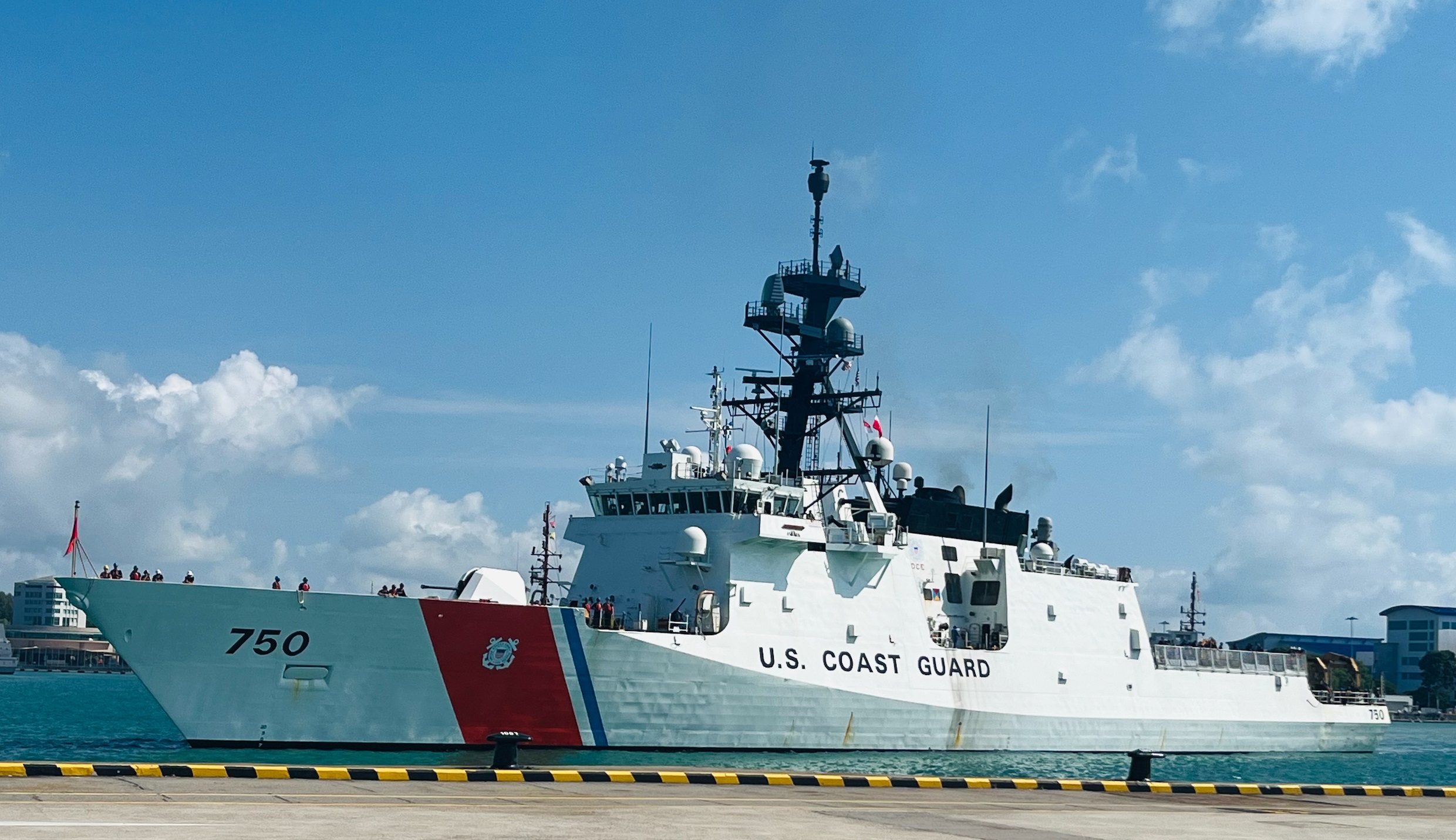
U.S. Coast Guard Cutter Bertholf (WMSL 750) arrives at Changi Naval Base in Singapore, Feb. 25, 2024. The Bertholf moored next to USS Gabrielle Giffords (LCS 10), a U.S. Navy Littoral Combat Ship, also in the region to support an open Indo-Pacific region. (U.S. Coast Guard photo by Cmdr. Trevor Parra)

Below is a US Coast Guard news release. You can find more photos at the link. 


March 5, 2024

Coast Guard Cutter Bertholf arrives in Singapore

SINGAPORE – U.S. Coast Guard Cutter Bertholf (WMSL 750) and crew arrived in Singapore, Feb. 25, after transiting more than 8,000 nautical miles over 30 days from San Diego, Calif.

During the visit to the Republic of Singapore, the crew of the cutter is scheduled to participate in several professional engagements and at-sea exercises.

The two-day professional meetings will allow for collaboration, exchanges of best practices, and operational planning for the scheduled two-day exercises at-sea with the Republic of Singapore Navy vessel, Guardian. In addition to the Republic of Singapore Navy, the crew of the Bertholf intend to work with the Singapore Police Coast Guard and Malaysia Maritime Enforcement Agency.

“The crew of the Bertholf is excited to be in Singapore and looking forward to the many events with the crew of the Republic of Singapore Navy, Police Coast Guard, and Malaysia Maritime Enforcement Agency,” said U.S. Coast Guard Capt. Billy Mees, commanding officer of the Bertholf. “The Indo-Pacific region is a dynamic environment and fostering partnerships with our allied nations helps ensure we improve maritime governance in these crucial economic waterways.”

Bertholf is one of four National Security Cutters homeported in Alameda. The U.S. Coast Guard currently maintains 10 National Security Cutters. Bertholf is operating as part of Commander, Task Force (CTF) 71, U.S. 7th Fleet’s principal surface force, promoting a free and open Indo-Pacific, strengthening partner networks, and enhancing maritime safety and security.

Bertholf is the first legend-class national security cutter and has a range of 12,000 nautical miles, endurance of up to 90 days and can hold a crew of up to 170. Coast Guard Cutter Bertholf is homeported in Alameda, Calif.

“Replacing a Legend: The Next Generation National Security Cutter” –USNI

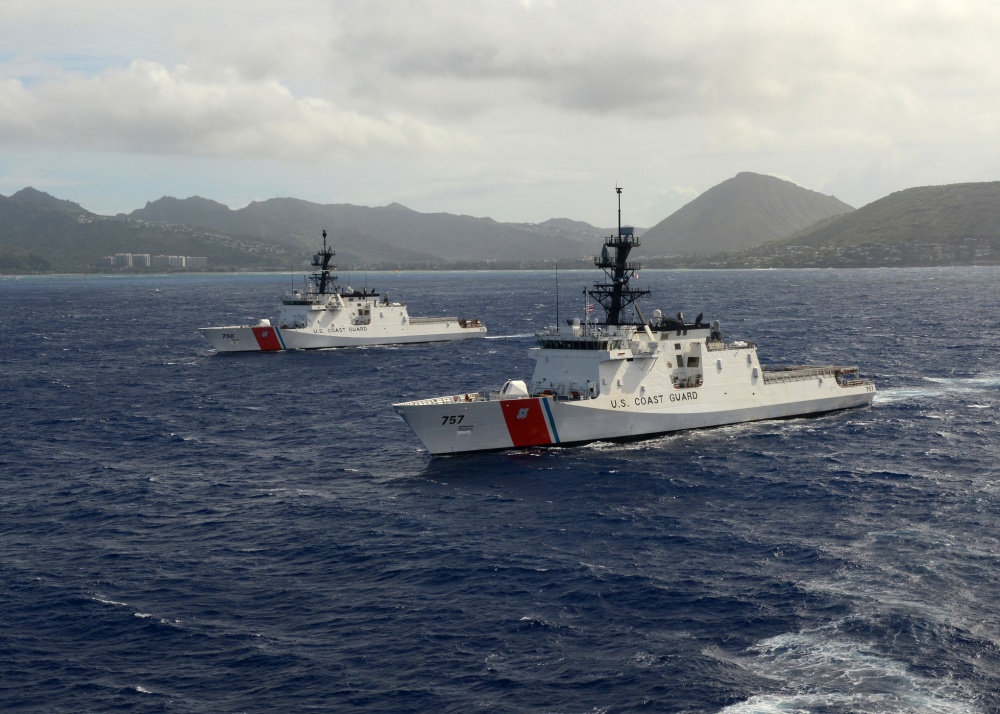
The crews of the Coast Guard Cutters Midgett (WMSL 757) and Kimball (WMSL 756) transit past Koko Head on Oahu, Hawaii, Aug. 16, 2019. The Kimball and Midgett are both homeported in Honolulu and two of the newest Coast Guard cutters to join the fleet. (U.S. Coast Guard photo by Petty Officer 3rd Class Matthew West/Released)

Sorry, this is late. I got bogged down in details. So, this is a streamlined commentary, but I hope still relevant. 

The December 2023 issue of US Naval Institute Proceedings has an article by Lieutenant Brian Adornato, U.S. Navy Reserve, suggesting it is time to consider designing a replacement for the Bertholf class National Security Cutters.

He points out that, based on the history of the Offshore Patrol Cutter and the Polar Security Cutter, it now typically takes 14 years from project initiation to commissioning.

“The Coast Guard began discussions with industry regarding the medium-endurance cutter replacement, the offshore patrol cutter (OPC), in 2010. The first OPC is scheduled to commission in 2024.2 The initial integrated product team for the next heavy ice breaker, the polar security cutter (PSC), was assembled in 2013, and the first ship is scheduled for delivery in 2028.3 The first NSC was commissioned in 2008 with a service life of 30 years, so the Coast Guard must start the process now to field the NSC(X) in 2038.

The Coast Guard is going to have to change its behavior if we are going to start replacing National Security Cutters (NSC) when they are “only” 30 years old. But even if we don’t, that doesn’t mean we should not be considering new cutter designs.

The first NSC was commissioned more than 15 years ago so its concept and requirements really originated more than 20 years ago and there is still one more ship that has not been delivered yet.

The OPCs’ concept was firmed up more than 10 years ago and the last is not expected to be delivered until 2038. That would be more than 25 years from concept to deployment of the last ship. I don’t think it will happen. I don’t think it should happen. It would be putting our collective brains on cruise control.

Instead, we should periodically reevaluate. One design may not be the most economical way to meet all our needs where weather, endurance, speed, and facilities vary from location to location. Trying to meet the most demanding requirements of every possible environment may preclude building enough ships to do all the missions well.

We know the Coast Guard has completed a new Fleet Mix Study. It has not been made public, but you can bet it suggests we need more large patrol ships. The original 2009 Fleet Mix Study indicated we would need 66 large cutters (NSCs and OPCs) to meet all our statutory mission requirements, and if anything, our commitments seem to have increased.

In 2000, when the program of record was being formulated, the Coast Guard had 44 patrol ships of six classes, each over 1000 tons full load. (12 x 378s, 13 x 270, 16 x 210, Alex Haley, Acushnet, and Storis).

Ships were distributed in recognition of their relative strengths and weaknesses. Stout, very sea worth, but relatively slow ships, Alex Haley, Acushnet, and Storis were based in Alaska to do fisheries patrol. 10 of 12 WHEC378s were assigned to the Pacific to take advantage of their long legs and seakeeping to conduct Alaska Patrol and deal with the great distances in the Pacific. 210s were generally assigned to where the weather was more benign, so that their small size was not a significant disadvantage. 270s, more seaworthy than the 210s, but not really suitable for Alaska Patrol, were generally assigned to more Northerly East Coast homeport from which they did fisheries and drug enforcement.

The original Program of record would have provided only two classes totaling 33 large patrol ships (8 NSCs and 25 OPCs). Congress has added three NSCs so it looks like we are working toward 36 (11 NSCs and 25 OPCs)

Once the announced decommissionings are completed, looks like we will have 33 (10 NSCs, 13 x 270s, Alex Haley, and 9 x 210s). I don’t expect any numerical increase as the last NSC and OPCs are completed and WMECs are decommissioned. Certainly, if we proceed as planned, we can’t expect to have even 36 until the completion of the OPC program in 2038.

The last Fleet Mix Study did not attempt to identify minimum requirements for different mission sets, rather it considered using only the NSC, OPC, and FRC as possible alternatives. This meant that the cutters might be “over qualified,” for specific missions and locations, because alternatives with different sets of characteristics were not considered. Being overbuilt may not sound like a bad thing, but if it means you can’t build as many ships as you need, it is.

The out years on the contracts we have are options. If the Coast Guard determines that it would be better served by contracting for a different design in the out years, the Coast Guard is free to do so, and, at this time, there are not even options for the last ten OPCs.

We know change is the only constant. Demands on the Coast Guard change. What the Coast Guard does changes. Technology options change. Threats change. I would argue the Defense Readiness mission has taken on increased urgency.

We need to reevaluate periodically. We really should have at least two broad classes of patrol cutters, the larger more capable ship that can operate in the most demanding environments and a second more numerous type to operate in the more typical circumstance. You can’t really say that is the case if we only have NSCs and OPCs, their size and capabilities are too similar. I am not a particular fan of the HEC/MEC designations, but it is a familiar construct that conveys the idea (why not WPL and WPM, Coast Guard Patrol Large and Patrol Medium).

Designs need to be reevaluated at least every ten years, we might decide to continue to build what we are building, but that should be a conscious decision, not just sleepwalking.

We could do it as rotating five year programs. I would suggest we need a true medium cutter than can be built in larger numbers than the OPC first and then look at designs for a new large cutter. That would still give us time to go through all the steps that seem to be necessary to design and contract for a ship.

The designs of the NSC and OPC were about ten years apart and it has now been more than ten years since the design of the OPC. We should not let our design and contracting skills atrophy. It is time to at least start the process to see if we cannot come up with a better design to address our changing requirements.

We should never stop building patrol cutters. I suspect we need more than 60. We really should be producing two per year, either one large patrol cutter and one medium patrol cutter or two medium patrol cutters every year.