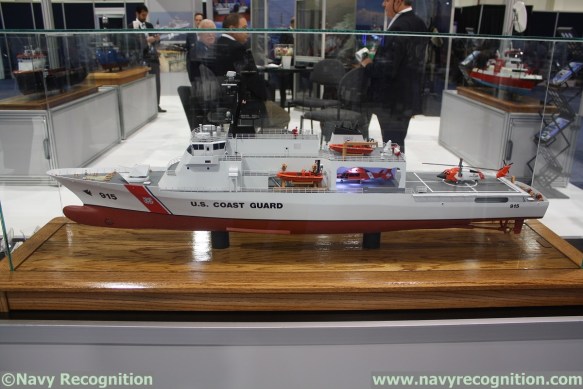
A Billion Dollar, Once in a Lifetime Opportunity

IMG_4128

I have been reading over Congressional Research Service’s Specialist in Naval Affairs Ronald O’Rourke’s prepared statement before the House Transportation and Infrastructure Committee’s Coast Guard and Maritime Transportation Subcommittee Hearing on The Status of Coast Guard Cutter Acquisition Programs, February 3, 2016. The implications are a bit startling.

By using Block Buy Contracting (BBC) and Multi-Year Procurement (MYP), the Coast Guard might save as much as $1.2B. This is an opportunity that may not come again for at least 30 years.  

This breaks down to about $100M on contracting for the remaining 26 Fast Response Cutters, $100M on a contract for two heavy icebreakers, and a whopping $1B over the life of the Offshore Patrol Cutter procurement.

We have never used these contracting methods before, but the Navy has with great success in their Burke class DDG, Virginia class submarine, and LCS programs.

The Congress has already granted authority to use Multi-Year Procurement (MYP) for the Offshore Patrol Cutter program, but because of the requirement of the law covering MYP a contract under these provisions probably could not be negotiated until at least FY2022 by which time the first five ships would have already been contracted for. Block Buy Contracting would require specific enabling legislation but could allow additional savings beginning in FY2018.

I would encourage reading the entire statement. There are only seven pages of testimony and ten pages of background appendices, but I’ll provide a “Reader’s Digest” version. Hopefully the author will forgive me for re-editing his work.

“The Coast Guard has used contracts with options in cutter acquisition programs. A contract with options may look like a form of multiyear contracting, but operates more like a series of annual contracts. Contracts with options do not achieve the reductions in acquisition costs that are possible with MYP and BBC.

“MYP can reduce the unit procurement costs of ships by roughly 10%, compared to unit procurement costs under the standard or default approach of annual contracting. BBC can reduce the unit procurement costs of ships by amounts comparable to those of MYP, if the authority granted for using BBC explicitly includes authority for making economic order quantity (EOQ) purchases (i.e., up-front batch purchases) of components. If the authority granted for using BBC does not explicitly include authority for making EOQ purchases, then the savings from BBC will be less—in the range of roughly 5%. EOQ authority comes automatically with MYP authority, but must be explicitly included in legislation granting BBC authority.

BBC, unlike MYP, can be used at the outset of a shipbuilding program, starting with the lead ship in the class. (emphasis applied–Chuck) MYP, in contrast, cannot be used until the lead ship has completed construction. Thus, for a class of ships that is procured at a rate of one ship per year and in which each ship takes five years to build, BBC can be a contracting option starting with the first ship in the class, and MYP can become a contracting option starting with the fifth or sixth ship in the class. This difference is due to the requirement under the statute governing MYP (10 U.S.C. 2306b) that a program must demonstrate design stability to qualify for MYP. In a shipbuilding program, design stability is typically demonstrated by completing the construction of the lead ship in the class.

“The Coast Guard wants to procure a total of 25 OPCs, and currently plans to use a contract with options for acquiring the first 9 to 11 ships in the program. The OPC program can be viewed as a candidate for instead using BBC for the initial ships in the program, and either BBC or MYP for later ships in the program. If using BBC and MYP were to reduce the acquisition costs of OPCs by about 10% (compared to costs under a contract with options), the savings would amount to roughly $1 billion. An alternate way to characterize such savings would be to say that using BBC or MYP would enable the Coast Guard to get about two and a half of the 25 OPCs for “free,” or to pay for the acquisition of a polar icebreaker.

“The Coast Guard plans to soon award a contract with options for acquiring the final 26 ships in the 58- ship FRC program. The final 26 ships in the program can be viewed as a candidate for instead using either MYP or BBC. If using MYP or BBC were to reduce the acquisition costs of OPCs by about 10% (compared to costs under a contract with options), the savings would amount to more than $100 million. An alternate way to characterize such savings would be to say that using MYP or BBC could enable the Coast Guard to get about two and a half of the 26 FRCs for “free.”

“The Offshore Patrol Cutter (OPC) program and the polar icebreaker (PIB) program can be viewed as candidates for using BBC, and the Fast Response Cutter (FRC) program can be viewed as a candidate for using either MYP or BBC. Using MYP and BBC for all three of these programs might produce savings totaling about $1.2 billion, an amount roughly equivalent to the average annual funding level in the Coast Guard’s Acquisition, Construction, and Improvements (AC&I) account. In considering whether to grant authority for using MYP or BBC for these programs, Congress may weigh the potential savings of these contracting mechanisms against the tradeoffs…From a congressional perspective, tradeoffs in making greater use of MYP and BBC include the following:  reduced congressional control over year-to-year spending, and tying the hands of future Congresses;  reduced flexibility for making changes in Coast Guard acquisition programs in response to unforeseen changes in strategic or budgetary circumstances (which can cause any needed funding reductions to fall more heavily on acquisition programs not covered by MYP or BBC contracts);  a potential need to shift funding from later fiscal years to earlier fiscal years to fund EOQ purchases of components;  the risk of having to make penalty payments to shipbuilders if multiyear contracts need to be terminated due to unavailability of funds needed for the continuation of the contracts; and  the risk that materials and components purchased for ships to be procured in future years might go to waste if those ships are not eventually procured.”

There seems little doubt we will need all the ships currently planned. The commitment is only a minuscule percentage of the Federal Budget, and therefore constitutes an extremely small risk. Use of Block Buy and Multi-Year Procurement could bring stability to the Coast Guard’s AC&I funding and result savings equal to an entire year’s worth of AC&I funding.
57 mm Guided Projectile

NavyRecognition reports initial unguided tests have been conducted on the proposed guided round for the Mk110 57 mm gun that is mounted on the National Security Cutters (class of 9 ships) and is expected to be deployed on the projected 25 Offshore Patrol Cutters.

If we could get a laser designator with sufficient range (over 4000 yards) I would think the CG would be more interested in the laser seeker than the millimeter radar version because we are more likely to want to target a specific area on a large target than we are to need to engage multiple small targets which would suggest the fire and forget round.

Laser designators might would be useful with small missiles like Griffin or Hellfire as well. They might be used from small boats and aircraft as well.

Document Alert: Coast Guard Cutter Procurement: Background and Issues for Congress

Samsung

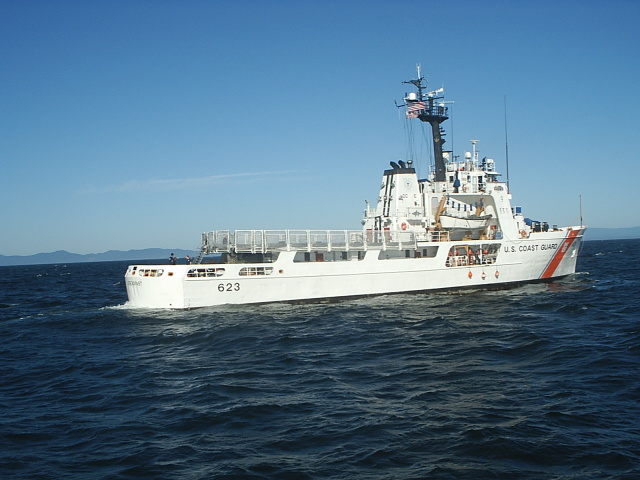
Photo: USCGC Steadfast, one of the newer 210 class, now about 48 years old. We don’t expect her replacement for at least another ten years.

The US Naval Institute has published the Congressional Research Services latest version of Coast Guard Cutter Procurement: Background and Issues for Congress, by their Naval Affairs Specialist, the ever prolific Ronald O’Rourke.

It is not quite up to date, because it does not reflect funding for a ninth National Security Cutter, but otherwise it nicely defines the issues the program has been faced with, most notably inadequate funding.

It also raises the question, should multi-year or block buy funding, with its potential for substantial savings, be pursued? We really should be doing this for the Webber class, which is a proven, mature design, approved for full rate production. In fact, we should have been doing this for a couple of years now.

The thing I found most disturbing was that the first Offshore Patrol Cutter (OPC) will not be funded until FY2018, although it looks like the detail design will be funded in FY2017. I am beginning to wonder if we will see the first OPC before 2022.

The FY2016 budget was a pleasant surprise with the addition of funds to build a ninth National Security Cutter. If this near $2B funding level is seen as a new norm (as I would hope) there will be room in the FY2017 budget for another major acquisition. It might be a tenth NSC. That would not be an altogether bad thing, but it would be outside the needs identified in the Fleet Mix Study. Unless another major project is injected into the FY2017 budget, we will loose the momentum for a larger AC&I budget.

If the FY2017 NSC, OPC, and FRC funding is as indicated in the document (see pdf page 14, marked at page 10), most of the shipbuilding funds will go for what looks like five or six more Webber class. There are smaller amounts for the OPC and NSC programs for a total of only $557M. There may, however, be the opportunity to fund a big part of the new polar icebreaker, as the Commandant has suggested, if the AC&I budget remains at least equal to the FY2016 level.

GAO Report on Operational Test and Evaluation of the National Security Cutter

USCGC_Waesche_by_Yerba_Buena_Island

GAO has published a report on the National Security Cutters, GAO-16-148, contending, “Enhanced Oversight Needed to Ensure Problems Discovered during Testing and Operations Are Addressed.” Note, it goes beyond problems discovered during tests and evaluation, to include other problems encountered during operation.

Results are interesting. In many ways it sounds discouraging, with ten major deficiencies found during testing, but on the basis of my very limited experience with this sort of thing, I suspect it is at least no worse than average. After all, the cutter was rated as operationally effective and suitable. The Littoral Combat Ship program is very much a contemporary program, and it is also still undergoing testing.

During testing there were problems with the gantry on the stern, the single point davit, the gun, air search radar, and the Nulka decoy system. I did find it a bit troubling that essentially, all the weapon systems seemed to be having problems.

Probably more troubling are the problems encountered during operations, “…the NSC’s engines and generators have experienced persistent problems, the reasons for which are not yet known. As a result of these and other equipment casualties, the NSC has been operating in a degraded condition in some mission areas, even while having spent fewer days away from home port than planned.” Problems with the main engines include an inability to maintain full power while operating in warm water due to over heating and incidents of cracked cylinder heads at a higher than normal rate, page 31-35.  Generator bearings are overheating and failing at an unacceptable rate, page 35/36. The generator problems have resulted in ships operating with no functional back-up generator.

You can find a list of “Initial Operational Test and Evaluation Major Deficiencies and Coast Guard plans to resolve them” in Table 5, page 23/24.

Table 6, page 28 identifies “Retrofits and Design Changes for the National Security Cutter Class with Costs over $1 Million as of June 2015” totaling $202.1M. This is of course an incomplete list, in that additional changes are expected. Changes are also expected for the ammunition hoists, and the stern and side doors.

Replacement of the Gantry Crane (page 29): The crane, intended to move boats around the stern, was not designed for a salt water environment. I’m sorry, whose idea was this? How was this ever acceptable. If the shipyard picked the crane, I think they owe us at least the cost of replacement. A replacement has apparently been successfully prototyped.

Single Point Davit, page 30: The davit doesn’t work in high sea states, and it is not compatible with the Over the Horizon Boat IV so the ships end up with three different type boats. A replacement for this has also been prototyped.

Appendix II provides a “Summary of the Key Performance Parameters of the National Security Cutter,” page 42/43.

“As we found in 2015, during 2013 and 2014 the NSC fleet spent fewer days away from home port than the Coast Guard’s interim goal of 210 days. In addition, the NSCs operated in a degraded condition in one or more mission areas during a majority of their time spent in operations from 2010 to 2014 due to major equipment casualties.”

But the ships have a degree of redundancy and a depth of capability that allowed them to carry on.

“Although the NSC was often operating with major casualties during the period we examined, during the period from September 2013 through September 2015 the NSC was not mission capable as a result of maintenance needs only about 2 percent of the time, indicating that the casualties experienced during those years did not prevent the NSC from maintaining at least partial mission capability.”

Despite the lack of maturity of these assets, in terms of routing out systemic problems, that 2% figure is far better than the legacy fleet.

There was also a somewhat surprising note that the NSCs have space, weight, and power for a mine detection system.

We have Bryant’s Maritime Consulting to thank for the link to this document. 

The Navy’s New Design for Maintaining Maritime Superiority–CNO

Download the pdf here.

Recently the new Chief of Naval Operations has issued a document , “A Design for Maintaining Maritime Superiority” that outlines how, hopefully, the US Navy can maintain a maritime superiority our foes will recognize and avoid confronting.

If you are looking for anything specifically regarding the Coast Guard here, you will not find it (other than the cutter in the formation on the cover). The Coast Guard is not mentioned even once, but it does talk about some things that are Coast Guard related. Perhaps we should not feel bad about this. It only mentions the Marine Corps once.

He talks about three forces that are changing the environment: 

  • The first global force is the traffic on the oceans, seas, and waterways, including the sea floor – the classic maritime system.
  • A second increasingly influential force is the rise of the global information system – the information that rides on the servers, undersea cables, satellites, and wireless networks that increasingly envelop and connect the globe.
  • The third interrelated force is the increasing rate of technological creation and adoption.”

Obviously the Coast Guard facilitates and regulates marine traffic and is tapped into the global information system. In wartime, these contacts will become essential. He also talks about new trade routes opening in the Arctic, that will only be reliable if we have new icebreakers. He also talks about illegal trafficing.

“This maritime traffic also includes mass and uncontrolled migration and illicit shipment of material and people.”

For once, finally, a document explicitly recognizes the competition,

“For the first time in 25 years, the United States is facing a return to great power competition. Russia and China both have advanced their military capabilities to act as global powers. Their goals are backed by a growing arsenal of high-end warfighting capabilities, many of which are focused specifically on our vulnerabilities and are increasingly designed from the ground up to leverage the maritime, technological and information systems. They continue to develop and field information-enabled weapons, both kinetic and non-kinetic, with increasing range, precision and destructive capacity. Both China and Russia are also engaging in coercion and competition below the traditional thresholds of high-end conflict, but nonetheless exploit the weakness of accepted norms in space, cyber and the electromagnetic spectrum. The Russian Navy is operating with a frequency and in areas not seen for almost two decades, and the Chinese PLA(N) is extending its reach around the world.

“…Coupled with a continued dedication to furthering its nuclear weapons and missile programs, North Korea’s provocative actions continue to threaten security in North Asia and beyond.

“…while the recent international agreement with Iran is intended to curb its nuclear ambitions, Tehran’s advanced missiles, proxy forces and other conventional capabilities continue to pose threats to which the Navy must remain prepared to respond.

“…international terrorist groups have proven their resilience and adaptability and now pose a long-term threat to stability and security around the world.”

He recognizes budgetary limitations.

“There is also a fourth ‘force’ that shapes our security environment. Barring an unforeseen change, even as we face new challenges and an increasing pace, the Defense and Navy budgets likely will continue to be under pressure. We will not be able to “buy” our way out of the challenges that we face. The budget environment will force tough choices but must also inspire new thinking.”

Throughout there is an emphasis on understanding history and the strategic concepts of the past. There is also a recognition of the need to work with partners.

“EXPAND AND STRENGTHEN OUR NETWORK OF PARTNERS: Deepen operational relationships with other services, agencies, industry, allies and partners – who operate with the Navy to support our shared interests.

Other than the Marine Corps, the US Navy has no closer partner than the USCG. The partnership has been a long and successful one, but I would like to see the Navy be a better partner to the Coast Guard.

What I want to see:

If we have “run out of money, now we have to think.” One thing we can do, is to try to get the maximum return from the relatively small investment needed to make the Coast Guard an effective naval reserve force.

  • We need explicit support from the Navy at every level, particularly within the Congress and Administration, for Coast Guard recapitalization.
  • We need an explicit statement from the Navy that they expect the Coast Guard to defend ports against unconventional threats, so that they can keep more forces forward deployed.
  • We need the Navy to supply the weapons we need to defend ports against unconventional attack with a probability approaching 100% ,including small missile systems like Hellfire or Griffin to stop small, fast, highly maneuverable threats and light weight anti-ship torpedoes that target propellers to stop larger threats, and we need those systems on at least all cutters of Webber class and larger.
  • We need to reactivate the Coast Guard’s ASW program and insure that all the new large cutters (NSC and OPC) have and ASW capability, if not installed on all of the cutters, at least planned, prototyped, tested, and practiced on a few ships (particularly in the Pacific).

(Note there is another post on this looking at the “design” from a Navy point of view.)

“Opinion: Coast Guard Budget Reductions Puts U.S. at Risk”–USNI

The US Naval Institute has a nice opinion piece by a retired Navy Rear Admiral, advocating restoration of funding cut from the Coast Guard budget over the last few years, and not incidentally greater number of National Security Cutters (NSC) to replace the High Endurance Cutters.

This is not the Admiral’s first editorial advocating for the Coast Guard. Whatever his affiliation, his opinions are on point, and I would really like to see the Congress add a ninth NSC to the budget

Long Range Interceptor In Action

I would not normally talk about a routine law enforcement action, but this video has some interesting aspects.

Stratton recently intercepted a second semi-submersible, that had been spotted by a Navy patrol aircraft, arresting its four crewmembers and recovering 12,000 pounds of its 16,000 pound cargo of Cocaine, before the semi-submersible sank under tow.

What I wanted to point out in the video was:

First, the instrumentation on the 35 foot Long Range Interceptor ship’s boat (time 1:12). (Correction–I made and error here, this is actually the instrumentation on a 26 foot “Over-the-Horizon (OTH) IV” of which the Coast Guard has procured 101.) It looks a lot like the “glass cockpit” of a modern light plane. Long Range Interceptors are only deployed by the Bertholf class National Security Cutters. (The OTH-IV is operated from the NSCs, WHECs, WMECs, and WPCs. Anyone know if they are also operated from WAGBs and WLBs?)

Second, was the way the boat was recovered in the stern ramp of Stratton (2:25 to 3:00). Note there is no one in the bow to attach the line that will pull the boat up onto the ramp. In 2013 we had a fatality on the Waesche because the automatic capture mechanism was not working properly and Petty Officer Travis Obendorf was on the bow of the boat. You can access the accident report here.

ASuW Hellfire Test Success–Operational Late 2017

Navyrecognition reports that a successful test of modified Hellfire missiles for use in the Surface to Surface Missile Module (SSMM) planned for the Littoral Combat Ship has paved the way for operational deployment of the system in late 2017.

We have talked about these missiles before. They seem to be an ideal way to deal with the threat of small, fast, highly maneuverable boats that might be employed by terrorists, and absent more effective weapons, may provide some capability against even large vessels. Unlike gun systems, they promise high first round accuracy and lethality, with very little chance of a round going astray and hitting something unintended.

The projected SSMM would provide storage and launch facilities for up to 24 rounds. 24 rounds would weigh only about 2500 pounds. The launcher and support systems is unlikely to weigh more than that, suggesting and all up weight of about 5000 pounds, far less than either the 76mm Mk75 gun or the 57mm Mk110 (two and a half tons compared to eight or nine tons). Both of these guns are commonly used on missile and patrol boats smaller than the Webber class WPCs. Also unlike a gun system, the SSMM is unlikely to require any significant deck reinforcement.  It would almost certainly fit on all large cutters and perhaps the WPCs and WPBs as well. (It should be included on Offshore Patrol Cutters from day 1.) If the 24 round system is too large to be comfortably carried by smaller cutters, it is likely a smaller, say four round, system could be quickly and economically developed for Coast Guard use and perhaps for the Navy’s MkVI patrol boat as well.

If we take the Ports, Waterways, and Coastal Security mission seriously we really should be looking seriously at acquiring these systems, not just for the new ships as they are built, but also for the existing fleet with the idea that the systems would be transferred to the newer ships as the older ones are replaced.

The Navy should be willing to pay for these systems under existing inter-service agreements.

As noted before, if we need to stop a terrorist attack, we are far more likely to have a WPC or WPB on scene than a larger cutter. For this reason, arming some the Webber class in each homeport should be the first priority. Unfortunately the Webber Class are not geographically wide-spread, so we should look at mounting systems on existing MECs and WPBs to insure all potential targets have some protection until the entire fleet is armed.

I would say there are places where they might be mounted on Coast Guard stations ashore, to act as gate keepers for the ports against clandestine attacks, but coast defense is still an Army mission. Perhaps this is something we should be talking about too. If not Coast Guard manned defenses (which is probably the proper solution), then perhaps placement of unused SSMMs with their associated Navy crews on Coast Guard facilities or small detachments of army troops with their weapons to perform this function.

Document Alert–Coast Guard Cutter Procurement

USNI news service has posted a copy of the Congressional Research Services latest take on the Coast Guard Vessel recapitalization program, “Coast Guard Cutter Procurement: Background and Issues for Congress.”  As usual their “Specialist in Naval Affairs,” Ronald O’Rourke, has done an excellent job and by simply stating the facts has made a strong case for recapitalization.

There are some criticisms implicit in the recitation of events thus far. I think it is apparent that the Crew Rotation Concept is proving an embarrassment, in that while we have now had three operational “National Security Cutters” for some time, there has been no attempt to validate the concept, and no attempt to repudiate this relic of the Deepwater program. The concept is a non-starter we have discussed several times. Ships are not cars in a motorpool. You cannot swap entire crews and expect good results. Time to piss or get off the pot. This bad news is not going to get better with age.

Limited progress on UAVs was also discussed.

The Coast Guard’s Missing Links–the Commandant

The Coast Guard Compass has published a post by the Coast Guard Commandant Adm. Paul Zukunft arguing for Offshore Patrol Cutter. This is obviously a topic close to my heart, and I don’t think anyone will mind if I quote it here whole cloth.

“Twenty miles east of the Dominican Republic, the Coast Guard Cutter Charles Sexton rescued 117 people from a dangerously overcrowded 30-foot makeshift craft. Hours later, the Coast Guard Cutter Stratton interdicted $14 million worth of cocaine and apprehended three suspected smugglers. In two days, on two coasts, two assets proved the multi-mission might of the U.S. Coast Guard as crews saved lives, secured our border and severed cash flows to a transnational criminal enterprise.

“The Charles Sexton, a 154-foot fast response cutter, and the Stratton, a 418-foot national security cutter, are part of the Coast Guard’s persistent presence, patrolling and protecting more than 95,000 miles of coastline and 4.5 million square miles of the U.S. Exclusive Economic Zone – home to our Nation’s precious resources, including our oil, natural gas, fish and mineral reserves. The vastness of this area, paired with our array of missions, requires a network of Coast Guard surface and air assets on shore and at sea to preserve America’s security and prosperity.

“Missing from this network – the necessary link between the national security cutter’s open ocean endurance and the fast response cutter’s littoral presence – is the offshore patrol cutter. The offshore patrol cutter will promote governance and provide capability on our oceans – the gateway for U.S. economic growth, opportunity and prosperity. It is here, beyond 50 nautical miles from U.S. shores, where national interests in the U.S. maritime domain require the Coast Guard’s unique blend of authorities. And, it is the offshore patrol cutter that will protect our sovereign interests, enforce laws, save lives, protect fisheries, secure offshore energy resources and provide command and control for major response and contingency operations.

“Currently, the 1960s-era 210-foot and the 1980s-era 270-foot medium endurance cutters are the link between the Coast Guard’s national security cutters and fast response cutters. However, this link is under untenable strain, characterized by decreasing readiness and skyrocketing maintenance costs. In the last two years, four of these aging ships had to be pulled out of service for emergency repairs, straining our ability to support and maintain other ships and aircraft, impacting crew safety and quality of life and diminishing the Coast Guard’s ability to project U.S. authorities and respond to crisis in the maritime domain. This past weekend, I went aboard our newest medium endurance cutter, Coast Guard Cutter Mohawk in Key West, Florida. Mohawk was commissioned in 1991 and will continue to serve our Nation until it is replaced with the next generation of offshore patrol cutters close to five decades after she began her service.

“I carried these thoughts with me as I set foot aboard the Coast Guard Cutter Robert Yered, one of our newest fast response cutters. Leaping forward nearly half a century from our oldest ships, the Robert Yered’s modern, high-tech systems are fully interoperable with our partners in the interagency and international community as it executes missions across our littorals. This nimble fast response cutter is not, however, without its limitations. It cannot launch and recover aircraft – a necessary capability in the Coast Guard’s operational network of assets – and has limited range and endurance relative to our major cutters. The Coast Guard must have flight deck capable ships with robust command and control capabilities exactly where we need them, from the farthest reaches of the transit zone off of Central America to our northernmost borders off of Alaska. The offshore patrol cutter is designed to fill this need.

“Our aging platforms do not suffer from neglect. Coast Guard men and women consistently demonstrate exceptional commitment and innovation to sustain a medium endurance cutter fleet that has served admirably for more than five decades. In fact, our first medium endurance cutter went to sea the very same year the first Mustang rolled off Ford’s assembly lines. Unlike antique cars, however, which are often restored at great expense and used for the occasional fair weather Sunday drive, the increasingly expensive ships of America’s Coast Guard are painstakingly maintained and regularly put to work in the harshest maritime conditions.

“Indeed, not having reliable use of these aged medium endurance cutters, the linchpin of our operational network, puts us at a disadvantage at a time when we are needed most. Given the complex threats facing the Nation today, we simply do not have the luxury of storing them in the garage.

“The U.S. Coast Guard has a proud history spanning nearly 225 years. We have won federal acquisition awards, maintained clean financial audits and earned a reputation for responsible stewardship. We cannot afford to dull our operational edge and jeopardize our Service to Nation any longer. The Nation deserves better, and the offshore patrol cutter is the answer.”