“AUSTAL USA EXPANDS MANUFACTURING CAPACITY WITH DESIGN FOR NEW FACILITY AND SHIPLIFT” –News Release

Austal’s planned new assembly building and ship lift. Ships featured in the illustration, Constellation class FFG, 496 ft (151.18 m) loa, and an Offshore Patrol Cutter, 360 ft (110 m), provide scale.

Below is a Austal USA news release.

June 2022 Austal was awarded a contract with options for up to eleven Offshore Patrol Cutters (OPCs #5 to #15). OPC #5 was in the FY2023 budget. It appears OPC #6 will be in the FY2024 budget. I expect we may see OPC #5 delivered in 2027, #6 in 2028, #7 in 2029 and both #8 and #9 in FY2030.

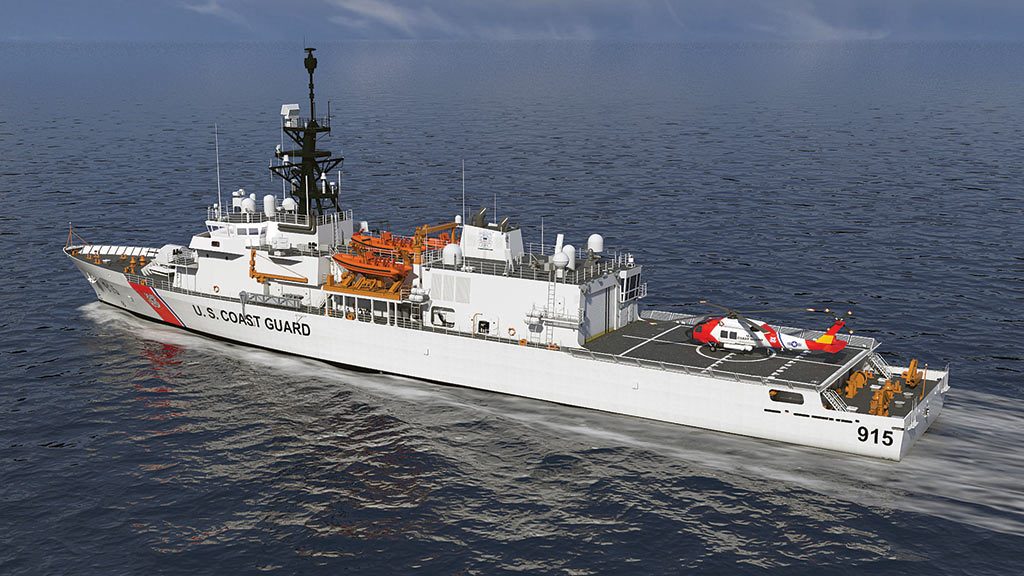
Eastern launched the future USCGC Argus, OPC #1, in Oct. 2023. Even so, it is not expected to be commissioned until 2025. Eastern has said they will deliver OPC#4 in 2026. I have a hard time being that optimistic. It might be more reasonable to expect delivery of one per year, #2 in 2025, #3 in 2026, and #4 in 2027.

If Eastern turns out a good product at a competitive price, a renegotiation of their contract options for five more cutters included in the original contract could accelerate procurement of these long-delayed ships, and reduce the resource shortfall that now seems inevitable.


FEBRUARY 6, 2024

MOBILE, Ala. – Austal USA announced the start of design for a new manufacturing facility signifying a major expansion of the company’s Mobile, Ala. shipyard capability.  The infrastructure expansion, which will be to the south of Austal USA’s current waterfront facility, will include a new assembly building, waterfront improvements, and a new shiplift system.  Start of construction on the project is planned for summer 2024.

The construction of this new building and waterfront support area, which includes a Pearlson-designed shiplift, continues the expansion Austal USA began in March 2021 with the groundbreaking of the steel panel line. In addition to the manufacturing capacity of the new buildings, the shiplift will provide a safe and reliable system to launch ships as they are completed in the assembly buildings. The system will also enable retrieving ships and bringing them back on the land-side facility.

“With the steel panel line in full production our expansion focus has shifted to the erection and launch facilities required to support our growing backlog,” commented Austal USA acting President Michelle Kruger.  “This new facility is continuing evidence of the close relationship we have with our local community including our community leaders; local, state and federal political leaders; and, regional organizations such as the Mobile Area Chamber of Commerce.”

Austal USA has partnered with Pearlson & Pearlson Inc, program manager and owner’s representative; Kiewit Infrastructure South Co., lead for design and construction; and, Pearlson Shiplift Corporation, designer and builder of the shiplift system, to execute the project.  The new assembly building will consist of three bays and enable erection of recently awarded steel ship contracts as well as provide the flexibility to manufacture modules for submarine and other surface ship programs.  The assembly building will be approximately 400 feet long by 480 feet wide providing over 192,000 square feet of covered manufacturing space occupying four and a half acres.

The Pearlson-designed shiplift system will feature an articulated lifting platform approximately 450 feet long by 125 feet wide, capable of lifting and launching vessels in excess of 18,000 long tons. This capacity will facilitate the launch and docking of the U.S. Navy Constellation-class Frigates, TAGOS-25 class Ocean Surveillance Ships, Independence-variant Littoral Combat Ships, and the U.S. Coast Guard Heritage-class Offshore Patrol Cutters.

When complete Austal USA’ s Mobile, Ala. facility will include a 117,000 square foot steel panel line, two module manufacturing facilities totaling over one million square feet of covered manufacturing space optimized for serial production, and seven assembly bays providing over 400,000 square feet of indoor erection space.  In all, the Mobile facility covers 180 acres and, when this project is complete, over 1.5 million square feet of indoor manufacturing space.

“SNA 2024: Adaptable Deck Launcher, MK 70 Missile Launcher, PAC-3 Missile and SPY-6 Radar” –Video

The video above is from Naval News via Youtube.

Just wanted to point out that, should a need arise to equip the NSCs, OPCs, or even icebreakers for combat, there are two options in the video above:

As to alternatives, on the NSCs, we know they were designed to be able to accept twelve MK56 VLS and could probably accept eight Mk41 VLS in their normal deck penetrating configuration. Using quad packed ESSMs this could allow them to carry up to 32 ESSMs or alternately perhaps 16 ESSMs and four vertical launch ASROC. (Since the latest versions of the ESSM are fire and forget weapons that no longer require an “illuminator,” it now requires less supporting electronics and can engage more than one target at a time.) 

I know of no information publicly available that suggests planned upgrades for the OPCs, although I did speculate, “What Might a Wartime OPC Weapons Fit Look Like?

The Mk70 would probably just be a temporary install on the flight deck to meet the requirements of a planned operation, but there is little doubt we could put at least four strike length four tube launchers, on NSCs, OPCs, or icebreakers.

For the OPC, the Adaptable Deck Launcher is a possible more permanent installation and would probably be mounted on the Focs’le. Weight and space requirements might mean a trade-off would be required. Loss of the 57mm in exchange for even four Mk41 tubes might be worthwhile, but we might also consider replacing the gun with eight deck penetrating Mk41 cells. If Strike length cells proved impossible, tactical length cells could still provide weapons with anti-air, anti-surface, and ASW capabilities we do not have with the 57mm.

Potential Mk41 VLS weapons load outs for tactical and strike length launchers.


“Struggling Austal USA Can Only Be Fixed By Big Changes…In Australia” –Forbes

Future USCGC Pickering (Image: Austal USA)

Forbes reports on, Offshore Patrol Cutter builder, Austal’s continuing difficulties.

The author, Craig Hooper, whom I regard as a friend of the Coast Guard, was at one time an Austal executive, departing in 2013. I would have to believe; he knows what he is talking about.

Thanks to Nick for bringing this to my attention.

“New court doc sheds light on Austal’s 2022 Offshore Patrol Cutter win” –Defense News

Future USCGC Pickering (Image: Austal USA)

Defense News reports,

“The court last month ruled against Eastern Shipbuilding, which had appealed the Coast Guard’s decision. The court unsealed the case documents Dec. 14, though with some redactions.”

There is a link to the 42-page court document, but really there is a lot more here than just the decision.

Eastern’s offer was judged better in several respects, but Austal’s price and indoor assembly facility were deciding factors.

“Ultimately, Austal’s proposal came to $3.22 billion, or about $292 million per hull, according to the unsealed documents.

“Eastern’s price is redacted in the documents but is characterized as a “very large price differential.””

It was noted,

“…only one OPC could be built in the indoor facility at a time, meaning the heel-to-toe production cadence could lend itself to “notable disruptions” to schedule.”

This suggests to me, that Austal might have trouble building more than two OPCs a year if the Coast Guard wanted to accelerate OPC production.

The paragraph below may refer to the same presentation by RAdm Jacoby discussed earlier, where he expressed a sense of urgency regarding the OPC program, but there is also an admission that maintaining the Medium Endurance Cutters has become problematic.

Coast Guard acquisition chief Rear Adm. Chad Jacoby said at a recent conference there’s no current plan to have both yards build concurrently into the future but that he’d be open to it if lawmakers increased annual OPC spending, since it’s “urgent” to get OPCs into the fleet to replace “the medium endurance cutters, which are struggling to maintain operational capability right now.”


“Coast Guard releases request for proposal for maritime unmanned aircraft system services” –CG-9

The unmanned aircraft sensor payload capability is varied based on the Coast Guard’s desired mission and search conditions: MWIR 3.5 is a mid-wave infrared for thermal imaging capability, for use at night or periods of low visibility; EO-900 is a high-definition telescopic electro-optical (EO) imager to zoom in on targets at greater distance; and ViDAR is a visual detection and ranging wide-area optical search system that is a comprehensive autonomous detection solutions for EO video. Courtesy Photo.

Below is a news release from the Acquisitions Directorate (CG-9). The solicitation is for Group 2 or 3 UAS.

The minimum performance specifications are not particularly demanding, including:

  • 50 knot cruise speed,
  • 70 knot dash speed,
  • 12 hours daily continuous coverage, but that could include two sorties,
  • Range 40 nmi in clear conditions, 35 nmi in light rain,
  • Operate from a flight deck 80 x 48 feet (Host Cutter drawings provided are for NSC, but also presumably OPCs. Not likely for icebreakers or Alex Haley because they have no air search radar, see below) within limits:  pitch +/- 3 degrees, roll +/- 5 degrees.
  • The UA must have space, weight, and power to concurrently operate vendor
    provided: Electro-Optical (EO) sensor, Infra-Red (IR) sensor, AIS, VHF/UHF
    communications relay, aeronautical transponder, and non-visible IR marker for
    the required flight endurance. (I found no minimum payload weight.)

There are some interesting specifications that may reflect how the systems are used.

  • The UA must provide a non-visible, near-IR marker or FDA approved illuminator to
    aid manned assets using NVDs for target acquisition at night
  • The UAS must be capable of operations in light icing conditions defined as
    accumulation of ¼ inch of ice in 15-20 minutes (Objective)(so not a minimum requirement–Chuck)
  • The UA must have an Infrared (IR) anti-collision lighting subsystem (providing a night visibility range of 3+ statute miles) producing energy emitted in a 360-degree pattern around the UA +30 degrees (above) and -30 degrees (below) the horizontal plane of the UA. The IR-light intensity must be at least of a Class B Night Vision Imaging System (NVIS) radiant intensity (NRIb) of 2.31 E -04 NRI. The Ground Control Station must have the capability to turn the IR anti-collision light on or off.
  • In addition to other sensor requirements identified in this document, when such a
    system is commercially available, the UA must be capable of incorporating a
    collision avoidance system (i.e. Detect and avoid (DAA) or Sense and avoid (SAA)
    systems) to extend the UA’s range beyond the host cutter’s air search radar
    envelope while maintaining compliance with international due regard. (Objective) (Not a minimum requirement. Meaning we will likely be operating these systems without a sense and avoid system, so will have to operate within the range of the cutter’s air-search radar. Also precludes operating these systems on vessels without an air-search until such a system is installed–Chuck)
  • At an operating altitude of 3,000 feet when the UAS is directly overhead of the target of interest (no slant range), the UA must be acoustically non–detectable per MIL STD-1474 (series), Level 1, requirements (quiet rural area with the closest heavily used highway and community noises at least 2.5 miles away)
  • The Contractor provided Datalinks must be capable of operating, with
    unobstructed Line of Sight (LOS), at a minimum range of 40 nautical mile
    (NM) (threshold) / 100 NM (Objective).

This sounds very much like a continuation of the Scan Eagle operations already being conducted on National Security Cutters (here, here, here, here, and here). Forgive me if I point out that I recommended we try this system back in 2011, five years before we actually did.


Coast Guard releases request for proposal for maritime unmanned aircraft system services

The Coast Guard released a request for proposal (RFP) Dec. 12 for maritime unmanned aircraft system (MUAS) services capable of deploying from Coast Guard cutters. The services sought are for contractor-owned, contractor-operated intelligence, surveillance and reconnaissance.

Requirements for the MUAS include fully automated flight operations, a minimum 12 hours of flight time a day, ability to be launched and recovered from the host cutter flight deck, and ability to provide services 24 hours a day, seven days a week. The MUAS must be capable of carrying a payload including electro-optical and infrared sensors and communications relay and be capable of providing surveillance, detection, classification and identification for all of the host cutter’s operational missions.

The Coast Guard plans to award one indefinite-delivery, indefinite-quantity firm fixed price contract. Initially, the contract will be used to continue UAS capability on the national security cutter (NSC) class; however, the contract could be used to support additional cutter classes in the future.

The full RFP is available here. Responses are due by 1 p.m. EST Jan. 11, 2024.

For more information: Unmanned Aircraft Systems Program page

“Coast Guard cutter program’s third phase could see rematch between Austal, Eastern Shipbuilding” –Breaking Defense

Future USCGC Pickering (Image: Austal USA)

Breaking Defense Reports,

A senior Coast Guard officer overseeing the Offshore Patrol Cutter program indicated he’d be open to working with either Austal or Eastern Shipbuilding Group for the third phase of the program, potentially setting up a rematch between the two companies with billions of dollars in work on the line.

For the first time, this report seems to reflect a sense of urgency on the part of the Coast Guard procurement team,

“All I want is ships as fast as I can get them,” said Rear Admiral Chad Jacoby when asked about maintaining two shipbuilders for the Offshore Patrol Cutter Program.

It’s about time. Replacement of the WMECs has been dragged out about two decades longer than it should have been.

The current situation is that Eastern was awarded a contract with options for up to nine Offshore Patrol Cutters in September 2016.  That should have kept the company busy into at least 2026. Now it looks like they will not be finished with the first four before 2026. The program was seriously delayed at least partly due to a hurricane that hit the shipyard. Eastern asked for extraordinary relief and relief was granted in the form of higher prices and delayed delivery, but the Coast Guard decided they would only exercises options with Eastern for ships one through four. They embarked on a second competitive bid for up to eleven ships, 5 through 15 which was awarded to Austal in June 2022. That contract should keep Austal busy until 2032 with the last contract to be awarded (I believe) in 2029.

The Coast Guard now says the Offshore Patrol Cutter and Polar Security Cutter are the services highest priority programs, but it has taken too long for the OPC to become a priority. We should have been building them in parallel with the National Security Cutter, just as we built WHECs and WMECs in parallel in the 1960s. The National Security Cutters were funded at a rate averaging about one every two years, so there were several years after the first NSC was funded when no major cutter was funded. At the very least we should have at least been funding one in those years. We might have been able to fund two WMEC replacements in years when we were not funding NSCs. In fact, both programs should have been begun in the 1990s. Why didn’t we? Our operational analysis, contracting, and naval engineering staffs had been gutted and atrophied. We can’t let that happen again.

Phase 3? Are we talking about an award in the near future or perhaps as a follow on to Austal’s contract for OPCs #5 through 15, e.g. about 2030?

If phase 3 is in the near future, would Austal even be able to build additional ships while also completing phase 2? I don’t really think we are ready to award a contract for ten additional ships in the near future.

If phase 3 is to begin following the last Fiscal Year of funding for phase two (about 2030) then Eastern will no longer have a hot production line.

If it is not Eastern or Austal, in the two contracts so far, the contractor was expected to build do a detail design and then begin building one ship each year for the first three years and only then begin building two ships per year. I don’t think we want a third subclass. I don’t think we want to go back to funding a new detail design or funding only one ship per year. Other shipyards probably would not be competitive anyway since Eastern and Austal will have both gone through the learning curve and would have substantial advantages over competitors.

Take another look at Eastern’s Contract. 

If as I believe, we will not be ready to contract for ten more ships in the near future, but we don’t want to wait until after OPC#15 when Eastern’s production line will be cold, to award phase 3, there may be another option.

If we are now confident that Eastern is competent and competitive, maybe we could revisit and renegotiate the original contract to provide at least two and potentially up to five additional OPCs.

Thanks to Lee for bringing this to my attention. 

“Three Improved Interior Features the New Offshore Patrol Cutters Have Over the Medium Endurance Cutters” — by Peter Ong

Friend and contributing author Peter Ong provides us a bit of information about the interior of the Offshore Patrol Cutter. 


While the exterior details of the OPCs are generally known among readers, what about the OPC’s interior features, and how are three OPC’s interior features improved over the 270-foot and 210-foot Medium Endurance Cutters (MECs) that have served for 30 to 55 years, respectively?

The USCG Office of Public Affairs, Coast Guard Headquarters, Washington, DC, replied to my inquiry in late November 2023.

“Like the National Security Cutters, the Offshore Patrol Cutters (OPC) will have smaller berthing areas to accommodate mixed-gender crews, crew lounges, training rooms, and a gym. What makes the OPCs unique is that the cutter’s design is focused on improving flow (i.e., how the crew can go about their day-to-day routine as easily as possible). Here are a few examples:

  • Mixed-gender Locker Room between Combat Information Center (CIC) and the Boat Deck: The OPC will have an actual locker room, similar to shore-based boat stations, that allows personnel to change into and out of their law enforcement and boat gear attire. It will also be adjacent to the CIC and boat deck and co-located with a small arms locker/weapons issue station and a dedicated washer/dryer.

  • Food/Stores Flow: OPC reefers and dry stores are located on the same deck and immediately adjacent to the galley and mess deck. There is also an elevator large enough to hold a standard-sized pallet going from the flight deck straight to dry stores (and vice versa).

  • Berthing/Stateroom Flow: Berthing areas and staterooms are more spread out than the Medium Endurance Cutters (MECs) but are also located near key watch areas for quick emergency response. Additionally, watchstanders will not have to transit through berthing areas during their rounds, unlike on the 210’ MECs.”

With an endurance of 60 days, the OPCs have the interior design improvements to accommodate a better operational and crew flow environment compared to the WMECs.

Offshore Patrol Cutter port quarter

“Coast Guard Cutter Procurement: Background and Issues for Congress, Updated Oct 19, 2023” –CRS

US Capital West Side, by Martin Falbisoner

The Congressional Research Service has again updated their “Report to Congress on Coast Guard Cutter Procurement”. (This link will always take you to the most recent edition of the report.) My last post on this evolving document was in reference to a August 30, 2022 update. I have reproduced the one-page summary in full below. It gives a good picture of where we are.

I will try to provide a little more detail after I get a chance to read the full report. Until then, remember that the full price of the ships includes much more than just the shipyard’s building costs. In addition to government furnished equipment, it includes the crew cost before the ship is accepted, their accommodations at the building site, and their training and travel. It may also include supporting shoreside infrastructure.


Summary
The Coast Guard’s program of record (POR), which dates to 2004, calls for procuring 8 National Security Cutters (NSCs), 25 Offshore Patrol Cutters (OPCs), and 65 Fast Response Cutters (FRCs) as replacements for 90 aging Coast Guard high-endurance cutters, medium-endurance cutters, and patrol craft.

National Security Cutters are the Coast Guard’s largest and most capable general-purpose cutters; they are replacing the Coast Guard’s 12 Hamilton-class high-endurance cutters. NSCs have an estimated average procurement cost of about $670 million per ship. Congress has fully funded the procurement of 11 NSCs—three more than the 8 in the Coast Guard’s POR—including the 10th and 11th in FY2018, which (like the 9th NSC) were not requested by the Coast Guard. The Coast Guard’s proposed FY2024 budget requests $17.1 million in procurement funding for the NSC program for post-delivery activities for the 10th and 11th NSCs, and for class wide activities. Nine NSCs have entered service; the Coast Guard accepted delivery of the 10th on October 13, 2023, and plans to commission it into service in 2024. The 11th is under construction.

Offshore Patrol Cutters are intended to replace the Coast Guard’s 29 aged medium-endurance cutters. Coast Guard officials describe the OPC program and the Polar Security Cutter (PSC) program (which is covered in another CRS report) as the service’s highest acquisition priorities. The first four OPCs are being built by Eastern Shipbuilding Group (ESG) of Panama City, FL. The Coast Guard held a full and open competition for a new contract to build the next 11 OPCs (numbers 5 through 15). On June 30, 2022, the Coast Guard announced that it had awarded a fixed-price incentive (firm target) contract to Austal USA of Mobile, AL, to produce up to 11 offshore patrol cutters (OPCs). The Coast Guard’s proposed FY2024 budget requests $579.0
million in procurement funding for the construction of the sixth OPC, the procurement of Long Lead Time Materials (LLTM) for the seventh OPC, and other program costs.

One oversight issue for Congress concerns substantial cost growth and schedule delays in the OPC program. A June 2023 Government Accountability Office (GAO) report on the OPC program states “The OPC’s total acquisition cost estimate increased from $12.5 billion to $17.6 billion between 2012 and 2022. The program attributes the 40 percent increase to many factors, including restructuring the stage 1 contract [for OPCs 1 through 4] and recompeting the stage 2 requirement [for OPCs 5 through 15] in response to a disruption caused by Hurricane Michael, and increased infrastructure costs for homeports and facilities, among other things. In addition, the program incurred a 1.5-year delay in the delivery of the first four OPCs due to Hurricane Michael and issues related to manufacturing the cutter’s propulsion system. GAO also found indicators that the shipbuilder’s significant level of complex, uncompleted work may lead to further delays.”

Fast Response Cutters are considerably smaller and less expensive than OPCs; they are replacing the Coast Guard’s 49 aging Island-class patrol boats. The Coast Guard’s FY2020 budget submission estimated the total acquisition cost of the 58 cutters intended for domestic use at $3.748 billion, or an average of about $65 million per cutter. A total of 65 FRCs have been procured through FY2023. As of August 10, 2023, 53 FRCs have been commissioned into service. The Coast Guard’s proposed FY2024 budget requests $20.0 million in procurement funding for the FRC program; this request does not include funding for procuring any additional FRCs. The Coast Guard’s FY2024 Unfunded Priorities List (UPL) includes, as one of its items, an unfunded priority for procuring four more FRCs (which would be the 66th through 69th in the program) for a combined procurement cost of $400.0 million, or an average of $100 million per
cutter, to provide increased Coast Guard presence and engagement with allied and partner countries in the Indo-Pacific region

“The Christening and Launch of U.S. Coast Guard Offshore Patrol Cutter ARGUS” –Video

Above we have a video of the christening and launch of the future USCGC Argus. Below my comments is Eastern’s news release.

The video is just over an hour. Preliminaries are over at about minute 10.

  • 17:30 Remarks by RAdm. Chad Jacoby, CG-9
  • 23:00 Admiral Fagan, Commandant
  • 31:45 Sponsor, Capt. Beverly Kelley, USCG (ret.)
  • 40:00 Christening
  • 56:00 Launch

Between the christening and the launch there is some explanation of the launch process.

It is a very large cutter and a good looking ship, but she is still months from delivery. Just to review how we got this far.

As to the follow-on ships:


EASTERN SHIPBUILDING GROUP CHRISTENS AND LAUNCHES U.S. COAST GUARD’s FIRST HERITAGE CLASS OFFSHORE PATROL CUTTER

PANAMA CITY, FL – Today, Eastern Shipbuilding Group christened and launched USCGC ARGUS (WMSM-915), the U.S. Coast Guard’s first Heritage-class Offshore Patrol Cutter (OPC). The ceremony was held at Eastern’s Nelson St. Shipyard in front of more than 3000 dignitaries and guests. Admiral Linda Fagan, Commandant of the U.S. Coast Guard, delivered the keynote address.

Ship Sponsor, Captain (Ret.) Beverly Kelley, had the honor of Christening the vessel. In her distinguished military career, Captain (Ret.) Kelley was the first woman to command a U.S. military vessel as the Commanding Officer of the 95-foot patrol boat, USCGC CAPE NEWAGEN and was the first woman to command both a medium endurance cutter and a high endurance cutter in USCGC NORTHLAND and USCGC BOUTWELL respectively.

“We are proud to christen this first of class national security asset in front of her crew today,” said Joey D’Isernia, CEO of Eastern Shipbuilding Group, Inc. “With each milestone we reach, our employees are constructing the most advanced and capable ship the U.S. Coast Guard has ever seen.”

“The Offshore Patrol Cutter (OPC) is one of the Service’s highest acquisition priorities and is absolutely vital to recapitalizing the capability provided by our legacy fleet of 210-foot and 270- foot Medium Endurance Cutters (MEC),” said Adm. Linda Fagan.

“We have overcome unprecedented challenges to arrive at this pivotal moment to witness this spectacular vessel enter the water for the very first time. People are only just beginning to see what this vessel is truly capable of and like the steel forged on her, we will not compromise,” said Joey.

Senator Rick Scott said, “It’s truly a monumental occasion in enhancing our national security as Eastern Shipbuilding Group’s Nelson Shipyard officially christens and launches the U.S. Coast Guard Offshore Patrol Cutter ARGUS (WMSM-915). Over the past few decades the need for our Coast Guard as grown globally with operations spanning the Artic, Antarctic, Middle East and Indo-Pacific, all while it continues to protect our valuable United States shoreline. This first-in-its-class vessel is a testament to the great coordination between Eastern Shipbuilding and the Coast Guard that now gives the service a much needed upgrade with the tools and capabilities needed for the great women and men of the Coast Guard to take the service even further in the future. As Florida’s U.S. Senator, I am fighting every day to support the continued success of Florida businesses and our Coast Guard as they work to ensure to safety and wellbeing of Americans across the nation.”

“The story of Offshore Patrol Cutter Argus is one of perseverance. Eastern Shipbuilding started working on Argus prior to Hurricane Michael. In the days that followed the storm, the Eastern Shipbuilding team returned to their yard ready to do their part,” said Congressman Dunn. “Despite the challenges of recovering from a catastrophic hurricane, this team stuck together to see this project through. This offshore patrol cutter means so much more than many realize. Argus is a reminder of not only how proud Eastern Shipbuilding and Florida’s Second Congressional District should be of their hard work and determination, but it is also a crucial asset to maintaining national security dominance.”

Over 1500 highly skilled craft employees and program professionals at Eastern Shipbuilding Group and 200 businesses from over 25 states are supporting the production of the first four Offshore Patrol Cutters in Panama City. The OPC is designed to conduct an array of missions including law enforcement, drug and migrant interdiction, search and rescue, disaster relief, and other homeland security and defense operations in support of the nation’s maritime security and border protection. The OPC design includes the capability of carrying an MH-60R or MH-65 helicopter and three operational over-the-horizon small boats.  The vessel is also equipped with a highly sophisticated Command, Control, Computers, Communications, Cyber, Intelligence, Surveillance, and Reconnaissance (C5ISR) suite that will greatly enhance the U.S. Coast Guard’s mission capabilities.

The first OPC is named for the Revenue Cutter Argus, which was one of the first 10 ships assigned to the U.S. Revenue Cutter Service, a predecessor service to the U.S. Coast Guard. Revenue Cutter Argus began 13 years of service to the newly formed United States of America in 1791.

“Christening and Launch Ceremony for U.S. Coast Guard’s First Offshore Patrol Cutter Friday, October 27, 2023” –Eastern Shipbuilding

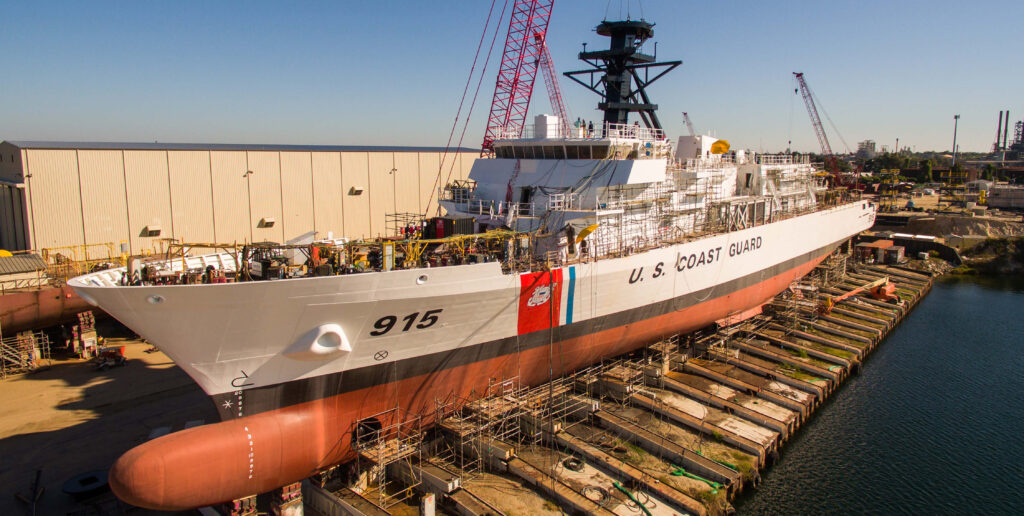
Future USCGC Argus building at Eastern. Eastern Shipyard photo.

Below is a news release from Eastern Shipbuilding. Good to see. 

MEDIA ADVISORY

Tuesday, October 17, 2023

Eastern Shipbuilding Group to Host Christening and Launch Ceremony for U.S. Coast Guard’s First Offshore Patrol Cutter

Friday, October 27, 2023

What:  Christening and Launch Ceremony for USCGC ARGUS (WMSM – 915)

Who:

Joey D’Isernia, CEO, Eastern Shipbuilding Group, Inc.

Admiral Linda Fagan, Commandant, USCG

Captain (Ret.) Beverly Kelley, Sponsor

Rear Admiral Chad L. Jacoby, Assistant Commandant for Acquisitions & Chief Acquisition Officer, USCG

Where: Eastern Shipbuilding Nelson Facility

2200 Nelson Street, Panama City, FL

When: Friday, October 27, 2023 – 1:00 PM central set up / 2:00 PM central event

The Christening and Launch of U.S. Coast Guard Offshore Patrol Cutter ARGUS (WMSM-915) is scheduled to take place at Eastern Shipbuilding Group’s Nelson Shipyard on October 27, 2023. The christening of the lead vessel of the Heritage Class Offshore Patrol Cutters is a historic event for the Coast Guard and marks the beginning of a new fleet of national security assets that will support critical missions at sea for decades to come. The christening ceremony is a time-honored tradition in shipbuilding that will recognize the history and significance of ARGUS and her sponsor, Capt. Beverly Kelley.

Request Media Credentials:
Please email Jessica Ditto at jditto@easternshipbuilding.com by Tuesday, October 24, 2023 to request media credentials and parking instructions.