gCaptain has a story, written by a Coastie, about a man with a love for the Coast Guard, who seems to exemplify the quote attributed to Woody Allen, “Eighty percent of success is showing up.”
An awful lot can be achieved by simple persistence.

gCaptain has a story, written by a Coastie, about a man with a love for the Coast Guard, who seems to exemplify the quote attributed to Woody Allen, “Eighty percent of success is showing up.”
An awful lot can be achieved by simple persistence.

Coast Guard Commandant Adm. Paul Zukunft delivers his first State of the Coast Guard Address and outlines how America’s Coast Guard will meet the challenges of today while preparing for complexities that remain ahead. U.S. Coast Guard video by Telfair. H. Brown, Sr.
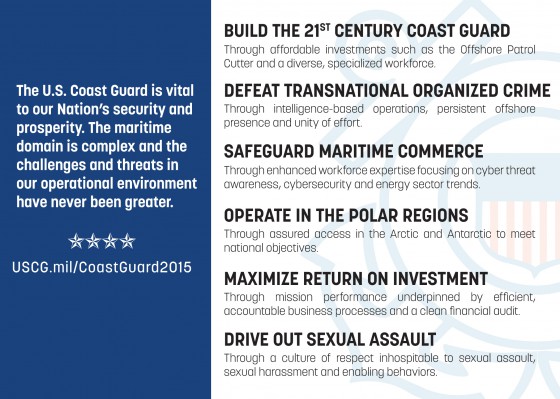
The Commandant has issued his State of the Coast Guard address, and I think you will find it well said, even inspiring. You can watch it above or read more here.
There is an upcoming event some of you might be interested in. It is the introduction of the new Navy/USCG/USMC strategy, “A Cooperative Strategy for 21st Century Seapower: Forward, Engaged, Ready”, slated for roll-out on March 13. Speakers include the Commandant, the Chief of Naval Operations, and the Commandant of the Marine Corps.
It will likely fill up quickly, so sign up soon if you want to go.
When: 3/13/2015 11:30 AM – 12:30 PM
Where: 1616 Rhode Island Avenue, N.W. Washington, DC 20036
Registration: http://my.csis.org/csis/CSIS1700/CSISEventRegistration.aspx?eventcode=2015_065
Cost: Free
Anyone want to be my on-scene reporter?
You gotta love a good story well told. Here are four.
Recently saw this on Bill Wells FaceBook page and thought it might be worth opening a discussion. I am republishing it here with his permission.
The current Coast Guard, and that of the immediate past, has relieved officers and enlisted men from command for any number of reasons. The “Relief for Cause,” or the “Loss of Confidence” reasons can mean anything and usually do. However, there is no legal process, the officer or enlisted man has little recourse and their careers as over. Many of the cases have devolved into using the “failure to abide by the Core Values.” It must be remembered that Core Values were implanted as part of the now defunct Total Quality Management System. The initial use of the values were to provide a guide for organizational conduct as shown in the Business Dictionary that defines Core Values as, “A principle that guides an organization’s internal conduct as well as its relationship with the external world. Core values are usually summarized in the mission statement or in a statement of core values.”
However, since inception the Core Values have been used as a hammer for punitive, extra-legal functions. The Coast Guard’s Core Values of Honor, Respect, and Devotion to Duty are claimed to have come from the Coast Guard’s history, but no one has pointed to that source. It is more faith and a belief system gone wrong. When first adopted no one could define just what the three words meant to the Coast Guard at large. So, explanatory paragraphs became additions to the words but these only confused the issue because the additional wording contained more core values, rules, and philosophical sloganeering. Still seeing the troops did not understand the additions, the Coast Guard added Twenty-Eight Competencies of leadership that all circled back to the Core Values providing more confusion.
So, how was the Old Guard tougher? They followed the prevailing rules. For example, in 1913 the Treasury Department charged Captain Horace B. West, USRCS, at a General R. C. S. Court with:
Neglect of Duty with six specifications.
Violating lawful regulations with eight specifications.
Conduct unbecoming an officer and gentleman with four specifications.
All these charges sound series until the reasons for the charges are known. West was found guilty on ‘neglect of duty’ and violating regulations and not guilty for unofficer-like conduct. His crimes consisted solely of his apparent dislike for paper work. West failed, according to the New York Times, to make “reply to several reports and communications transmitted to him from the Treasury Department. Although, the USRCS had had a service motto, “Semper Paratus,” since 1896, he was not charged being in violation of it and all it could have referenced was he was not ready to do paper work. The charges were not his first brush with not filing paperwork. In 1905, while in command of the cutter Woodbury at Portland, ME., he failed to submit assistance reports and for not having officers comply with a General Order. The assistance reports were more important because they provided the statistical data the Treasury Department used to justify the existence of the USRCS.
His sentence consisted of a suspension from the service for six months on half pay. A vacation of sorts and he resumed full service and his command with no real adverse effect on his career. Of course, West understood it all. He was an 1880 graduate of the Revenue Cutter School of Instruction (later the Coast Guard Academy).
The Treasury Department of West’s era would have never relieved him for cause. If they had specific charges and proof they brought the person to a legitimatize trial to exact that pound of flesh. Using the sloganeering of core values does little to inspire confidence in the ability of the Coast Guard’s leadership to address situations in a fair and military manner. Perhaps it is time to look at the Core Values and see that they do represent the Service beyond being a punitive cat o’ three tails.
Thursday the Commandant addressed the annual Surface Navy Association symposium in Arlington, Virginia. Navy Times has a short description of his address. It is certainly worth the read. Reading it, I get the impression, perhaps this Commandant is thinking outside the box, and recognizes that business as usual is not cutting it.
The summary includes comments on Drug Enforcement, Migrant Interdiction, and Polar Operations.
Thanks to James WF for bringing this to my attention.
The Navy has taken action to cure what has been seen as a lack of strategic thinking by establishing a Strategy subspecialty for unrestricted line officers.
Here is the relevant message: NAVADMIN 011/15, SUBJ/ESTABLISHMENT OF THE NAVAL STRATEGY SUBSPECIALTY 230X//
Interesting.
I got a request to pass along a message that a TV production company is seeking individuals interested in participating in a new reality show.
It appears to be legit, and, if it comes to fruition, it would not hurt to have a Coastie involved.
Are you looking for an action-packed sea adventure? Raw TV, the makers of Discovery’s hit series Gold Rush, is looking for experts to be the on-screen stars of a brand new show.
Have you got what it takes to survive some of the world’s deadliest seas? Could you tough it out on a remote desert island?
We are looking for people from a range of backgrounds such as fishing, sailing, military, security, survival & any other related fields. If you’re ready for an exciting new mission, get in touch: Email: sea@raw.co.uk
CdrSalamander offers us a cautionary tale, the story of Destiny Savage, Chief Engineer and acting XO/CO, to remind all in authority that the Naval Services are not really like StarTrek. There are still some lines that should not be crossed. But how does one go around the normal direct lines of authority?
The US Naval Institute News service has a short story about the evacuation of more than half a million people from Southern Manhattan following the attack on 9-11 as told by former Commandant James Loy. Apparently this is part of much larger oral history project.
Based on 15 interviews conducted by Paul Stillwell from August 2002 to August 2006. The volume contains 621 pages of interview transcript plus appendices and a comprehensive index. The transcript is copyright 2014 by the U.S. Naval Institute; the interviewee placed no restrictions on its use.
I’ve posted the video above before, but it is an excellent tribute to the spirit of those that responded so unselfishly to this attack.
 Chuck Hill's CG Blog