“Iran’s ‘Zulfikar’ Submersible Torpedo Boat” –Covert Shore

Covert Shores reports on Iran’s version of an unusual asymmetric threat that originated in North Korea. Used by the Islamic Revolutionary Guard Corps, PATFORSWA may encounter these.

“I originally interpreted these to be Special Operations assets intended as a form of swimmer delivery vehicle. This would be consistent with related types in North Korean and Vietnamese service. In that role the torpedoes would be for self-defense. However, I now view them more as submersible torpedo boats intended to sink ships with torpedoes.”

The torpedoes are 12.75 inch (324mm) light weight anti-surface homing torpedoes. (243mm noted in the diagram above is apparently a typo.) We can’t take too much comfort in the fact that these are not heavy weight torpedoes. Heavy weight torpedoes frequently break ships in half, but because water is not compressible, the 100 pound warhead of a typical light weight torpedo still has about one half the impact of the 600 pound warhead of a typical heavy weight torpedo. These smaller torpedoes can seriously hurt even a large ship, possibly including immobilizing it, and making it an easier target for follow on attacks. Used against a vessel the size of PATFORSWA’s Fast Response Cutters, they would be fatal. Assuming these are wake homers, it might be wise to learn the maneuvers used to defeat wake homing torpedoes.

It is unlikely these little submersibles can go very deep or that they have much mobility while submerged. Even so, much of the Persian Gulf is shallow, so there are certainly places where they could rest on the bottom, lying in wait.

PATFORSWA Photo from USNI

Five U.S. Coast Guard Sentinel-class fast-response cutters and two Avenger-class mine countermeasures (MCM) ships sail together in the Gulf of Oman, Nov. 3, 2023. Click on the photo to enlarge. US Navy Photo

An unusual photo from the December 28 edition of the US Naval Institute News Service’s Fleet and Marine Tracker. The Avenger class, like the cutters, are based in Bahrain.

Why this get together? I presume this is an exercise in which the FRCs protect the MCM ships from Iranian drones or small craft swarm tactics. Alternately the exercise may have been for the cutters to protect high value units, with the MCM ships simulating larger ships, but FRCs already routinely escort high value units, though I don’t think I have seen this many involved in a single operation.

Late addition: 

“Inside the U.S. Navy’s Cutting-Edge Drone Boat Tech”–WSJ

A reader brought the video above to my attention, recognizing the significant Coast Guard participation in the program. 

Below I have reproduced the text that accompanied the video on YouTube. 


Drone boats appear to be on the cusp of a revolution. The U.S. Navy’s Task Force 59 has been pairing cutting-edge unmanned surface vehicles with artificial intelligence to expand the military’s eyes and ears in the Middle East. Now, similar efforts will be rolled out in the Pacific and Central and South America. The military’s objective is to leverage machine learning to detect and anticipate threats before they occur. Experts say the U.S. is currently the leader in this field, but competitors like China and Russia are racing to catch up. I traveled to Manama, Bahrain to see the high-tech drones in action and speak to officials about how they’re preparing for a future with robots in the world’s waters. 0:00 A rare look at the U.S. Navy’s drone boat operation 0:30 Meet the Navy’s Task Force 59 2:14 Drone boat capabilities 4:05 How artificial intelligence is layered with the drone boats 5:11 The global race to advance unmanned marine vehicles 7:23 What’s next for the U.S. military? Check out more from my exclusive interview with Vice Admiral Brad Cooper, commander of U.S. Naval forces in the Middle East, about unmanned vessels and the Navy’s future fleet:    • Drone Boats, AI and the Future of Mar…   I’m Shelby Holliday, a reporter for WSJ. Subscribe to join me as I explain some of today’s most pressing geopolitical events, from superpower showdowns and conflicts to supply chain snarls and natural resource struggles.


The link embedded above was to this video. 

Thanks to David for bringing this to my attention.

“U.S. 5th Fleet Enhances Middle East Maritime Security with Unmanned Capabilities” –NAVCENT

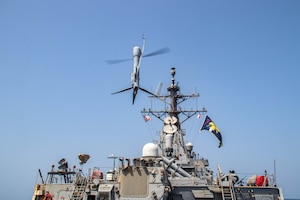
GULF OF OMAN, An Aerovel Flexrotor unmanned aerial vehicle launches from the deck of the Arleigh Burke-class guided-missile destroyer USS McFaul (DDG 74) in the Gulf of Oman, in an image released Oct. 6. US Navy photo.

Below is a 6 October news release from U.S. Naval Forces Central Command Public Affairs. It notes Coast Guardsmen were involved, presumably PATFORSWA, but no details of how. All the photo here accompanied the release.


MANAMA, Bahrain —

Last month, naval forces in the Middle East region successfully integrated unmanned platforms with traditionally crewed ships and aircraft to conduct enhanced maritime security operations in the waters surrounding the Arabian Peninsula.

Seven task forces falling under U.S. 5th Fleet integrated 12 different unmanned platforms with manned ships for “manned-unmanned teaming” operations, tracking Iranian Navy and Islamic Revolutionary Guard Corps Navy (IRGCN) ships and small boats over several days during routine patrols in and around the Strait of Hormuz.

This operation bolstered presence in and around a critical chokepoint that in recent months has seen Iran unlawfully seize internationally flagged merchant ships.

Unmanned underwater vehicles (UUVs), unmanned surface vehicles (USVs) and unmanned aerial vehicles (UAVs) were involved in the operation.

“We have been operating UAVs and UUVs in the region for years,” said Capt. Joe Baggett, Director of Maritime Operations for U.S. Naval Forces Central Command and U.S. 5th Fleet. “Adding our new USVs, and then integrating all of these platforms into fleet operations, is how we expect to fly and sail well into the future.”

Sailors, Marines, Coast Guardsmen, ships and aircraft from Task Force 51/5 (Amphibious/Marine), Task Force 52 (Mine Countermeasures), Task Force 53 (Logistics), Task Force 55 (Surface Warfare), Task Force 56 (Expeditionary), Task Force 57 (Patrol/Reconnaissance) and Task Force 59 (Unmanned/Artificial Intelligence) conducted the operations.

“The integration of new, multidomain unmanned platforms into routine fleet operations provides more ‘eyes on the water,’ enhancing maritime domain awareness and increasing deterrence in the region,” said Vice Adm. Brad Cooper, Commander, U.S. Naval Forces Central Command and U.S. 5th Fleet.

Cooper added that collectively, these platforms support the safe navigation and free flow of commerce through vital regional chokepoints, particularly around the Strait of Hormuz.

“This enhanced maritime security serves as a deterrent against malign activity and strengthens regional stability, which is good for everybody,” he said.

U.S. Naval Forces Central Command/U.S. 5th Fleet’s area of operations encompasses about 2.5 million square miles of water area and includes the Arabian Gulf, Red Sea, Gulf of Oman, Gulf of Aden, Arabian Sea and parts of the Indian Ocean. This expanse, comprising 21 nations, includes three critical choke points at the Strait of Hormuz, the Suez Canal and the Strait of Bab al Mandeb.

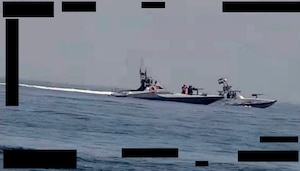
STRAIT OF HORMUZ (Oct. 6, 2023) An undated still image released on Oct. 6 from video taken by an Arabian Fox MAST-13 unmanned surface vessel of two Islamic Revolutionary Guard Corps Navy patrol speedboats in the Strait of Hormuz.

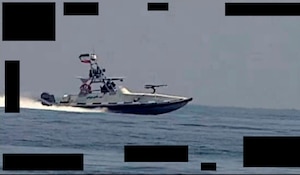
STRAIT OF HORMUZ (Oct. 6, 2023) An undated still image released on Oct. 6 from video taken by an Arabian Fox MAST-13 of an Islamic Revolutionary Guard Corps Navy patrol speedboat in the Strait of Hormuz.

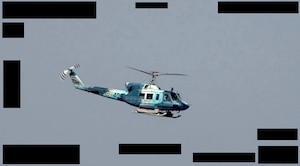
STRAIT OF HORMUZ (Oct. 6, 2023) An undated still image released on Oct. 6 from video taken by an Arabian Fox MAST-13 unmanned surface vessel of an Iranian Navy AB-212 helicopter in the Strait of Hormuz.

STRAIT OF HORMUZ (Oct. 6, 2023) A undated still image released on Oct. 6 from video taken by a MARTAC T-38 Devil Ray unmanned surface vessel of an Islamic Revolutionary Guard Corps Navy warship in the Strait of Hormuz.

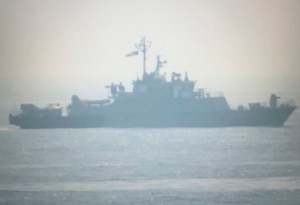
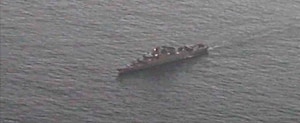
STRAIT OF HORMUZ (Oct. 6, 2023) An undated still image released on Oct. 6 from video of an Iranian Navy frigate taken by an Aerovel Flexrotor unmanned aerial vehicle (AAV) in the Strait of Hormuz.(U.S. Navy photo)

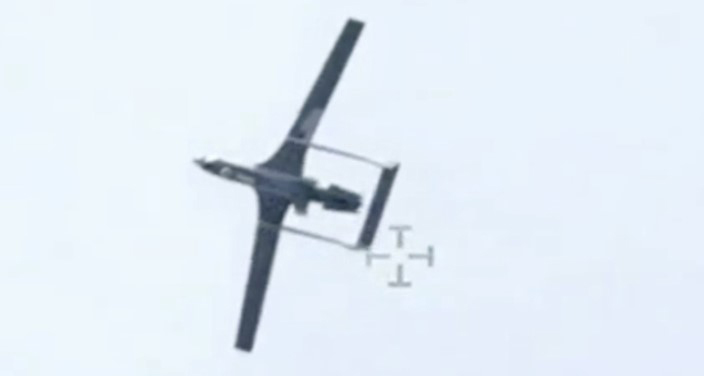
STRAIT OF HORMUZ (Oct. 6, 2023) An undated still image released on Oct. 6 from video taken by an Arabian Fox MAST-13 unmanned surface vessel of an Iranian unmanned aerial vehicle in the Strait of Hormuz.

Iran’s Shahid Soleimani Catamaran Missile Corvette and Torpedo Armed RHIB

Iranian torpedo armed RHIB carried by Shahid Soleimani class catamaran corvette.

Covert Shores reported on new Iranian missile armed catamaran corvettes, but the report also included the photo above. What we are seeing is a boat suspended from the stern of the corvette. The boat is equipped with what appears to be a torpedo tube for a lightweight torpedo. Presumably there is a second tube on the other side. Diameter is likely to be the same as the NATO standard, 324mm or 12.75″. Unlike most lightweight torpedoes, this is unlikely to be intended for use against submarines. Almost certainly, it is intended for use against surface ships.

There is not a lot of public source information about Iranian torpedoes but their partners in crime, Russia and China, are both believed to have cloned the US made Mk46 torpedo and both passive and active acoustic and wake homing technology is readily available. Passive acoustic homing in the search phase, and wake homing in the terminal phase, seems likely. Range is probably at least 8,000 yards.

This means, these torpedoes can be launched from well outside the effective range of typical Close In Weapon Systems (CIWS) of 20 to 40mm. 

We can’t take much comfort in the fact that the warhead of these torpedoes would be about 100 pounds. That is way less than the approximately 600 pounds of a heavy weight 21″ torpedo like the Mk48, but the effects of an underwater explosion are not linear. The effect of a 100-pound warhead is about half that of heavy weight torpedoes that we have repeatedly seen break ships in half. So, a lightweight torpedo, exploding under the keel, might not break a ship in half, but it is going to hurt.

I have long felt an anti-surface light weight torpedo like this would provide Coast Guard cutters a relatively low-cost way to forcible stop a medium to large vessel, regardless of size, a capability they do not currently have. Apparently, the Iranians think it will work.

Shahid Soleimani Catamaran Missile Corvette:

This is a significant departure for the Islamic Revolutionary Guard Corps. Apparently, they have recognized that their naval swarm forces are vulnerable to attack from the air, and, I believe, particularly helicopters.

hIran Shahid Solemani class corvette top view

With its array of VLS AAW weapons, these corvettes constitute a serious threat to USN and allied helicopters that might be used to counter Iranian swarm tactics.

When engaged in force protection, if the force protection package includes aircraft, and one of this class shows up, a PATFORSWA Webber cutter class might be doing useful service, if they take station a couple hundred yards behind the corvette and maintain a fire control solution on that probably highly flammable and explosive collection of weapons in the center of the superstructure, behind the bridge–without pointing the gun, of course.

Fincantiari of Italy Builds Two Small but Powerful OPVs

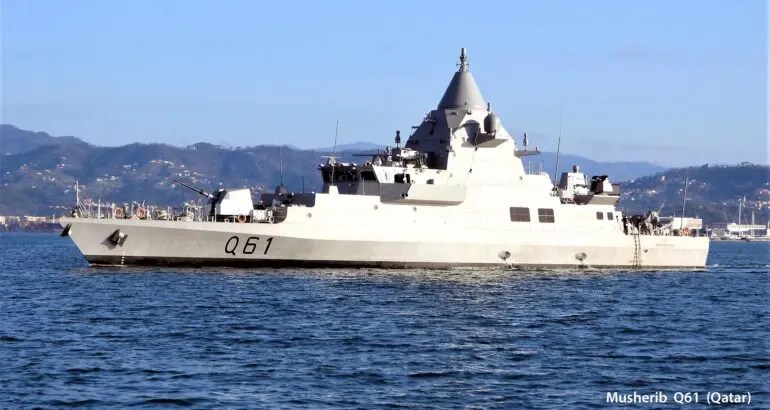
The Qatari Navy OPV is about 63 meters long, 9.2 meters wide, with a maximum speed of 30 knots. Giorgio Arra picture.

Naval News has done a couple of posts on a pair of Offshore Patrol Vessels (OPV) built in Italy for the Qatar Emiri Naval Forces by Fincantieri (owner of Marinette Marine in Wisconsin):

These are not your typical OPV. They look more like FAC(M) i.e fast attack craft, missile, but they trace their linage back through the UAE’s Falag 2 class to the Italian Coast Guard’s Diciotti class. Let’s compare to a typical OPV and talk about why they are so different.

First what is a typical OPV?

  • Displacement: at least 1,500 tons full load, typically less than 3,000
  • Length: at least 75 meters (246 ft), typically less than 100 meters (328 ft)
  • Range: at least 3500 nautical miles, typically 5,000 or more
  • Endurance: at least three weeks
  • Speed: 20-25 knots
  • Aviation: At least flight deck for medium helicopter
  • Boats:  at least two RHIB of 7 meters or larger
  • Weapons: one deck gun of 76mm or less plus two to four guns .50 cal to 30mm guns with one or two typically mounted in remote weapon stations. Anti-Ship Cruise missiles are rare and Anti-Aircraft missile systems more capable than MAPADS rarer still.

Examples include ships building or in service with Argentina, Australia, Britain, India, Japan, Malta, the Philippines, Singapore, Türkiye, the Fassmar designs used by Chile, Colombia, and German, and Damen designs used by Malaysia, the Netherlands, Pakistan, and Vietnam.

The 270 foot Bear class WMECs fit the profile pretty well, if you ignore the fact they can’t quite reach 20 knots. In some respects they are still more sophisticated that some of the newer OPVs.

The 210 foot Reliance class WMECs fall outside the current norm, being smaller and slower than typical, but they otherwise fit the profile. Of course even the newest is 53 years old.

Now let us compare the new Qatar OPV.

Range/Endurance:

Their range is only 1500 nautical miles at 15 knots, that is even less than that of the smaller Webber class cutters’ 2500 at 14 knots. Their seven day endurance is more typical of the smaller Inshore Patrol Vessel class. As a patrol vessel, it is closer to the Webber class WPCs than even the Reliance class.
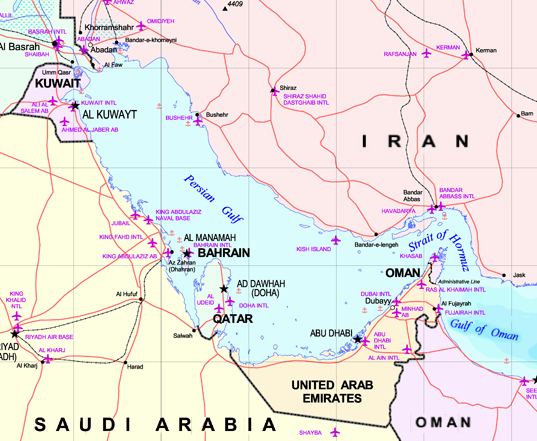
Persian Gulf. US Government work product in the public domain.

Geography is the reason. Qatar’s coast line is only 563 km and its EEZ is 31,819 sq km (that of the US is 11,351,000 sq km, 357 times greater). They just don’t have to go very far. It may also be that these ships will be used more in reaction than as actual patrol vessels.

Size:

Full load displacement is 725 tonnes, with a length of 63.80 (209 feet) (59.60 meters or 195.5 feet between the perpendiculars) and a beam of 9.20 meters/30 feet. This makes them smaller than the Reliance class and only about half the size of the smallest of the typical OPVs. Rough seas are probably less of a concern than in more open areas.

Speed:

Their speed of 30 knots, rather than the typical 20 to 25, also seems to suggest their role is one of rapid reaction rather than persistant patrolling.

Aviation:

Unlike most modern OPVs, there is no apparent provision for supporting aviation assets, not even UAS. That is presumably because land based air is always close.

Starboard quarter of second Musherib-class OPV “Sheraouh” for the Qatar Emiri Naval Forces. Visible are the ship’s boat, two twin Exocet launchers and two 30 mm Marlin-WS secondary gun systems. Picture by Luca Peruzzi

Boats:

The OPV has a stern area with crane for launch and recovery of a RHIB. This is not an arrangement that suggests the boat would be used frequently or that boat ops is a high priority.

The second Musherib-class OPV “Sheraouh” for the Qatar Emiri Naval Forces. Fincantieri picture.

Amaments:

“…in addition to the NA-30S Mk2 FCS for the Leonardo Super Rapido 76/62 mm Multi-Feeding main calibre gun, the Leonardo-provided  EO/IR suite also includes two SASS IRSTs and a single Medusa Mk4B FCS for the two 30 mm Marlin-WS secondary gun systems. The missile armament package also includes two four-cell VLSs for the MBDA VL MICA surface-to-air system in the bow area and two twin-launchers for the MBDA Exocet MM40 Block 3 anti-ship missiles in the stern area.”

The Persian Gulf is a rough neighborhood. Qatar faces Iran across the relatively narrow Gulf. Potentially hostile craft are always close. Shore based anti-ship cruise missiles are always within range. Iranian surface units are at most only hours away, aircraft and missiles only minutes.

The vertical launch MICA missile system and Super Rapid 76mm gun provide credible defense against aircraft and cruise missiles.

While normally I would not feel four Exocets would be enough to provide two salvos of adequate size, against the potential Iranian opposition, four are probably adequate for two engagements.

It is not surprising these ships are better armed than any US Coast Guard cutter, including the more than six times larger National Security Cutters. They may be the most heavily armed “OPVs” in the world.

Two four-cell VLSs for the MBDA VL MICA surface-to-air system mounted between the bridge and a Leonardo 76mm gun forward. Picture by Luca Peruzzi

USCGC Robert Goldman (WPC 1142), Bound for Bahrain, To be Commissioned 12 March, 2021

Phoro: Sister ship, the Charles Moulthrope (WPC 1141), delivered on Oct. 22, 2020, and commissioned on Jan. 21

Below is an Atlantic Area news release. USCGC Robert Goldman (WPC 1142) is the 42nd Webber class WPC and is expected to be one of the first two of six to join PATFORSWASIA, replacing six 110 foot WPBs currently homeported in Bahrain.

united states coast guard

News Release

U.S. Coast Guard Atlantic Area
Contact: Coast Guard Atlantic Area Public Affairs
Contact: (757) 452-8336
Atlantic Area online newsroom

U.S. Coast Guard to commission 42nd Fast Response Cutter

USCGC Robert Goldman Seal

Key West, Fla. — The U.S. Coast Guard will commission the USCGC Robert Goldman (WPC 1142), Patrol Forces Southwest Asia’s second Sentinel-class cutter, into service at Coast Guard Sector Key West, Friday at 10 a.m. EST.

Due to COVID mitigation, in-person attendance is limited. Anyone interested in viewing the ceremony livestream may do so at http://bit.ly/WPC1412Com, clicking on the image at the top, or by clicking here

Vice Adm. Scott Buschman, deputy commandant for operations, U.S. Coast Guard, will preside over the 42nd Sentinel-class cutter ceremony. Mrs. Eleanor Goldman is the ship’s sponsor.  

The Robert Goldman is the second of six FRCs planned for service in Manama, Bahrain. The cutter is named after Pharmacist’s Mate 2nd Class Robert Goldman, remembered for heroic and selfless actions as a member of the joint forces serving in the Pacific theater during World War II. 

The Coast Guard took delivery of Robert Goldman on Dec. 21, 2020, in Key West. They will transit to Bahrain later this year with their sister ship, the Charles Moulthrope (WPC 1141), delivered on Oct. 22, 2020, and commissioned on Jan. 21, in Portsmouth, Virginia.

Are PATFORSWA WPBs Being Equipped With a Target Designation System?

Crewmembers aboard the U.S. Coast Guard cutter USCGC Adak (WPB-1333) raise the American flag. Adak is assigned to CTF 55, supporting maritime security operations and theater security cooperation in the U.S. 5th Fleet area of responsibility. U.S. Coast Guard photo by Seaman Frank Iannazzo-Simmons

NavyRecognition has some more details about the multi-unit exercise that prompted recent Iranian harassment of Navy and Coast Guard vessels, “U.S. Navy Surface Forces and Army Helicopters Conduct Live Fire Exercise in North Arabian Gulf.”

The ships involved in the event included Navy Expeditionary Landing Base ship USS Lewis B. Puller (ESB-3), coastal patrol ships USS Sirocco (PC 6), USS Whirlwind (PC 11), USS Firebolt (PC 10 ), USS Tempest (PC 2), Coast Guard patrol boats USCGC Adak (WPB 1333), USCGC Maui (WPB 1304), USCGC Wrangell (WPB 1332), and guided-missile destroyer USS Paul Hamilton (DDG 60).

In addition, there were Army AH-64 Apache attack helicopters operating from USS Lewis B. Puller. What I found particularly interesting was:

On the ships involved without organic aircraft control capabilities, a Joint Terminal Attack Controller (JTAC) was embarked to communicate directly with the aircraft and provide targeting information.

Does this mean that the Island class WPBs are getting a form of data link to allow them to pass targeting information to the Army attack helicopters? Other DOD aircraft?

Will the Webber class WPCs expected to go to PATFORSWA going to get these?

“IRGCN Vessels Conduct Unsafe, Unprofessional Interaction with U.S. Naval Forces in Arabian Gulf” –US CENTCOM

NORTH ARABIAN GULF (April 15, 2020) Iranian Islamic Revolutionary Guard Corps Navy (IRGCN) vessels conducted unsafe and unprofessional actions against U.S. Military ships by crossing the ships’ bows and sterns at close range while operating in international waters of the North Arabian Gulf. U.S. forces are conducting joint interoperability operations in support of maritime security in the U.S. 5th Fleet area of operations. (U.S. Navy photo)

The following is a news release from US Fifth Fleet Public Affairs: (I bet one of those long range acoustic projectors could be really unpleasant if someone shouted over one of them at you at close range. Maybe every cutter should have them.)

On April 15, eleven Iranian Islamic Revolutionary Guard Corps Navy (IRGCN) vessels repeatedly conducted dangerous and harassing approaches of the USS Lewis B. Puller (ESB 3), USS Paul Hamilton (DDG 60), USS Firebolt (PC 10), USS Sirocco (PC 6), USCGC Wrangell (WPB 1332) and USCGC Maui (WPB 1304) while the U.S. vessels were conducting joint integration operations with U.S. Army AH-64E Apache attack helicopters in the international waters of the North Arabian Gulf.

The IRGCN vessels repeatedly crossed the bows and sterns of the U.S. vessels at extremely close range and high speeds, including multiple crossings of the Puller with a 50 yard closest point of approach (CPA) and within 10 yards of Maui’s bow.

The U.S. crews issued multiple warnings via bridge-to-bridge radio, five short blasts from the ships’ horns and long range acoustic noise maker devices, but received no response from the IRGCN.

After approximately one hour, the IRGCN vessels responded to the bridge-to-bridge radio queries, then maneuvered away from the U.S. ships and opened distance between them.

The IRGCN’s dangerous and provocative actions increased the risk of miscalculation and collision, were not in accordance with the internationally recognized Convention on the International Regulations for Preventing Collisions at Sea (COLREGS) “rules of the road” or internationally recognized maritime customs, and were not in accordance with the obligation under international law to act with due regard for the safety of other vessels in the area.

The U.S. Navy, Coast Guard, Marines and Army have been conducting joint interoperability operations in the North Arabian Gulf since late March.

U.S. naval forces continue to remain vigilant and are trained to act in a professional manner, while our commanding officers retain the inherent right to act in self-defense.

NORTH ARABIAN GULF (April 15, 2020) Iranian Islamic Revolutionary Guard Corps Navy (IRGCN) vessels conducted unsafe and unprofessional actions against U.S. Military ships by crossing the ships’ bows and sterns at close range while operating in international waters of the North Arabian Gulf. The expeditionary mobile sea base USS Lewis B. Puller (ESB 3) is conducting joint interoperability operations in support of maritime security in the U.S. 5th Fleet area of operations. (U.S. Navy photo)

“US Builds Global Coalition to Protect Gulf Shipping” –Global Security

USCG Monomoy (WPB-1326) and Adak (WPB-1333), elements of PATFORSWA

Global Security reports that the US is attempting to build a coalition to escort merchant ships through the Straits of Hormuz.

We would almost have to assume that the WPBs of PATFORSWA would be involved.

It would not be surprising to see the Coast Guard contribute up to six already commissioned Webber class WPCs in the near future. These could ultimately replace the current 110s stationed in Bahrain rather than waiting for FRCs specifically procured to replace the PATFORSWA WPBs, but for the duration of escort mission, they would augment them.

I would like to see some modifications done to these vessels before they go, but it is a question of urgency.

The Webber class could make the trip on their own bottoms if needed, especially if escorted by an National Security Cutter.