Philippine 378 Upgrade

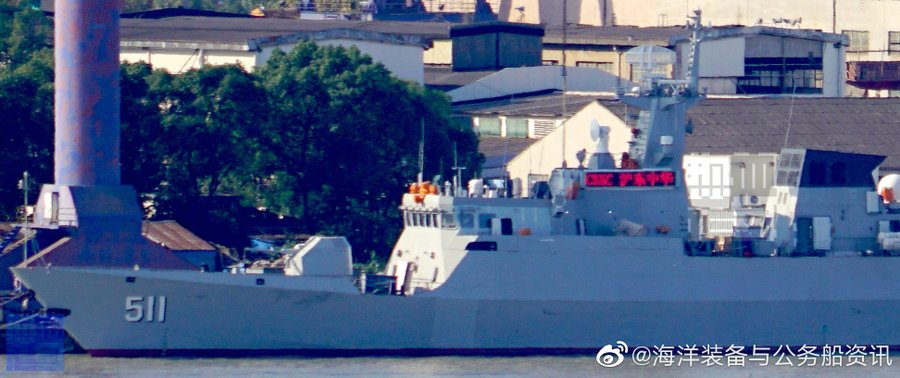
BRP Ramon Alcaraz sporting her new Sea Giraffe radar in Cebu.

When the US Coast Guard Hamilton class 378 foot WHECs were decommissioned and transferred to other nations, the AN/SPS-40 air search radars were removed, along with the Phalanx close in weapon system. At least one of the three former cutters, in service with the Philippine Navy, has been upgraded with the addition of a Sea Giraffe multi-mode radar and a pair of 25mm Mk38 guns as can be seen on these photos of BRP Ramon Alcaraz (former USCGC Dallas). There were plans to acquire at least two Sea Giraffe radars. I can’t say how far they have gotten.

The Sea Giraffe, USN designation AN/SPS-77, is the radar that will equip the Argus class OPCs. It is also currently installed on Independence class LCS.

I found these on Facebook, but apparently they came from Daryll Evan Mancao’ Flickr page.

BRP Ramon Alcaraz (former USCGC Dallas) equipped with new Sea Giraffe multi-mode radar in Cebu.

“THREE ROUNDS OF COERCION IN PHILIPPINE WATERS” –CSIS

China CG Cutter 5203

The Center for Strategic and International Studies’ Asia Maritime Transparency Initiative brings a report of Chinese tracking and harassing vessels conducting legitimate activities in the Philippine’s Exclusive Economic Zone (EEZ) on three occasions.

There are some things worth noting about these three encounters:

  • In the first the Taiwanese Coast Guard was successful in allowing the research vessel to complete its task. In the second encounter, the Philippines appears to have surrendered preemtively while the Chinese vessel came no closer than 0,9 miles. In the third, the two Philippine vessels were successfully intimidated and turned away by China Coast Guard vessels supported by maritime militia vessels.
  • While Chinese vessels approached these vessels and came with 100 meters in the third incident, there was no indication that they attempted to ram or block movement, though blocking did appear to be the ultimate intent in the third incident. Chinese vessels have intentionally rammed in the past, but I cannot recall a Chinese government vessel ramming another government’s vessel. Chinese maritime militia have employed this tactic.
  • In the first encounter the Taiwanese Coast Guard used some of their largest ships as escorts. 5001 is more than 5000 tons full load, larger than the Bertholf class ships (4,500 tons full load). Taiwan Coast Guard’s CG129 is also relatively large at 120 meters (394 ft). It is nominally 3,000 tons, but probably over 4,000 tons full load. China Coast Guard (CCG) 5203 is reportedly 102 meters (335 ft) in length and 14 meters of beam.  It is probably around 3,000 tons full load.
  • The two Philippine Coast Guard cutters mentioned, BRP Capones and BRP Cape Engaño were both Parola class patrol boats, built in Japan and delivered in 2017 and 2018 respectiely. These 44 meter/146 ft vessels are just a bit smaller and slower than the Webber class. They were much smaller than the CCG vessels.
  • Only the Chinese employed vessels were armed with medium caliber naval guns. I was unable to find specs or photographs of CCG 5303 or 5304 but at least CCG 5203 was armed with a modern 3″ gun. The Taiwanese vessels were armed with auto-cannon of up to 40mm. The Philippine CG vessels were armed with nothing larger than .50 cal.
  • Taiwanese and Philippine CG vessels appear to have had a speed advantage, but the CCG had a speed advantage over the vessels being escorted. In the third incident any speed advantage was also largely negated by the larger number of Chinese vessels.

It should be clear that if the Philippines intends to operate in their EEZ, in areas included in the “Nine Dash Line,” they should expect the Chinese will confront them. If they intend to operate there, they need to decide to either support the effort strongly or operate not at all. Being chased out repeatedly strengthens China’s position.

Should the Philippines decide to operate in the disputed waters, it does have some advantages at least for operations of short duration. While the China CG is much larger, the Philippines has the advantage of proximity. Far from their bases, the Chinese cannot reinforce quickly. The Philippines can surge large numbers of units the short distance from their bases quickly.

The Philippines has been pushed around. Perhaps it is time to push back. Not an escalation, but a reponse in kind.

A coordinated sweep of Chinese fishing vessels fishing illegally should be possible.

To deter shouldering, size is important, so the Philippine CG should include their largest ships.

To deter the Chinese from resorting to weapons, Philippine law enforcement vesssels should be supported by Philippine Navy vessels. It would not hurt if Philippine light attack aircraft were airborne.

It would also help if vessels of other nations, including the US, were on scene to witness the encounter.

BRP Capones in Davao Gulf. Philippine Information Agency.

Thanks to Paul for bringing this to my attention.

“Indonesia spearheading regional cooperation in South China Sea” –Indo-Pacific Defense Forum

Indonesian Maritime Security Agency vessel KN Tanjung Datu, left, sails alongside U.S. Coast Guard Cutter Stratton during joint exercises in the Singapore Strait in August 2019. IMAGE CREDIT: PO1 LEVI READ, USCG

The Indo-Pacific Defense Forum reports,

Indonesia is reaching out to its South China Sea neighbors to foster harmony on maritime sovereignty issues and enhance cooperation among regional coast guards, analysts say. The nation engaged closely with Vietnam in late 2021 and plans to add five countries to the collaborative effort in 2022.

It appears Indonesia is working with its SE Asian neighbors to resolve their bilateral maritime territorial disputes based on UNCLOS and develop multi-lateral agreement.

This would allow the ASEAN nations to present a united front, to push back against China’s expansive claims. It might even lead to something like my proposed Combined Maritime Security Task Force.

Up-Gunning the China Coast Guard–Add 22 New Type 056 Corvettes

Type 056 corvette, credit 樱井千一

We have a report from Defence.PK, that 22 PLAN Type 056 corvettes are being transferred to the China Coast Guard. These ships are the early models that were completed without the more sophisticated anti-submarine warfare capabilities of the Type 056A. Rather than upgrade them, the Chinese Navy will build 22 additional Type 054A Frigates.

Reportedly they are adding a LED billboard and the missiles are being removed. Probably the torpedoes as well. But that still leaves a 120 round/minute 76 mm gun and a pair of 30mm Guns.

The China Coast Guard already has more large cutters than the US Coast Guard, despite of the fact that their EEZ is less than 20% that of the US, even if all their outrageous claims were accepted. But most of these cutters have no guns of 20mm or larger. 22 AK-176 76mm guns and 44 30mm Guns will substantially increase the China Coast Guard’s firepower.

These 1500 ton 25 knot ships are a handy size for an area like the South China Sea.

Unlike the US Coast Guard, the China Coast Guard tends to operate their cutters in groups. Three of these, snuggled up to you, at close range, could be very intimidating even to a DDG like those the US Navy uses for Freedom of Navigation Exercises. For relatively unarmed Asian Coast Guard cutters, it would be much more so.

Chinese Naval Forces don’t have a lot of naval victories in their past so the Battle of Paracel Islands, where they defeated the Vietnamese by opening fire at very close range, must assume outsized importance in their imagination.

Image

I note, the cutters China used when they recently turned back a Philippine resupply effort in the South China Sea, included at least one armed with a 76mm gun.

In case you missed it, below is a statement from the US Ambassador to the Philippines (and to China).

“Coast Guard cutter returns home following Western Pacific deployment” –News Release

Coast Guard Cutter Munro (WMSL 755) crewmember Petty Officer 2nd Class Kurt Chlebek, a boatswains mate, is greeted by his dog after Munro returned to their homeport in Alameda, California, Oct. 20, 2021, following a 102-day, 22,000 nautical mile multi-mission deployment. Munro’s crew departed Alameda in July for a Western Pacific patrol and operated in support of United States Indo-Pacific Command, which oversees military operations in the region. U.S. Coast Guard photo by Chief Petty Officer Matt Masaschi.

Wrap-up of USCGC Munro’s recent deployment to the Western Pacific.

united states coast guard

News Release

Oct. 20, 2021
U.S. Coast Guard Pacific Area

Coast Guard cutter returns home following Western Pacific deployment

Photo of U.S. and Japan Coast Guard vessels
Coast Guard Cutter Munro crew returns home following 102-day, 22,000 nautical mile multi-mission Western Pacific deployment Coast Guard Cutter Munro crew returns home following 102-day, 22,000 nautical mile multi-mission Western Pacific deployment

Editors’ Note: Click on images to download high resolution versions.

Alameda, Calif. – The U.S. Coast Guard Cutter Munro (WMSL 755) and crew returned to their Alameda homeport Wednesday following a 102-day, 22,000-nautical-mile deployment to the Western Pacific.

Munro departed Alameda in July to the Western Pacific to operate under the tactical control of U.S. Navy 7th Fleet to promote a free and open Indo-Pacific.

“Munro’s deployment demonstrated the Coast Guard’s unique authorities in support of the Indo-Pacific command,” said Vice Adm. Michael F. McAllister, commander Coast Guard Pacific Area. “Joint operations help strengthen our partnerships through search and rescue, law enforcement, marine environmental response and other areas of mutual interest which preserve a stable and secure global maritime environment.”

Munro’s crew executed numerous cooperative engagements, professional exchanges and capacity building efforts with naval allies and partners, including the Japan Coast Guard, Japan Maritime Self Defense Force, Philippine Coast Guard and Bureau of Fisheries and Aquatic ResourcesRoyal Australian Navy, and Indonesia Maritime Security Agency.

“Our relationships in the Western Pacific are stronger today, and our partners are unified in their commitment to security,” said Capt. Blake Novak, commanding officer of Munro. “It was an incredible opportunity for our crew to participate alongside allies, sharing search and rescue and law enforcement concepts to promote peace, prosperity, and the sovereign rights of all nations.”

As both a federal law enforcement agency and an armed force, the U.S. Coast Guard is uniquely positioned to conduct defense operations in support of combatant commanders on all seven continents. The service routinely provides forces in joint military operations worldwide, including the deployment of cutters, boats, aircraft, and deployable specialized forces.

Munro is one of four 418-foot national security cutters homeported in Alameda. National security cutters like Munro feature advanced command and control capabilities, aviation support facilities, stern cutter boat launch, and increased endurance for long-range patrols, enabling the crews to disrupt threats to national security further offshore.

Photos from the Munro’s deployment are available here.

“U.S. Coast Guard concludes training with Philippine maritime agencies” –Pacific Area

U.S. Coast Guard trains with Philippine maritime agencies

U.S. Coast Guard Cutter Munro (left) and Philippine Coast Guard Offshore Patrol Vessel Gabriela Silang (right) render honors to each other following bilateral operations and exercises Aug. 31, 2021, in the West Philippine Sea. The Munro and crew are currently deployed to the Western Pacific Ocean to strengthen alliances and partnerships and improve maritime governance and security in the region. (U.S. Coast Guard photo by Marine Corps Sgt. Kevin G. Rivas)

Passing along a Pacific Area news release. More photos here. Recently read USCGC Munro had completed an Underway Refueling from a Japanese Maritime Self Defense Force Vessel (Thanks to Paul). Of course this upset the Chinese. They seem to be perpetually upset.

united states coast guard

News Release

U.S. Coast Guard Pacific Area
Sept. 1, 2021

U.S. Coast Guard concludes training with Philippine maritime agencies

Photo of Coast Guard members on cutter Saluting on the cutter Cutters underway

Editors’ Note: Click on images to download high resolution version.

ALAMEDA, Calif. — The U.S. Coast Guard Cutter Munro (WMSL 755) arrived in Subic Bay, Philippines, Tuesday following operations and exercises in the West Philippine Sea with the Philippine Coast Guard and the Philippine Bureau of Fisheries and Aquatic Resources.

Munro’s crew participated in bilateral operations, professional exchanges, search-and-rescue and communications exercises, small boat operations, multi-vessel maneuvering, and maritime domain awareness drills while at sea.

“As the maritime security challenges in the Indo-Pacific region become increasingly complex, partnering with our Philippine Coast Guard and fisheries counterparts is vital to our shared interest in a free and open maritime environment,” said Munro’s Commanding Officer Capt. Blake Novak. “We thoroughly enjoyed our Philippine hosts’ professionalism and hospitality, and we look forward to future bilateral operations to further our longstanding relationship.”

The search-and-rescue exercise simulated the agencies’ bilateral response to a vessel in distress. During the exercise, the Munro, PCG, and BFAR practiced searching for the distressed vessel, shipboard firefighting techniques, and recovering and treating persons in the water. As part of the exercise, members of the PCG joined USCG members aboard Munro as they launched the cutter’s Small Unmanned Aircraft System to aid in the search-and-rescue response. The day’s exercises and operations provided opportunities for each involved agency to learn from each other.

“The success of the joint maritime exercise between the PCG and USCG will not only strengthen international partnerships for immediate response to calamities and disasters but will also ensure that our personnel could effectively perform their mandated functions in countering terrorism and other acts of lawlessness in our country’s waters,” said Admiral George V. Ursabia JR., PCG commandant.

The USCG has a long history of cooperation with the PCG. In 2019, the Coast Guard Cutter Bertholf conducted engagements with the PCG as part of its Western Pacific deployment, focusing on search and rescue, maritime security, and law enforcement capabilities.

Munro, a 418-foot national security cutter, departed its homeport of Alameda, California, in July for a months-long deployment to the Western Pacific. Operating under the tactical control of U.S. 7th Fleet, the cutter and crew are engaging in professional exchanges and capacity-building exercises with partner nations and are patrolling and conducting operations as directed. National security cutters like Munro feature advanced command and control capabilities, aviation support facilities, stern cutter boat launch, and increased endurance for long-range patrols, enabling the crews to disrupt threats to national security further offshore.

“The Coast Guard shares deep and abiding interests with our allies and partners, who, like us, have long endorsed a rules-based international order,” said Vice Adm. Michael F. McAllister, commander, U.S. Coast Guard Pacific Area. “Partnering with the Philippines to enhance maritime governance, including important missions such as search and rescue and enforcement of fisheries laws and treaties, is essential to the security, stability and prosperity of all nations.”

As both a federal law enforcement agency and an armed force, the USCG is uniquely positioned to conduct defense operations in support of combatant commanders on all seven continents. The service routinely provides forces in joint military operations worldwide, including the deployment of cutters, boats, aircraft, and deployable specialized forces.

More photos from Munro’s Western Pacific deployment are available here. Subscribe here to receive notifications when new photos are added.


“USCG’s Schultz on Halifax Forum, Budget, Pacific, Arctic” –Defense and Aerospace Report

Above is a Defense and Aerospace report interview with the Commandant, Adm. Karl Schultz. It is worth a look.

There is a lot here about what is going on in the Western Pacific and our response to China’s changing behavior. There is a lot of discussion about the Philippine Coast Guard which is apparently growing at a tremendous rate. There is also some discussion about other coast guards in South East Asia and the USCG’s place with “The Quad” (US, Australia, New Zealand, and France).

Thanks to Lee for bringing this to my attention. 

Philippines Awards Contract for Upgrade of Former WHECs

BRP Andrés Bonifacio (FF-17), the former USCGC Boutwell.

Updates added below

NavyRecognition is reporting that the Philippines has awarded a PHP1.5 billion ($28.6M) contract to a South Korean firm for upgrades to their Del Pilar Class Frigates. These are the former cutters Hamilton, Boutwell, and Dallas.

“The project has an approved budget of PHP1.5 billion which will be sourced from the Armed Forces of the Philippine Modernization Trust Fund. The upgrade seeks to enhance the ships’ combat management systems, electronic support and sonar capability to make it capable of operating with incoming and more modern naval assets like the two Jose Rizal-class missile frigates being completed by Hyundai Heavy Industries in South Korea.”

The AN/SPS-40 air search radar, SLQ-32 Electronic Warfare System, 25 mm Mk38 guns, and the Phalanx CIWS were removed before the vessels were transferred to the Philippines.

Presumably in addition to sonar, this upgrade will include torpedo tubes and Korean manufactured torpedoes (Update: apparently not–not included in this contract). The EW system will likely also include countermeasures. An air search capable radar like the Hensoldt TRS-3D Baseline D multi-mode phased array C-band radar being installed on the Jose Rizal-class frigates, to replace the AN/SPS-40 will almost certainly be included (Update: Sea Giraffe multi-role radar had been purchased from the US for this purpose, this is the same radar being purchased for the OPCs). Provision for anti-ship cruise missiles is a possibility, but at this point the full extent of modernization is not clear. I would assume the former WHECs will share some systems with the new frigates. 

“OCEA Launched Largest Aluminum OPV in the World for Philippine Coast Guard” –Naval News

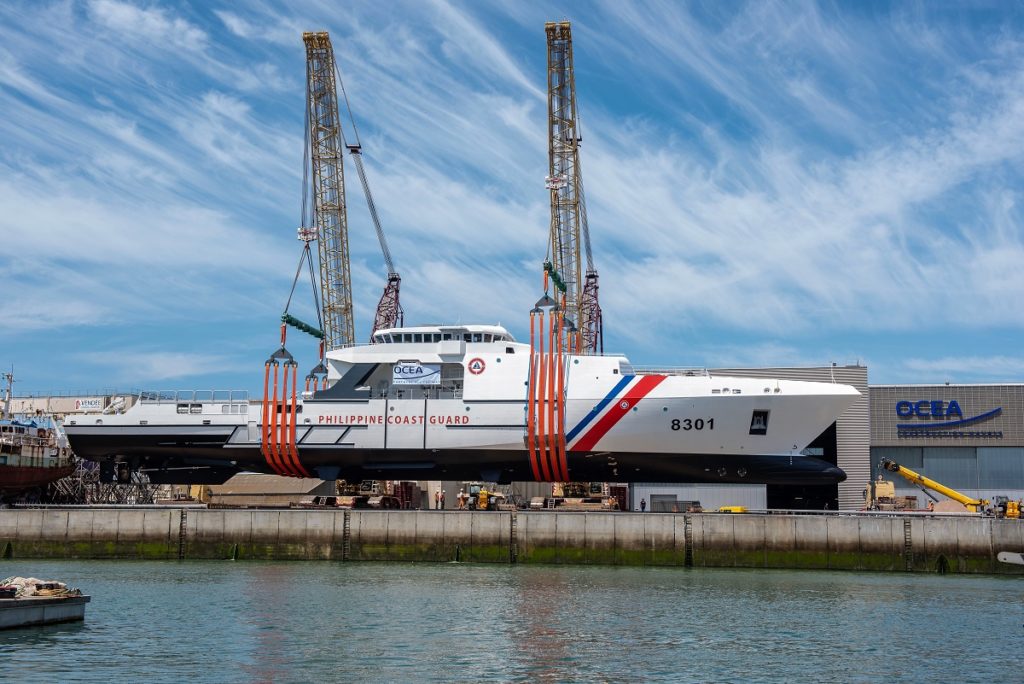
OPV270. OCEA photo

Naval News reports that the French shipyard OCEA has launched the largest aluminum offshore patrol vessel ever constructed. It is going to the Philippine Coast Guard as part of a package deal that also included four much smaller patrol boats. The shipyard claims substantial lifecycle saving in fuel and maintenance as well as lower emissions due to the choice of building materials. (Note the underwater body on the after third of the ship. It looks unusual.)

Choice of an aluminum hull and superstructure does bring on discussion of the possible dangers of using aluminum, frequently blamed for serious damage due to fire including USS Belknap (CG-26) and loss of British type 21 frigates HMS Antelope and HMS Ardent and the destroyer HMS Sheffield during the Falklands War.

There are real issues with the use of aluminum, since it softens, melts, and looses its structural integrity at lower temperatures than steel, as seen on HMS Amazon when it had a fire in 1977, but losses as a result of structural aluminum have frequently been exaggerated. Problems with cracking of aluminum superstructures have been largely as a result of the different expansion rates of mixed steel and aluminum construction.

In the case of Belknap, the collision severed fuel lines running outboard on the carrier and dumped huge amounts of fuel onto the ship, feeding the fire, while ammunition cooked off. Nevertheless the ship was saved by extraordinary DC effort.

The loss of Antelope and Ardent were evaluated to have not been the result of their Aluminum superstructure.

The Sheffield actually employed steel rather than aluminum in both its hull and superstructure, so aluminum construction played no part in her loss.

OPV 270 main specifications

  • Overall length : 84.00 m (275.5′)
  • Range : 8000 nm @ 12 kts
  • Endurance : 5 weeks
  • Speed : 22.0 knots
  • Crew : 40 persons
  • Passenger and VIP : 26 persons
  • Survivors : 35 persons

“Ukraine, France discussing delivery of OCEA FPB 98 patrol boats ” –Naval News

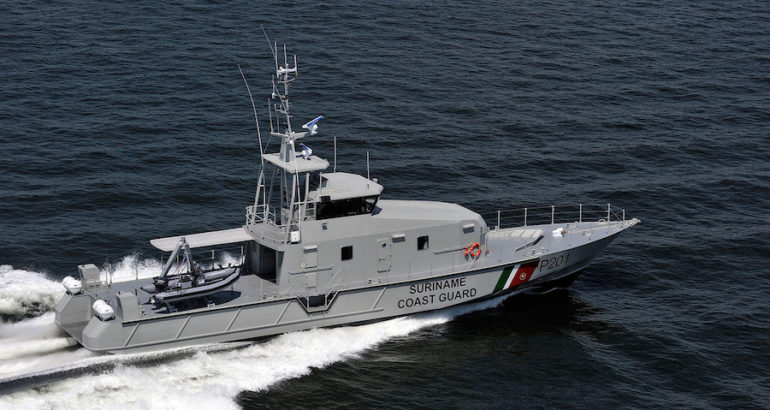
A Suriname Coast Guard FPB 98 patrol boat (Credit: OCEA)

Naval News reports that Ukraine has announced they are in negotiations for joint production of 20 Patrol Boats to a French OCEA design for their “Sea Guard of the State Border Guard Service,” their coast guard. Sounds like it is a done deal with only minor details to work out.

As noted in the report, the Algerian Navy bought 21 of these and has ordered ten more.

They have a GRP hull and are powered by two 3,660 HP Caterpillar diesels using waterjets. Specs on the Algerian boats as follows.

  • Displacement: 100 tons
  • Length: 31.8 meters (104’4″)
  • Beam: 6.3 meters (20’8″)
  • Draft: 1.2 meters (3’11”)
  • Speed: 30 knots
  • Range: 900 nmi @ 14 knots
  • Crew: 13

Most of these boats are armed with a single auto-cannon forward. In most cases a 20mm, the Algerian boats have a 30mm. Given the Ukranians’ tensions with Russia, curious to see if they may choose to provide more weapons.

We have seen products from OCEA before. They provided four smaller patrol boats to the Philippine Coast Guard. These boats like those that went to the Philippines have provision for a RHIB launched by davit.