FLIR Maritime announced recently that it has been awarded a $50 million indefinite delivery, indefinite quantity contract to provide marine electronics systems under the U.S. Coast Guard’s Scalable Integrated Navigation Systems 2 (SINS-2) program over a five-year period providing the purchaser a right to extend delivery for an additional five years.
FLIR will provide electronics systems that will be standard fit on over 2,000 U.S. Coast Guard vessels, ranging from small-class boats through large cutter-class vessels. The systems include Raymarine multi-function navigation displays, radars, sonars, remote instrument displays, and autopilots.
Category Archives: Sensors
“SNA 2017 Surface Navy Association Day 3 – Part 2/2”–NavyRecognition
This is one of a series of videos from NavyRecognition discussing sponsors’ presentations at the Surface Navy Symposium. This one includes:
- Extended Range Harpoon from 00:20 to 02:45
- SeaRAM launcher from 02:45 to 05:15
- RAM Block 2 from 05:15 to 5:45
- Lockheed Martin export Multi Mission Surface Combatant 5:45 to 7:00
- Curtis-Wright towed sonar (TRAPS) 7:00 to 08:30
- Atlas North America SeaCat AUV 08:30 to 10:54
The things I found interesting were:
- The growing use of SeaRAM, which has been being fitted to the trimaran Independence Class LCS, has replaced Phalanx on some destroyers and will replace the Mk49 RAM launcher on the mono-hull Freedom Class beginning with LCS-17. It is also expected to be fitted on the follow on LCS derived Frigate as well. If things start to get tense we may see these on NSCs and OPCs as well.
- The fact that the extended range RAM Block 2 is now operational. The SeaRAM has the same degree of autonomy as Phalanx but because it is a “fire and forget” missile, will be able to engage multiple incoming anti-ship missiles at extended range.
- More info on the Curtis-Wright TRAPS containerized active passive towed array which should be able to fit on anything WMEC sized and larger.
Mk20 mod1 Electro Optic Sensor System
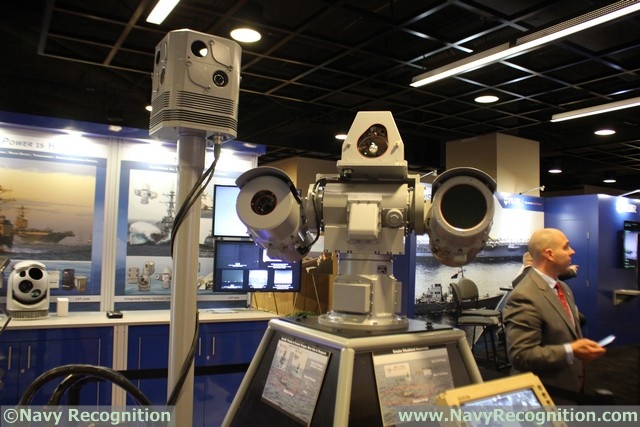
Two reports by NavyRecognition from the Surface Navy Symposium on the L3 Mk20 Mod1 Electro Optic Sensor System (EOSS). The video report above discusses the system from time 00:45 to 2:55, and there is this short written post reporting successful testing. Reportedly this EOSS will weigh half as much as the previous mk20 mod0 system, but have greater resolution and range. According to the report it is currently planned to be installed aboard U.S. Navy Cruisers/Destroyers and U.S. Coast Guard Cutters, presumably the Offshore Patrol Cutters (OPC).
The earlier Mk20 Mod0 is on the National Security Cutter.
The three parts visible are, I believe, a day light TV camera, a thermal imaging camera, and a laser range finder. I wonder if it could also function as a laser target designator?
Other than using it as a firecontrol for ASuW and AAW, this system can be used for:
– Spotting and kill assessment
– Target detection and identification
– Naval gunfire support
– Safety check-sight
– Location and track of man overboard
– Channel position and navigation
TRS-3D Baseline D Multi-Mode Radar for 9th NSC.
NavyRecognition reports, “Airbus Defense and Space, Inc., under contract with its affiliate Airbus DS Electronics and Border Security GmbH, will provide the TRS-3D Baseline D multi-mode radar (MMR) for the U.S. Coast Guard’s ninth National Security Cutter (NSC).”
The Bertholf Class have been equipped with the rotating Active Electronically Scanned Array (AESA) TRS-3D multi-mode (air search, surface search, helicopter control, and firecontrol) radars from the first. My understanding is that this is an improved version of the same radar that equips earlier National Security Cutters and the Freedom class LCS.
Airbus (formerly EADS) has an excellent multi-paged description of the system here.
It is not clear to me how this compares with the TRS-4D system, also from Airbus. The TRS-4D will equip Freedom Class LCS beginning with LCS-17, and I expected it to be used on the Offshore Patrol Cutter (OPC). (Late note: in fact the OPCs will have the SAAB Sea Giraffe multi-mode radar– Chuck) The TRS-4D appears to be very similar in many respects, but it looks at higher elevations and is lighter. Is it a replacement for the TRS-3D or is it a “junior” version of the same technology?
Towed Reelable Active Passive Sonar
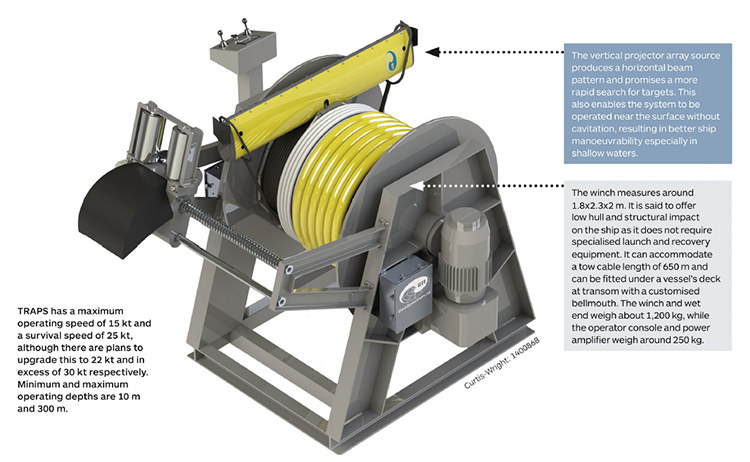
NavyRecognition reports, “GeoSpectrum Technologies Inc. is pleased to announce that it has received a contract through the Build in Canada Innovation Program. Defence Research and Development Canada will test the TRAPS (Towed Reelable Active Passive Sonar) variable depth ASW sonar on Royal Canadian Navy ships.”
This system is seen as a possibility for both the twelve Kingston class “Coastal Defense Vessels” (970 tons, slightly smaller than the 210s) and the projected six icebreaking Arctic Offshore Patrol Ships. There is apparently no intention of using these on the more capable frigates.
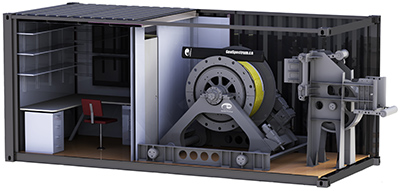
The system can be fitted in a standard sized 20 foot container.
“The modular design of TRAPS provides a variety of installation options, including containerization on multi-mission vessels and standard deck-mounting.
“The TRAPS system is ideal for small combatants such as OPVs, corvettes, ships of opportunity, and USVs. Applications include naval defence/surveillance, drug interdiction, homeland security, and other water-borne policing.”
In addition to detecting submarines and surface vessels, the system is claimed to be usable for:
- Active torpedo detection
- Torpedo decoy
- Passive receiver
- Black box pinger detection
- Sonobuoy processor
A typical detection range of 50 nautical miles is claimed. If it works as advertised this might give most of our larger ships an ASW capability and perhaps help us detect semi-submersibles. Thales’ CAPTAS series is similar, with CAPTAS 2 and CAPTAS 1, designed for ships of over 1,500 and 300 tons respectively.
Coast Guard Denied Use of Laser Technology

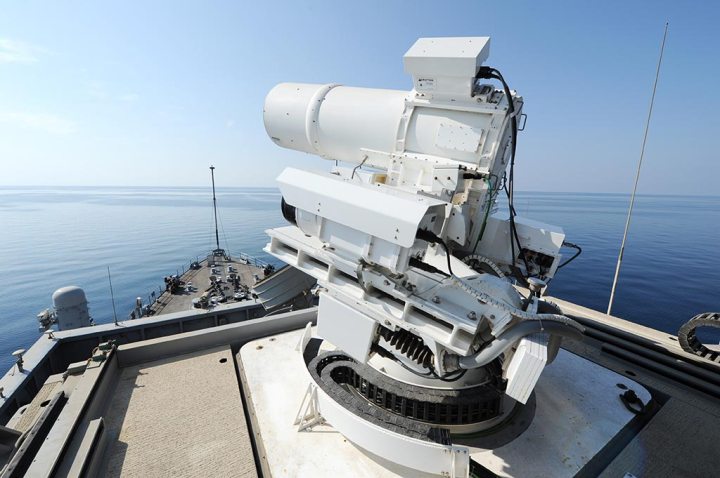
The Afloat Forward Staging Base (Interim) USS Ponce (ASB(I) 15) conducts an operational demonstration of the Office of Naval Research (ONR)-sponsored Laser Weapon System (LaWS) while deployed to the Arabian Gulf. U.S. Navy photo by John F. Williams
This Navy Times story is one of several I have seen that report Rep. Duncan Hunter’s (R-CA) displeasure that the Coast Guard is unable to use some of its laser equipment because of FDA regulation.
“The equipment in question is the Electro-Optical Sensor System and the PEQ-15, a laser sight with an illuminator. ESS is a turret installed on Coast Guard helicopters, with a laser illuminator that can enhance camera images, while PEQ-15 is a rifle sight with a laser illuminator. The Coast Guard is not allowed to use ESS at all, while PEQ-15 can be used on a low setting.”
Representative Hunter has done us a favor in bringing attention to the issue, but ultimately I think he will find that the FDA oversight requirement is based in law and Congress will have to change it.
There is, after all, a reason for regulating the use of lasers. We don’t like it when they are directed at our aircraft or at ships. We don’t want to blind people we are attempting to rescue. (Incidentally where is the FDA regulation of lasers in the hands of civilians?)
“Hunter wants to cut that red tape and allow the Coast Guard to certify its own laser systems, like the other military branches…”
That is all very well, but the Coast Guard probably does not have many laser experts who can do that, and we should not trust the word of our contractors. If Representative Hunter wants to introduce a bill to cut some of the read tape, by all means allow the Coast Guard to self certify if they develop the independent expertise to do that, but it would be more immediately useful if there was simply provision for DOD certification of Coast Guard equipment. This should include automatic application of DOD certification to any DOD type Coast Guard equipment used for the purpose for which it was certified.
AN-SPQ-9B, the NSC’s Air-Search Radar/Firecontrol Gets New Capability
Defense Industry Daily reports that the AN-SPQ-9B, the firecontrol system and secondary air-search on the Bertholf class National Security Cutters, is being modified to provide a Periscope Detection and Discrimination (PDD) capability.
The post also provides additional background information on the sensor.
Interestingly, the post also notes that the radar has a “Cooperative Engagement Capability” or CEC (See the April 24/12: CEC entry) which means that ships and aircraft can share a common tactical picture and weapons launched from one unit can be controlled by a different unit. If we ever get long range missiles, this could be useful.
Hopefully the Offshore Patrol Cutter will have either this system or a better replacement.
A Combined Air/Surface Search Radar for Boats
The illustration here appears to show the system on a Combat Boat 90 (CB90) which is only a 52 foot long boat.
I don’t see an immediate need for this, but it is an interesting new type of radar sensor.
Naval Today reports Saab is offering, “…a 3D, active electronically scanned array (AESA) radar offering simultaneous surface and air surveillance capabilities,” and “…the entire system weighs less than 650 pounds (294 kilograms) in total, which makes it suitable for smaller patrol ships.”
Apparently they are thinking UAVs, “To combat the growing UAV (Unmanned Aerial Vehicle) threat, Sea Giraffe 1X features Saab’s Enhanced Low, Slow and Small (ELSS) surveillance function. This feature allows the radar system to detect and classify small, low-flying, slow-moving air targets.”
I suppose this might also be used to control small UAVs, putting them over surface targets of interest. The Coast Guard is looking at small UAVs.
Sensor Hosting Autonomous Remote Craft (SHARC)
These little Unmanned Surface Vehicles (USVs) may be one way to enhance our Maritime Domain Awareness. They have already traveled a million nautical miles.
NavyRecognition has the story.
I could see a line of these in the Eastern Pacific, used to detect drug smuggling semi-submersibles.
Perhaps we will also see them used to cue Anti-Submarine Warfare Continuous Trail Unmanned Vessels.(ACTUV) or maritime patrol aircraft to the presence of submarines. It might not be too expensive to provide a line of them covering an entire trans oceanic route.
There will almost certainly be a war time role for launching these or something similar. Maybe a role for our buoy tenders.
Electro Optic System That Will Likely Be On the OPC
Navy Recognition reports on an improved Electro-Optic system evolved from one currently on the National Security Cutters.