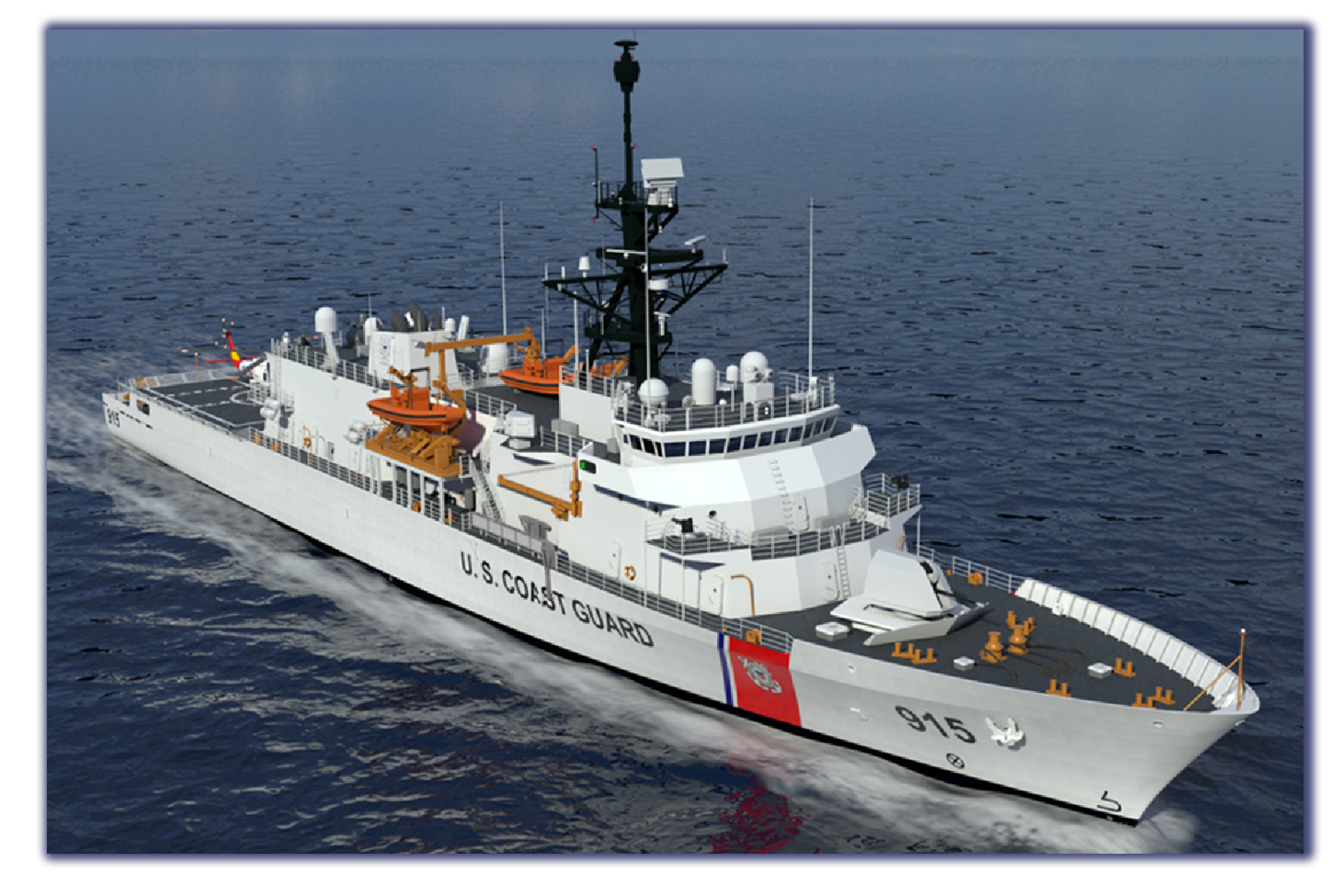
“DHS, Coast Guard extend limited contract relief for Offshore Patrol Cutter” –CG News Release

Below is a news release in full. It reports that “contract relief” will be granted to Eastern Shipyard for construction of the first four ships but that the Coast Guard will reopen bidding for the follow on ships. The Coast Guard always had this option although it seemed unlikely before. The statement that this relief will be granted, “in parallel with immediate recompete” probably means we will see a request for proposal in the near future. 

It seems unlikely that the follow-on ships would be of a different design. The Coast Guard now owns the detail design (correction, I am told the CG does not own all the design details yet but has the option to purchase them) and a different design would introduce additional delays and expense for design development. 

A recompete once again opens the possibility of using a block buy which could result in substantial savings. The recompete could easily provide a block buy for ten ships over five years. A block buy, rather than a contract for two with options, would tend to level the playing field between Eastern, that has the advantage of already building this class, and other shipyards. 

From a historical perspective, the 270 program was also completed by two different shipyards, the first four being built by Tacoma Boat, the other nine by Derecktor Shipyard in Rode Island. The change did result in an 18 month gap between the fourth and fifth ship. 

united states coast guard

 News Release

U.S. Coast Guard Headquarters
Contact: Coast Guard Acquisitions
(202) 475-3069/5532
Headquarters Media Relations (202) 372-4630
mediarelations@uscg.mil
Headquarters online newsroom


DHS, Coast Guard extend limited contract relief for Offshore Patrol Cutter

WASHINGTON – The Department of Homeland Security, in close coordination with the U.S. Coast Guard, granted extraordinary relief to the Eastern Shipbuilding Group (ESG) for the Offshore Patrol Cutter (OPC) under the authority of Public Law (P.L.) 85-804.

ESG submitted a request June 30, 2019, for extraordinary relief after their shipbuilding facilities sustained significant damages from Hurricane Michael, a Category 5 storm, in October 2018.

Acting Secretary of Homeland Security Kevin K. McAleenan made the decision to grant extraordinary contract relief limited to the first four hulls on the basis that ESG’s performance on the OPC contract is vital to the national defense. The Coast Guard will immediately transition to a follow-on competitive contract for the remaining OPC program of record.

P.L. 85-804 was enacted in 1958 and extended to DHS through Presidential Executive Order in 2003. Under this law, an existing contract may be amended or modified when such actions are necessary to facilitate the national defense.

The Coast Guard, supported by DHS and the Navy, conducted an extensive analysis of ESG’s request guided by law and Federal Acquisition Regulation. This review included an assessment of the cost, schedule, and performance impacts on the existing contract. The review was overseen by a Contract Adjustment Board chaired by the DHS Deputy Under Secretary for Management.

“Eastern Shipbuilding’s request for extraordinary relief was carefully considered,” said Coast Guard Vice Commandant, Admiral Charles W. Ray. “This review validated the essential contributions the OPC will provide to our national security and determined that limited relief, in parallel with immediate recompete, is the best option in this exceptional situation. Doing so is consistent with the law, fiscally responsible, and the most expeditious means to deliver this essential national capability.”

The Coast Guard intends to release a Request for Information to gauge industry interest in re-competing the remainder of the OPC program of record. This information will inform the acquisition strategy for the follow-on procurement.

The OPC will replace the fleet of Medium Endurance Cutters, commissioned between 1964 and 1991, providing a critical capability between the National Security Cutter and the Fast Response Cutter. OPC acquisition will expand the Coast Guard’s capability to secure the U.S. border and approaches, disrupt drug cartels and other illicit actors, prevent unlawful immigration, and enhance national preparedness. This decision will ensure critical capabilities are delivered to the fleet as expeditiously and responsibly as possible.

-USCG-
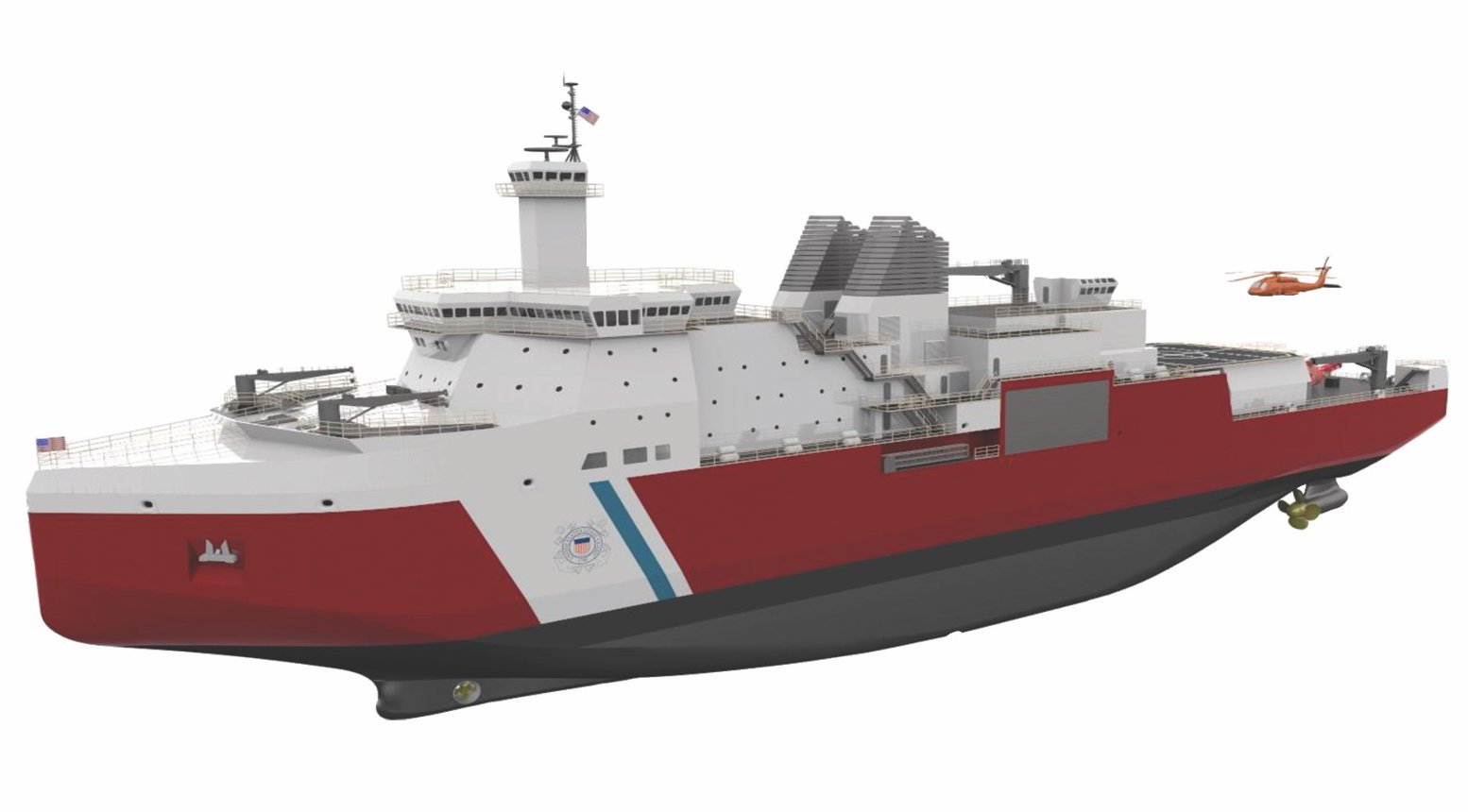
CRS: “Coast Guard Polar Security Cutter (Polar Icebreaker) Program: Background and Issues for Congress”/ Plus a Note on Great Lakes Icebreaker Procurement

The Congressional Research Service his issued a revised “Coast Guard Polar Security Cutter (Polar Icebreaker) Program: Background and Issues for Congress” updated 9 August 2019.

It includes a short appendix (Appendix E, pp 63-66) on the issue of a potential new Great Lakes icebreaker. The final paragraph of that appendix states:

“An examination of procurement costs for Mackinaw, the National Science Foundation’s ice-capable research ship Sikuliaq, new oceanographic research ships being procured for NOAA, and OPCs suggests that a new Mackinaw-sized heavy Great Lakes icebreaker built in a U.S. shipyard might have a design and construction cost between $175 million and $300 million, depending on its exact capabilities and the acquisition strategy employed. The design portion of the ship’s cost might be reduced if Mackinaw’s design or the design of some other existing icebreaker were to be used as the parent design. Depending on the capabilities and other work load of the shipyard selected to build the ship, the construction time for a new heavy Great Lakes icebreaker might be less than that of a new heavy polar icebreaker.”

If you would like a quick, only slightly out of date (May 2017), summary of world icebreaker fleets, take a look at Fig. B-1, page 40.

“OCEA Launched Largest Aluminum OPV in the World for Philippine Coast Guard” –Naval News

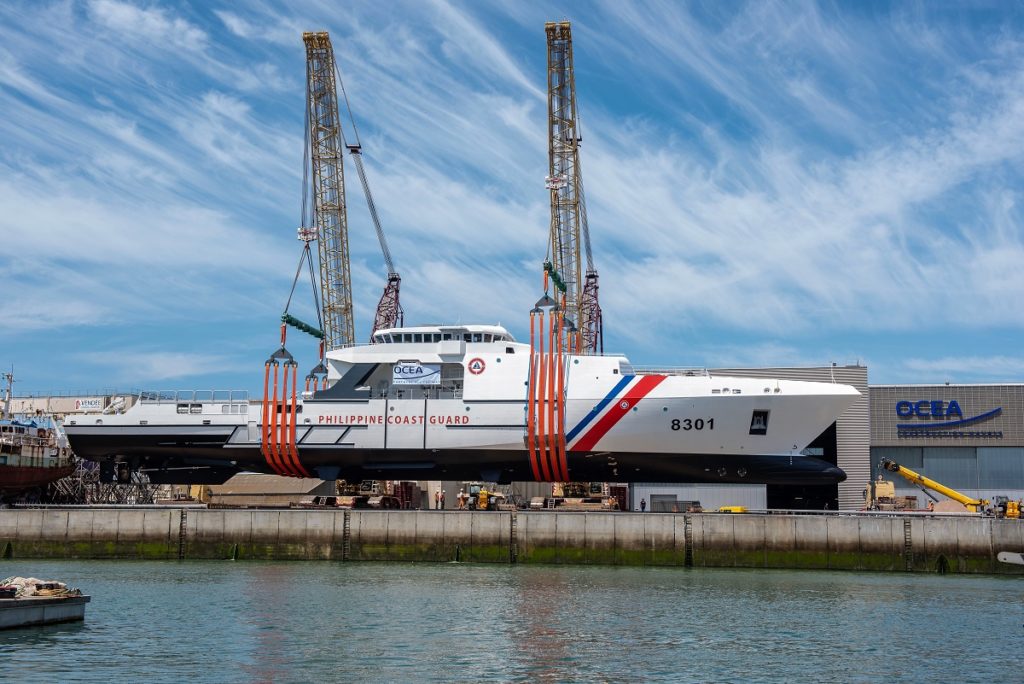
OPV270. OCEA photo

Naval News reports that the French shipyard OCEA has launched the largest aluminum offshore patrol vessel ever constructed. It is going to the Philippine Coast Guard as part of a package deal that also included four much smaller patrol boats. The shipyard claims substantial lifecycle saving in fuel and maintenance as well as lower emissions due to the choice of building materials. (Note the underwater body on the after third of the ship. It looks unusual.)

Choice of an aluminum hull and superstructure does bring on discussion of the possible dangers of using aluminum, frequently blamed for serious damage due to fire including USS Belknap (CG-26) and loss of British type 21 frigates HMS Antelope and HMS Ardent and the destroyer HMS Sheffield during the Falklands War.

There are real issues with the use of aluminum, since it softens, melts, and looses its structural integrity at lower temperatures than steel, as seen on HMS Amazon when it had a fire in 1977, but losses as a result of structural aluminum have frequently been exaggerated. Problems with cracking of aluminum superstructures have been largely as a result of the different expansion rates of mixed steel and aluminum construction.

In the case of Belknap, the collision severed fuel lines running outboard on the carrier and dumped huge amounts of fuel onto the ship, feeding the fire, while ammunition cooked off. Nevertheless the ship was saved by extraordinary DC effort.

The loss of Antelope and Ardent were evaluated to have not been the result of their Aluminum superstructure.

The Sheffield actually employed steel rather than aluminum in both its hull and superstructure, so aluminum construction played no part in her loss.

OPV 270 main specifications

  • Overall length : 84.00 m (275.5′)
  • Range : 8000 nm @ 12 kts
  • Endurance : 5 weeks
  • Speed : 22.0 knots
  • Crew : 40 persons
  • Passenger and VIP : 26 persons
  • Survivors : 35 persons

“Ukraine, France discussing delivery of OCEA FPB 98 patrol boats ” –Naval News

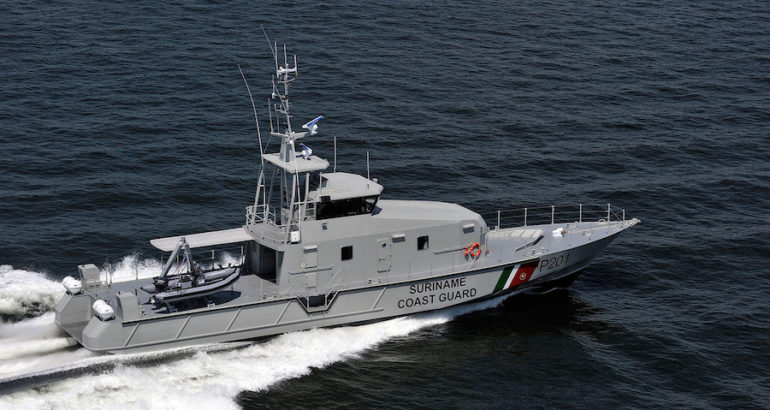
A Suriname Coast Guard FPB 98 patrol boat (Credit: OCEA)

Naval News reports that Ukraine has announced they are in negotiations for joint production of 20 Patrol Boats to a French OCEA design for their “Sea Guard of the State Border Guard Service,” their coast guard. Sounds like it is a done deal with only minor details to work out.

As noted in the report, the Algerian Navy bought 21 of these and has ordered ten more.

They have a GRP hull and are powered by two 3,660 HP Caterpillar diesels using waterjets. Specs on the Algerian boats as follows.

  • Displacement: 100 tons
  • Length: 31.8 meters (104’4″)
  • Beam: 6.3 meters (20’8″)
  • Draft: 1.2 meters (3’11”)
  • Speed: 30 knots
  • Range: 900 nmi @ 14 knots
  • Crew: 13

Most of these boats are armed with a single auto-cannon forward. In most cases a 20mm, the Algerian boats have a 30mm. Given the Ukranians’ tensions with Russia, curious to see if they may choose to provide more weapons.

We have seen products from OCEA before. They provided four smaller patrol boats to the Philippine Coast Guard. These boats like those that went to the Philippines have provision for a RHIB launched by davit.

19 meter (62 foot) Motor Surf Boat, Maybe a Small Port WPB Alternative

Earlier, when I discussed  developing a WPB replacement, I was primarily concerned that in addition to a SAR response, that the Coast Guard in major ports have a response to unconventional maritime attacks by terrorists or other hostile forces. But there are also a number of WPBs in small ports where such attacks would have far less impact and consequently are far less likely. The US shipbuilder Metal Shark has new 87 foot patrol boats in series production for Foreign Military Sales (FMS) that were evolved from the Marine Protector class. They might fulfill the needs of these smaller ports. They appear to be relatively cheap. Looks like the last group had a cost per boat of about $4.3M each. That is way less than the approx. $60M we are paying for the more capable FRCs. Still there might be a better alternative,

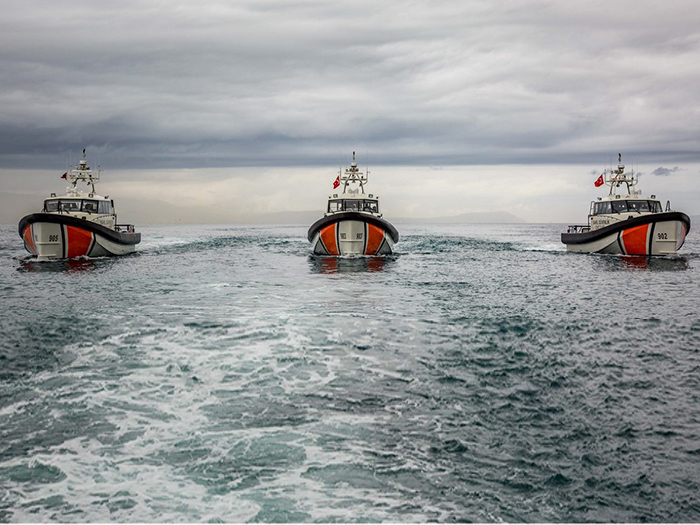
A recent Marine Log report that the EU is buying nine large motor lifeboats to help the Turkish Coast Guard deal with their immigrant crisis, got me to thinking that perhaps, at these small ports, what is really needed is a larger motor lifeboat. Specs for the Damen designed Turkish Coast Guard boats are here. They are apparently a version of the Netherlands own motor lifeboat.

Damen SAR 1906 motor surf boats

There has been a lot of work on development of Motor Surf Boats since the 47 footers and the now over 50 year old 52 footers. Canada and the Netherlands have both made such craft over 60 feet in length. The RAFNAR hull form looks particularly promising. They may not be more survivable than the ones we have now, but they may be better in other ways. Where we don’t need the long term endurance of a WPB, we could have a boat of about Marine Protector class size or perhaps some what smaller, that could operate with a smaller crew, be faster, tow equally large or larger vessels, reduce G-forces on the crew, and still be able to operate in weather where the legacy WPBs could not. There might also be Foreign Military Sales potential for such a vessel. 

“Khulna delivers Bangladesh Coast Guard patrol boat trio, lays keels of two more” –Baird Maritime

CGS Sonar Bangla moments before being launched on May 23, 2018

Baird Maritime has reported that the Bangladesh Coast Guard has taken delivery of three new cutters.

These are based on the Bangladesh Navy’s Padma-class patrol vessels

They are similar in size to the Webber class Fast Response Cutters. Specs for the Bangladesh vessels are:

  • Displacement: 350 tons
  • Length: 165.35 ft (50.40 m)
  • Beam: 24.61 ft (7.50 m)
  • Draft: 13.45 ft (4.10 m)
  • Speed: 23 knots
  • Endurance: 7 days
  • Crew: 45

Armament for the Coast Guard versions of vessel is two Oerlikon 25mm, while that for the Navy version is two 37mm and two 20mm. They are also reported to be capable of minelaying.

Wikipedia indicates up to 23 of these indigenously produced craft are planned (presumably Navy and Coast Guard).

“MAST Asia: Mitsui Unveils OPV Design Proposal for JMSDF OPV Requirement” –Naval News

At MAST Asia 2019, the defense exhibition and conference currently held near Tokyo, Japan, local shipbuilder Mitsui Engineering & Shipbuilding (Mitsui E&S) unveiled its OPV design currently competing for a JMSDF requirement.

Naval News reports on a proposal to meet Japanese Maritime Self Defense Force requirement for Offshore Patrol Vessels

This looks like a pretty typical modern Offshore Patrol Vessel if a bit larger and faster than most, with its medium caliber gun, two remote weapon stations for heavy machine guns and helo deck. In fact it looks very much like an improved L’Adroit with it 360 degree vision bridge, integrated mast, and two boats launched from stern ramps .

The real surprise is the crew of 23, one less than the crew of a Webber class. This might not be quite representative of how the Coast Guard would figure the crew size since there is a possibility the law enforcement officers of the boarding party and the aviation support personnel that are part of a USCG crew, may be handled as visiting detachments rather than as crew by the Japanese. Still the crew is going to be less than half of that of a 270.

Since the crew is a large part of the life cycle cost of a ship, there is a natural desire to cut the size of the crew. In operating a ship, frequently there is no reason the size of the ship should be reflected in the size of the crew, if the tasks the crew performs are the same. Still, 23 hardly provides a decent damage control party. Can they operate the helicopter and both boats simultaneously? Having junior personnel aboard in an apprentice role has much to recommend it. The experience of the Navy in attempting to man the LCSs with a minimum crew looks like a cautionary tale. I just hope they are including some provisions for adding personnel.

“Great Lakes-St. Lawrence Shipping: We need Icebreakers” –MarineLink

Launch of USCGC Mackinaw (WLBB-30) on April 2, 2005. Photo by Peter J. Markham.

Marine Link reports that,

“The Great Lakes-St. Lawrence shipping industry is calling for at least five new icebreakers to be part of the (Canadian–Chuck) federal government’s recent announcement of $15.7 billion for Canadian Coast Guard fleet renewal.”

This appeal was addressed to the Canadian government, but we can expect to hear continued appeals for more USCG icebreakers on the lakes as well.

“Canadian and U.S. Coast Guard crews worked tirelessly during the Great Lakes spring break-out, but were hampered by the age and condition of the fleets at their disposal. Two U.S. Coast Guard icebreakers were out of service in March and a Canadian icebreaker assigned to Lake Superior was only able to operate at 60 per cent of capability and was idled in April due to mechanical issues.”

Congressmen from states bordering the Great Lakes have been asking for more icebreakers for years. There was $5M in the FY2019 budget to start work on procurement of a Great Lakes icebreaker at least as capable as USCGC Mackinaw.

There is an indication that the system may be expanded and the navigation season extended,

That economic contribution is only set to increase as ports and their customers invest in increasing the capacity of the waterway as well as looking at options like lengthening the navigation season of the St. Lawrence Seaway.

There might be an opportunity here to combine the program to provide medium polar icebreakers with a new icebreaker for the Great Lakes. The Great Lakes icebreaker might serve as a prototype for the medium polar icebreaker.

“Canada to build 18 more Coast Guard vessels” –Marine Log

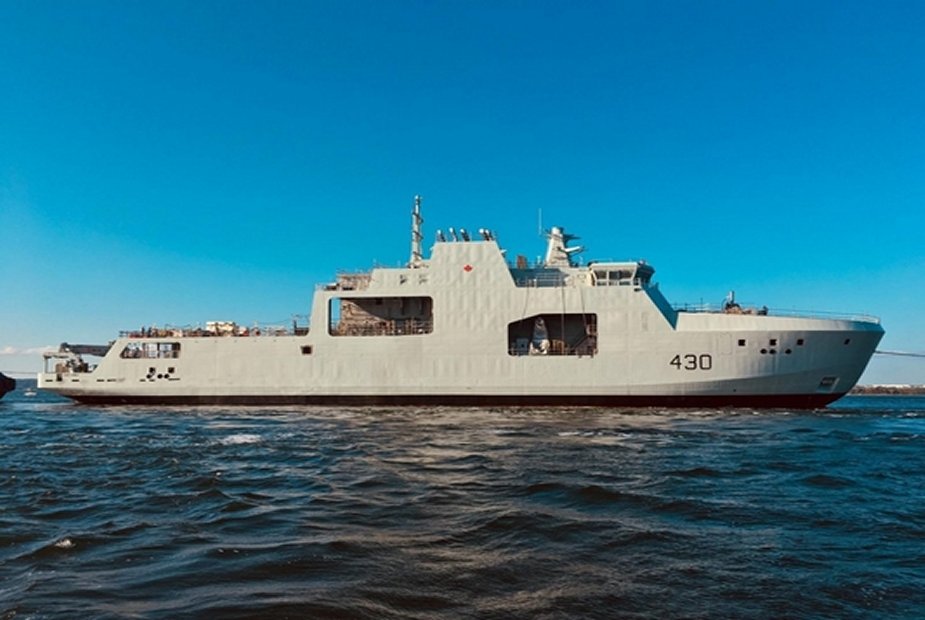
Arctic Offshore Patrol Ship (Royal Canadian Navy photo)

MarineLog is reporting that Canada is planning to build 18 additional ships for the Canadian Coast Guard including two additional Arctic Offshore Patrol Ships (AOPS, a type previously built for the Royal Canadian Navy).

They will also add a third shipyard to the national shipbuilding strategy.

The cost may appear out of line. The total for the 18 ships, C$15.7 billion (about US$11.7 billion) averages US$650M per ship. That is more than the average cost of the contract with options for three USCG Polar Security Cutters ($1.9B for three ships or $633M on average), but the price is not final and it appears it may include extended support.

The C$15.7 billion funding for the 18 large ships in represents early estimates of project budgets including construction, logistics and support, contingency, project management and infrastructure costs. The costs of each ship will be announced following contract negotiations.

Still there is likely to be some criticism.

There is also mention of an intention to also build some smaller vessels,

The Government of Canada will also proceed through a competitive process with the design of a new class of smaller ships, the new Mid-Shore Multi-Mission Ship, which would complement the work of the large fleet in shallow areas and deliver mid-shore science activities.

All in all, good news for the Canadian Coast Guard and an investment in ship building in Canada, assuming it actually happens. Like the US Coast Guard, they have had their problems.