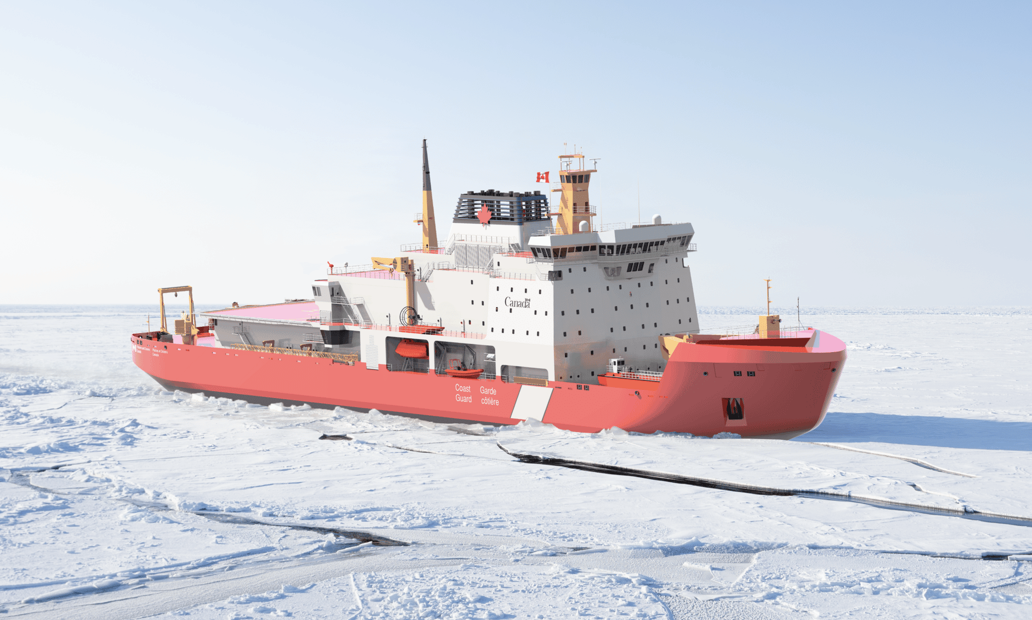
“USCG Polar Security Cutter Program Offers DOGE An Easy ‘Win’”–Forbes

Forbes’ always perceptive Craig Hooper takes a look at the Polar Security Cutter program and finds it ripe for cancellation, “years late, wildly over-budget, and both the budget and the schedule are at risk of slipping even further into the red…”

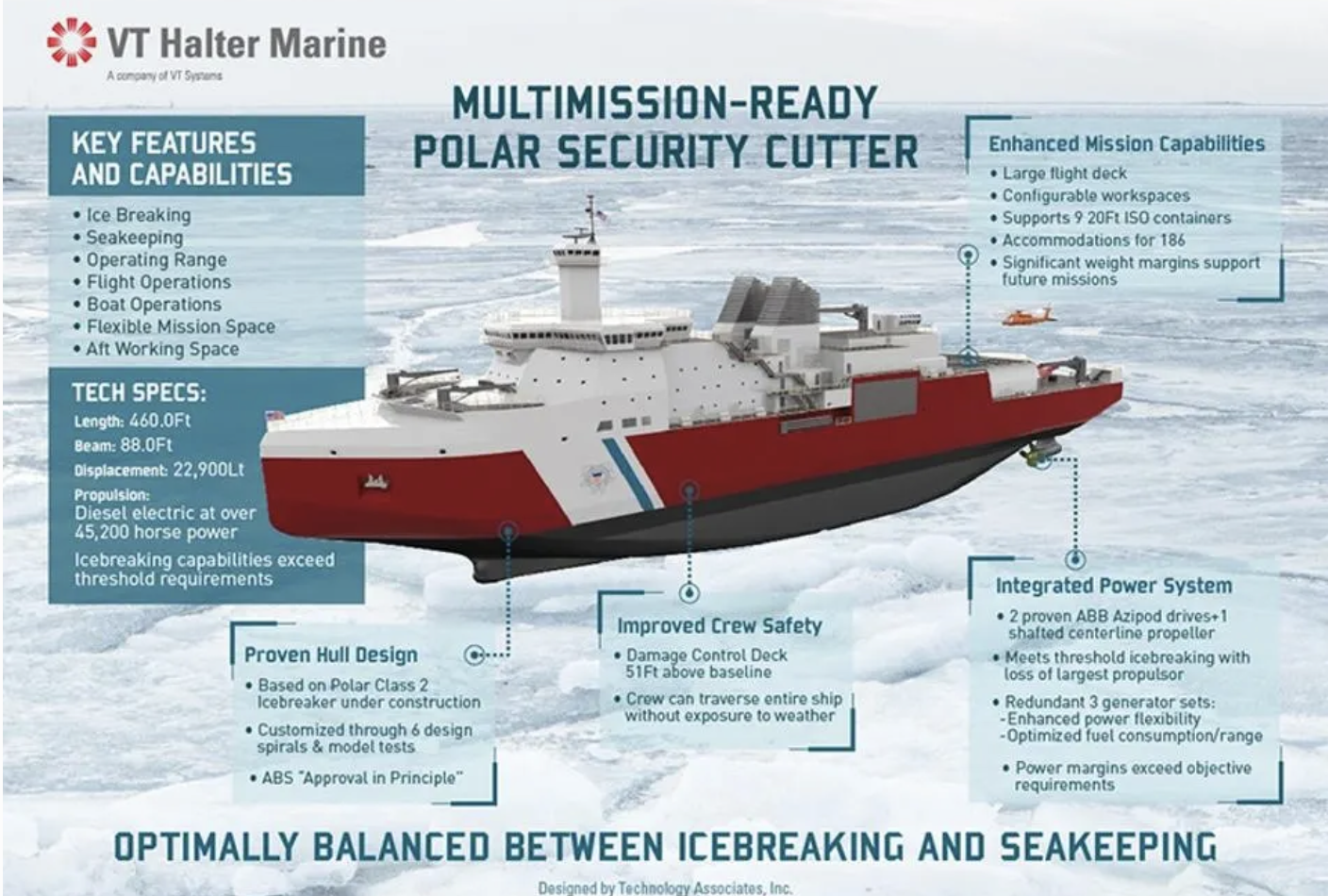
I still want to know who decided that the Coast Guard should award this critically important contract to a relatively inexperienced and less than fully successful shipyard even though they had failed to offer a proven design as had been required by the original solicitation and apparently repeatedly lied that the design was building (See the graphic from VT Halter above, “Proven Hull Design”).

I don’t know enough to agree that the Polar Security Cutter contract should be cancelled, but I do think Hooper would agree that it is time to start procurement of the Medium Icebreakers we know we need, even if the first is to be built in a foreign yard.

Given his comments on the Offshore Patrol Cutter (OPC) program in the same article, I think he might also agree that the Coast Guard should be looking at an alternate design for a medium endurance cutter replacement to be built in lieu of at least some of the planned OPCs.

The first OPC has yet to be delivered, and the costs are likely to increase. If the PSC aligns with the OPC’s ugly performance trends, starting PSC construction with this amount of design uncertainty puts the Coast Guard at real risk of an even bigger fiasco…Sadly, these Coast Guard tastemakers don’t reflect that the building rate–as it is now–appears unable to meet the positively glacial building pace set by years-late and massively over-budget Offshore Patrol Cutter.

Thanks to Paul for bringing this to my attention. 

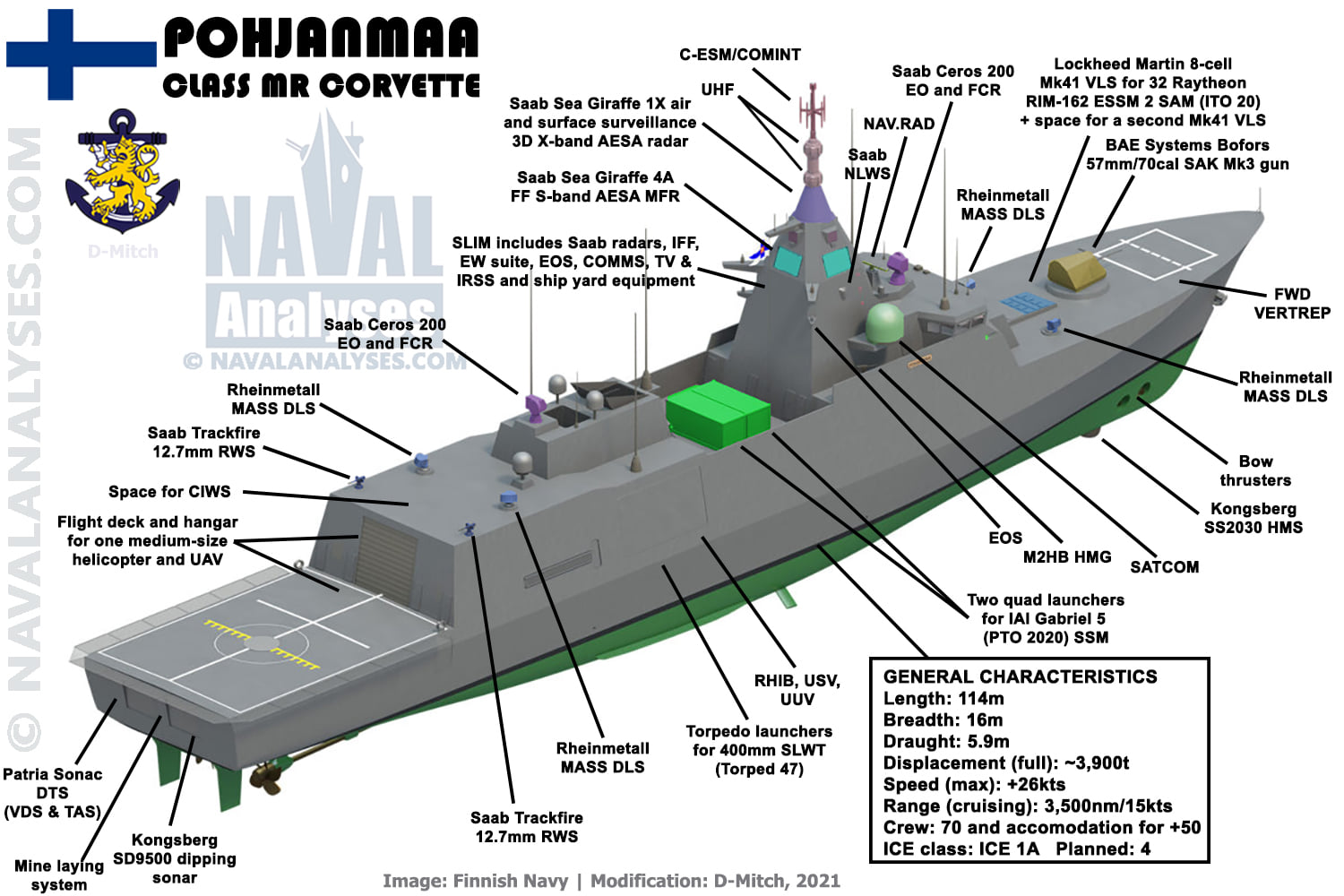
“AKER ARCTIC SELECTED TO PROVIDE ADVANCED ICE LOAD MONITORING SYSTEM FOR FINNISH NAVY MULTI-ROLE CORVETTES” –Aker Arctic

Below is an Aker Arctic news release. Frankly I didn’t know there was such a thing as an ice load monitoring system, but it sounds like something we would want on ships going into the Arctic or Antarctic. I presume it is monitoring the role rate (Tups do you have more info?)

Specs for the class have been updated since the graphic above:

  • Displacement: 4300 tons
  • Length: 117 m (384′)
  • Width: 16 m (52.5′)
  • Draught: 5 m (16.4′)
  • Speed: 26 knots (48 km/h)
  • Crew: 73

More on this new class of warships here and here.


Aker Arctic has been chosen to supply its state-of-the-art ice load monitoring system to the Finnish Defence Forces Logistics Command. The contract includes the delivery of Aker Arctic’s ARC ILMS ice load monitoring, measurement and analysis system for the series of four Pohjanmaa-class multi-role corvettes currently under construction at Rauma Marine Constructions for the Finnish Navy.

The ARC ILMS is Aker Arctic’s platform for measuring loads that the ship’s structure experiences when operating in ice-cover waters, providing feedback to the operator on the safety level of the ship in ice.

“Following our recent successes being chosen to supply the ARC ILMS for the Canadian Coast Guard’s Multi-Purpose Vessels (MPV) (here–Chuck) and our collaboration with French cruise company Ponant measuring ice loads on the Le Commandant Charcot as she made her historic trans-Arctic voyage last summer, we are excited with the vote of confidence the Finnish Navy has put in us to supply our ARC ILMS to their important program” said Kari Laukia, Head of Equipment Business and Special Projects at Aker Arctic.

The contract builds on Aker Arctic’s long-term involvement with the Pohjanmaa-class. In addition to the ARC ILMS, Aker Arctic is supplying the ice-strengthened controllable pitch propellers and their pitch control mechanisms, propeller shafts, bearings and shaft seals. In addition to complete design, calculations and material supplies, Aker Arctic is also responsible for installation supervision and commissioning of the propulsion lines.

“Elomatic awarded Polarstern 2 icebreaker design contract” –Marine Log / A Little Late for the Polar Security Cutter

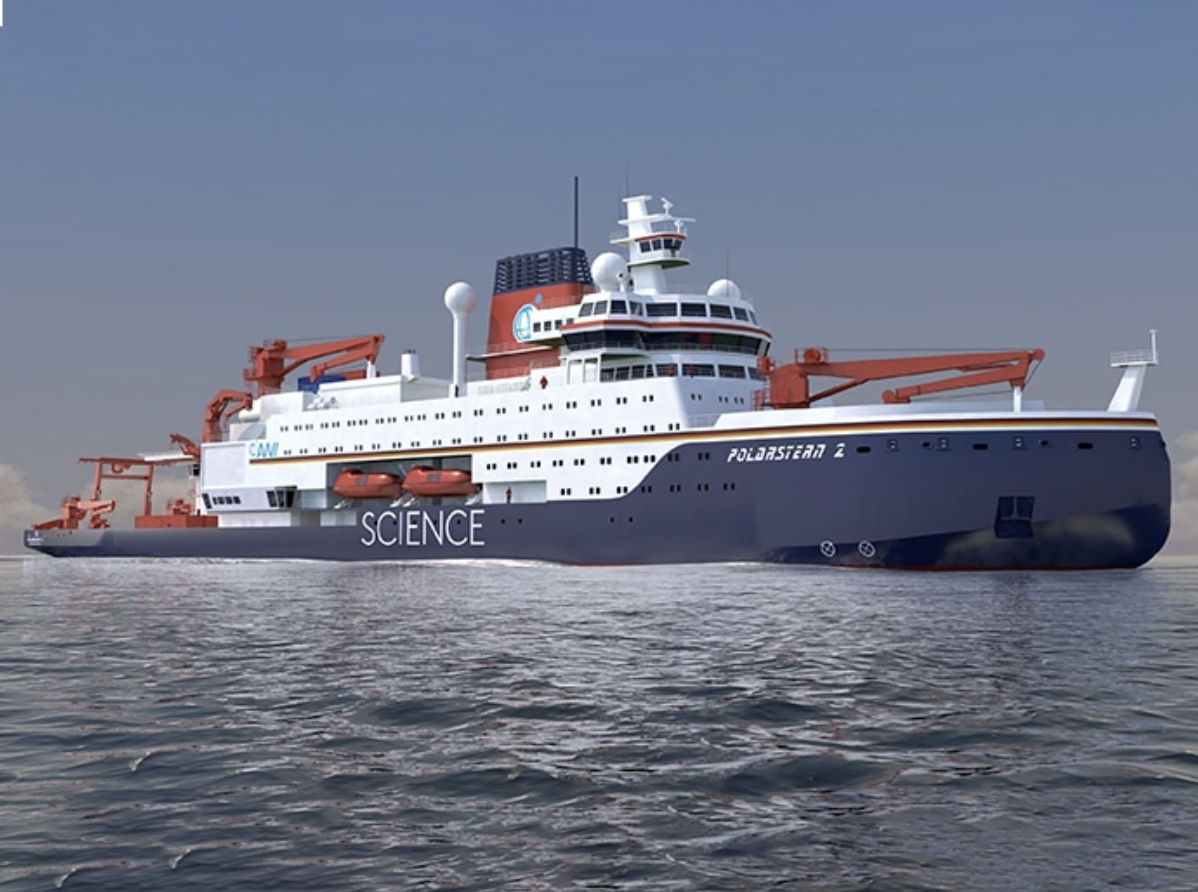
Polarstern 2 rendering: Ocean Architects and Elomatic. This does not look much like the Polar Security Cutter.

As you may recall ,the Polar Security Cutter was supposed to have been based on a proven design. VT Halter Marine Inc. won the contract based on the design of the Polarstern 2, but really Polarstern 2 was, at that point, vaporware rather than a proven design. Its design contract has just been signed almost six years after the award of the contract for the Polar Security Cutter, April 23, 2019.

Marine Log reports,

“Thyssenkrupp Marine Systems (TKMS) has awarded Elomatic Maritime Technologies GmbH a design and engineering contract to support the construction of Germany’s new Polarstern 2 icebreaker.

How did this happen?

No News About Eastern’s Offshore Patrol Cutters / OPC Alternatives

Future USCGC Argus at launch Eastern Shipyard

No News from Eastern: 

I was hoping for some news about Eastern’s progress on the Offshore Patrol Cutter (OPC) program, but I could not find any. Eastern has contracts to build four ships,

  • Argus (915) and Chase (916) to go to San Pedro, CA
  • Ingham (917) and Rush (918) to go to Kodiak, AK

Reported milestones for the four ships are as follows:

  • Argus:     Steel cut Jan. 7, 2019; Keel laid April 28, 2020; launched Oct. 27, 2023
  • Chase:    Steel cut April 27, 2020; Keel laid May 27, 2021
  • Ingham:  Steel cut Sep. 27, 2021; Keel laid July 15, 2022
  • Rush:     Steel cut Oct. 18, 2022

Nothing since October 2023, not even a report of keel laying for Rush, which should have happened in 2023. Was Rush’s keel laid? Are sea trials being conducted on Argus? WTFO!

The Planned Timeline:

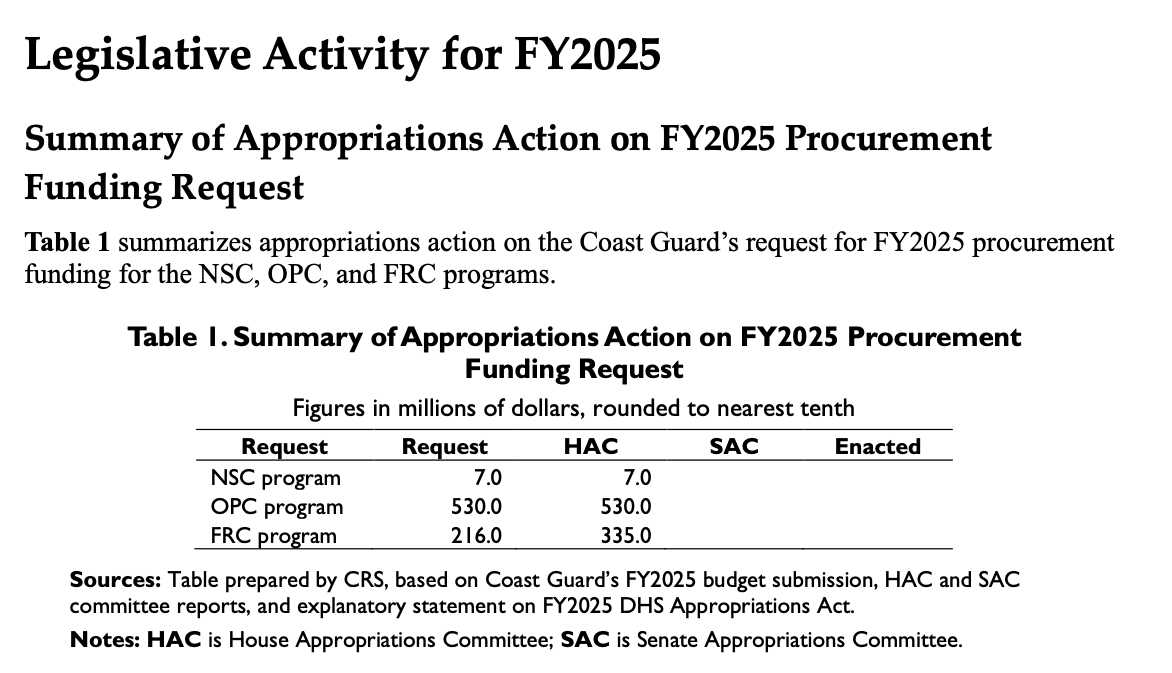
The Congressional Research Service report, “Coast Guard Cutter Procurement: Background and Issues for Congress” noted.

“The posting for the RFP for the Stage 2 industry studies (October 11, 2019–Chuck) included an attached notional timeline for building the 25 OPCs. Under the timeline, OPCs 1 through 7 (i.e., OPCs 1-4, to be built by ESG, plus OPCs 5-7, which are the first three OPCs to be built by the winner of the Stage 2 competition) are to be built at a rate of one per year, with OPC-1 completing construction in FY2022 and OPC-7 completing construction in FY2028. The remaining 18 OPCs (i.e., OPCs 8 through 25) are to be built at a rate of two per year, with OPC-8 completing construction in FY2029 and OPC-25 completing construction in FY2038.

Using these dates—which are generally 10 months to about two years later than they would have been under the Coast Guard’s previous (i.e., pre-October 11, 2019) timeline for the OPC.

The Current Optimistic Timeline: 

We are in the middle of FY2025 and still waiting for OPC#1, so we are at least an additional three years late on delivery of USCGC Argus and we are almost certainly an additional two years late getting the first ship from Austal (though I am hoping for a pleasant surprise).

Eastern was expected to deliver one ship every year. I would have expected construction to speed up with experience, but the intervals between steel successive steel cuttings and between successive keel layings never got down to 12 months. But let us presume that Argus OPC #1 will be delivered in 2025 and Eastern will deliver #2- 4 at 12 month intervals.

Austal started cutting steel for OPC #5, Pickering (WMSM-919), on August 29, 2024. I assume they will deliver four years after starting steel cutting and annually thereafter with two per year delivered after #7. It should look like this.

  • 2025 #1
  • 2026 #2
  • 2027 #3
  • 2028 #4 & #5
  • 2029 #6
  • 2030 #7
  • 2031 #8 & #9
  • 2032 #10 & #11 These will replace the last of WMEC210s
  • 2033 #12 & #13. These will begin replacement of Alex Healy and the 13 WMEC270s
  • 2034 #14 & #15 These are the last that will be built under existing contracts
  • 2035 #16 & #17
  • 2036 #18 & #19
  • 2037 #20 & #21 These will begin replacement of the six SLEP WMEC270s
  • 2038 #22 & #23
  • 2039 #24 & #25 These will replace the last of the WMEC 270s

This does assume a smooth continuation of the program, delivering two ships a year without interruption even after exercising all options and completion of existing contracts.

All the WMEC210s will not be replaced until 2032. At that point even the youngest of the 210s would be 63 years old. It is by no means certain any will last that long, but Reliance is already 61 years old.

All WMECs would be replaced by the end of 2039 by which time the youngest WMEC270 will be 48 years old.

Will the program continue uninterrupted after the completion of the currently optioned 15 OPCs? This would be easy only if Austal wins the contract for a Phase 3. Is that a forgone conclusion?

If some other company wins the Phase 3 contract, will they also initially deliver the first three ships at the rate of one ship per year as was done with the first two contracts?

Alternatives: 

It can take up to ten years from the beginning of planning to delivery of the first ship. In reality it has taken considerably longer for the first OPC to get this far and we still no finished product. Even if all options are exercised, the last currently contracted OPC will be funded in FY2030 or 2031.

Do we still want to be building a design in 2030 that is 15 years old? Does the Coast Guard now own the design that could be handed over to another contractor to build the last ten ships or would a third yard have to provide a third detailed design, creating a “C” class of OPC?

Now is the appropriate time to consider alternatives.

Assuming we want to continue with the same design, Phase Three might be started with the idea of awarding a contract in FY2027 and delivering one additional OPC each year 2032, 2033, and 2034 by either Austal or a competing shipyard, with the winner producing two per year thereafter, until all 25 are completed. It would allow completion of all 25 a year and a half earlier.

If we want to look at an alternative that could replace the last ten currently planned OPCs and start delivering ships by 2035, we should issue an RFP in 2026.

There are two directions this new design could go.

  • A cheaper design that can be made in larger numbers.  A primary goal would be a smaller crew as a way to reduce operating costs.  It might be smaller and cheaper (we already have contracted for more than enough ships to do Alaska patrols), but should be able to support alternative mission modules and unmanned systems.
  • Ships that can be more readily upgraded for a wartime role. We might accelerate the design process by looking at the European Patrol Corvette, Australia’s Tier 2 combatant under the AUKUS umbrella, or if the country needs an ice capable combatant look at Finland’s Pohjanmaa-class corvette.

“Canadian shipyard in talks to buy US shipbuilder amid trade war talk” –Defense News

Canada’s Polar Icebreaker

After the continued frustration of the Polar Security Cutter program, the ICE Pact agreement between Finland, Canada, and the US seems promising, but we have heard little about how it will work or what it will produce. Forbes discusses the possibilities here.

We may be seeing the first steps of implementation as Canada’s Davie shipyard, which has already purchased a shipyard with a long history of building icebreakers in Finland, seeks to buy a shipyard in the US. There aren’t many possibilities, I would guess either the old Navy yard in Vallejo that has been doing the five year rolling service life extension on Polar Star or the Philly Shipyard currently building “National Security Multi-Mission Vessels” for the merchant marine academies.

Defense News reports.

Davie, a Quebec shipbuilder set to play a key role in a joint icebreaker production agreement between Canada, the United States and Finland, is moving forward with plans to expand its operations south of the border despite a looming trade war threatening the continent.

As part of the expansion, the Canada-based multinational shipbuilder has set out to acquire an American shipyard, which would secure an initial and important footprint in the U.S. for the company.

Davie is expected to build Canada’s second in class large Polar Icebreaker and six “Program” Icebreakers.

Davie is very clearly specializing in icebreakers while continuing to produce ice strengthened commercial ships.

The first of Canada’s Polar Icebreakers (pictured above) is being built by Seaspan, with the second of class being built by Davie. These will be heavy icebreakers, even by US Coast Guard standards, bigger and more powerful than the Polar Security Cutters.

  • Length Overall 158.2m (519 ft)
  • Beam: 28m (91 ft 10 in)
  • Draft: 10.5m (34 ft 5 in)
  • Classificaton: LLoyd’s Polar Class PC2
  • Installed Power: 46 MW (61,687 HP)
  • Top Speed: 18 knots
  • Icebreaking 2.5m @ 3 knots continuous
  • Design Displacement: 26,000 tons
  • Complement: 100 Persons

Canada’s “Program Icebreaker.” Six are planned.

The design for the six “Program Icebreakers” might provide a basis for both the Coast Guard’s Arctic Security Cutter (medium icebreaker program) and the new Great Lakes icebreaker. (It would be a substantial improvement of USCGC Mackinaw and  we really need some medium icebreakers.) Their specifications are:

  • Length: 100-110 m (328 to 360 ft)
  • Beam: under 23.8 m (78 ft) for Great Lakes;
  • Draft: 6-8 m (20 to 26 ft)
  • Icebreaking: Capable of maintaining 3 knots in 1.4 m (4.6 ft) of ice
  • Accommodations: more than 30 crew and program teams of 34
  • Range: 20,000 nautical miles at 12 knots
  • Able to operate and maintain one medium helicopter
  • Significant general and containerized cargo capacity

“This Icebreaker Has Design Problems and a History of Failure. It’s America’s Latest Military Vessel” –Military.Com / Was Halter Marine Ever Really Qualified to Build the PSC?

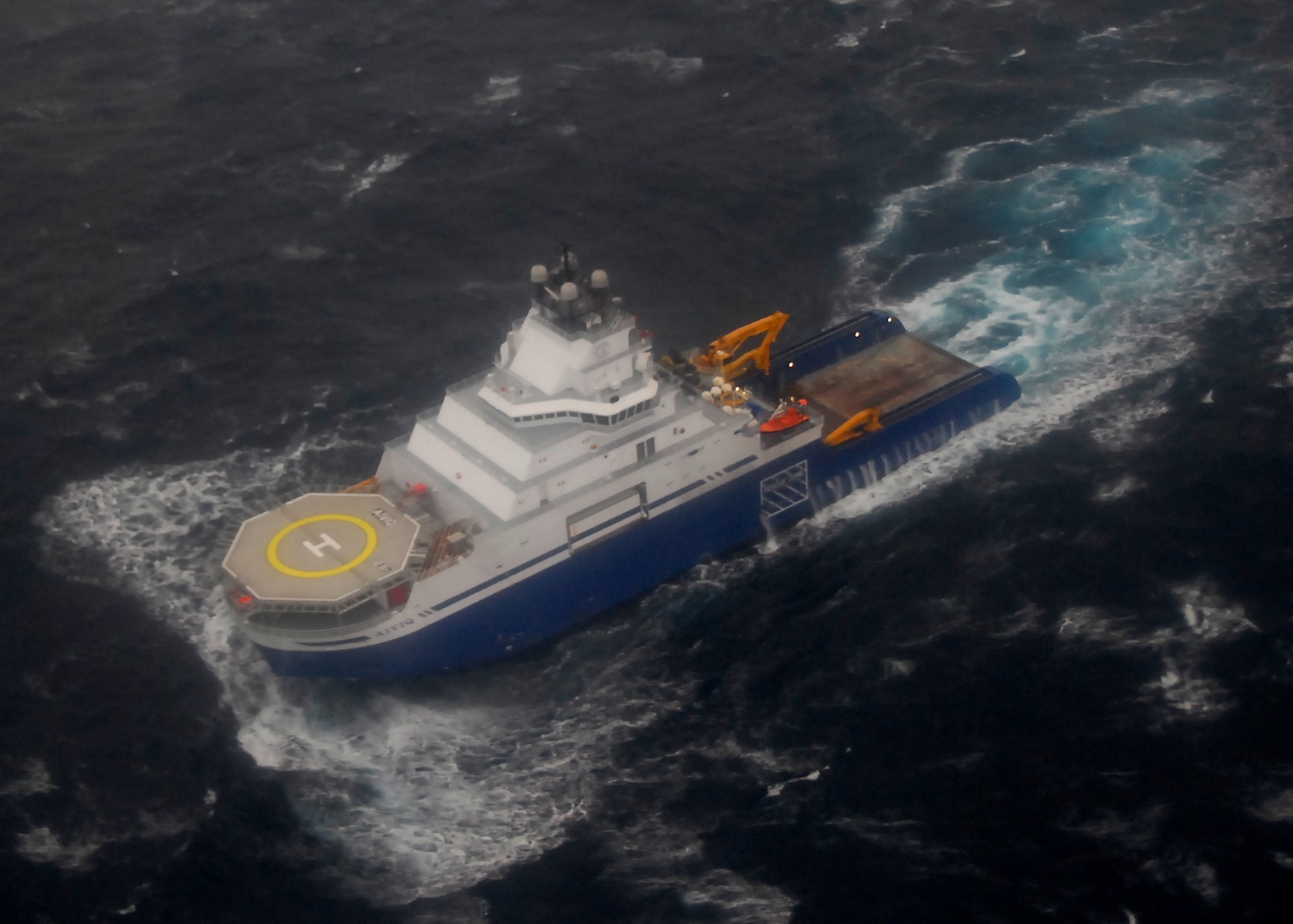
The tug Aiviq traveling with the mobile drilling unit Kulluk in tow 116 miles southwest of Kodiak City, Alaska, in 2012. Credit: U.S. Coast Guard | Petty Officer 2nd Class Chris Usher

Military.com provides an article, originally published by ProPublica, that questions the acquisition of the new USCGC Storis, formerly M/V Aiviq., suggesting undue influence in the decisions to procure the vessel and to homeport it in Anchorage.

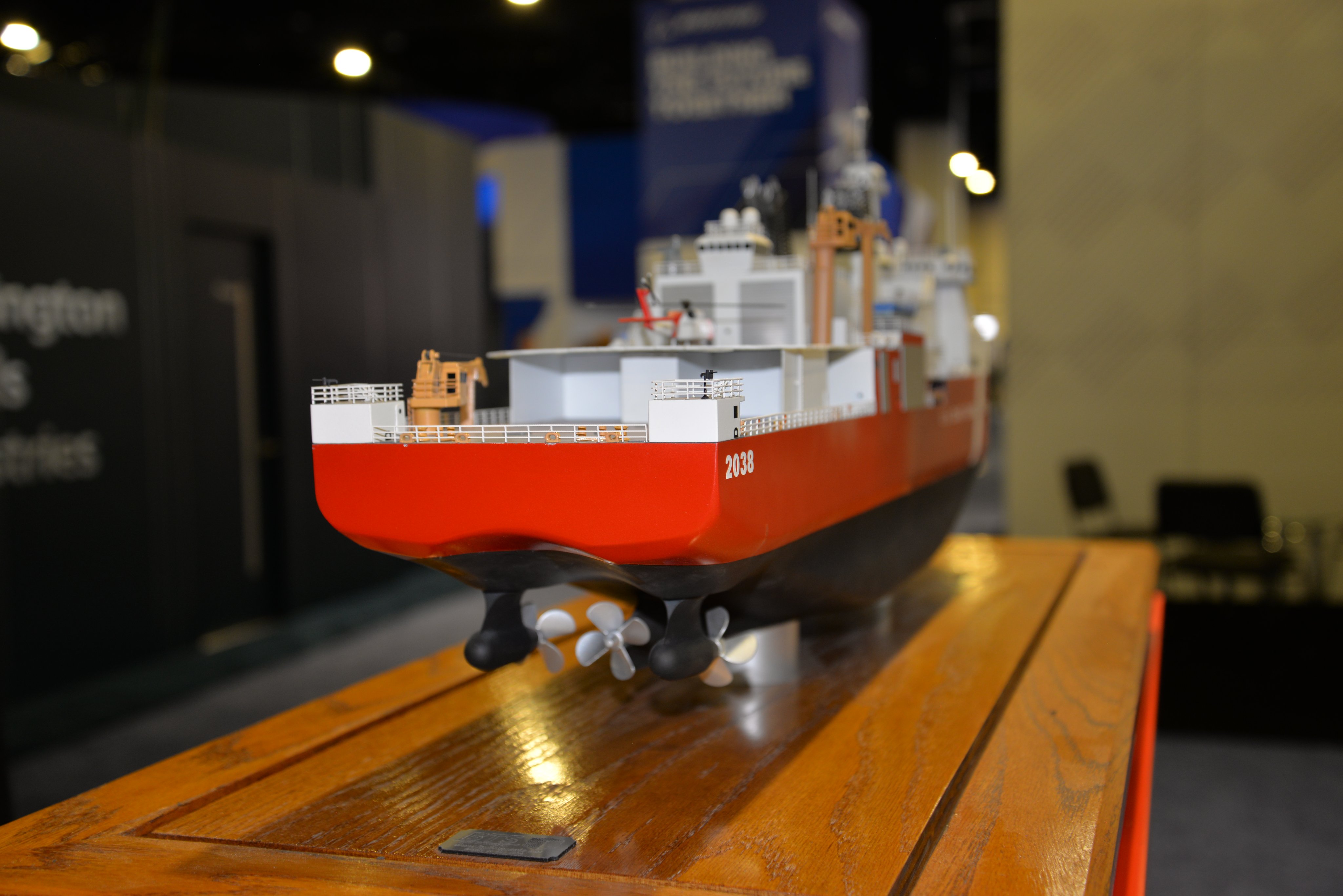
Photo of a model of Halter Marine’s Polar Security Cutter seen at Navy League’s Sea-Air-Space Exhibition have surfaced. Photo credit Chris Cavas.

We would like to think that the Coast Guard has free reign in its award of contracts, but that is, of course, not entirely true.

With this and with the long history of difficulties with the Polar Security Cutter (PSC) program, I have to wonder about the decision to award the contract to award the decision to relatively inexperienced Halter Marine for a design that did not meet the RFP requirement that the design be based on a proven design.

In February 2017, the USCG awarded five fixed-price contracts for heavy polar icebreaker design studies to Bollinger ShipyardsItaly’s Fincantieri Marine GroupNational Steel and Shipbuilding CompanyHuntington Ingalls Industries, and Singapore’s Halter Marine Inc .

On 23 April 2019 Halter Marine was awarded a $745.9M contract for detailed design and construction of the lead ship. This was probably the low bid, but it has proven an unrealistically low bid.

Of the five contenders, Halter Marine was the least experienced and the least familiar to the Navy and Coast Guard.

Halter Marine had changed hands in 1983, 1996, 1999, 2003, and 2022, not a picture of stable management, and it was not partnered in this offer with any experienced builder of icebreakers.

At the time of the award, Halter Marine had built two ships for the US Navy, none for the Coast Guard. The two ships for the Navy were USNS Howard O. Lorenzen (T-AGM-25), 12,642 tons, a Missile Range Instrumentation Ship and USNS Maury (T-AGS-66), 5000 tons, an oceanographic survey ship.

The Navy’s experience with the construction of USNS Howard O. Lorenzen might have raised red flags. Defense News’ Chris Cavas reported,

“The new ship, built under an initial $199 million contract awarded in 2006, has been under construction at VT Halter’s yard since August 2008, when delivery was scheduled for June 2010. The design is based on a pair of Navy survey ships built in the mid-1980s.
“The Navy’s Board of Inspection and Survey, known as INSURV, conducted the Lorenzen’s acceptance trials in the Gulf of Mexico during the week of May 9, …”
“The trial “was reported as unsatisfactory” by INSURV…The failed grade was due to three major discrepancies – thrust bearing temperature, and steering and anchor demonstrations. Three of 15 graded areas – electrical, damage control and aviation – were also graded unsatisfactory.
“INSURV recommended that acceptance not take place until the systems “can be fully re-demonstrated.”
“…In recent years, problems have emerged with several ships under construction at the Moss Point yard for U.S. government customers.
“Last fall, the National Oceanographic and Atmospheric Administration (NOAA), for which VT Halter built a number of fisheries research ships, abruptly canceled completion of a new research ship when it was nearly finished, claiming it was overweight and unable to carry out its coastal mapping mission. The ship was seized by NOAA and moved elsewhere for completion and modifications.
“In 2005, contract disputes led the U.S. Army to cancel completion of a logistics vessel and delay delivery of two others.

The Coast Guard might also have looked at their safety record.

 “…in 2009, unsafe working conditions led to an explosion that killed two employees and injured five others. The company was fined $1.32 million by the United States Department of Labor for 17 willful and 11 serious violations, including willfully exposing workers to toxic fumes in a confined space. According to Secretary of Labor Hilda L. Solis, the explosion “was a horrific and preventable situation. VT Halter Marine was aware of the hazards and knowingly and willfully sent workers into a confined space with an explosive and toxic atmosphere.”

The use of a never completed design should have disqualified Halter Marine. With this as background, could the Coast Guard have missed the warning signs, or might they have been overruled in the selection of the yard? Could this have been a case of undue influence? Who made the final decision, the Coast Guard/Navy acquisition team, the Commandant, the Department of Homeland Security, or someone else? and why?

“Hellenic Navy names four (former USCG) Island-class patrol vessels (Video)” –Naval Today

Credit: Ministry of National Defense (Greece)

Naval Today reports on the commissioning of four former US Coast Guard Island class cutters into the Greek Navy.

Lots of friendly nations are benefitting from receipt of previously well-maintained US Coast Guard vessels through Foreign Military Sales. Their availability helps our friends in the maintenance of a global rules based maritime environment. Ships that are no longer economical to support in the US, may be maintainable in other countries where labor costs are lower.

This movement of retiring ships should be part of regular Coast Guard planning. We should set a reasonable life, say 30 years for large ships and 25 for smaller, and produce a 30 year ship building plan. Yes, it may change, and it should, but it would establish expectations for future budgets. We should produce a new projection every year.

“Sails on an OPV? Vessel Design, with French Flair” –MarineLink

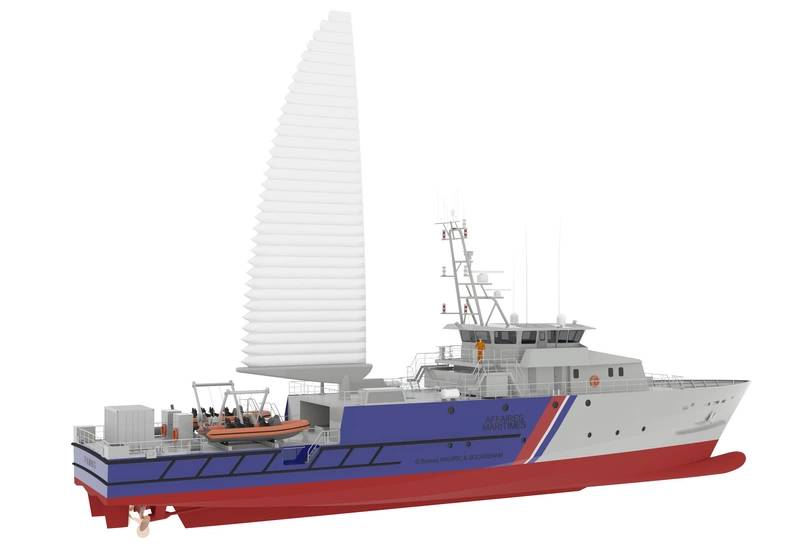
3D rendering of the PAMNG. Image ©MAURIC

Marine Link reports a contract for construction of a small Offshore Patrol Vessel (OPV) for the French Directorate General for Maritime Affairs, Fisheries and Aquaculture (DGAMPA).

I have been seeing reports of sails of various sorts being added to merchant vessels in order to reduce fuel consumption, but this is the first time I have seen this applied to a modern OPV.

It is just part of their efforts to make the ships fuel efficient while minimizing emissions,

The wind-assisted propulsion solution, combined with diesel-electric hybrid propulsion and IMO TIER III compliant engines, are designed to position the vessel “at the forefront of maritime ecological transition,” wrote DGAMPA.

As with all vessel designs, there is not a silver-bullet solution to increased efficiency, and this vessel will also have a hull design optimized through computational fluid dynamics, enhanced insulation with optimized energy management, photovoltaic panels, and an active trim control system.

Based on some modest experience with sailing craft, the sail may also have the effect of steadying the ship, slowing the roll and making it more comfortable as well. In addition, with the mast apparently stepped a bit aft of amidships, and the sail aft of that, it appears that the ship would drift with its head into the wind and seas rather than broadside as most ships do.

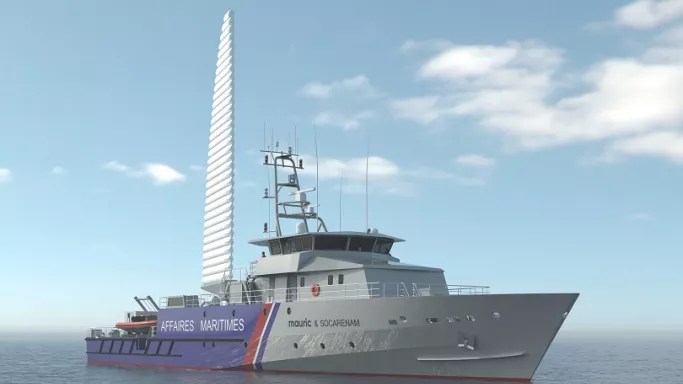
Rendering of the PAMNG. Image ©MAURIC

54m OPV Main Particulars

  • Crew: 16 persons
  • Duration: 12 days, up to 200 days at sea per year
  • Length: 53.7 m
  • Construction: Steel hull, aluminum superstructure
  • Propulsion: Diesel-electric hybrid system with wind assisted propulsion
  • Maximum speed: 17 kts
  • Endurance: 3,600 nm at 12 kts
  • Nautical equipment: 2 semi-rigid boats of 6.50m (speed: 35 kts)

Main Missions

  • Protection of national interests
  • Maritime fisheries surveillance and control
  • Environmental regulations compliance
  • Pollution and navigation monitoring
  • Assistance to persons
  • Public service missions and representation of French Maritime Affairs Administration

“Top Ten Navies by Aggregate Displacement, 1 January 2025” –Analysis and diagram by Phoenix_jz

This is becoming an annual thing. I do not know but he has produced a version of the graphic above annually and provides brief additional analysis. I just pass it along. You can check out the entire accompanying discussion here.

The graphic above will be hard to read unless you click on it to enlarge.

Again, the author also listed Navies 11–20 in the comments, “No.11 to 20 are as follows for 1 January 2025;”

  • 11: Indonesia – 330,200t
  • 12: Taiwan – 276,166t
  • 13: Egypt – 232,046t
  • 14: Spain – 229,373t
  • 15: Germany: 226,952t
  • 16: Australia: 216,594t
  • 17: Greece – 189,184t
  • 18: Brazil – 163,805t
  • 19: Chile – 161,404t
  • 20: Canada – 143,242t

Note, Coast Guards are not included in this analysis. This leads to some distortion since navy operated Offshore Patrol Vessels (OPVs) and patrol craft are counted as combatants, but coast guard operated OPVs and patrol craft are not counted at all. The US, China, Russia, Japan, India and South Korea all have substantial sea-going coast guards, notably the UK and France do not. The Indian Navy in particular has a large number of Navy operated OPVs and patrol craft.

Just for reference the US Coast Guard’s projected eleven NSC and 25 OPC program alone would amount to 173,000 tons not to mention icebreakers, buoy tenders, and patrol craft. The total projected 64 Fast Response Cutters would add 23,360 tons.


Hello all!

The fourth edition of my top ten navy list arrives with 2025! For those unfamiliar, here are links to 20222023, and 2024, with a general explainer for the whole concept in that first 2022 edition.

The long and short of it is that this graph reflects a personal tracker I keep of almost every large and moderately sized navy, and calculates the aggregate displacement of these navies. It’s not a perfect way to display the size of navies – far from it in fact – but it is at least more representative than counting numbers of hulls alone, in my opinion.

To break down what each of these categories mean;

  • Surface Warships is an aggregate of all above-water warships and major aviation and amphibious assault platforms. This category includes CVNs, CVs, CVLs, LHDs, LHAs, LPDs, CGs, DDGs, FFGs, corvettes, OPVs, CPVs, lighter patrol craft, and MCM vessels.
  • Submarines is what it says on the tin – SSBNs, SSGNs, SSNs, SSKs, and for select nations where applicable (and where information is available), special purpose submarines. Please note dedicated training submarines are counted separately.
  • AORs includes all major fleet replenishment vessels (coastal vessels do not count, however).
  • Other Auxiliaries is a very wide net that essentially captures everything else. Special mission ships, support vessels, minor amphibious assault vessels (LSDs, LSTs, LCAC’s, LCM’s, LCU’s), training vessels, tugs, coastal support vessels, hydrography ships – all essential parts of navies, but generally often paid less attention to as they’re not as flashy as the warships proper.

Interesting trends in data that I thought I would share for various navies, and thoughts and observations otherwise;

The USN’s position remains unimpeachable, and record a slight increase in both overall tonnage (+11,983t, or 0.16%) and numbers of vessels (net +2), commissioning an LPD, a destroyer, an SSN, and three LCS against the decommissioning of four Ticonderoga-class ‘cruisers.’ It is interesting to note that with these commissioning’s, there are only two more LCS – one of each class – and two remaining Flight IIA Burke’s left to enter service before the torch is entirely passed to the Flight III Burke (ten of which are currently building or fitting out) and other future platforms. Only nine of the venerable Ticonderoga-class remain in service.

The PLAN (China–Chuck), no one will be surprised to hear, increases in displacement again this year, though the on-paper 74,350t (+2.56%) from last-years figure does include some ‘fluff’ – I corrected the displacement of the Type 055 up 1,000t and split off the Type 052D’L’ (12) from the Type 052D’s, which netted +9,800t for the PLAN from thin air. 2024 was a relatively light growth year for the PLAN, with only a two new major warships entering service – the first Batch IV Type 052D and the first Type 054B. That being said, several ships are in advanced stages of trials and likely follow in very early 2025 (the second Type 054B and two other Batch IV Type 052D). There is also an addition of at least one new Type 039C SSK – though for full transparency, while I have three vessels listed presently, there is probably ±2 boat margin of error given the difficulty with tracking individual PLAN boats with open-source data. The rest of the increase comes from the auxiliary category in general, with the most notable of these being a second Type 927 ARS (submarine rescue ship, different from the AGOS formerly dubbed Type 927 but now Type 816). I have also struck a pair of Type 053 variants that have clearly left service.

Despite the modest growth, 2024 has been a big year for PLAN-related shipbuilding, crowned by the launch of the Type 076 LHD – a unique catapult-equipped amphibious assault ship – but one that has also seen the launch of the second Type 055 Batch II (with two more in build) and two more Type 052DL destroyers. Additionally, three Type 054AG frigates have been launched – a new, lengthened variant of the Type 054A, able to handle the Z-20 helicopters (also accommodated by the Type 055 and 052DL destroyers). The production of these additional ships and the absence of additional Type 054B builds has been a curious development that may signal the 054B as more of a transitional design, like the original Type 054 frigates, instead of a design the PLAN intends to produce at large scale (as with the Type 054A).

What is more consequential than any of these, however, is the continued launches of what is generally believed to be Type 093B SSNs from Bohai. 2024 may have seen up to three launches this year, indicating a similar pace of 2-3 boats per year as last year. This would mean that since the spring of 2022, five to seven Type 093B have been launched, compared to four American SSNs in the same period. It remains to be seen if these SSNs will just be built in a limited number, as has been the case in the past, or if the PLAN is adopting a more continuous production model for their SSN fleet (as practiced by the United States).

The VMF  (Russia–Chuck) has also seen a very slight uptick in 2024, of 3,605t (+0.17%). Combat losses in 2024 were less severe for the Russian navy than in the first two years of the Russo-Ukrainian War, but still notable. In 2024, Ukrainian forces sank two corvettes, an OPV, and an LST in the Black Sea. Despite this, arguably the largest blow Russian naval forces suffered this year was the collapse of the Assad regime in Syria and the naval base it allowed Russia at Tartus. While Russia appears to be sounding out Libyan National Army under Gen. Haftar to use Tobruk as a base (Cyrenaica, Libya), this will not be able to replace the facilities that had been built up at Tartus.

Russia’s most notable additions to its fleet this year include a fifth Yasen-M SSGN, a second Lada-class SSK, and a new Project 21180M icebreaker. Three new corvettes entered service, though this did not offset losses given the retirement of six other corvettes in addition to combat losses. The growth in the submarine force has been offset by retirements of not just aging Project 877 Kilo’s, but also the first of the deeply unsatisfactory Lada-class.

The British Royal Navy sees a reduction for a third year in a row, with 2025 looking to include an even sharper decline given cuts announced late this year. 2024 reductions include two Type 23 frigates (Argyll and Westminster) and all but the last Sandown-class MCM (HMS Bangor). This equals a drop of 11,072t tons (-1.25%).

An additional Type 23 frigate, as well as both Albion-class LPDs and the two Wave-class AORs will be decommissioned in early 2025. This is more a reduction on paper than in practice given the condition of the vessels, which had little to no chance of ever returning into service. It should be noted that while this is a cut in platforms, the up to £500M the British MoD expects to save on maintenance and refit costs for these vessels over the next five years will remain within the MoD for investment in other programs.

Perhaps the most perilous malfeasance facing the Royal Navy at present is the plight of the Royal Fleet Auxiliary, which for want of pay raises competitive with commercial shipping continues to hemorrhage mariners.

“Quentin Walsh — D-Day planner and Cherbourg liberator 80 years ago!” –MyCG

190606-N-DM308-001 A graphic illustration of the future Arleigh-Burke class guided-missile destroyer USS Quentin Walsh (DDG 132). (U.S. Navy photo illustration by Mass Communication Specialist 1st Class Paul L. Archer)

MyCG has a retelling of the life of my favorite Coast Guard Hero, Quentin Walsh. Read the whole thing, but I have quoted below the section on what he and his 53 man  SeaBee unit did in less than three weeks following the Normandy invasion.

German prisoners march out of surrendered Cherbourg under U.S. Army guard. U.S. Navy photo.

By Tuesday, June 27th, Walsh’s men had fought their way through to Cherbourg’s harbor. During this assault, Walsh moved his men quickly to occupy strategic parts of the port and take control the harbor. During the assault, the men in his unit experienced a twenty-five percent casualty rate. By the end of the day, Walsh’s unit had advanced to the city’s old naval arsenal, where he accepted the surrender of 400 German troops.

After capturing Cherbourg’s port facilities, Walsh learned that the Germans held American paratroopers in the city’s old citadel at Fort du Homet. In the highlight of the Cherbourg operation, and likely his career, Walsh and one of his officers put themselves in harm’s way to save the lives of the Americans. The two officers entered the fort under a flag of truce and met with the commanding officer of the German garrison. By greatly exaggerating the numeric strength of his small force of Sea Bees, Walsh convinced the commanding officer to surrender the stronghold. With the surrender of Fort du Homet, Walsh and his men disarmed another 350 German troops and liberated over fifty American prisoners.

I have added this story to my Heritage page. There is an earlier post here reporting that the Secretary of the Navy had announced the decision to name DDG-132 after Walsh while on the deck of USCGC Eagle, in Cherbourg, June 6, 2019.

USS Quentin Walsh (DDG-132), a Flight III Arleigh Burke class destroyer, is to be built by Bath Iron Works.