Not yet commissioned, but MarineLog is reporting the eighth FRC has been delivered to the 7th District where it will be attached to Sector Key West.
Eighth Webber Class FRC Delivered
5

Not yet commissioned, but MarineLog is reporting the eighth FRC has been delivered to the 7th District where it will be attached to Sector Key West.
This is another post I prepared for Center for International Maritime Security (CIMSEC) as part of “Corvette Week.”
The US Coast Guard is currently in the first part or a two part program to select a design for a planned class of 25 ships referred to as Offshore Patrol Cutters (OPC) also called the Maritime Security Cutter, Medium (WMSM). In many respects these might be thought of a third class of Littoral Combat Ships. They have different characteristics and different strengths and weaknesses, but there is considerable overlap in there characteristics. Like the LCS they will be small, shallow draft, helicopter equipped warships with the 57mm Mk110 gun. It seems likely the OPC will be 2,500 to 3,500 tons, similar in size to the Freedom and Independence class LCS.
The existing LCS classes emphasize adaptability, are faster and have more spacious aviation facilities. The cutters will emphasize seakeeping and will:
The acquisition process:
A two step Acquisition process is being used. First, up to three contractors will be selected to develop their concepts into fully detailed contract proposals. This selection is expected by the end of the second quarter of FY2014. These three will then compete for a contract which will include all documentation, construction of the first OPC (expected delivery in FY2020) and options for up to ten follow-on ships.
Eight yards have submitted bids:
There has been international interest in the project. VT Halter has partnered with French Defense Contractor DCNS. Vigor is allied with Ulstein, Bollinger is working with Dutch Ship builder Damen. It appears Eastern may have teamed with STX (supposition on my part, based only on their concept‘s similarity to the New Zealand Navy’s Protector Class OPV.

An early DCNS concept
The funding schedule is expected to look like this:
There was also a statement of intent to hold the maximum price of units four through nine to $310M each.
Specifications:
The ships are to be built to modified American Bureau of Shipping Naval Ship Rules excluding explosive or underwater shock hardening.
They are expected to operate in cold climates. They will be equipped “to operate in areas of broken plate, pancake, and sea ice ranging from 10 to 30 inches thick.” There is also a required capability to operate an ice capable small boat and to have automated topside de-icers.
“The WMSM will provide increased protection for (sic.) small caliber weapons and shrapnel fragmentation around the bridge, CIC, and magazine spaces.”
It will tow up to 10,000 tons.
The ships are expected to be able to do Fueling at Sea (FAS), Replenishment at Sea (RAS), Vertical (Helicopter) Replenishment or VERTREP, and to refuel smaller vessels (apparently reflecting an expectation of sustained operations with smaller patrol vessels (WPCs or WPBs) at locations remote from their bases).
I did not have access to the latest specifications, but have deduced some details of the proposed equipment from the Allowance Equipage List included in the Draft RFP. All the systems below are referenced. (In a few cases there may be duplicate listing if different nomenclature is used for the same system.) The outfit, in most respects, repeats or even improves on that of the National Security Cutter:
Communications:
Sensors:
Weapons:
Electronic Warfare:
Navigation:
Intelligence:
Aviation:

Coast Guard HH-65 Dolphins
Unresolved
Having watched this program develop over a number of years, it is remarkable that the specifications have moved from specific to general as the need to minimize cost has resulted in softening of the requirements. As with many contracts, threshold and objective characteristics were defined, but if there are incentives for going beyond threshold requirements, they have not been made public. For this reason there seems little reason to expect the capabilities to exceed the threshold requirement which include a speed of 22 knots (objective 25).
The aviation support requirements also seem to have gone soft and may result in the ability to support only smaller helicopters and UAVs
Potential Naval Roles
Weapons–A minimal projected fit has been identified, but the Commandant has stated that the ships will have space and weight reservation for additional weapons, but I have not been privy to the extent of this reservation. It may be limited to replacing the Mk38mod2 with a Phalanx, but there is reason to hope the ships have greater potential.
The ships do have an unusual specification. For the Alien Migrant Interdiction Operations, they are required to be able to feed and provide basic shelter for up to 500 migrants for 48 hours, all while keeping them on the main deck or above. This actually constitutes a substantial weight/moment reserve for other missions. If we assumed 150 pounds for each person, that would equate to 37.5 tons.
Modules–While there was apparently no stated requirement to host mission modules or containers in the specifications, some of the foreign designed potential contenders may already include provision for taking containers. For instance, the Damen designed OPV 2600 (ton) has provision for five 20 foot containers. Others may use containers as part of their plan to meet the 500 Alien Migrant holding requirement.

Vigor concept with its Ulstein X-bow. It was reported to have a length of 328 feet, a beam of 54 feet, a draft of 16.5 feet, and a max speed of 22knots. It included a reconfigurable boat hangar.
Manning:
The Coast Guard’s latest Manpower Estimate for the Offshore Patrol Cutters (OPCs), completed 18 March 2011, was 104 (15 officers, 9 CPOs, 80 E-6 and below) plus an aviation detachment (five personnel) and Ship’s Signals Exploitation Space (SSES) detachment (seven personnel) for a total of 116. Accommodations are planned for at least 120 (threshold requirement) and hopefully as many as 126 (“objective”). The manning assumes four section underway watches.
Unlike the two current LCS classes, the OPCs are expected to train junior personnel: “The Coast Guard depends on cutters to expose our junior personnel, officers and enlisted, to our wide mission set. With this real world experience derived from a first tour operational assignment, these sailors populate critical billets such as law enforcement detachments, independent duty corpsmen, and XOs on patrol boats.”
These ships, like the LCS are expected to have multiple crews, with four crews for a group of three ships, allowing them to operate up to 225-230 days away from home port per year. (I personally don’t like the concept as proposed)
Survivability: The preliminary manning documents assumes that two full Repair Lockers (27 crew members in each locker) plus a Rapid Response Team (RRT) will be constituted for General Emergency Situations, but only one full Repair Locker and the RRT will be available at General Quarters. Two engine rooms will provide a degree of propulsion redundancy.
LCS Council:
The CNO saw the need for high level coordination of the introduction of the LCS to insure that they made the most of their potential. Since established they have added oversight of the Joint High Speed Vessels.
I see a need for the Coast Guard to also have a seat the Council to
LCS 2.0, or a Missed opportunity?:
I keep hearing that many, including former undersecretary Bob Work, may not be entirely happy with the characteristics of the existing LCS designs, but that because they are the design we have, we should continue to build them. I have hoped that the Offshore Patrol Cutters would offer a possible alternative for an LCS 2.0. It may be that cost considerations and program choices will make them unsuitable, but at the very least, the eight design proposals and the three fully developed contract proposals should make interesting reading for those who would like to consider alternatives to the existing designs.
In addition, these ships, or designs developed from them, may offer a cheaper alternative basis upon which to offer our allies interested in American built corvettes or OPVs.
If I had my druthers:
If I had my druthers these ships would be designed, but not necessarily equipped, from the start, for wartime roles including ASW and NSFS.
Background: “What might Coast Guard cutters do in wartime.”
I don’t normally make note of this sort of thing, because it should be routine, but it hasn’t happened since 2006. Dec. 3 Polar Star got underway enroute McMurdo.
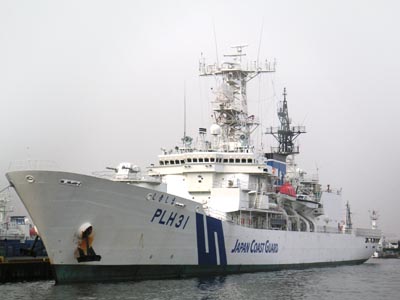
Photo from Japanese Wikipedia; ja:ファイル:JapanCoastGuard Shikishima.jpg
More than two decades after the first of class was delivered the Japanese Coast Guard has taken delivery of the second ship of the Shikishima Class, Akitsushima (PLH 32), These are the largest offshore Patrol Vessels in the world.
These ships have some notable features.
As Coast Guard cutters go they are very large. At 9,300 tons full load, they twice the displacement of the National Security Cutters. The vessels have a length of 150m (492 ft), beam of 17m (56 ft), and draft of 10m (33 ft). They can accommodate two relatively large Eurocopter EC225 helicopters (Max Gross weight: 11,000 kg (24,251 lb)). They are the only Japanese Coast Guard vessels with anti-aircraft weapons. Their outfit includes two 35mm mounts on the centerline with one mount well forward and a second on top of the hangar, the older Shikishima uses twin mounts and the newly built Akistsushima uses single mounts. There are also two 20 mm Sea Vulcan Gatling guns mounted port and starboard forward of and below the bridge.
They look more like merchant ships than warships, but they are good for 25 knots, and their range of 20,000 miles allows them to transit between Japan and Europe unrefueled. They also have a relatively large number of davits. It appears they have six, two of which are used for lifeboats.
gCaptain reports the Finns are building another new ice-breaker, this one will be dual fuel, eg, able to Natural Gas.
Reportedly the vessel will “… be capable of operating continuously in ice up to 1.6m thick and break a 25 meter wide channel in 1.2 meter thick ice at a speed of 6 knots.”
FierceHomelandSecurity is reporting the Coast Guard and Customs and Border Protection are admitting that Pangas smuggling north from Mexico are going around existing patrols. Shouldn’t surprise anyone, there is a lot of money in it. In addition to drugs they could be smuggling terrorist just as easily.
Perhaps we need a few of those Webber Class WPCs in the Pacific. Reportedly the administration is taking another look at border security. Its time to make our case that the water side is way too porous.
Press release announcing the planned commissioning of the seventh Fast Response Cutter, Charles W. David, Jr. (WPC-1107) (The press release says, this is “…the eighth Sentinel Class Fast Response Cutter (FRC) to arrive to Coast Guard Seventh District” but by my count this is the seventh to be commissioned. Suppose it may be possible both statement are true. Last one commissioned was Paul Clark, on 24 August.) They are coming out at approx. three month intervals.
This will be the first FRC homeported in Key West.
Navy Times is reporting the Navy is issuing new “flame proof” coveralls for use underway. Now will the Coast Guard follow suite?
“For the fleet’s top boss, this is personal. Gortney remembers being a lieutenant junior grade aboard the aircraft carrier Nimitz on the night in 1981 when a Prowler crashed into the flight deck, unleashing a fuel fire that cooked off bombs in a terrifying maelstrom. By the time it was extinguished two hours later, 14 people were dead, including the aircrew and first responders.
“’It kind of shapes you for the rest of your life: 50 sailors injured and we lost 14,’ Gortney recalled. ‘Discovered that night that if you’re going to have a major conflag[ration], there’s three things that occur: You’re either running to fight the fire, you’re trying to evade the fire or you’re trying to aid a shipmate in need. And you do that wearing what you got on.’
“’And so we have about one and a half major conflags a year, believe it or not, for the last 30 years,’ Gortney continued, defining this as a fire that exceeds the capability of the initial responders. ‘So it’s important that we put our sailors in outfits that they’re able to be the first person on the scene to deal with the fire that’s there.’
“Gortney said that’s what the new coveralls are designed to do. Their fabric is 100 percent cotton treated with flame-resistant coating, a combination that self-extinguishes and can protect its wearer’s skin from a blaze.”
Unfortunately, it seems the need for flame resistant clothing is a lesson that needs to be learned over and over again.
 Chuck Hill's CG Blog
