Ramblings on the Russian Naval Attack on Syria

You have probably heard that Four Russian naval vessels based in the Caspian Sea have launched 26 missiles against targets in Syria. This attack demonstrates a capability similar to that of the US Tomahawk missile.

What you might not realize is how small the Russians ships that launched the attack really were. While the US surface vessels equipped with Tomahawk are Burke class destroyers and Ticonderoga class cruisers of 8,000 to 10,000 tons, the Russian operation involved only a one small frigate and three small corvettes. The corvettes were smaller than a 210, and the frigate was less than two thirds the size of a 378. All four were considerably smaller than the projected Offshore Patrol Cutter. All four together displace only slightly more than a single Bertholf class.

The largest ship, Dagestan, is a Gepard class light frigate or large corvette, 1,930 tons (full load), 102.14 m (335.1 ft) in length overall, 13.09 m (42.9 ft) of beam, with eight Kalibr (SS-N-27) anti-surface missiles, SA-N-4 AAW missiles, a 76.2 mm gun, two six barreled 30 mm guns, four 533 mm (21″) heavy weight torpedo tubes, and an RBU-6000 ASW  rocket launcher.

The other three, Grad Sviyazhsk, Uglich, Veliky Ustyug, were Buyan-M class corvettes, displacing 950 tons full load, with a maximum speed of 25 knots, armed with Kalibr (SS-N-27) anti-surface missiles, 100-mm and 30-mm guns, and Igla-1M air defense missiles.

While the US Navy has begun talking about distributed lethality, the Russians are practicing it.

Certainly the Coast Guard is not going to arm their ships like this in peacetime, but we might want to keep the possibility in mind if things start to go south.


Innovation in Propellers

Tip vortices – conventional versus Kappel. Tip vortices are tubes of circulating water that are formed at the tip as the propeller generates thrust.

Tip vortices – conventional versus Kappel. Tip vortices are tubes of circulating
water that are formed at the tip as the propeller generates thrust.

gCapatain has photos of a new type of propeller.

Although I have a hard time seeing it in the photos, this shape is similar in concept to the upturned wing tips that now common on commercial aircraft. Propellers are after all, really just wings that rotate around a central hub. Having seen this, I now wonder why we haven’t seen this before.

Diagrams of fluid flow over a airfloil section usually show a linear flow from the leading edge to the trailing edge, but actually there is also a span-wise flow that spills off the tips and creates vortices. They add drag and increase noise.

Photo: The air flow from the wing of this crop duster is made visible by a technique that uses colored smoke rising from the ground

Of course the reason the airlines use these devices is to improve fuel economy. The principle also works for propellers.

Poland looking for OPCs

ProposedPolishCorvette

Rolls Royce proposal

Poland is planning some ships that have many similarities to the Offshore Patrol Cutters. We have talked about these a little already, in the context of an unconventional hull form offered by ThyssenKrupp Marine Systems (TKMS) that promises better fuel economy. Our friend at Thinkdefence talks about another proposal from Rolls Royce. He also provided a link to a more detailed description of the program.

The intention is apparently to produce three “Miecznik” corvettes and three “Czapla” patrol ships (with mine countermeasures) with the two classes sharing a common platform. ThinkDefence reports the key features of Rolls Royce’s corvette version as follows:

“It is 99.7 metres long and displaces just over 2,400 tonnes. Accommodation for 60 crew and an additional 30 personnel is included and the ship is said to have a 28 day endurance. With a CODLOD propulsion system its design top speed is 25 knots. Weapons and sensors include a 76mm Oto Melara gun, twin MSI 30mm automatic cannons, two quad NSM missile launchers, MU90 torpedo launchers and four Sylver A35 cells for quad packed VL-MICA anti-aircraft missiles; Smart-S 3D radar, Thales optronic systems and Kingclip sonar.”

Substituting some equivalent US systems, I think that would represent a good approximation of how a war ready OPC might be equipped.

Apparently they intend to order one ship a year beginning with the corvettes in 2017. That starts them on nearly the same schedule as the OPCs. Which will be finished first? Unfortunately the Poles will probably see their first ship before we see the first OPC.

Rolls Royce CDV 4


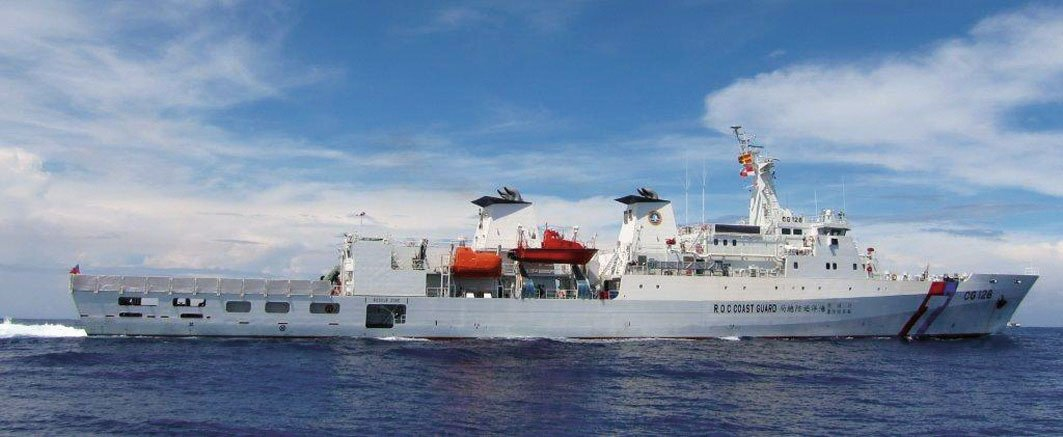
Taiwan Commissioned Two WHECs

ROCcutterYILAN(CG128)

Photo: Yilan (CG 128). (Taiwan Coast Guard Administration)

I mentioned this earlier in a comment on an earlier post, but Jane’s has more detail and much better pictures. Back on June 8, Janes 360 reported that Taiwan’s Coast Guard administration has commissioned two new 3,000 ton, 119 meter (390 foot) helo capable cutters, Yilan (CG 128) and Kaohsiung (CG 129), with a speed of 24 knots and a range of up to 10,000 miles.

Taiwan, along with Mainland China, supports the concept of the Nine Dash Line, but they have a particular beef with Japan. regarding the Senkakus Islands as they are known in Japan or the Diaoyutais as they are known in China and Taiwan, about 120 nautical miles (220km) northeast of Taiwan.

The other area where these might be assigned is protection of the area around Taiping Island, the largest of the Spratly Islands in the South China Sea (at least before the Chinese began reclamation) which the Taiwanese have garrisoned.

ROCcutterKAOHSIUNG(CG129)

Photo: Kaohsiung (CG 129). (Taiwan Coast Guard Administration)

According to the Diplomat,

“Since 2008, Taiwan’s Coast Guard Administration has been engaged in a 37-ship building program totaling 17,000 tons at a cost of  approximately NT$ 24 billion ($782 million).”

China CG gets Surplus PLAN Frigates

Recent spotter pictures from China show that the four Type 053H2G Frigates (NATO designation Jiangwei I) belonging to the People's Liberation Army Navy (PLAN or Chinese Navy) have been transfered to the China Coast Guard (CCG) and are being converted into patrol vessels.

Navy recognition is reporting that all four type 053H2G frigates (NATO designation Jiangwei I) have been transferred to the Chinese Coast Guard, contributing to the already feverish build up of this service. These 115 meter (376 foot),  2,200 ton, 27 knot, helo deck and hangar equipped, diesel powered ships entered service with the Chinese Navy (PLAN) between 1991 and 1994, so while far from new, by USCC standards, they should have considerable life remaining. The design seems quite appropriate for a cutter.

The fact that the PLAN is willing to give up these ships suggest both the pace of modernization of the PLAN and the priority given to bulking up their Coast Guard.

The conversion apparently results in the removal of all the primary weapons including a twin 100mm gun, anti-air and anti-surface missiles, and anti-submarine weapons.

But the ships will not be unarmed, and how they are armed may suggest how Chinese Coast Guard vessels, which were essentially unarmed in the past, may be armed in the future.

The guns that remain are four twin 37mm type 76A mounts. Positioned as they are, this will allow at least two twin mounts to be pointed at any direction, and in perhaps most cases three twin mounts. The projectile weight is about 1.6 pounds; rate of fire is 375 rounds/minute/barrel. They have a range of 9,400 meters and an effective range of 3,500 meters, with a 1600 round ready service capacity at each twin mount.

While these weapons are obviously limited in range, at close quarters they would be extremely dangerous.

In an earlier post I used the weight of projectiles a ship could shoot per minute as one measure of the possible effectiveness of a weapon system. By that measure four 37mm firing 375 one-point-six pound projectiles per minute would mean the capability of firing 2400 pounds of projectiles per minute. This is more than a single 57mm Mk110 (1160 pounds), a 76mm Mk75 (1120 pounds), or even a 5″/62 Mk45 mod4 (1400 pounds).

Why did they retain all four mounts? It would not have been hard to remove two of the four mounts and still retain, what many would see as more than adequate law enforcement firepower, but we probably should not read too much into the retention of all four mounts; it was the easier option, and they may be seen as nothing more than on board spares. They certainly have retained a fierce capability to engage at anything less than 4,000 yards. I would not mind seeing similar redundancy on USCG cutters for our peacetime missions..

The deletion of the ASW equipment certainly suggest the new, more militarized, Chinese Coast Guard does not see itself as ASW capable, and the removal of the 100mm guns suggest they don’t expect to be used as a Naval Gun Fire Support asset.

WMECs and WLBs Getting New Gyros

A small thing, but encouraging.

NavyRecognition is reporting that the Coast Guard has contracted to replace the gyros on fourteen 210 foot Reliance Class WMECs, in addition to those on ten Juniper class 225 foot WLBs that were contracted for in April.

The gyros are reported to use a new technology and be both cheaper and more reliable.

Seeing that it appears we will have most 210s around for more than another decade, at least they are getting some newer equipment.

(My only question is, there are 16 Juniper class, what about the other six?)

Australia to Build OPVs

Australia has been talking about getting new ships for sometime, but recently they announced a policy of “continuous shipbuilding” in an effort to maintain a domestic  warship building capability.

While submarines and frigates have gotten most of the press, and will get most of the money, they also intend to build Offshore Patrol Vessels (OPVs) to replace their Armidale class patrol craft, which have proven not quite up to the demanding missions they have been assigned. (They will also be building patrol boats to be distributed to Pacific island nations.)

“The construction of offshore patrol vessels to replace the Armidale class has also been moved forward to 2018.”

2018 puts them two years ahead of the Frigates, so this may be a lead in for the more sophisticated project. I suspect they will be strongly influenced in the selection of their OPV by New Zealand’s experience. due to the frequent contact and cooperation between the Australian and New Zealand Navies.

The New Zealand OPVs, HMNZS Otago and Wellington, appear to be progenitors of Eastern’s OPC proposal, so there is a good chance the Australians will be building something like the OPC. The CG should make its selection of the final OPC design about a year before Australia has to make their OPV design selection, so perhaps they could benefit from the Coast Guard’s selection process.