Ten More Hero Namesakes for the Webber Class

The Coast Guard Compass has published ten more names that will be applied to Webber Class WPC.

Announcements of previous names are here and here. There was a bit of a change in that the name of Joseph Napier was reassigned to WPC-1115 when WPC-1110 was named after Raymond Evans.

Previously assigned Cutter names assigned were:

Bernard C. Webber (WPC-1101)
Richard Etheridge (WPC-1102)
William Flores (WPC-1103)
Robert Yered (WPC-1104)
Margaret Norvell (WPC-1105)
Paul Clark (WPC-1106)
Charles David (WPC-1107)
Charles Sexton (WPC-1108)
Kathleen Moore (WPC-1109)
Raymond Evans (WPC-1110)
William Trump (WPC-1111)
Isaac Mayo (WPC-1112)
Richard Dixon (WPC-1113)
Heriberto Hernandez (WPC-1114)
Joseph Napier (WPC-1115)
Winslow W. Griesser (WPC-1116)
Richard H. Patterson (WPC-1117)
Joseph Tezanos (WPC-1118)
Rollin A. Fritch (WPC-1119)
Lawrence O. Lawson (WPC-1120)
John F. McCormick (WPC-1121)
Bailey T. Barco (WPC-1122)
Benjamin B. Dailey (WPC-1123)
Donald H. Horsley (WPC-1124)
Jacob L. A. Poroo (WPC-1125)

I cannot be sure which hull numbers will be assigned to each of the names, but the names in the order they were announced are:

Joseph Gerczak
Richard T. Snyder
Nathan Bruckenthal
Forrest O. Rednour
Robert G. Ward
Terrell Horne III
Benjamin A. Bottoms
Joseph O. Doyle
William C. Hart
Oliver F. Berry

Presumably they will be WPC-1126 through WPC-1135.
FY2016 Budget–First Look

We now have access to the proposed Coast Guard Budget for FY2016 in several levels of detail in the form of pdfs. These range from a one page “fact sheet” to over 500 pages of Congressional justification.

FierceHomelandSecurity, also gives us a quick overview including how it fits in the larger Department budget. The Department’s budget is up 7.3% while the Coast Guard budget is up by only 1.6%.

The good news is that the budget has increased, the bad news is that all the increase can be accounted for by the increase in retired pay. In real terms, it is another cut, though not a big one.

In support of the DHS’s strategic objectives, the FY 2016 Budget provides for the acquisition of six Fast Response Cutters, continues to invest in pre-acquisition activities for an affordable Offshore Patrol Cutter and funds vessel sustainment projects for two 140’ WTGB Icebreaking Tugs and a 225’ Seagoing Buoy Tender.  The budget also continues sustainment and conversion work on legacy fixed and rotary wing aircraft, missionization of the C-27J aircraft received from the Air Force, and investment in Command, Control, Communications, Computers, Intelligence, Surveillance, and Reconnaissance (C4ISR) systems.

It is a bit surprising that the cut in the AC&I account is not larger than it is, considering the Coast Guard is not ready to fund any new large ships in 2016. The NSC program is just finishing up and there is a small amount for that and some money to prep the OPC program, but no new starts for major cutters.

The six Webber class “Fast Response Cutters” puts the program back on track to continue delivering four per year since only two were included in 2015. This program will be with us until far into the future, with the last delivered in 2026 at the current rate.

Major Renovations for the 140 icebreaking tugs have already begun. The Acquisition Directorate, CG-9, is reporting work on the second vessel, Penobscot Bay has begun. Looks like C-27J integration is getting a boost.

I still wonder when we will start doing something about the inland fleet.

CG-83527

No caption.  No date listed; probably June 1944.  No photo number.  Photographer unknown.

No caption.
No date listed; probably June 1944.
No photo number.
Photographer unknown.

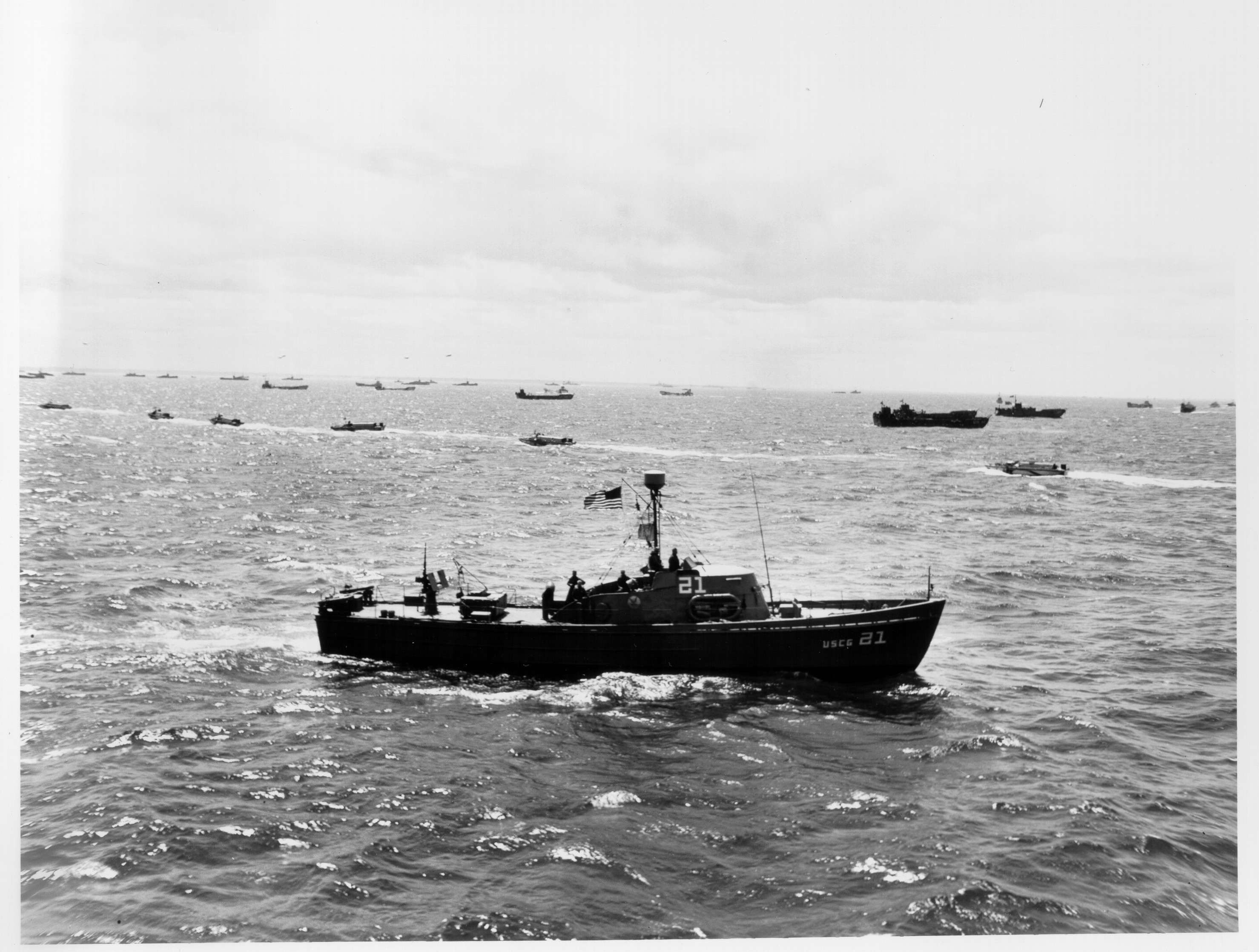
One of the proudest achievements in Coast Guard history was the performance of the sixty 83 foot gasoline powered, wooden hull patrol boats of Rescue Flotilla One, that saved 1,438 American and Allied lives during the Normandy landings in June 1944. An average of approximately 24 rescued for each boat.

"Crew of CG-16 pointing to the tally board of 126 rescued soldiers."  Photo courtesy of Terry Hannigan. (NOT AN OFFICIAL USCG PHOTOGRAPH)

“Crew of CG-16 pointing to the tally board of 126 rescued soldiers.”
Photo courtesy of Terry Hannigan.
(NOT AN OFFICIAL USCG PHOTOGRAPH)

There is at least one vessel of this class, CG83527, still in near original condition.

She’s in Everett, WA. Unfortunately the boat is not currently open to the public. The caretaker organization is having a hard time keeping the boat up. They need some help. Dan Withers, Cell: 206-947-2303, danwithers@q.com, is heading the organization.

At some point, I hope we will have this vessel, or another of its class, at the new Coast Guard museum being built at New London.

The 83-foot Coast Guard cutter USCG 1 off Omaha Beach on the morning of D-Day, tied up to an LCT and the Samuel Chase

The 83-foot Coast Guard cutter USCG 1 off Omaha Beach on the morning of D-Day, tied up to an LCT and the Samuel Chase

Commandant Remarks and Q&A–USNI/CSIS on CSPAN

Earlier we talked briefly about the Commandant’s address to the USNI and CSIS Maritime Security Dialog. This is the entire address.

It is about 53 minutes, of which the first half is prepared remarks and the second half Q&A.

I think you will find it worth the time.

Thanks again to James WF for pointing me to this.

Navy Rethinking Ship Designations–Time for the CG to do so too?

cropped-uscgc_waesche_by_yerba_buena_island2.jpg
Photo: Doesn’t this look like a Patrol Frigate?

The USNI is reporting that, “The modified Littoral Combat Ship (LCS) class will be redesigned as frigates, Secretary of the Navy Ray Mabus announced on Thursday at the Surface Navy Association 2015 symposium on Thursday.”

Mabus noted, ““It’s not an ‘L’ class ship,” he said. “When I hear ‘L’ I think amphib, so does everybody else.”

The FF designation for the LCS will be the first of a planned set of nomenclature changes for other ships classes as well that will come in the coming weeks, Mabus said.

Apparently he also intends to address the designations of the Afloat Forward Staging Base (AFSB), the Mobile Landing Platform (MLP), and the Joint High Speed Vessel (JHSV).

I will repost something I quoted in a comment to a previous post regarding an article by Norman Polmar in the US Naval Institute Proceedings “US Navy-LCS, JHSV, MLP…What?”

Quoting his conclusion: “Unquestionably, the LCS, JHSV, and MLP designations must be changed—it is logical and sensible to do so. It can be done with the stroke of a pen by a Secretary of the Navy notice. At the same time, two other ship classes should have their hull numbers changed: The three ships of the Zumwalt (DDG-1000) class and the three submarines of the Seawolf (SSN-21) class should be assigned realistic hull numbers within their respective types, and thus be in accord with the 90-year-old directive that stated ships were to be designated in sequential order within their designation types…“The U.S. Navy’s basic ship-designation system is excellent and deserves to be carried out professionally and logically.”

Perhaps it would be a good time for the Coast Guard to take another look at their designation system too, and bring them back into line with the Navy system. I talked about this earlier, “Ship Type Designations–The Bertholfs are Minesweepers?”

The designations currently chosen for the Bertholf class (WMSL) and the Offshore Patrol Cutter (WMSM) are do not fit within the established and customary designation conventions of either the US Navy or NATO.

I would suggest, W-PFL (CG Patrol Frigate, Large) for the Bertholfs and W-PFM for the Offshore Patrol Cutters or more simply W-PL (CG Patrol, Large) and W-PM (CG Patrol, Medium). We might also apply the new designations to existing WHECs and WMECs as well.

We might also want to take a look at icebreakers and AtoN vessels, but those designations are really less problematic.

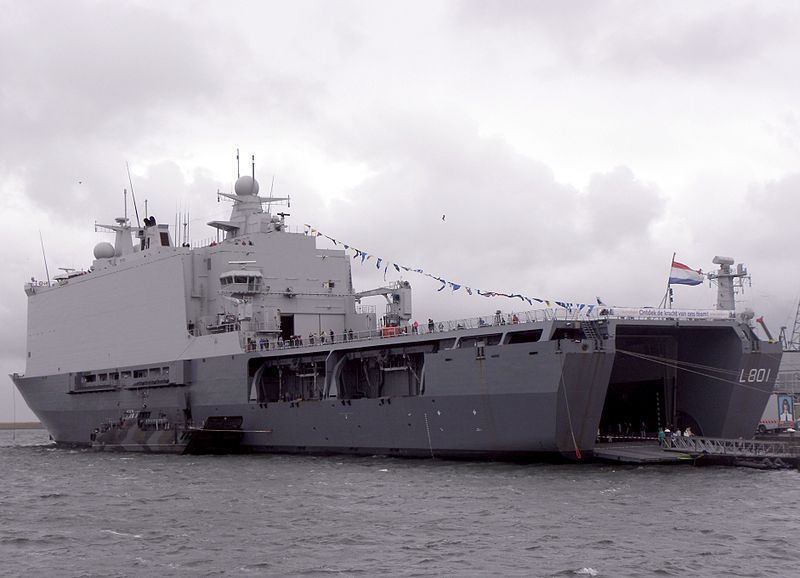
Dutch Mothership?

L 801 Johan de Witt Uploaded by Oxyman

L 801 Johan de Witt Uploaded by Oxyman

The following was reported by the German Navy blog Marine forum, “8 January, PIRACY–Anti-Piracy Forces: Sweden is preparing for another mission (M-04) in support of EU operation “Atalanta”, this time working jointly with the Netherlands navy … COMBAT BOAT 90 fast interceptor craft, helicopters and 70 personnel to embark on Netherlands Navy dock landing ship JOHAN DE WITT.”

As you may recall, I have advocated using WPCs supported by a mother ship to supplement the larger cutters for distant drug interdiction operations.

We have done cooperative counter drug operations with the Netherlands Navy in the past. Early last year, the Netherlands OPV Zeeland embarked both a CG LEDET and a CG helo det.

Perhaps we could run a test using the Johan de Witt or her sistership Rotterdam to try out the mothership concept. Their crew size is similar to that of the National Security Cutters (less than that of the Hamilton class), but they have berthing for hundreds more. They have aviation facilities for up to six helicopters. They can handle boats from both davits and a well deck. They have excellent Command and Control facilities.

“The ships have a complete Class II hospital, including an operating theater and intensive care facilities. A surgical team can be stationed on board.” That could make them welcome in a lot of ports.

Would the Dutch be interested? The Dutch Navy has already demonstrated its commitment to counter drug trafficing. They have used these ships several times for counter-piracy. Counter drug operations are not that much different, and piracy seems to be in decline. When it was being finished, there were reports that the Dutch wanted to sell the Johan de Witt. Operating off Latin America might be seen as an opportunity to demonstrate both this class and the Netherlands’ ship building expertise in an international market.

What might the experimental effort include. In addition to the mothership, perhaps three MH-65s, add a mix of Webber class WPCs, WPBs, Response Boat Mediums (RB-M), and Navy Riverine Command Boats (the US Navy version of the Combatboat 90).

In addition to its counter drug objectives, the deployment might be seen as a partnership station effort, training as well as working with the locals, and if there should be a natural disaster while they are in the area, it will be a ready made Coast Guard response.

Germany to Build Four OPVs for Israel

Photo Credit: jimmyweee, Malaysian OPV Pahang, IMDEX2007

Photo Credit: jimmyweee, Malaysian OPV Pahang, IMDEX2007

DefenseNews is reporting that Germany will be building four Offshore Patrol Vessels for the Israeli Navy. Israel has seen a need for OPVs to protect its growing offshore energy industry.

Israel had previously considered the Lockheed “international” LCS design, but it was deemed too expensive. The design selected is a version of the MEKO A100. Two versions of this design are already in service, The Kedah class (pictured above) with the Malaysian Navy and the K-130 class corvettes of the German Navy.

It will be interesting to see how these ships turn out. They will be similar in size, perhaps a bit smaller than the Offshore Patrol Cutters.

A late addition:

Israel_Navy_Saar_6_MEKO_TKMS_1

Added Nov. 16, 2020.


China Builds Cutter X for Nigeria

NavyRecognition Photo, Model of P18N OPV on the CSOC stand during AAD 2014
Photo credit: NavyRecognition, Model of the P18N OPV on the CSOC stand during AAD 2014. Click to enlarge.

NavyRecognition reports delivery of another cutter similar in concept to Cutter X. This time it is first of two being built in China for Nigeria.

P18N Offshore Patrol Vessels have a displacement of 1,700 tons, a length of 95 m, width of 12.2 m and beam of 3.5 m. It is powered by two MTU 20V 4000M diesel engines (I believe this is essentially the same engine as in the Webber class WPCs–Chuck). The maximum speed is 21 knots. The endurance of the vessel is 20 days at sea (range 3000 nautical miles at 14 knots) for a crew of 70 sailors.

The range and speed are certainly adequate for their purposes, but “nothing to write home about,” and the hangar is only suitable for UAVs, but it is actually better equipped in some ways than the proposed Cutter X with a 76mm gun and two 30mm. This probably contributes to the size of its 70 member crew.

Nigeria is modernizing their forces. The Nigerian Navy took over the former USCGC Chase in 2011, and they expect to get the Gallatin in 2015. Nigeria is the source of much of our imported oil, and they have an ongoing insurgency and a serious piracy problem.

If the helicopter on the model pictured above looks familiar, it is a Z-9, a Chinese license built version of the French helicopter that was the basis for the H-65. Chinese variants include both ASW and attack helicopter versions.

Protecting the Exclusive Economic Zone–CIMSEC

CIMSEC is taking a week to look at Ship Design and one of their first posts deals with Offshore Patrol Vessels. It is a two parter. You can read it here and here.

The posts include an extensive bibliography and notes that some might find interesting. This is the information on the author, “Dr. Alexander Clarke is our friend from the Phoenix Think Tank in the United Kingdom and host of the East-Atlantic edition of Sea Control.”

“The Fleet we Have, Want, and Need – with Jerry Hendrix,” Midrats

Sunday there will be a streaming live interview that some of you might find interesting. It is on a podcast called Midrats. There is an opportunity to contribute to the discussion both by phone and using an online discussion tool. It would not hurt to have a little Coast Guard representation there as well to clarify how he sees the role of the Coast Guard in the National Fleet. If you miss it on Sunday, it is archived on line or you can pick it up on itunes. You can also find the connection through the USNI blog or through the Eaglespeak blog.

Below is a quote in full of the program description. I don’t think they will mind my passing it along.

Please join us at 5pm EST on 9 Nov 14 for for Midrats Episode 253: “The Fleet we Have, Want, and Need – with Jerry Hendrix”

What is the proper fleet structure for the USN as we design our Navy that will serve its nation in mid-Century?

Join us for a broad ranging discussion on this topic and more with returning guest, Henry J. Hendrix, Jr, CAPT USN (Ret.), PhD.

Fresh off his recent retirement from active duty, Jerry is a Senior Fellow and the Director of the Defense Strategies and Assessments Program at the Center for a New American Security (CNAS).

A Naval Flight Officer by training, his staff assignments include tours with the Chief of Naval Operation’s Executive Panel (N00K), the Office of the Undersecretary of Defense for Policy (Force Development) and the OSD Office of Net Assessment.

His final position in uniform was the Director of Naval History.

Hendrix also served as the Navy Fellow to the Weatherhead Center for International Affairs at Harvard University. He has a Bachelor Degree in Political Science from Purdue University, Masters Degrees from the Naval Postgraduate School (National Security Affairs) and Harvard University (History) and received his doctorate from King’s College, London (War Studies).

He has twice been named the Samuel Eliot Morison Scholar by the Navy Historical Center in Washington, DC, and was also the Center’s 2005 Rear Admiral John D. Hays Fellow. He also held the Marine Corps’ General Lemuel C. Shepherd, Jr. Fellowship. He authored the book Theodore Roosevelt’s Naval Diplomacy and received a number of awards, including the United States Naval Institute’s Author of the Year and the Navy League’s Alfred T. Mahan Award for Literary Achievement.Listen in here (or use that link to pick the show up later) or visit us on iTunes.